Tag: blogging

  • three philosophies

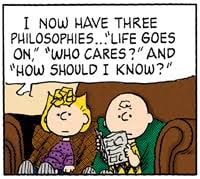
    images-1Before calling it a day to say hello to a new tomorrow on a hard day’s night, to happen on this comic strip of my all-time favorite Peanuts seems almost too pat. Provident, even. It chimes the bells of my heart and soul that are dented with the shrapnel of existential vertigo in the most impressively elliptical way: that none other than simple tenets of life are needful to live a less stressful life.

    As Sally elegantly puts: Life does not end at one fell swoop even if I stumble into an imbroglio of misadventures; any such mistakes or misdeeds betray that to err is human; and that I should not fall into the bottomless pit of worries and anxiousness, for tomorrows are always new with their own unknowns.

    What Sally blithely professes strikes the chords of Logotheraphy, a 3rd Viennese school of psychotherapy founded by Dr. Viktor E. Frankl based on existential analysis focusing on ego qua meaningfulness, a purpose of living a meaningful life. With these simple but potent tenets of life in mind, I can say good-bye to this spent day with the alacrity of departure for nightly dreamscapes to rest myself.

  • Vet’s long-lost wallet comes home

    RE: 8/26/2018 The Los Angeles Times article of “Long-lost wallet’s unlikely return”

    For the times passed by, you can just look away and say, “they are gone away” because they are woven by your memories that you have collected through life, willed or unwilled. They become part of you, making you of spirit, fire, and dew, an unique star in a constellation of the universe. Hence nothing could be more pleasingly surprising than discovering that part of you or your beloved kept in photographic images or words of the frozen time, evocative of distant nostalgia that beckons you to reminisce about them, by a happy stroke of serendipity paired with benevolence of a stranger. Something like that happened to Ms. Sharon Moore, a daughter of one former army corporal Robert McCusker.

    When Ms. Moore received a “Friend” request from a certain Frenchman named Patrick Caubet on her Facebook page, she deleted it. But then Mr. Caubet messaged her inquiring about the lost wallet of her father Mr. McCusker with the pictures and documents contained therein that he had accidentally found in a basement of his building presumably used as an America officers’ social club. This time she responded and verified that it was her father’s. Prior to Mr. Caubet’s contacting Ms. Moore, he had launched a campaign for locating the rightful owner of the wallet, which encompassed an aid of his English-speaking friend and inquiries to the Pentagon and the U.S. Embassy for help to no avail. Then the help came from a French military office in Paris that located the names of Mr. McCusker’s children in just days. Being a military man himself with a certain feeling of soldierly camaraderie, he was determined to succeed in his campaign, which ultimately came to fruition.

    Thanks to this benevolent efforts of one French military man, Ms. Moore and her brother living in Dover, New Hampshire, could reminisce about the lost pages of his Korean War veteran father who had died in 1983. The wallet had pictures of their mother and aunt, military documents, Massachusett Driver’s License, and a Social Security Card, all of which were still kept in a mint condition. Ms. Moore said that since she had her father’s Purple Heart, her brother would be in possession of the wallet that their father had lost on his way from the Korean War to home. In return of her gratitude, Ms. Moore sent Mr. Caubet a lovely basket full of sweet jars of maple syrup she had made herself, some of the candy her father had enjoyed, and a New England Patriots Jerky. Thus, the wallet became their treasure of their beloved father’s memories that they had not known – the terra incognita of their father’s memories before they came to the world -. It became the part of their memories that bound them together to the legacy of their lineage, reminding themselves of their father’s valorous war efforts as a soldier and of his tender loving memories of their mother as a man.

    Amid the news of endless politicking, peddling of social media that goes beyond reasonable measures, and a litany of social ills, this article stroke me as a bonanza of altruism that still thankfully kept alive in everyday life, a fresh breath of air that made me feel grateful and hopeful for our future in which so long as we don’t lose a thread of sanity and milk of human kindness, we can make constraints of our lives bearable with a lightheartedness. The kindness of the Frenchman speaks to us that no matter what language you speak, the feelings and emotions that you and I have can strike the chords of our humanness because the principles of reason and of sentiment are universal in all human creatures. The return of the lost wallet as the living record of Ms. Moore’s father attests to the truth.
     

  • “Mind Your Language” (TV Series 1977-1979)

    1

    Have you ever tried to explain a certain colloquial expression, such as “kick the bucket,” “shoot off his mouth,” or “until the fat lady sings” to someone whose mother tongue is anything but English? You probably have been delighted to find out how meanings of words can yield multifarious feats of creative interpretations, which can also, in turn, be prospective nouveau vocabulary of the most effectively deployed Lingua Franca of our time. After all, that’s what Geoffrey Chaucer and William Shakespeare, and George Bernard Shaw did to the English language, which is still kicking and alive in keeping up with the evolution of our own cultural progress. And certainly, the students in the evening English class are a tour de force of such cultural enterprise in this hilarious original British sitcom “Mind Your Language.”

    The story of Jeremy Brown, an ingenuous young academic teaching English to his slightly offbeat motley crew of foreign adult students at evening classes in an adult education college in London forms the basis of the show. Mr. Brown has to deal with his students’ creatively wily answers to his questions, while trying to instill in them the elements of the English language with his Oxford-educated academic credentials. In fact, it’s the class that gets the laugh by pushing their naive enthusiastic young teacher into an imbroglio of jocular situations all for the celebration of joviality in their evening English class after hard days of work. In bewilderment of his students’ wily but innocuous chicanery, Mr. Brown’s affection for his class grows bigger and deeper as the show continues; you see him becoming something of Jack of all trades for his students as well as the principal, Ms. Courtney. You will find Mr. Brown at the police station, in court, in hospital, on the dance floor at the school fete, and of course at the pubs with his beloved students or Sidney, the cockney school caretaker.

    91QJXCCwS7L._RI_
    The Cast of “Mind Your Language”

    The delightful peals of hearty laughter, the bounty of warmth, and even remedial lessons of English embroider on these three scintillating series of the show produced by London Week Television between 1977 and 1979 for ITV in England. Each of the episodes was ingeniously written with simply brilliant feats of words and ideas on the grounds of realistic situations relating to anyone who speaks English as a foreign language or anyone who deals with such person in reality. Also, the collective efforts and performance of the cast with each actor and actress harmoniously contributing the best of the self to the respective character is the ipso facto gem of the perennial popularity of the show to this date. All in all, the setting, the topic, the storyline, and the cast of “Mind Your Language” give you the idea that in order to make a good TV comedy show that strikes the chords with a wide range of people regardless of ethnic, racial, and/or social backgrounds, all you have to do is to look into the everyday life around you and see if there is anything that transcends the subjectivity of the aforementioned backgrounds in order to reach the universal code of humor and humanity without pontificating social/political ideology. For these reasons, “Mind Your Language” is an unmissable feast of comedy of intelligence, wit, humor, and a touch of innocence that deserves of its recognition in the canons of British Classic Comedy.

  • Songs of Lady Egoist

    IMG_4047

    Time is like a fashionable host that greets its guests with a variety of hues and styles depending on occasions: for weekdays, it welcomes the guests with professional attire and proprieties perfected in workmanship. But for its festive weekend guests – especially the divine sabbatical Sundays, the host and the guests are all dressed in delightfully comfy clothes to lounge around their homes free from dress codes. On this beautifully leisurely Sunday afternoon, Seraphina, a full time secretary who also sometimes moonlights as a ghost writer, decides to indulge herself in a banquet of music given by the fashionable host in celebration of the divine rest all to herself alone at home with her fluffy canine sister Nena.

    Seraphina’s eclectic taste in music is worth the telling: a mixture of classical standard of beauty and her pleasant quirkiness and feminine queasiness stylishly fashioned with a modish streak is her trademark, which makes her belong in her own class by herself. During her totally off-guard hours, she goes for a parade of modern day troubadours of catchy melodies and good lyrics. “Good music is to refresh the mind of anyone after her studies or work, isn’t it?” is the question Seraphina asks to herself and Nena lying prostate at her feet in defense of music she listens to as she writes down a list of the five songs in mind as follows:

    IMG_4048

    • Bigmouth Strikes Again – the Smiths (It’s rather surreal and dismal, but the mood created by the lyric is then betrayed by the upbeat, and melodious tune and mellifluously sonorous voice of Morrissey, who sided with Joan of Arc.
    • Wouldn’t It be Good? – Nik Kershaw (The song emits pathos of human life tantamount to a brevity of Greek tragedy – or comedy? It’s about a person whose life seems to be in the rut of life. Seraphina remembers reading an article about the singer having worked at an employment agency, so maybe it might have resulted from his encounter with one of the unemployed about whom the singer felt a touch of humanity.
    • Just Me and you – Jane Birkin (Seraphina’s fashion icon Jane Birkin sings a triumphant love in secret that gives no care to anybody but to her and her lover only.)
    • Yesterday, Yes A Day – Jane Birkin ( J. Birkin is all femininity personified in a mixture of delightful sensuality and sultry sensuousness, which she wears like her favorite perfume. It’s never lewd or slutty, but stylishly and poetically intoxicating. Seraphina is emulous of her favorite icon’s style to all appearance.
    • Daisy Bell – Blur (One day Seraphina accidentally found a retro but fabulous English sitcom “Mind Your Language” on her Kindle Fire for free thanks a lot to her Amazon Prime membership. In one of the episodes, amiable teacher Jeremy Brown, wonderfully played by the unforgettable Barry Evans, sang the song with his adult students at evening classes. Its tune so charming and catchy, Seraphina listens again to the song by the band whose CDs she had once collected.

    IMG_4046Then she realizes that it is now almost late afternoon, the end of the restful day has come closer to the end of the meridian sun. And so has her afternoon respite from the existential dealings of the world. “Indeed pleasure and action make the hours short,” says Seraphina while glancing at her canine companion Nena taking an afternoon nap at her feet under the desk. “But with you my dear Nena and all the things I can think of to take care, I guess it’s not altogether bleak to live every day.” Seraphina smiles at Nena, gently caressing her fluffy body. It seems that to Seraphina and Nena at that blissful moment, God is in heaven, and all’s well with the world.


    저장

  • Inside American’s Tomb for Illegal Wildlife Trade

    RE: July 16th, 2018 article of “On the Grounded in Commerce City, Colo. : Inside America’s tomb for illegal wildfire trade by David Kelly of the Los Angeles Times

    Imagine the vistas: a cornucopia of a mounted tiger fetus with its tiny ears, a grand giraffe head, a pair of shiny python skin-made thigh high boots, a black bear’s toes coupled with its gallbladders, and many more artifacts made out of animals that will never cease to blindside your vestige of humanity and overawe your tactile senses. If your mind tells you to think that the imagery is but a visceral affectation of a surreal painting of Salvador Dali, you just think yourself awake in the stupendousness of dreamlike morbidity. They are just a few illustrations of taxidermic animals confiscated in the course of international illegal trafficking of endangered animals exhibited in the National Wildlife Property Repository (the “Repository”) located in Commerce City, Colorado.

    My opinion on the report of the Repository as to its existence and nature is threefold: First, I can’t believe that there is such a horrendous and macabre exhibition of the animals killed and stuffed – and in the shoddiest way – open to the public, especially aimed at school students. Second, the grim underworld of a huge illegal trading market where a great demand of the coveted animal products is constantly met with a colossal supply of the dead animals is a stark reality even in this age of technological supernova. Third, it shudders me to think the wantonness of avarice and gluttony for which the sinners would find themselves in the third and fourth circles of Dante’s Inferno. What’s more, the fact that the Repository of such abhorrent kind is located not in the outpost of civilization where the artifacts of the sorts would be regarded as a cultural tradition but in Commerce City in Colorado chills me to the bone.

    It is reported that the purpose of the Repository is to educate the public on the gravitas of poaching and trafficking of endangered animals systematically perpetrated in global criminal syndicates of Chinese origin active in South Africa. However, I am concerned about the effects it intends to produce, however noble it may seem, which will likely work at cross-purposes, even counter-productively, pace its original intention to raise social awareness and ethical context of the issue. It might be all over but the shouting that rather than promoting awareness of destruction of the ecological system and its inevitable adverse impacts on mankind as well as the nature itself, the sight of the mutilated dead animal bodies and/or parts may be regarded as a freak show for those who have bizarre tastes of necrophilia and/or sadism emanating from the perceived sensual pleasures of watching animals torn apart from rib to rib, ear to ear, or head to toe in perpetual torture.

  • ‘Creators: From Chaucer and Durer to Picasso and Disney’, by Paul Johnson – review

    CreatorsCreators by Paul Johnson

    My rating: 5 of 5 stars

    Kurt Vonnegut encouraged anyone dabbling in the act of creativity: “To practice art, no matter how well or badly, is to make your soul grow. So do it.” Accordingly, the art of creation is a noble act of finding a meaning of life in which man searches for his freedom of will and will to meaning by translating the principles of sentiments and reason that are universal in humankind to various forms of creativity, ranging from writing and painting to music and dance, and to even gardening and making people laugh. Such act of making something out of nothing requires Herculean feats of courage and spirit that serves as a sovereign remedy for the existential ills of everyday life, however ordinary or exceptional. Paul Johnson’s Creators, which looks into the bright side of clever, talented individuals contrary to his previously published Intellectuals in which he recounted the hypocrisy of historically famous intellectuals, presents his thesis: that we all have creative traits in us is our divine prerogative of humanity; and to produce works of the arts involves prodigies of courage as well as talent that is sublimated to the aesthetic expression of intellect and beauty, such as to be in the cases of luminous artists whose oeuvres marked their standing in literature, painting, and music.

    Each chapter on each different artist draws up on the artist’s unyielding courage and creativity, which is a quintessential element of creative originality of outstanding quality. Johnson admits that an artist tends to be egotistical due to his extravagant faculty of creativity into which the artist pours out everything that is in him. An unusual degree of courage that is akin to physical courage of a soldier on the front is demanded of the artist unless he bows to the final enemy of creativity, such as age or increasing debility. Take Beethoven’s struggling against his deafness by using a toothbrush in his mouth to feel the tonality of each piano key while composing his immortal symphonies. Great impressionist painter Toulouse-Lautrec’s inherited disabilities and grotesque deformities as a result of hereditary inbreeding could not stop him from producing beautiful paintings with his triumphant willpower and courage until his death at the age of thirty-seven. Robert Louis Stevenson wrote incessantly despite his chronic illness due to his weak and unreliable lungs that eventually killed him in his early forties. Emily Dickinson wrote poetry without encouragement and public response, while David Hume failed to receive public recognition upon publishing Human Understanding. So did Anthony Trollope of The Macdermots of Bally Cloran that was neither reviewed nor sold of a single copy.

    The life of an artist is full of peculiar aspects and strange satisfaction often spurred on by personal weaknesses, such as in the cases of Jane Austen and George Eliot whose real name was Mary Ann Evans. Both of the women led lonely and lugubrious lives without experiencing felicities of love and adulation by men despite their brilliant spirits and ingenious minds. Surely beauty was in their time and still is only skin-deep, but their plainness left them in spinsterhood and forced themselves to spur loneliness on writing that was the solace in which they could fall in love with the men they desired. In effect, the reader will learn that it was the courage to express their spirits and feminine aspiration to be loved that fed on their creativity. Also, self-awareness, careful nursing, and restricting of the talents and subject matters, rather than audacious rampant criticism of society in general in undisciplined tempest of words, were added to the wings of their creative spirits.

    In light of the above, art is not genius but a work born of love and labor of its creator whose Herculean degree of courage and desire of expressing imaginations and intellect perform a painful but delightful feat of ingeniousness. Johnson avows that rational and professional methods of using skills, experiences, creative industriousness, and self-confidence are the ingredients to create the work of art. Also, he affirms the reader that there is no need to make a pact with the devil or perform a magical ceremony to invoke a creative spirit because inspiration comes from within. It is how to find it and reveal it like a hidden diamond in its most radiant luminescence. Written in common words devoid of academic locutions and once again his usual consummate narrative skills, this is Johnson’s another scintillating book to be acquainted with the human face of geniuses whose works have produced pleasure in our senses and minds.