Tag: book blog

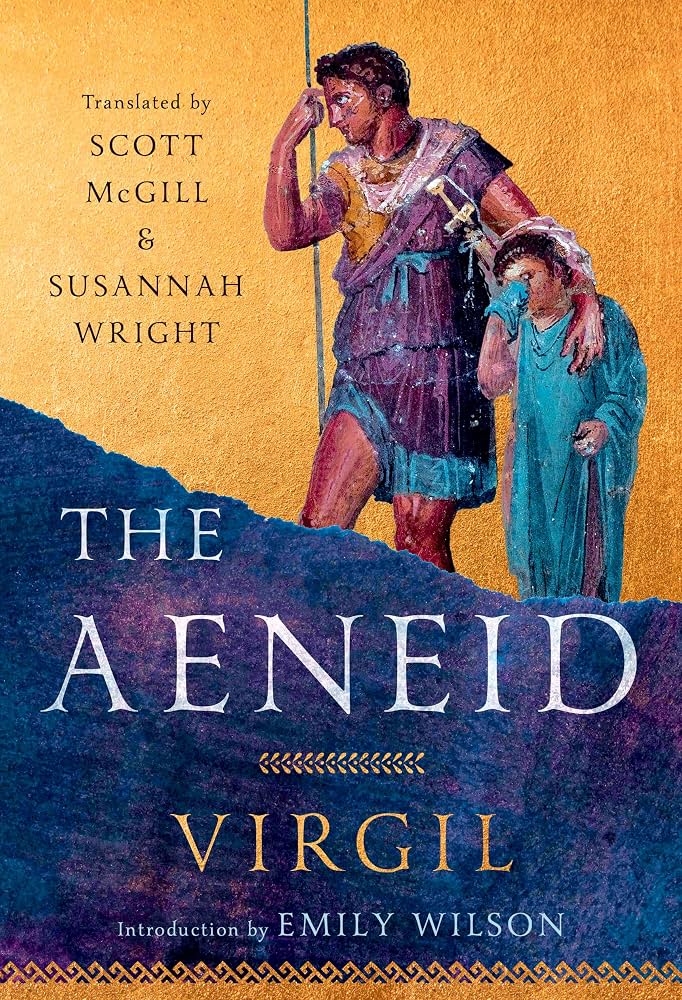
  • Reading on A Review of the Aeneid, Translated by Scott McGill and Susannah Wright, by Deborah Warren

    First, let me confess that I have not yet read the translation of The Aeneid by McGill and Wright. Maybe I will after I finish reading Robert Fagles’s translation. So, while it would be unfair for me to judge which translation better serves readers of the twenty-first century, I can say that Fagles’s translation of Virgil’s epic narrative of Aeneas reads like a prose poem to me, simply because its language and arrangement suit my taste.

    This essay is not for general readers but for readers with an academic background in Latin. Therefore, for general readers such as myself, its comparison of the original Latin with the English translations—in terms of metrical structures, the choice of words, and their juxtaposition—may not ring a bell. My interest in reading The Aeneid comes from a purely personal curiosity: I want to understand why Aeneas is the way he is, breaking the hearts of the women who loved him dearly. In that regard, Fagles’s translation chimes the bell of my heart and soul because his words are poetic and, at the same time, go straight to the heart. Take a look at these translations:

    Fagles:

    “Wars and a man I sing—an exile driven on by Fate,
    he was the first to flee the coast of Troy,
    destined to reach Lavinian shores and Italian soil.”

    Robert Fitzgerald:

    “I sing of warfare and a man at war.
    From the sea-coast of Troy in early days
    He came to Italy by destiny
    To our Lavinian shores,
    A fugitive, this captain . . .”

    McGill and Wright:

    “I sing of arms and of a man displaced
    by Fate, the first to leave the coast of Troy
    for Italy and its Lavinian shores.”

    Fagles’s version of “Wars and a man I sing . . .” clearly expresses Virgil’s intention to sing about a man destined to put duty before feeling. By placing the mainstay of The Aeneid—the fate of the man—at the beginning, Fagles conveys to his readers that Aeneas was not born to be a romantic figure, or even a heroic star, but to be a man torn between what he wants and what he must do.

    Through Fagles, we hear Virgil sing of Aeneas, a demigod and an excellent soldier: the embodiment of the Roman ideal, whose pietas and gravitas signify personal virtue as well as martial prowess. But Virgil was not a soldier; he was a poet. Bernard Knox, however—the classicist who wrote the introduction to Fagles’s translation—brings the crack of a horsewhip to it. A former U.S. Army captain and World War II veteran, Knox had literally followed in the footsteps of Antony and Octavian during the Italian campaign. He must have carried Euterpe and Calliope with him—the Muses who had also stood behind Virgil thousands of moons before.

  • Upheaval: Turning Points for Nations in Crisis by Jared Diamond – book review

    Jared Diamond’s Upheaval analyzes why a nation is how it is now. Of course, culture plays a role in changing the ethos of each new zeitgeist. Still, it is not so much a differentiating element as a distinguishing factor to characterize a national character. Instead, it is a mindset of individuals, including the governing elites in the nation, that determine the success and stagnation of the nation’s progress.

    Of all nations’ approaches to and results of political and sociological revolutions, the most successful example is Japan’s Meiji Restoration in the 19th century and democratization in the aftermath of WWII, both of which are one-of-a-kind upheavals yielding to outstanding progress. Japan’s confrontation with the West might have blown their isolated cultural prestige. However, rather than coiling in fear of the changes, Japan sprang back with new attitudes adapted from Europe’s and the U.S.’s technological development and cultural legacy to survive the new zeitgeist as the time’s juggernaut.

    On the other hand, the United States today needs change because it is highly polarized by political affiliations, ideological inclinations, and racial stratifications. The U.S. seems to have lurched in the above marsh when it should focus on the constructive, substantial, and realistic aspects of political agenda and social movements. For example, Americans tend more to ideas than facts that collectively affect individual needs, such as universal healthcare, a better educational system, employment opportunities, housing assistance, welfare programs, and workers’ rights. It s because American politicians aim to mobilize an army of people, aka constituents, to win their ideological war for occupying more congressional seats. In fact, American exceptionalism, that America is the best of all other countries in the world, averts the eyes from the lessons from other countries simply because they are beneath.

    Diamond is a polymath well versed in science, literature, philosophy, geography, psychology, and sociology. He talks about his family, students, and friends from other countries. He is no stranger to their cultures with the knowledge of the languages and cultural cues, which entitles him to an appellation of “a citizen of the world.” This book reads persuasive and perspicacious, among other books on similar subjects. Maybe I am biased, but if the man whose assessment of nations strikes my chord, then I can’t help it.

  • ‘The Maid’ by Nita Prose

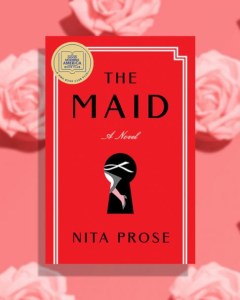
    The Maid by Nita Prose is a one-of-kind, touchy-feely novel without collapsed grand narratives and vehement subjective rhetorics about existential vertigoes in life that burdens the reader with a duty to interpret the philosophical, the intellectual meaning of a story, all fragmented and adrift. Instead, the story uses the real to perfect the ideal delightfully blended with a taste of Murder She Wrote with relatively ordinary characters doing the most extraordinary things like you never know.

    The Maid is one lonely young Molly Gray. She is a Maid of Maids, taking her job religiously in a hotel that does not quite reciprocate her dedicated service but sees her as a quiet oddball because of her reclusive comportment. But Molly is a swan in a lake of ducklings and geese, a harpist among percussionists, whose feet constantly move beneath reality’s surface. Molly is anachronistically muliebral and incongruously proper. She belongs to a preceding era of decency, saying early Edwardian London as a chambermaid, a coveted position for working-class women. To judge Molly as a misfit is downright callous and heartless because she inwardly craves recognition from those she thinks of as sympathetic souls who use her as a pawn in their game of passion and avarice. The more we learn about Molly as the narrative deepens, the better we know of her as if we were contracted severe strains of Stockholm Syndrome. Hence, our better angels persuade us to forgive and forget the stupendousness of truth that Molly confides to us at the end of the story’s labyrinth.

    This fictional Maid by Nita Prose and that real-life Maid by Stephanie Land are stories about working-class women struggling with the realities of life by themselves. The only difference is that the former has a blessing of luck in the form of sympathetic and resourceful supporters who rescue her from a dungeon of hopelessness. It is understanding because, as Charlotte Brontë expressed, one of the reasons she wrote was to be a kind creator for her stories’ heroines otherwise to whom no sweet soft touch of warmth and love would caress their weeping heads. However, Molly, the Maid is not all melancholic, a damsel in distress, a clueless loner succumbing to a subtle form of gaslighting because she is the one who laughs the last laugh with intelligence wrapped in a maid’s hide. Molly Gray the Maid may have a woman’s body but has the king’s stomach and heart in the most magnanimous way. Therefore, don’t mess with Molly – and the likes.