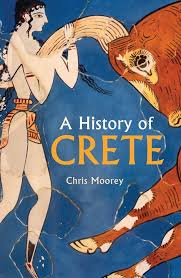
Before the Greeks came, there were the Minoans, with their Linear A, saffron gatherers, bull-leaping boys and girls, and dolphins jumping out of the Aegean Sea. The Minotaur in the Labyrinth was a creature of the island, and the islanders were vibrantly colorful in clothing and facial expression, as seen in the frescoes. The Snake Goddess danced before the klepsydra of civilization’s history, as if her sinewy body uncoiled to birth her children, first in her beloved Crete.
A History of Crete unfolds the mystery of its people like Ariadne guiding Theseus through the Labyrinth with a ball of thread, allowing us to see the face of the mystical Minotaur: half man and half bull. Rather than producing a stuffy, academically inclined history of Crete, the author organizes each chapter and section chronologically, with Herodotus-like backstories about who the Cretans were, what they did, and how they did it. Crete was Zeus’s home—literally, at least in myth. It was where he was born and where he fathered children in its royal line. Perhaps this home-ground advantage affected Cretan society, whether the god intended it or not.
One of the most remarkable claims I encountered in the book is that, compared with Sparta, slaves in Crete were not treated as harshly as their counterparts in Sparta. Moreover, the Hermaea festival at Cydonia was a Cretan equivalent of a carnival, in which masters served their slaves and endured their ridicule in a role-reversing psychological drama. Such a custom might have helped the slaves release their emotions and thus prevented them from plotting to subvert the status quo.
Although I enjoyed reading this book, it was somewhat different from what I had expected; I wanted to know more about the people, such as what they wore, what they ate, how they spoke, and what they did at home or at work. My growing interest somehow stalled as the centuries passed because I wanted to remain in ancient Crete. Call me biased, but I would have been more delighted to read anything about the ancient Minoans than about Crete under its successive conquerors. But then, that is the author’s call, not mine.
This book is a commanding introduction to more detailed studies of Crete’s mysterious peoples and their lives on the island. And I know that this is what the author wanted it to be. He serves as something of a cicerone, helping readers discover what they did not know. It is also a good coffee-table read to pick up when Netflix has nothing interesting to offer, or simply to dispel boredom.
No matter where you read this book, you will not close it without a piece of ancient treasure from Crete.


Leave a Reply