Tag: book review

  • ‘The Sumerians: A History From Beginning to End’, by Hourly History – review

    The Sumerians: A History From Beginning to End (Mesopotamia History Book 1)The Sumerians: A History From Beginning to End by Hourly History

    My rating: 5 of 5 stars

    I have always been interested in this mysterious ancient people who were the first inventor of the systematic written language in the history of human civilization. No eminent academics have ascertained where they were from. Subsequently, many a civilization claimed to be their descendants, ranging from the Caucasians to the Indians and even to the Far Easterners. But one thing is certain that the civilization of this enigmatic people merits itself as the cradle of civilization on the grounds of the following characteristics: (1) social structure based upon diverse economic sectors; (2) religious system concomitant with system of government; (3) advances in technology contributing to the cultural and scientific enterprises; and (4) written language, which is the bedrock of any known human civilization. They were the Sumerians. In fact, the Sumerian legacies are the sine qua non of a broad substratum of our modern cultural and social infrastructure. Notwithstanding such contributions, the Sumerians are still veiled in mysterious mist; no one knows for sure where these people came from and then vanished, leaving us with their brilliant legacies as their gifts to human history. Which makes the Sumerians all the more interesting and enigmatic as vividly and elegantly related in this book.

    The Sumerian civilization burgeoned in the area between the Tigris and Euphrates Rivers, also known as one of the River-Valley Civilizations, in modern day Iraq for almost 4,000 years. The staging of the Sumerians in history was akin to a dramatic entrance of a dark horse on stage. In around 3,300 B.C. a group of outsiders with “straight black heads” from nowhere, and they called themselves “Sumerians.” However shady and murky their backgrounds might be, the Sumerians were already smart and practical when they arrived at the land with their already fully developed written language and scientific knowledge, especially on irrigation systems. To elucidate, the priests oversaw the design and building of irrigation systems as something of civil engineers who also controlled the building of embankments to prevent flooding of agricultural land during rainy season in order to allow the rapid transport of produce from farms to cities. In fact, these two inventions are regarded as the most highly advanced and influential enterprises that betoken their cultural sophistication and engineering feats that are hardly inferior to those of ours in modern time. The irrigation resulted from a need of bringing water from the rivers to the fields, and the whole procedure was exclusively operated by the priests, who negotiated with farmers for water supply in exchange of a portion of the harvested crop.

    With respect to the writing system, it is known as “the cuniform” engraved in the form of wedge-shaped markings made in wet clay using sharp reeds. And this the necessity of writing came from an accounting need of recording the amounts of agricultural produce. But the Sumerian writing was more than a language of commerce. It also blossomed into an art of literature modeled for other writings, such as famous biblical stories of the Garden of Eden, the Ark of Noah, and the Book of Job were all based upon Sumerian stories allegedly based upon true events that had occurred to them. Also, the words “saffron” and “cane” we use today are derived from the cuniform.

    Since Sumerians also instituted farming of the land, instead of being a nomadic hunter-gather people, they established a village as a permanent settlement, which begot food surpluses, creating diverse social structures, including a compartmentalized class system and various types of work unrelated to farming. Sumerians also produced the first codes of law and the first written literature in the form of pieces of writing, such as the Sumerian proverbs as wittingly inserted in the beginning of every chapter of this book. For instance, on the subject of married life one Sumerian man uttered thus: “For his pleasure he got married. On his thinking it over, he got divorced.”Which also bespeaks a permission of divorce in Sumerian society. Sumerians treasured monogamous marriage in which a man gave gifts to the bride and her family upon agreement to a marriage contract. Besides, women were not confined in domestic restraints; they could work as scribes, weavers, and proprietress of businesses.

    There were four strata of social class in Sumerian society as follows:

    • Nobles: Senior priests and warriors and their families who owned the most of the land. The nobles distinguished themselves by resplendent clothing made of fine fabrics and impressive jewelry with their shaved heads. They all lived in temples and palaces in the center of the cities where the irrigation systems and commercial centers were located.
    • Commoners: Traders, artisans, merchants, scribes, and craftsmen. In fact, scribes were held in high esteem because of their dual role as accountants. Commoners also owned a small portion of land.
    • Clients: Senior administrators and temple personnel working for nobles who lived in small houses in highly congested streets close to the city walls or outside cities on farms.
    • Slaves: Manual laborers who were prisoners of war or sold into slavery due to the inability to pay the debts. Also, fathers of free people could sell their children into slavery to raise the funds. (So Thomas Hardy’s Mayor of Casterbridge in which a man sold his wife and daughter in a public market had its legal foundation in the Sumerian practice.) However, slaves could merry free people and purchase manumission themselves.

    The emergence of the above-referenced class system indicates that the Sumerian economic infrastructure was constituted by a variety of business sectors developed in the cities with food surpluses, highly advanced irrigation systems to transport water from the rivers to the farms, and solid military prowess endowed by professional solders and inventions of steel chariots used at war for the first time in history.

    In conclusion, the Sumerian contributions to our modern civilization as a collective enterprise are deeply entrenched in many aspects of our life, whether or not we know or even care, because well, let’s face it, history is written by a winner, a victor, a survivor who lives to tell beyond the boundaries of time and space. In this regard, the Sumerians might not be ostentatious de riguer per se victors because just like their mysterious origin, their demise as a sovereign entity with their direct descendants to whom their cultural artifacts and legacies stunned the proliferation of its heritage. Nonetheless, the Sumerian civilization bestrides one of the world’s most significant ancient civilizations that left indelible marks on our cumulative cultural progress as elliptically put by the following Sumerian proverb: “What comes out from the heart of the tree is known by the heart of the tree.” You see, the Sumerians were indeed brilliant. Nothing could be further from the truth.

  • Celts Vs. Romans?

    51n6uMCA63L
    Asterix (L) and Obelix (R)

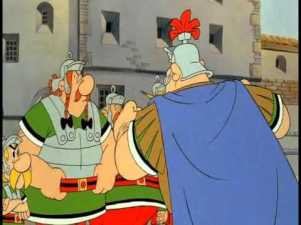
    In The Adventures of Asterix, a popular Franco-Belgian comic strip whose protagonists Asterix and his friend Obelix in a village of Gauls during the Roman occupation in 50 BC outwitted their Roman colonialists with Druidic magic potion and spontaneous ingenuity laced with Celtic sense of humor and and mysticism, the Gauls were constantly at war with the Romans in the reign of Julian Caesar, who was bent on subjugating the culture of the colonials, let alone the recalcitrant Celtic spirit, to that of the empire. But it wasn’t always like that, pace popular conception of the Roman ruling of the Gauls and the Britons as widely portrayed in popular culture. The relationship between the Romans and the Celts was quite peaceful and even surprisingly symbiotically beneficial – that is, at least prior to the emergence of Caesar and Claudius.

    The Romans and the Celts were in Apollonian co-existence bound by flourishing trade and cultural exchange between the two peoples. There was a long period of peaceful trading between the Mediterranean Romans and the Celts of Gaul inhibiting modern-day France with exports and imports particular to each of the regions. To illustrate, the Gauls were known for their penchant for diluted Mediterranean wine that was transported by boat on the sea and wagon in land from the Peninsular. The Romans received in return Celtic slaves who never seemed to be short of a supply because there was a surplus of slaves in Gaul where frequent raiding among the tribes was the sine qua non of such abundance of exploited manpower to be used to tend the Roman vineyards and other aristocratic estates. Gaulish chieftains offloaded excessive number of newly acquired slaves by trading them off for proverbial Roman wine to distribute it to his followers as an ostentatious display of their wealth and prowess in their tribes. In fact, the Gauls’ love of the Roman wine was so undeniably famous that among the Romans the stereotypical image of the Gauls as drunkards slurping wine through their long, drooping mustaches was widely circulated in the empire.

    hqdefault
    Asterix and Obelix in the Roman Army

    Olive oil, tableware, jewelry, and other luxuriant goods were among the popular Roman exports, however expensively they were sold by canny Roman traders, who then bought metals, cured hams, beer, and hunting dogs from the Celts at low prices. Notwithstanding such discontentment in terms of fair trade, the prosperous bartering of the goods between the colonials and the colonialists brought the grist to the mill of effective management of the colonies in the context of regarding economic and political stability that could/would have been otherwise in turmoil as a result of despotic constraints on the preexisting native social and political structures characteristic of colonialism. This favorable symbiotic relationship between the Romans and the Celts (the Gauls in France and the Britons in Britain) greased the wheel of the cultural and political expansion of the empire by egging the Celts on to adopt Roman-style systems of government and the young ones on to enlist in the Roman army as auxiliaries.

    R22b
    Julius Caesar

    However, the pacific era of the Roman-Celtic relationship saw cataclysmic waves of change that would punctuate the stability of the status quo as destabilizing forces loomed large in Western Europe: Firstly, the prospect of Germans occupying the Alps was a cause of concern to the Roman Elite. Secondly, Julius Caesar, the ambitious Roman ruler who was seeking for a popular acclaim to fortify his rulership in the empire as well as booty enough to get himself out of debts, determined to impose his despotic rules on the peoples of the conquered lands as portrayed in The Adventures of Asterix. Then later, there came Claudius, the lame and slightly deaf emperor who was spared of his life by his nephew Caligula perhaps on account of such physical defects. Claudius launched a campaign of conquest in northern Europe to attain military prowess in the region and thus enforced totalitarian policy on the management of the colonial systems, discouraging autonomous trading and social and cultural exchanging between the colonial and the colonialist.

    In light of the above, the relationship between the colonialist and the colonial sometimes begets unexpectedly mutual benefits in terms of cultural exchanges between the two peoples counter-intuitive byproducts, such as attested in the case of the Romans and the Celts, which could lead to diversification of native cultures, enriching the wealth of cultural legacies that would become another mode of new culture. If the Celts had been vehemently resisted against the cultural influences of the Romans as a result of the conquest of their lands, the cultures and history of Western Europe would and could have become very different from what we have known today, such as the English language, architectural and other historical artifacts, and political systems. In my opinion, sometimes, the colonial regime is not altogether downright evil in the sense that it somehow results in amalgamation of cultures favorable to both of the ruling and the ruled, not out of the benevolence of the former for sure but of the necessity of governing the conquered in the most effective way in order that the conqueror may quell the social and political dissonance arising out of the inept administration of the colonial affairs. In point of view as held by Ancient Athenian historian Thucydides, one must listen to the other less popular side of the story to transcend the subjectivity of times and to test the validity of truth. In this regard, I opine that however adamantly one may object to the benefits derived from the Roman-Celtic relationship, it attests to the fact that it enriched the cultures of both of the peoples and helped them reshape their ideas of epicurean ways of life that has passed on to the present progeny.


    Author’s Note: The inspiration of this essay comes from my reading of “Traders to Invaders,” written by Barry Cunliffe, formerly professor of European archeology at the University of Oxford, from December 2018 issue of BBC History Magazine.

    저장

    저장

    저장

    저장

  • ‘The Open Boat,’ by Stephen Crane – review

    The Open Boat and Other StoriesThe Open Boat by Stephen Crane

    My rating: 4 of 5 stars

    Four men in a dinghy adrift on a sea for 30 hours. The tempest of waves and a great shark occasionally circling around the perimeter of the boat. And the men rowing endlessly as if it were their only tangible way of protesting against their fates. It all happened in reality because the author Stephen Crane himself experienced the ordeal as one of the four men from the sunk SS Commodore off the coast of Florida en route to Cuba, where Crane had been sent as a war correspondent. The short story of the Open Boat is as realistic as it can be based upon a factual event the author himself was fatefully partaken in.

    The four survivors of the vessel were aggregates in a dinghy bound by a remote hope of finding a rescue crew in the middle of the ocean that moved them with terrible grace of waves. The men were a captain, a cook, an oiler, and a correspondent, who was the author himself. There was a subtle brotherhood of men built in the boat who took care of each other. Crane surmised that the captain’s heartfelt devotion to the safety of the motley crew resulted in comradeship, which the author himself had always regarded as a hypocritical concept of men until then.

    There were indeed moments of despair as their drifting became protracted, and the author saw this as nature not regarding human as important. He would jeer at any signs of nature in any deity form because thinking of the captain and the two other seamen who had worked so hard on the sea in such distress was the abominable injustice.

    Stephen Crane was a great American realist writer who later influenced Ernest Hemingway. Born in 1871 as a ninth child of Protestant Methodist parents in Newark, NJ, his literary talent began when he wrote his first poem at the age of eight. Although brilliant, Crane was not academically inclined, so he left University of Syracuse and became a kind of itinerant writer. It is said that Crane was a naturalist writer who emphasized observation in the portrayal of reality based on scientific principles of objectivity and detachment applied to the story of human characteristics. However, in my opinion, he was more of a realist writer who focused on objective, truthful presentations of details of the ordinary lives influenced by Gustave Flaubert and George Eliot. In this story, Crane’s use of vocabulary was pithy and straightforward with elegant expressions of emotions and feelings that so appropriately described the situations in which the characters were trapped.

    After Crane’s untimely death at the age of twenty-eight in a Black Forest sanitorium in Germany, Crane’s works began to gain their long overdue acclaim, one of which was this story of the sunk vessel and his own experience thereof. Stephen Crane’s works should deserve wider readership because he’s the first and foremost American writer in Realism literary movement who paid attention to the lives of the ordinary by being the experience of living among the ordinary and writing the existential presentations of the ordinary lives.

    저장

  • Musee d’orsay in Paris – review

    Musée d'Orsay in Paris - a travel guide and tour as with the best local guide (Paris Travel Stories Book 4)Musée d’Orsay in Paris – a travel guide and tour as with the best local guide by Wander Stories

    My rating: 5 of 5 stars

    Of all the world famous museums, my favorite is Musee d’Orsay in Paris because it possesses most of the paintings of Impressionism, to which I am partial because of its prevalent portrayal of ordinary life of people with simple but innovative techniques of using color and light like never before. In fact, I enjoyed a virtual tour of this lovely museum with a guide of Musée d’Orsay in Paris by Wander Stories, a wonderful reference book on this lovely museum with rich information on the history of the museum, biographies of artists, let alone the backgrounds of their paintings they created, all of which beautifully presented in a wealth of rich color photos and illustrations to conjure up the vivaciousness of life right before your eyes in the comfort of wherever you may be.

    The birth of Musee d’Orsay starts with the zeitgeist of our modern era when the spirit of liberty and expressionism was born out of a pyrrhic victory over the antediluvian customs and dogmas upheld by a few select. Originally, the land surrounding the museum was part of a private garden belonging to Queen Margaret, the wife of King Henry VI. In the 19th century, the Palais d’Orsay was used for the Court of Accounts, most of which were burned down to the ground during the uprising of the Paris Commune in 1871. Then in 1897 the government decided to build a new railway station to facilitate transportation of passengers to the center of Paris directly, preparatory to the upcoming 100 World Fair. During WWII, the station was used as a mailing center to send packages and letters to prisoners of the war and to receive them after the war. Finally, the station was re-born as Musee d’Orsay exhibiting all the arts from the second half of the 19th century with a presidential blessing of Francois Mitterrand in December 1986.

    Musee d’Orsay embodies individualism freed from the rigid status quo of the old academics in the French arts scenes. It houses famous impressionist and post impressionist paintings of the 19th by Gustave Courbet, Eduard Manet, Edgar Degas, Camille Pissarro, Pierre-Auguste Renoir, Claude Monet, Vincent Van Gogh, and so forth. All of these painters were revolutionary vanguards of Impressionism, a new genre depicting everyday life of the ordinary not of mythological or even loyal figures and the simple beauty of nature in the most artistically innovative methods of painting that had not been seen in the paintings of previous eras.

    Vincent Van Gogh’s “The Siesta” in the museum deserves a special recognition both by its artistic merit and personal background of the painting. It was painted when Gogh was a patient in a mental asylum. Initially beginning his career as a preacher, Gogh was soon disillusioned with arid rigidity of Christianism, and turned himself to the word of painting in attempt to find a solace for his restless soul. He often copied the works of Jean Francois Millet and thought more highly of him than of Manet. Gogh’s use of vibrantly contrasting colors, such as blue and yellow, violet and organic, Gogh portrayed rural France at its most vividness dynamically.

    As with many creative artists, Gogh lived a difficult life of being let down by his low self-worth. To illustrate, Gogh had a drunken brawl with Paul Gaughin, in which Gogh threatened Gauguin with a razor then fled a local brothel, where he ended up cutting off the lower part of his let ear lobe. Moving from one asylum to another, Gogh’s creative ingeniousness was recognized and encouraged by Dr. Gachet, an Impressionist enthusiast who drove this extraordinary patient of his to creative indulgence, leading Gogh to create 70 more paintings in 70 days, although he sold only two paintings in his lifetime. The last day of Gogh was just like another working day, for he shot himself in the chest while painting in a wheat field. Notwithstanding the tragic end and life wrinkled in anguishes and distresses, Gogh’s resilient spirit driven by his creative madness is enshrined in his paintings that have stood the test of times all around the world, canonizing him as a key figure in transformation from Impressionism to modern art in art history.

    Musée d’Orsay in Paris by Wander Stones is a lively reference book about the museum and the oeuvres of the aforesaid and other famous painters with beautifully displayed photos and detailed information on the paintings and the painters in easy language. This is also a lovely book to be viewed on a Kindle Fire with easy references to pages and stunningly colorful photos effortlessly downloaded on the device to enjoy the tour of the museum anywhere, magically transporting you in front of each of the paintings in the museum. Or if you plan to visit the museum, then reading this book will prepare you with arms of information. All in all, the knowledge from the book will help you appreciate the beauty of the arts at their best because as defined by Sir Edmund Burke the standard of reason and beauty is all the more appreciated by the faculty of the mind affected with the works of imagination and the elegant arts, which is universal in all humans and of sentiment common to all mankind.

  • ‘Essays in Aesthetics’, by Jean Paul Sartre – review

    Essays in AestheticsEssays in Aesthetics by Jean-Paul Sartre

    My rating: 4 of 5 stars

    Jean Paul Sartre was something of a celebrity in the European Intelligentsia in the Swinging Sixties; despite his rather homely exterior equipped with a pair of thick horn-rimmed spectacles covering the squint eyes, Sartre was brought into celebratory limelight with a panoply of illustrious epithets- L’Enfant Terrible of the European intelligentsia, a precursor of modern existentialism, and husband of Simone de Beauvoir, a trailblazer of modern feminism – The truth of the matter is that Sartre loved the attentions bestowed upon him. In fact, he thrived on it. On a question of fame relating to his celebratory statue as an intellectual, Sartre answered with forthrightness: “Fame is good, even at forty or fifty is desirable; there is happiness, an intense enjoyment, in pushing one’s way into the spotlight like this.” It is this unusual, feisty frankness in conjunction with his audacious existentialism vis-a-vis Viktor E. Frankl’s Logotheraphy that inspired me to find out more about the man’s school of thought in this book written by Sartre himself.

    This light volume of essay collection draws on Sartre’s exceptional knowledge of the arts and the creators and yokes it to the tenets of existentialism, which means that the reader should have at least rudimentary knowledge about existentialism. The substratum of existentialism is the experience, the action taken by himself, which constitutes a man’s identity in the world. This might sound materialistic and even bathetic at first blush. However, do we not tend to judge our own self or other people based upon the manifested achievements or deeds, regardless of the character, personality, and/or other planes of circumstances pushing the doer into such actions? With every one of our actions, we particularize our self, thus creating a ‘self’. It is this realization of the abstract self existing as an abstract essence that results in the following dictum: Experience precedes our essence, establishing our own self identity in society.

    In terms of existential analysis of a meaning of life or a sense of purpose in life, our actions becoming our experience make us responsible for our own lives, including our missteps and achievements. In other words, this explication of existence shows us how we look and what we are like as the touchstone of our existential selves in everyday life, as the Russian writer Anton Chekhov once said: “”Man will become better when you show him what he is like.” In this regard, existentialism coincides with Logotheraphy, which identifies a meaning of life, freedom of will, and will to meaning with fulfilling demands placed upon our daily tasks, to achieve ego qua meaningfulness.

    In sum, Sartre’s existentialism strikes the zeitgeist of our time convoluted with reality shows, fake news, selfies, social media approbation, and grand collapsed narratives in which we often find ourselves uprooted in the midst of inflated self-aggrandization, however overtly and incorrectly exalted. Sartre tells us: “Man can will nothing unless he has first understood that he must count on no one but himself in the midst of his infinite possibilities without help.” That is, the purpose of our life is to live it, to taste experience to the utmost by actualizing our purposes amid our daily lives, for we are what we do and create our own reality of the world by acting out our ideation. This book will be a good primer on more in-depth world of Sartre’s existentialism with his no-nonsense perspectives on the nature of humanity and proverbial touchy-feely approaches to the real world and a man’s place as a human being therein, all marked in his literary craftsmanship that is all the more enjoyable to the reader.

  • The etymology of black friday

    black-friday-space-for-rent

    There were long lines of people everywhere today here in this otherwise peaceful sunny Californian city. As I swiveled my head in wonderment to figure out possible causes for the formation of the lines, my eyes directed me to a sign posted on a window of one of the outlet stores bearing “Black Friday Sale.” Hmm, so it was that time again. In fact, the word ‘Black Friday’, I think, always renders me an ambiance of Dystophia where desperate citizens resulting from a carnage of  wars and great famine are hell bent on looting stores for a paucity of goods. Besides, it is named so very dull, tawdry, and crude that the very sound of the name boasts a lack of cultural sophistication of its obscure name-giver who seems to me nothing but a philistine following a cult of Mammon.

    That being said, to come upon an article about the origin of this consumerist feast day from a magazine seemed pat in the paradoxical sense of animosity colluding with curiosity on this whimsically leisurely Black Friday. It’s rather unsurprising to discover that the etymology of the term ‘Black Friday’ is ambivalent  in origin. There are four a posterior grounds of the birth of the term as follows:

    • Black Friday was the day when financial markets collapsed on September 24th, 1869, as a result of the disclosure of a Wall Street conspiracy to raise the gold price.
    • It was the day after Thanksgiving Day when police in 1950’s Philadelphia, having sacrificed their holiday leave, concentrated the force on the cresting influx of shoppers and American football fans into the city.
    • In 1961 retailers in the selfsame city foresaw the potential to galvanize business by choosing the term “Black Friday” as a catchy-phrase.
    • The retailers saw it as the day by which they could have procured sufficient revenue for the year, so that they could move their accounts written in red to black, finalizing a profit for the year.

    black-friday-pros-and-cons-cartoonIn my opinion, the third postulation seems the most plausible, which logically constitutes the fourth one as a basis for the etymology. It’s always this mercantile ingenuity that prompted cults of consumerism, such as Valentines Day, White Day, and Christmas Day. Inevitably, in our modern capitalistic society such promotional encouragement of spending money on consumer products is the grist to the mill of market economy and greases the wheel of monetary circulation for the behoof of the vivaciousness of societal atmosphere in general. Yet, the hustling and bustling of the mindless shopping spree blindly egged on by the media prompting to buy things that you really do not need in frenzy appears to live beyond the principle of the Golden Mean, the virtuous moderation of restraining yourself from indulging in lavish expenditure, as advocated by Plato in corporation with the inscription written on the terrace at Delphi, “Nothing in Excess,” which chimes the bell of our ethos embroidering on conspicuous consumption.

    저장