What more can I say? I am simply thrilled by his recognition of my thoughts on the book. Which can say more than this rich praise, that you alone are you?
Tag: book reviews
-
‘Cursed Britain: A History of Witchcraft and Black Magic in Modern Times’ by Thomas Waters – review
 Cursed Britain: A History of Witchcraft and Black Magic in Modern Times by Thomas Waters
My rating: 5 of 5 stars
Witchcraft as popular belief system may sound anachronistic, if not extinct, in our age of the Internet, Satellite TVs, and planned colonization of the Moon, in the same way, that people in Renaissance regarded the Medieval times culturally backward and religiously superstitious. Yet, it has survived the leaps of time and waves of persecution, withstanding like a flickering candlelight in hours of stormy dark nights and remains in modern landscapes of buildings, cars, airplanes, and people with mobile phones on their hands.
Thomas Waters in his Cursed Britain: A History of Witchcraft and Black Magic in Modern Times tells us how this ancient belief system of faith-based healing at its lightest and of maleficent bewitching at its darkest has kept its vitality from the rural areas of provinces to the bustling streets of cities in Great Britain throughout the centuries based on his extensive research of historical documents and scholarly analysis on the uncanny but very real phenomena that grips your attention on every page of this fascinating book.
If you are keen on historical facts and anthropological evidence of human nature in relation to the ancient esoteric knowledge that looks so appealing and tempting, this is an excellent book.
-
‘Dr. Faustus’ by Christopher Marlowe – review
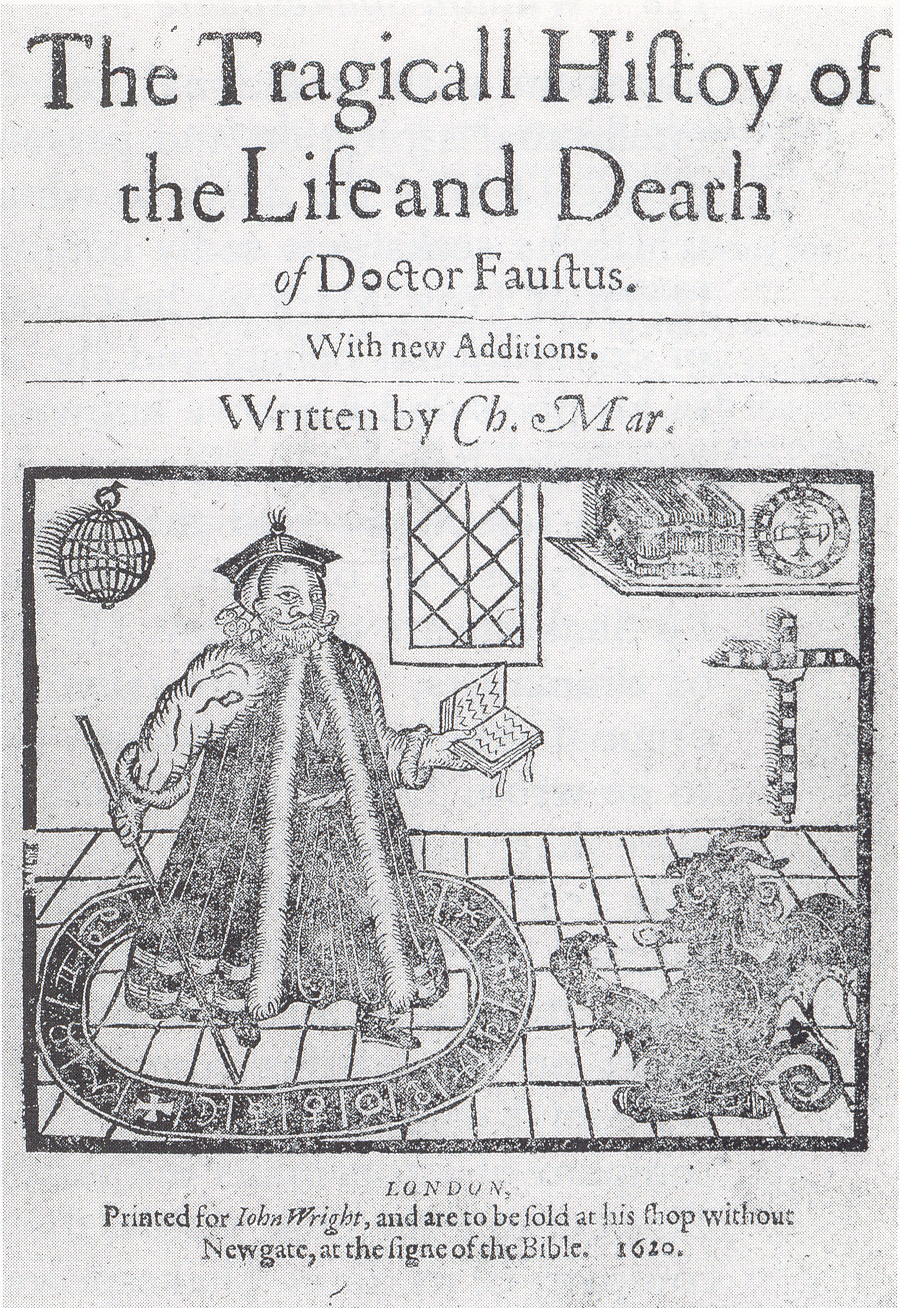 He was a formidable agent provocateur: a blasphemous rebel, a proud atheist, a counterfeit, and a sybaritic seeker of tobacco and boys and an alleged spy for the government with his literary arsenal and daredevil machismo toward life. It was no less a dramatist, playwright than Christopher Marlowe, who introduced the concepts; a man whose life was staged so mysteriously and controversially that even his death was enveloped in a provocative imbroglio of factoids. In a case of life imitating art, Marlowe’s life was an epic tragedy for a literary enfant terrible struggling to mark his name in the Elizabethan England, where his literary genius and individualism were something of irreligious decadence to be reckoned with. Marlowe’s version of Dr. Faustus was his testimony against conventional absurdities of life in defense of his existential meaning of life, and there’s his outcry of existential dilemma spreading through the mind of the reader and connecting to the world of Marlowe.
Dr. Faustus is a collective model of existential dilemma of Marlowe and his educated poor peers boxed in clerical positions with paltry sustenance in the Church of England. In fact, the strains of daily life of an educated poor is inculcated in the figure of Dr. Faust in retribution of their social confinement unparalleled to the scholarship and academic achievements. Marlowe saw poverty obstructing the progress of gifted minds, and consequently, it became his literary and psychological stratagem of fictional world populated with characters terminated by inner conflicts set in the background against the class divisions and religious dogmas intractably entrenched in Elizabethan England. Thus, Marlowe carried out his poetic justice by making Dr. Faustus able to fulfill his materialistic objectives by the agency of magic from the demonic power, even though it required of him a spiritual as well as physical quid pro quo in this story laden with super abundance of religious tenets and morals that all seemed a pompous, sanctimonious hokum.
Marlowe used Dr. Faustus as his literary artifact, a psychological and spiritual medium through whom he made parallels with his own life, measuring himself against the burgeoning careers of his peers of his time. Dr. Faustus was in a way Marlowe’s mirror image that reflected all things about himself in the peculiar alchemy of literature. It all seems to me that Marlowe was a way ahead of his time because the contextualization of inner conflicts of the characters and the thematic substratum strike the chords of readers of post-enlightenment, post-Second Vatican Council and post-modernism. His behemoth contemporary peer William Shakespeare said, “Some are born great, others achieve greatness.” I like to think that Marlowe was both in the canon of English literature.
-
‘The Great Fire of London in 1666’ by Walter George Bell- review
 The Great Fire of London in 1666 by Walter George Bell
My rating: 5 of 5 stars
The great city of London was burning. The noble and the humble were all in together in the face of furious fires that looked something of the eternal flames of Inferno. It took from September 2 to September 6, 1666 for Old London – Shakespeare’s London- to disappear into the past. It was a scene to behold, it was a scene to record. The medieval City of London inside the old roman city wall became a gray detritus of ashes and more ashes, which changed the face of London forever – in a far better way that improved the conditions of living in the scandalously popular city, the city that had no regards for the lowly and the lowest. For out of the detritus of the devastation, came a phoenix hoovering over the gray skies of London with golden opportunities for the contemporary Londoners and even better for the progeny and the citizens of the world as magnificently illustrated in this telling book by Walter George Bell.
It all happened on the morning of Sunday, September 2nd, 1666 at the shop and house of one Farynon, King Charles II of England’s baker, stood in Pudding Lane, ten doors from Thames Street due to his lack of due care of the oven. Although the baker later vehemently disavowed such negligence that caused the Inferno, Bell confirms the tortious act on the part of the baker on the ground of “a calm consideration of the evidence” collected afterwards. However, at the time of and the immediate aftermath of the Fire, the public fueled by the demotic uproar of the angry mob decided that it resulted from a concerted plot of the Roman Catholics and Frenchmen. In fact, the unanimous vengeance upon Catholics and subjects of any Catholic countries was all the rage under the misbelief that they set fire on the city as punishment for the impudent English heresy against the Papacy. Even the supposedly judicious members of the Council were prejudiced against foreigners and Catholics in London despite the King’s speech to the homeless in effort to assuage such outrageous public agitation. In consideration of the ethos of the period, the speculated causes of the Fire related to religious motivations that all called for God’s punishment for heresy (especially Catholicism) and other cardinal sins that looked particularly rampant in “sinful London”. Nevertheless, the Council finally relented by proclaiming that the cause of fire was no other but “God’s will, a great wind and the seasons so very dry.”
What seemed to be a scourge of God turned out to be a seismic labor pain of birth of a new city that was beneficial to those at the low rungs of a social ladder because the ecclesiastical city of bell towers and spires would be transformed into a commercial city of work and more work in new salubrious environment. Bell expounds that post-Fire London was a new breed of commercialism, making London culturally vibrant and famously cosmopolitan as a uniquely quaint city where modernity and traditionality were fashionably blended. Moreover, Bell points out that rebuilding of London after the Fire also improved living qualities of the inhabitants in terms of unhealthy housing and inconvenient pavement conditions with the reconstruction of the streets of London designed by Sir Christopher Wren. It also generated a plethora of trades that contributed to the betterment of economic conditions of people living in and coming to London for better life.
This book is at its most compelling when assessing the consequential events of the Fire drawn on a multitude of historical records and the author’s calm objective analysis of the Fire without a hint of religious proclivity or partisan social commentaries. It doesn’t turn out to be a stuffy history book that the topic indicates but an engaging nonfiction narrative that combines Orwellian journalistic perspectives with Thucydides’ standard of historical realism, all in the perspicacious use of plain English communicative to all. All in all, if you are curious about post-Shakespearean London or want to know about the history of London, this book will not disappoint you.
-
‘Shakespeare’s Library’ by Stuart Kells
 Shakespeare’s Library: Unlocking the Greatest Mystery in Literature by Stuart Kells
My rating: 5 of 5 stars
We talk of him so much, yet we know of him so little. As George Orwell elliptically put, “Much rubbish about Shakespeare has been written” by anti-Stradifordians as well as Stradifordians, and various sects of Shakespearenism still multiplying and evolving. Nonetheless, William Shakespeare is a heavyweight literary champion and a provocateur of authorship of his popular plays and pearly poems. He is certainly a man of reputation that gives him a status fusing highbrow elitism of a famed writer with a sensuous appeal of modern-day celebrity. In Shakespeare’s Library by Stuart Kells, such academic hullabaloos over Shakespeare’s authorship of his oeuvres are laid bare in the course of Kells’s quest of the existence of Shakespeare’s library, a list of books the Bard owned and a folio of his own manuscripts per se. For the meaning of Shakespeare’s library and its whereabouts are bound up with the authorship question and hold the key to the cardinal principles of humanities and truth.
Much of the debate on the Authorship Question arises from Shakespeare’s non-aristocratic family background despite the erudition of his writing. The book serves as Kells’s scholarly demurrer challenging the claim of Shakespeare’s non-authorship and flagrant plagiarism. Kells demurs at such preposterous allegations that negate the capacity of Shakespeare as a writer on the basis of ambiguity, uncertainty and prejudice. Kells takes a conservative liberal Socratic position of impartial advocate who defends the Bard on the grounds of (1) different social and historical criteria; and (2) the demonstrative evidence of the library at issue. With respect to Shakespeare’s alleged plagiarism, it must be regarded as a common de rigueur literary practice of his day that adopted the ideas from other source texts into an adaptor’s own. Adaptation was a revered literary custom, stretching back to medieval times when a monk modeled other people’s writings on his own because they taught him different styles of writing he wanted to emulate. Shakespeare lived before the advents of copyright and intellectual property law and psychoanalysis with the emergence of the powerful middle-class intellectuals as a substitute of the ecclesiastical caste. Therefore, we must not make an anachronistic mistake of looking at the past with our modern criteria in making parallel with our own time period, measuring the trend of the days against the principles of our day.
Further to the social background, including a lack of formal education and humble family origin, classicism is used as a touchstone of validity of Shakespeare’s authorship as carefully nuanced in this book. Kells as a learned adventurer shines through in this book. Various debates on the Authorship Question are rendered accessible as he pivots deftly from keenly observed details about the source texts to the universally equitable ramifications of his search of Shakespeare’s library in favor of the ingenious Bard. Kells wears his learning lightly here and writes with a general reader in mind, discriminating none regardless of social and cultural differences to invite all in his search of Shakespeare’s library. Shakespeare’s library is his source texts ingeniously combined into his world of imagination populated with star-crossed lovers, fairies, witches, kings, princes and a parade of various walks of life, all manifested in his legacy of literature still revered by all around the world. It is an excellent case of dispersion of collective knowledge throughout society as an Elizabethan-styled meme, a unit of cultural imitation, which is a form of cultural revolution in which art always flourishes.
If Chaucer foundered the bedrock of English literature, Shakespeare popularized it through his appealing works all over the world, making his timeless quotations indexes of wisdom and wits percolated through our daily lives. Rather than as a serious grim-faced man of letters, such as what Leo Tolstoy and his Anglo-Saxon ilk liked to lionize, Shakespeare was a fashionable Elizabethan literary tradesman, a workaday dramatist who had a feat of converting existing works into new kinds of drama, packed full of scintillating wits and memorable lines easy to understand with themes blended with the highbrow concepts and the lowbrow dramas that were contemporaneously popular in Shakespeare’s time. In Shakespeare’s library, readers will meet the Man as he was thanks to Kells’s impressive scholarship of Shakespearean literature and general erudition combined with his Socratic principle of “Knowledge to All” as manifested in his approachable writing style. Moreover, readers will come to know more interesting, more lively and more attractive libertine Shakespeare who was a practical artist with a wordily sense of success and vision to match. For he knew that to create was to recombine by letting his fancy free in his solipsistic library of books and notebooks – his Cabinet of Curiosities in Mind.
-
‘Coal Black Mornings’, by Brett Anderson – review
 Coal Black Mornings by Brett Anderson
My rating: 5 of 5 stars
Albert Einstein once said, “There comes a point in your life when you need to stop reading other people’s books and write your own.” That said, the story of Brett Anderson, the founder and lead singer of English rock band Suede from London, has a polyphony of vicissitudes woven by multiple strands of existential life experience and innate artistic sensibilities which seems to give him a status fused with the wisdom of an Orwellian thinker and the suaveness of a modern day troubadour in a stylishly insouciant way. Now, on his second calling as a writer, Anderson in Coal Black Mornings tells a story of his family and himself without “the usual coke and gold discs” in such a way that it strikes the hearts of the ordinary and underlings alike who feel a burden of existential needs on their shoulders that smother their creative spirits and ambitions.
Anderson traces the long and winding road that led him from a childhood as a sentimental boy from a poor but culturally sophisticated family. A poverty of material comforts was reconciled with a wealth of artistic sensibilities and intellectual proclivity inherited from his eccentric taxi-driving father whose saint was Franz Liest and his quiet and beautiful painter mother who used to make clothes for him and his elder sister. He evokes the grim, bleak, and dreary scenes of very real urban poverty in which a lack of money can make you feel debagged and insignificant, but he does not hold grudge against the discomfort of such poverty because it became a part of his inspiration for his music that empathizes with the feelings of others in distress. Anderson charts the wandering romance of loneliness and creativity in an existential reality where his wings of artistic aspiration were often clipped by chains of subsistence. It’s a literary catalog of his ongoing journey of life, a personal treaty on the depth and breadth of his life so far, which the author wants to dedicate to his son who will continue a saga of his beloved family.
This is a heartfelt, sincere memoir of an artist who tells it all about himself in hope of chiming the bells of emotions of readers whose life stories share the same elements of existential life when they collide with ideals and dreams that are universal in kindred spirits all around the world. Coal Black Mornings is a literary kaleidoscope of one man’s vicissitudes of life, many of which illuminate the glory of being beautifully misfit in materialistic society. Anderson said that this book was primarily written for his son and that any form of public accolade would be a bonus to him. He was right because the book told me that I wasn’t alone and that I am not alone by feeling misfit. Here we come, the beautiful ones.


You must be logged in to post a comment.