Tag: book reviews

  • Live, Die, Repeat, Repeat…

    Life is still beautiful, even if it deceives you.

    I wanted to find the Church’s stance on reincarnation and, above all, what the Bible said about this seemingly endless shapeshifting until the purification of the soul is complete, so to speak. What about the Christian belief that we live only once and have no return of life?

    According to “A Concise Dictionary of Theology,” reincarnation is the belief or metempsychosis (“animate afterward”) that the soul preexists its embodiment. After death, the soul exists in a ghostly state before animating one again, a body of the same in a different state, which sounds a lot like a demon or malevolent spirit possessing the body of the living. It is this very belief in resurrection and official rejection of the preexistence of wandering souls without corporeal substance that denies reincarnation itself. By maintaining an endless series of chances, the doctrine of reincarnation reduces the seriousness of God’s grace and, most importantly, human liberty exercised in one life that is ended by once-and-for all death.

    Furthermore, in the Catechism of the Catholic Church, death is the end of man’s earthly pilgrimage. When the single course of our earthly life is completed, we shall not return to other earthly lives as “it is appointed for men to die once” [Hebrews 9:27]. Christianity defends the duality of the body and the soul. However, reincarnation defends dualism that both beings exist separately and that the body is simply an instrument of the soul; existence by successive existence as an altogether different body is repeatedly assumed each time one recycles life. Thus reincarnation denies the idea of the resurrection of the body, as evidenced by the resurrection of Christ, and most primarily rejects the Christian doctrine of salvation. Therefore, there is no reincarnation after death.

    I feel much better now than before. While I succumbed to the belief in reincarnation, I couldn’t accept the thought of my present life as punishment for my wrongdoings in my past lives. To think that I have to live in a miserable state of discipline until my subsequent due recycling puts me on the verge of lunacy in the form of murderous headache for which I recently found myself in the ER. Viktor E. Frankl, the survivor of concentration camps during World War 2 and the founder of Logotherapy, urged us to trust that there is meaning in suffering, which helps us lead to our purposes in life. Samuel Johnson, one of the most significant 18th-century English men of letters and the author of A Dictionary of the English Language, describes life as progress from want to want, not from enjoyment to enjoyment. Forget the arguments about the religious dogma dictating an institutionalized belief for mass mind control. Or it so, then so be it. After all, reincarnation is also another offshoot of mysticism developed into religious thought. Then I will follow the light that gives me a sense of hope. And for this reason, I proclaim that my body and soul are inseparable and that I live only once, and that’s it.

  • ‘Thinking Fast and Slow’ by Daniel Kahneman – book review

    We are not always right in what we believe. What we see with the eyes may not be the truth but in the likeness of truth as our instinctual response to sensory stimuli is swifter and mightier than the wise arbitrator of reason. Whether you like it or not, we procrastinate diligently assessing what the senses tell us, bypassing the voice of reason and judgment. Using automatic and biased instinct is a mental shortcut to make a judgment call in one fell swoop, sans inconvenience of time and cognitive analysis. Socrates knew it, Plato portrayed it, Aristotle acknowledged it, Shakespeare saw it, and now in our time Daniel Kahneman, an Israel-American psychologist and economist interpretes it in this book.

    Kahneman illustrates our intuition, or sense, as System I and mind, reason, as System 2. System 1 activates the images stored in a mind’s cabinet when prompted to evaluate the stimuli. There are three factors contributing to this design of instant machinery of thinking without an assistant of reason: available information, time constraints, and limited cognitivity. The system is highly biased, touchy, and impatient like a quick-tempered, spoiled celebrity. It is tuned to subjective truth inured to sensory perceptions about our surroundings and ourselves with quick fixes without consulting System 2, the voice of reason, the superego, which strives for objective truth. But such a dichotomy of Sense and Reason has always been observed and acknowledged, as I introduced earlier in this writing. For example, Plato alluded to the Chariot of Two Horses, of which one is noble and logical, and the other impulsive and recalcitrant. But the difference between Plato and Kahneman is the applicability of the mind-system to the principle of economic activities and consequences.

    The book is a steady bestseller, readable to all ranges of readers who want to search for the cause of their mental malaise and existential vertigo. What might have been a reiterating modern interpretation of how the mind works proves to be a piece of practical advice on how to overcome emotional trauma and live a purposeful and gainful life as thus: 1) When the signs of ill-judged biases arise from within, slow down and ask for reinforcement of the spirit of System 2. In doing so, we must acquire such skills to dominate the hubris of System 1 in a regular steady environment that provides an adequate opportunity to practice and rapid and unequivocal feedback about the correctness of thoughts and actions. If you still prefer a mental and physical shortcut to put the aforesaid into more effortless locomotion, how about taking the simple advice from Socrates?: “When unpleasant, depressive thoughts begin to cast on you, breathe deeply once, then bring a smile to your face.” Too trivially mundane? “Of course, you have to make it a habit,” quibbled Aristotle to support his teacher.

  • Believe it or not

    The morbidity of cannibalism is often associated with the primitive obscure tribes living on a faraway island or in the deepest heart of the darkest jungle over the other side of our comparatively Atlantis-like world. To put it more blatantly trenchant, it was a practice of uncivilized non-European races reported by European explorers of the age of voyage until the mid-twentieth century. As it is always dark under the lamp, the idea of eating human flash ipso facto overrides the fact of consuming it in one way or another yet purposefully. The evidence is the existence of mummia in recent Europe.

    Mummia was human flesh or excretions mostly imported from the Middle East as medicinal palliatives in apothecaries’ shops, a prototype of a modern-day drugstore. It was made of desiccated human corpse matter from mummified bodies and ingested for its supposed healing powers in the same sense that the ancient Egyptians and Romans crushed up mice to put on cavities to cure toothaches. Farther to the east, people believed that the leg of a fresh corpse was to be a panacea to any incurable disease during the Chosen Dynasty in Korea. For mummia in the 16th and 17th Europe, it was recently deceased bodies of executed criminals, a youth of violent death, or unfortunate socially disfranchised. The former two kinds are the flash of passion that rushed thru the veins to the brain, resulting from a sudden frenzy of instantaneously leashed sensations. Such corpses were believed to possess magical feeling power akin to aphrodisiac or love potion, aka pharmaka, enveloped in an Egon spell with the aid of a demon. Mummia of the corpse was famous for abscesses, carbuncles, menstrual problems, and pestilence, all of which are directly or indirectly connected to blood circulation-related illness.

    Believe it or not, the presence of mummia was conspicuous in British pharmaceutical catalogs until 1908. I think some people might have bought it without the information about the source. But even if they knew about it, if the poor people could not afford to see the doctors cure their painful illness, the abomination of a corpse would yield to the need. The intuitive preference of judgment by resemblance applies to the folk religion, especially in the form of magic or witchcraft to which ordinary villagers often had recourse in need of an instant response to their wishes without rigidity and arrogance of the church putting dogmas before hearts. So, I like to believe that the use of mummia was on the same continuum. After all, it was different from Druids, Mayans, and Aztecs, who killed humans in the most defiantly brutal ways as sacrifices to their devil gods.

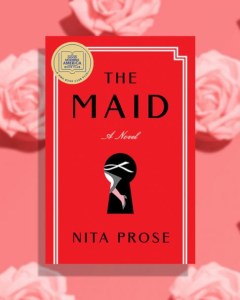
  • ‘The Maid’ by Nita Prose

    The Maid by Nita Prose is a one-of-kind, touchy-feely novel without collapsed grand narratives and vehement subjective rhetorics about existential vertigoes in life that burdens the reader with a duty to interpret the philosophical, the intellectual meaning of a story, all fragmented and adrift. Instead, the story uses the real to perfect the ideal delightfully blended with a taste of Murder She Wrote with relatively ordinary characters doing the most extraordinary things like you never know.

    The Maid is one lonely young Molly Gray. She is a Maid of Maids, taking her job religiously in a hotel that does not quite reciprocate her dedicated service but sees her as a quiet oddball because of her reclusive comportment. But Molly is a swan in a lake of ducklings and geese, a harpist among percussionists, whose feet constantly move beneath reality’s surface. Molly is anachronistically muliebral and incongruously proper. She belongs to a preceding era of decency, saying early Edwardian London as a chambermaid, a coveted position for working-class women. To judge Molly as a misfit is downright callous and heartless because she inwardly craves recognition from those she thinks of as sympathetic souls who use her as a pawn in their game of passion and avarice. The more we learn about Molly as the narrative deepens, the better we know of her as if we were contracted severe strains of Stockholm Syndrome. Hence, our better angels persuade us to forgive and forget the stupendousness of truth that Molly confides to us at the end of the story’s labyrinth.

    This fictional Maid by Nita Prose and that real-life Maid by Stephanie Land are stories about working-class women struggling with the realities of life by themselves. The only difference is that the former has a blessing of luck in the form of sympathetic and resourceful supporters who rescue her from a dungeon of hopelessness. It is understanding because, as Charlotte Brontë expressed, one of the reasons she wrote was to be a kind creator for her stories’ heroines otherwise to whom no sweet soft touch of warmth and love would caress their weeping heads. However, Molly, the Maid is not all melancholic, a damsel in distress, a clueless loner succumbing to a subtle form of gaslighting because she is the one who laughs the last laugh with intelligence wrapped in a maid’s hide. Molly Gray the Maid may have a woman’s body but has the king’s stomach and heart in the most magnanimous way. Therefore, don’t mess with Molly – and the likes.

  • ‘American Made: What happens to people when work disappears’ by Farah Stockman

    Howard Stern might not be everyone’s friend, but he’s got the point when he articulated in his radio show a decade ago that what was eating out this great nation was not racism but classicism. The recent unionization movements among service industry workers, such as Amazon and Starbucks, indicate that the demand for the dignity of workers supersedes ideological politics that discourage the growth of American esprit de corps. American Made is a story about this American class consciousness that will put together disintegrated tesserae of the collective national mosaic made by the people and events.

    The author follows the three principal workers of the now-defunct Rexnord Factory in Indiana: Wally, a black man whose diligence and amiability promoted him to a coveted position in the factory; Shannon, a single white woman with an abusive partner taking pride herself in being a wielder, a male-dominated position, and John whose fortitude and conscience never left him during his long, turbulent unemployment days. Sex and race don’t matter when it comes to losing their jobs, let alone loving them because the importance of what they do for a living and the need for their livelihood are their commonalities that build a sense of camaraderie. In fact, class solidarity can never be achieved if class consciousness is transcendent of racial prejudice to be achieved first. Unfortunately, the antebellum wealthy southern plantation owners systematically destroyed the poor white laborers’ wage systems by replacing their workforce with the free labor of African slaves, thus planting the seeds of racial hatred in the hearts of the poor whites. The vicious cycle of devious racialized economic caste system has since firmly constituted the American economic system ethos under “Separated but Equal.” The author sees the absurdities of American society as a result of the disintegrated labor movements primarily due to racial prejudices, which is why worker’s solidarity is a way forward to achieve national unity.

    Wally, Shannon, and John are not just working-class Americans. The author emphasizes differentiating her elite station characterized by expensive private higher education and intellectual “profession” from those with hardened coarse hands of workers in the factory. They are ordinary people, a majority of Americans making up this country, ubiquitous in the landscape of our daily life. They are expendable at the whims and caprice of profit-driven employers who see their employees as no more than living at-will automates. That is what happened to the Rexnord Factory, where workers’ lives were no less than collateral damage for a successful operational mission of the company.

    At times, the author positions herself as a conscientious liberal intellectual, paralleling her fortunate environment with her unfortunate subjects. Perhaps it’s an occupational hazard for being an NYT journalist. Nevertheless, the book succeeds in pointing out a lack of national cohesion resulting from the politicization of racial rhetorics into bipartisan ideology, which falls by the wayside of solidarity of labor movement overcoming institutionalized racial prejudices. Recently, I have read that the workers of Starbucks and Amazon in New York have voted to unionize. American Made is a story about them and us too because the dignity of work makes us who we are.

  • Nobody’s property

    My letter to the editor of BBC Wildlife was printed in this month’s issue. I wrote about my impression of an illegal primate trade in the UK featured on a previous issue, which reminded me of human slavery where lives were treated as expendable chattel.

    The story of TikTok tells the marmoset baby monkey who was rescued from a miserable life as a pet in a birdcage abandoned alone. It raised awareness of animal abuse in mental and physical forms as pets at the mercy of whims and caprice of the owners, who regard them as nothing more than live, expendable toys. TikTok was first bought for its exotic beauty and rarity in the illegal animal market, but the owner soon lost interest in the new pet, forsaking due care owed to him. When TikTok was finally rescued, he was in a state of fear and shock, so he was put together with another rescued older marmoset who cared for him like his son. Looking at the two photos, I thought of enslaved people who were sold off like commodities seen from Alex Haley’s heartrending saga of American black family “Roots.” In the story, humans are perceived and treated as nothing more than talking stock, and therefore the most basic unit of society in the form of family is unthinkable for slaves. Mothers and children are forcefully separated, let alone husbands and wives are for mating purposes only to multiply the population. Such comparison is not a stretch of the imagination but a sheer fact of association.

    We have come a long way to the progress of the mind regarding human rights and animal rights compared to the past, or we like to think it so. Perhaps it is our animal instinct to dominate what is perceived as controllable. That is why a force of civilization in the form of rules and law is essential to reining in our unruly and crude id in implementing reason as a way to prevent cruelty against lives. But such rationalism should always complement humanism lest we should act on the mechanism of the mind. And let us not forget that those who mistreat animals also do the same to their human brethren.