Tag: book

  • Caligula: A Life From Beginning to End by Hourly History

    Caligula: A Life From Beginning to EndCaligula: A Life From Beginning to End by Hourly History

    My rating: 5 of 5 stars

    For nearly two thousand years, Ancient Rome was a great arena of fearless political gladiators whose ambitious instincts to rule the world coincided with epochal shifts in demography and geopolitics in the regions it had conquered. No wonder the history of Ancient Rome is fraught with memorable figures whose names are immortalized in a variety of literary forms: Plays, Poems, Paintings, and Films depict the deeds and actions of these men of exceptional characters, one of whom is unforgettable Caligula as elegantly narrated in Caligula by Hourly History.

    Gaius Julius Caesar Augustus Germanicus was born in 12 A.D. The nickname “caligula” derived from caliga, meaning “little military boot” was attached to him as a term of endearment as Caligula accompanied his father Germanicus on the military campaign to Germania at the age of two attired in a full soldier’s uniform. In fact, Germanicus was a renowned Roman general whose valor was second to none and very popular among soldiers and citizenry. Perhaps it was this great popularity that caused his demise and the tragic end of his beloved family under the rule of Tiberius, the second emperor, the successor of the first emperor Caesar Augustus (which also indicates that Caligula was a distant nephew of Julius Caesar.) It was believed that Piso was responsible for the assassination of Germanicus out of jealousy and imprisonment of the family except Caligula who had managed to escape the arrest by fleeing to Tiberius in Capri when his mother Agrippina the Elder and his two elder brothers were horribly mistreated in prison and beaten to death. And it was this Tiberius who named the only living son of the popular Germanicus to be his successor – the third emperor.

    Thus Caligula’s rise to the throne of the emperor was the sine qua non of the tumulus aftermath as a result of his father’s death that rekindled the ember of political intrigues of the Senate and the Praetorian Guard. What’s more, the first six months of Caligula’s reign was regarded as quite innovative and auspicious. With a huge sum of money in the Roman Treasury, Caligula’s achievements included the following: 1) to reinstate the popular vote allowing all citizens to speak in the government process; (2) to make the ledgers of the use of treasury funds public; (3) to raise the salaries and provide bonuses to every branch of military; and (4) to recall all those who had been exiled under Tiberius.

    According to a popular theory, Caligula was struck with a serious mental illness eight months after his enthronement. Some say that Caligula suffered from a lifelong epilepsy as evidenced by his having never learnt to swim, whereas swimming was a popular form of exercise at the time. It was also this time when Gemellus, the young grandson of Tiberius who had supposed to co-rule with Caligula was executed under his order along with Caligula’s father-in-law and brother-in-law with his younger sisters being sent into exile. However, curiously enough, he saved his uncle Claudius, who had been afflicted with a serious illness that left him with a severe limp and partial deafness.

    Caligula’s stupendousness of eccentricity continued in building two large ships for personal use, one of which was a floating palace and erecting many monuments commemorating himself as well as theaters, temples, and entertainment complexes for his personal use at the expense of the treasury funds. Furthermore, by 40 AD Caligula proclaimed himself to be a god in attempt to dictate religious aspects into political policies by beginning to refer to himself as “Jupiter” in public documentation while still alive.

    However, the reign of Caligula’s pseudo-theocracy met its end when Cassius Chaerea, a member of the Praetorian Guard, and his accomplices faced Caligula during a public event held in honor of Augustus and stabbed the emperor until he fell to the ground and breathed no more. It was only three years and ten months that Caligula ruled the young empire and it was how it was ended.

    Caligula by Hourly History is a comparatively light read, written in plain English from insightful views on the notorious emperor Caligula based upon factual analysis and historical backgrounds that help the reader understand the cohesiveness of how Caligula rose to power in the turbulent time of political intricacies, which might have caused the young and impetuous emperor to be agitated and anxious evermore as his ambition to emulate the ruling style of Augustus and the popularity of his beloved father clashed with a harsh reality. Caligula’s acting upon instincts or “guts” did not work out for him because of his trauma as a result of the tragedy of his once beloved family in combination with his impulsive temperament that needed a wise guardian to tame it. If you have heard about Caligula but do not know much about him other than you have seen him in movies, which have a tendency to portray him as a downright madman indulging in every form of debauchery you can possibly imagine, this is the read you can enjoy in your spare time at one sitting.

  • The Mysterious British Isles by Charles River Editors

    The Mysterious British Isles: A Collection of Mysteries, Legends, and Unexplained Phenomena across Britain and IrelandThe Mysterious British Isles: A Collection of Mysteries, Legends, and Unexplained Phenomena across Britain and Ireland by Charles River Editors

    My rating: 4 of 5 stars

    Great Britain, which is composed of England, Scotland, and Wales, is arguably one of the ancient lands imbued with history and tradition, full of primeval sites, historical artifacts, unique landscapes where skyscrapers casting shadows over castles, and a people of equally unique heritage and culture. But most of all, to me England appears to be a gem of the Crown, the archetypal image of Great Britain because there is London that has existed for thousands of years. The Mysterious British Isles by Charles River Editors offers the reader an elegant history of London with interesting information on the city itself, including backgrounds of famous buildings, places, and on its equally fascinating inhabitants who lived and worked to make their ends meet before our time.

    London has been a cosmopolitan city for centuries, and it is a city of amalgamation of the ancient and the new with churches built atop pagan temples, ordinary commercial buildings grounded around medieval burial grounds, and so on. To illustrate, St. Paul’s was built upon an old temple to Diana, the Roman version of Greek goddess Artemis. Also, Westminster Abbey, dating back to the reign of William the Conqueror and the Norman Conquest, was originally located on the Isle of Thorney – supposedly the site of a Roman temple to Apollo, which was destroyed by an earthquake and then replaced with an Anglo/Saxon temple to Thor. It was in 610 A.D. that it finally made Christian by King of the East Saxons, who had converted to Christianity, in dedication to St. Peter.

    In addition to the aforesaid great churches, the ancient Roman time street named Hounds Ditch, still running through the City of London, was used as the old London’s dumping ground. But Hounds Ditch is not the only place of the disposed remaining to be seen today. There are quite a few modern buildings with part of their plots unused, bits of empty lands in crowded, expensive London with signs warning people to “Keep off the Grass.” In fact, they are old plague pits, mass graves used to place a myriad of infected corps during the period of great plagues in London.

    Since London has been the center of economic activities, many professions have been come and gone as a consequence of changes of social and economic systems. Some of the worthwhile professions to mention in memory of the people who worked in them for their livelihood are listed as follows:

    • Chimney Sweep: It was city law that people should keep their chimneys clean due to a fire hazard. So many poor boys aged between seven and eight started becoming climbing boys, serving the apprenticeship to master sweeps. Unsurprisingly, may of them died of suffocation, suffered from deformity, developed scrotum cancer as a result of residue of soot.
    • The Mudlark: It was a popular job for poor boys in the 18th and 19th centuries; many of them were orphans. They scored the banks of the Thames for items of value. When the tides were low, the mudlarks looked for items through the muddy banks and became easy targets for police harassments, one of which was to throw the boys to the river. So the mudlarks were also good swimmers.
    • The Tosher: After the Great Stink of 1858, a genius engineer named Joseph Bazalgette developed a citywide sewer system that is still in use. It was this great Victorian engineering feat that gave birth to this profession. Toshers were specialized in the sewer system for any valuables dropped out of the pockets of Londoners.
    • The Linkboy: Before the late 19th century, London night was as dark as Persian night without public lamps. Hence these linkboys whose parents were dead or were so impecunious that they had to allow their little child to roam London’s dark nights became the essential night guides with lanterns on poles to drunken citizens or travelers or theater-goers. Sometimes, linkboys were also employed to decoy to guide customers to brothels in addition to their tips.
    • Sandwich Men: As a rise of advertising due to prosperous cheap printing with growing disposable income in the early 19th century, shops and stores were eager to hire the city’s impecunious citizens however old or young to use them as mobile advertisement. These sandwich men worked with poor pay by standing out in the sun and rain for up to 12 hours with their front and back covered with boards held up by ropes over their shoulders. In fact, the term was originated by Charles Dickens’s description of such man as a “piece of human flesh sandwiched between two slices of pasteboard. Sandwich men survived the centuries despite several attempts to ban the profession. Although the Westminster City Council prohibited the presence of sandwich men in 2008 in effort to upgrade the city’s shopping ambience in West End, the other boroughs of London have not yet perished sandwich men.

    The Mysterious British Isles by Charles River Editors encapsulates some of the most interesting facts of Great Britain, such as the aforesaid history of London and facts of its inhabitants. It also covers subjects such as famous criminals, fairies and giants, and legends of historic places throughout the Isles. It is worthwhile to read this book as a concise but essential reference book on Great Britain either to satisfy your curiosity for the country where the Sun never set on in the past or to occupy yourself with something at once entertaining and informative during your lunchtime, coffee break, or before going to bed.

  • Sleeping Imaginations

    shep
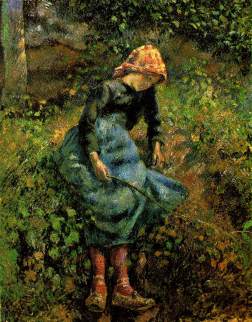
    The Shepherdess
    1881
    by Camille Pissarro

    I am awake – I know I dream not,
    Making every image in seeing real
    The fancy of the mind I know for aught,
    Riding on a train of thoughts by a mile.

    When I dream – I think myself awake,
    Seeing things in fantasy of the obscured mind
    Buried in the vales of decaying senses at stake,
    Gliding on a Flying Carpet overlooking the world.

    For my dreams are impertinent when unguided
    By the consciousness of reality – Law of Reason –
    Pulling the reins of Rational Truth in on the mystified,
    Hunting out the causes of the Revolt against Reason.


    P.S: I wrote this poem upon reading “You and Your Dream” by Thomas Hobbes (1588-1679) in which the philosopher assessed the nature of /evidence of supernatural sights and other related matters. So in a way, this is  my review on his essay, which I thought would be interpreted better in poetry based on its subject matter and the impressions it evoked.  

  • The Brilliant Legacy of the Mycenaeans: Ancient Greece’s First Advanced Civilization

    The Mycenaeans: The History and Culture of Ancient Greece's First Advanced CivilizationThe Mycenaeans: The History and Culture of Ancient Greece’s First Advanced Civilization by Charles River Editors

    My rating: 5 of 5 stars

    Before Homer wrote about the fearless warriors and extraordinary heroes enshrined in the temples of the Olympians in Iliad and The Odysseys, there were a people of invincible spirits and adventurism on a par with those of the characters – The Mycenaean, the torch-bearers of a great Aegean civilization in the Pre-Classical Greece existing from 2000 to 1200 BC, whose bravery and enterprising minds inspired Homer to pay tribute to them as immortalized in the two great Classical epics in the history of western civilization. Accordingly, The Mycenaeans: The History and Culture of Ancient Greece’s First Civilization by Charles River Editors takes us to look back on the Mycenaean culture in the Pre-Classical era when these ancient ethnic Greeks ruled the Aegean Sea as the maritime power and left their indelible marks on the posterity of the Classical Greek culture.

    The Mycenaeans, the first Greeks, were never unified under a central state and were a collection of several kingdoms. Influenced by the earlier Minoan civilization (2000-1450 BC) at Knossos, Crete, the Mycenaean adapted the Minoan art and religious practices and developed them to their highest expectation of militaristic and cultural ideology. For example, the Mycenaeans developed Linear B Script, which was the writing system comprising hieroglyphics, used between 1450 and 1100 BC especially in Knossos and Pylos, the corporate headquarters of the Late Bronze Mycenae. The letters were mostly written in clay tablets largely concerned with documenting economic transactions of the palace administration and various business transactions. In fact, the Linear B Script, preserved as the oldest Greek writing system, indicates that the Mycenaeans were the linguistic and ethnic ancestors of the Classical Greeks.

    In addition to transcribing economic activities Linear B Script also lets us glimpse into the belief system of the Mycenaeans with the names of the deities they worshiped, such as the head of the Pantheon and Poseidon, the god o f the seas whom the Mycenaeans paid special due respect for their being sea-faring people. The Mycenaean reverence for Poseidon is worth noting because it betokens the importance of the Mycenaean as the maritime power of the Aegean Sea as well as the most of the Mediterranean Sea. They eclipsed the Minoans and their Aegean neighbors in terms of open sea trade by establishing trade routes with the islands of Sardinia and Sicily as well as the Libyan coastline and importing more goods than exporting, such as grain from Egypt and metal from Cyprus and Anatolia to make weapons.

    With respect to artistic and cultural historiography of the Mycenaeans, the art of burial practices entailed the Minoan influence assimilated into the Mycenaean of their own accord, which was akin to the fashion of Hellenism, the spread of the Greek culture through enculturation by Alexander the Great centuries later. Likewise, after then conquest of Crete, the Mycenaeans continued to employ many of the Minoan artistic traditions one of which was burial practices and their beliefs in afterlife as expressed in the Hagia Triada Sarcophagus on the island of Crete. Made in a Minoan style under the rule of Mycenaeans, it depicts scenes of funereal game held in honor of a fallen warriors and dead kings, consisting of the following athletic events as part of the ritual:

    • Chariot Race – Popularized by the Hittite and the Egyptian as a symbol of power and prestige; powered by 2 to 4 horses carrying a team of 2 to 3 men. The Hittite had 3 men – a driver, a shield bearer, and a warrior- while the Egyptian simply had 2 men – a driver and a shield bearer. The Mycenaeans would most likely to have either of the styles, though not manifested.
    • Armed Combat – conflated with the Hittite sport
    • Boxing – popularized by the Minoan and developed by the Mycenaean

    In fact, the actuality of the aforesaid athletic sport events is alluded in Homer’s Iliad, suggesting a Bronze Age tradition of funerary games in Greece with vivid descriptions of the games to honor the slain Greek warrior named Patroclus, which were all coordinated by Achilles. However, contrary to the nude events of the Classical Greece Olympics, which were the offspring of the Mycenaean funereal games, the competitors in the funereal sport events wore loincloths called “zoma.”

    The demise of the Mycenaean Kingdom resulted from several factors one by one in a period of times, including the invasion of the Sea Peoples and the emerging of the Dorian in the north, all of which represented the end of the Mycenaean Age, coinciding with the collapse of the Bronze Age in the ancient Near East, where the Mycenaeans played an important role as a formidable trade partner with the Egyptian. Notwithstanding the fall of the Mycenaeans as the major sea power in the ancient Bronze Age, the brilliant legacy of the Mycenaean culture still thrives in; (1) the form of Linear B Script, the oldest writing system of the Greek language before the adoption of the Phoenician alphabet system many centuries later; (2) the belief system in which Zeus and Poseidon were first recorded in the writing tablets and revered with due respect; and (3) the initiation of  the sparks of the organized athletic events developed into the Olympic Games in posterity. It is this ingenuity imbued with the spirit of adventure and the policy of engagement in adopting cultural traditions of other people that exemplified themselves among other Pre-Classical peoples, which is something we in the modern time should adopt as well, so that our posterity can benefit from what their ancestors learned and experienced, for it also becomes our legacy of heritage and culture to pass it down from generation to generation.

    저장

  • For Love of Fate: Book review on Man’s Search for Meaning by Viktor E. Frankl

    Man's Search for MeaningMan’s Search for Meaning by Viktor E. Frankl

    My rating: 4 of 5 stars

    Many books are to be tasted or swallowed, whereas certain books are to be chewed and digested for the nourishment of our minds and souls, such as Man’s Search for Meaning by Viktor E. Frankl, the founder of Logotheraphy, the third Viennese School of Psychoanalysis, along with Freudian psychoanalysis and Adler’s individual psychology, that deserves of its recognition of being one of the books of our time for its content as well as its origin. This book is not of survival literature of the Holocaust but of a memoir of a courageous human soul that did not succumb to despondency. It is less about what he suffered and lost as a prisoner at four concentration camps during World War II than it is about the sources of his intention to live through it, attesting to the words of Nietzsche: “He who has a why to live for can bear almost any how.”

    Man’s Search for Meaning is a fruit of Frankl’s resilient soul ever resisting the existential horrors of situations that life could afford; whenever the miserable conditions of the camp suppressed the spirit, Frankl diverted such negative energy to reconstructing the manuscript which he had lost in the disinfection chamber of Auschwitz and scribbling the key words in shorthand on tiny scraps of paper. In fact, it was a way of intensifying his inner life full of intellectual resources and spiritual freedom to which he could retreat from his terrible surroundings by forcing his thoughts to turn to another subject, which made him enable to rise above the situation, above the sufferings of the moment.

    In addition to the willful act of deluding anxiety and negative feelings, Frankl ensures us that a sense of humor is another of the soul’s weapon in the fight for self-preservation and can afford an aloofness and an ability to transcend any situation, for developing a sense of humor and seeing things in humorous light is a kind of trick learned while mastering “the art of living.” That is, by laughing about any sordid or callous situation, we ease our mental distress and are able to take on a different stance on the situation in a less negative way that is essentially not overwhelmingly stressful or unbearable. After all, humans are the only biological organism that can laugh, and thus this sense of humor is our prerogative as human.

    It is also interesting to learn that the prisoners who did their utmost best to look good even in the sordid surrounding survived the dreadful experience because they looked “fit” for survival. This act of grooming links to will to meaning – that is, a will to live- that has physiological bases of psychic energy which rejuvenates the body and the spirit to see a why to live. On the other hand, there was a young inmate in the camp whose sudden loss of hope and courage to live affected his already typhus-stricken body so adversely that such mental condition lowered the man’s temperature and resistance against typhus, which ultimately caused his premature death. This episode shows us that what we believe becomes our truth and thus can alter our reality with another one, a virtual reality as a product of psychosomatic effect, which also links to the three sources for meaning of life as follows:

    Creative Value – Doing something meaningful, such as Frankl’s scribbling the manuscript
    Experiential Value – Appreciating beauty of the Arts or love, such as his thinking of his wife in another camp whenever he was on the verge of falling into an emotional distress; and
    Attitudinal Value – Triumphing over biological, social, and cultural inhibitions during difficult times, such as Frankl’s endless efforts to divert his thought to another object of lofty value. It is this value that gives to our sufferings meaning by the way in which we respond to.

    Man’s Search for Meaning by Viktor E. Frankl testifies to Nietzsche’s dictum as aforesaid that suffering can grow out of existential frustration in the sense that there is a point to sufferings, that there is a hidden meaning in the guise of suffering, as there is only one right answer to the problem posed by the situation at hand. The essence of existence, which is search for meaning of life, underlies our awareness of a possibility against the background of reality – that is, what we can do about our given situations, not depending on the happenstances. Our emotions, which are interpreted as suffering, cease to be suffering as soon as we form a clear and precise picture of it by applying the three sources for meaning of life. Viewed in this light, this book is a veritable guide to how to overcome the struggles of our lives and achieve demands imposed upon our daily tasks however insurmountable they seem, which gains utmost credibility against the backgrounds of his own anguish in Auschwitz.


  • Bluebird Interview

    photo

    She was born when Saturn and Uranus were housed in the Aquarius. That says pretty much about her. The Aquarian are known for their independent spirits, compassionate and caring nature, and unquenchable wants of knowledge, all enveloped in mysterious estrangement even among the crowds. Yet, Stephanie, the writer and the editor of her two-year old Web log, “The Stylus,” (formally known as “Offbeat) is generally quite approachable and genial although she is never too loquacious at a first meeting. In fact, you might find her quite interesting to talk to, especially when you strike up a conversation with her about books written by classical writers or about history, dogs, or cultures. And if any of these appertains to one of her writings published on her digital log, “The Stylus,” you will see her soul being elevated to the ether with her eyes sparkling like stars on the Persian night sky. On Monday morning at a cozy cafe in Avonlea, Bluebird had the pleasure sitting down  with a cup of warm hazelnut coffee to talk with her about her blog, from the inception, the purpose, and the future thereof.

    BD: Hi, Stephanie. As Oscar Wilde has said that a woman who would reveal her age would tell anything about her, I won’t ask you how old you are because I suspect that you will not anyhow.

    Stephanie: I appreciate your judiciousness. (Smile) And yes, you are right in saying that I won’t tell you my age. (Smile) But I am neither teen-aged nor maturely aged, single, like one of those 10 vestals in the ancient Roman Empire. (Smile)

    BD: Okay, then let’s start talk about your Web log. What was the idea behind the creation of this log of yours? Did it occur to you all of sudden that you wanted to have yours like everyone else?

    Stephanie: Well, I first started thinking about having my writing log about 2 years ago. I had always wanted to write things about what I liked and to convey it in written letters because I think writing revels one’s soul in his/her genuine self without worrying about the physical appearance and how to present the self externally in public. In that regard, writing is non-discriminating of all social and biological differences. And I always thought that in people’s writings I could see the intelligence and nature of the writers because people would tell about their innermost feelings by means of writing rather than by speaking, which I think, sometimes seems a bit pompous and artful.

    BD: So, is this why you came to create your blog to write about what you think and feel that cannot be shared by speaking in public?

    phoo

    Stephanie: Partly so. And partly it’s because writing seems easier to communicate than speaking, which requires of me instantaneous faculty with dialogue that necessitates breaking from shyness. You see, English is not my mother tongue. Being a native Korean, the language differences between the two languages are as wide and deep as the Pacific Ocean: The English belongs to the Indo-European lingual family, while the Korean to the Ural-Altai to which the Japanese, the Turkish, the Finnish, and the Hungarian also belong. The syntax and the grammar are of course very different. So, it will be much different from, say, someone from any Western European country speaking and writing English because Western European languages belong to the same family as the English. Nevertheless, I want to break from such syntactical, grammatical, and literary inhibitions to craft the art of writing, just as Jack Kerouac felt the same about it.

    BD: That’s a sublime motivation to create your blog. Then how about the name of your blog? It has recently gone through some changes…

    Stephanie: Yes, indeed. But for the good reasons. First, it was started as “Offbeat” because one of the teachers at the language school I currently work at told me that my blog seemed to carry this offbeat vibes, a sort of New York feel, the independence, the avant-garde spirit that knew no boundary of subject matters of writing. So I thought it was a cool name for my blog and kept it until the last week. But suddenly I came to think that it needed name changing just for a change of scenery; you know the kind of moment when you want to reinvent your image with a new haircut.

    BD: Okay, Stephanie. By the way, what are your readers like? Do you have many followers?

    WK-AK224_BOOKS2_20071011174112

    Stephanie: To be honest with you, I am more concerned about the qualitative likes I get for what I write from fellow bloggers who also love writing and publish qualitative posts by which I mean the writings, such as musings, creative stories, poems, and/or book reviews. The reason I say this is that recently there has been someone who creates several unsolicited blogs that only contain commercial stuff, copied works of others, or nothing just to get to my blog. And I tell you that I only appreciate the likes from those qualitative bloggers. And I also tell you that I don’t appreciate those of illegitimate ones’ likes. How do I know they are illegitimate? Well, can you like my writing as soon as I publish? That means that person does not bother to read my writing, which I take it as an offense.

    BD: Who is that one plaguing your blog with empty likes? Have you done something about it?

    Stephanie: First, that one appeared in my spam comment section. He said he liked my blog and asked for some advice of writing. I think I was too naive to even reply to him, thinking that he was going to have his meaningful blog filled with writings, but no… I should have never done that…. This is my character flaw; that I bring trouble and pain on myself through pity and compassion… In that respect, I sympathize with Katherine Cookson, who said the same thing in her memoir Before I go, about which I have also written.

    BD: You must be really frustrated with that person… Sorry to hear that.

    betty beaver

    Stephanie: I even contacted an engineer at wordpress. about this issue in effort of stopping him from visiting my blog, but was told that because it’s in a public domain, there’s no way I could do that… And you know it’s really disheartening to see it happening in my blog because it is a sheer form of sabotage to my blog because my blog is not an object of popularity… Although my current followers are 52, what I care about is my works being duly appreciated by fellow writers, amateur or professional. Nevertheless, I don’t want to canvass for liking my writings. It’s just not me. But if you like any of my writings in terms of the contents regardless of any grammatical errors, that makes me feel fulfilled. And any comment is always welcome.

    Don’t be shy to comment on any of my posts because I am a human being, too! (Smile)

    BD: Stephanie, I understand how you care about your blog and your love of writing in this interview. Any word to your readers?

    Stephanie: I just want my readers to know that I write because I like to portray what I feel about things in my heart in poetry and what I think about books I read in my mind in belief that taste and reason is universal in all human creatures regarding principles of judgment and of sentiment common to all mankind, as Edmund Burke averred in his essay On Taste. So Many Thanks to You, Dear Readers with My Whole Heart.

    BD: Thank you, Stephanie. I hope your writings will have a wide range of loyal noble readership.

    Stephanie: Thanks! Have a lovely day!

    img-thing

    저장

    저장