Tag: books

  • Teresa of Avila – book review

    Teresa of Avila: A Life from Beginning to End by Hourly History

    My rating: 4 of 5 stars

    Her epithet is deservedly illustrious, equal to her protean capacities for being multifarious: saint, mystic, and artist’s muse who was a curious kind of practical mystic with vision to match – that she would talk and hear God’s words from within and share them with the crowd in practice of charity, faith, and hope but never without heart. Protestant Elizabeth I of Great Britain might have envisioned the image of a Catholic nun of Spain a night before her Tilbury address that she had a woman’s body but had the bravery of a king. She is also the Doctor of the Church. She is Saint Teresa of Avila, the headstrong founder of the Carmelite Discalced and the woman of Lorenzo Bernini’s Ecstasy of Saint Teresa.


    My first encounter with this remarkable woman was not religious but academic; while researching women’s monasticism in the high medieval age during my college. Teresa saw many women who were too poor to pay dowry and didn’t want conjugal life found convents as shelters from social conventions without certain religious convictions. Consequently, convents became gossipy sonority houses populated with lackluster and jealous nuns backstabbing one another. The sad atmosphere of the convents used as a mere social institution propelled Teresa to establish the Carmelite Discalced – the Convent of Saint Joseph – with physical labor and disciplined monastic rules not without tenderness attended to individual nuns from all walks of life. She abolished land ownership and rent collections of and by nuns and instituted self-sufficiency of working without shoe but sandals, hence the name “Discalced.” The reformation within the Church was seismic but was a necessary medicinal receipt for the ailing monastic community.

    What is most brilliant about Teresa was to create the idea of “The Interior Castle,” a philosophy that the creator of the Universe dwells inside the castle of our souls. That God is from within us, rather than the beyond betokens the idea of personal God with whom we can communicate and thus become a literal mirror image of him for what’s best in ourselves. In fact, this revolutionary philosophy is also linked to Giordano Bruno’s “The Memory Palace,” from which the knowledge needs to be unlocked to bestow upon us the power and joy of the knowledge from within. Further, it is related to the idea of the Nine Muses, whose inspirations are invoked from our minds, not from the Olympus or oracles. All of the mentioned above shares one origin in the cognitive technique employed in Christian meditation developed from the essential reading and contemplating the Bible. But Teresa’s Interior Castle is a beautiful poetic license to enrich power that is never esoterically prideful but blissfully joyful. Where Bruno’s Memory Palace and the Artist’s Nine Muses are not all-inclusive, Teresa’s Interior Castle is universal with tender charity and faith even if it is not necessarily Christian God.

    Teresa of Avila was one brave and adventurous woman who was a prototype of feminist in the sense that she voiced out her mind to the patriarchal church authority in danger of being suspicious of heresy or witchcraft even in Catholic Spain, known for the Spanish Inquisition. But she was not a vociferous activist for abolishing the Church or would-be founder of an offshoot of the Church. Teresa was religious of the supreme kind. However, she never abandoned her femininity latticed with passion for helping a young priest in his spiritual crisis in war with physical temptation, tenderness for attending those in need of her consolation, and beauty that was both beautiful externally and internally. She shows us that a strong woman doesn’t need to shout out invective expletives or clamor for the reward for her damages in the name of womanhood when it is really for her sworn revenge. Aside from sectarian religious affiliations, Teresa of Avila deserves her reputation as a star in the Milky Way of the Great.


    View all my reviews
  • The Girl Without Hands

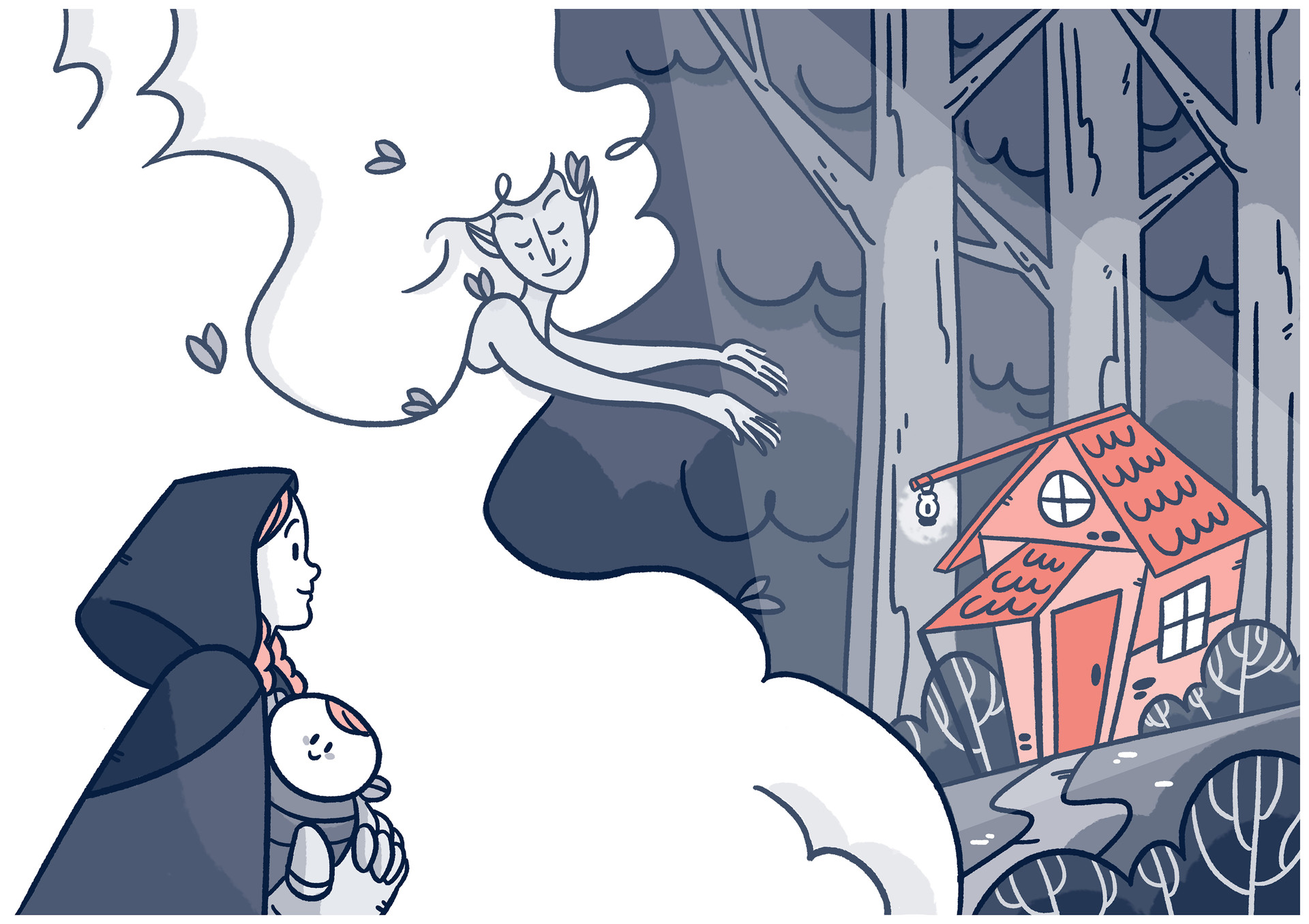
    The devil came upon a poor miller
    In exchange for wealth with luster
    And wanted his daughter’s hands
    Though it pained her in blood and tears.

    Now the girl without hands wandered off
    Day and night with her tears washing off
    The pain she suffered from the promise
    Her father made with the devil for riches.

    The girl without hands came upon a garden
    Where Tree of Fruits of Grace seemed to beckon
    with the susurrus of leaves coaxing her
    And she saw a besotted king approaching her.

    The girl without hands became a queen
    But the devil returned with a scheme
    To kill her and her son for their pure souls
    As bounty for his region against angels.

    The girl without hands fled with her son
    Deep into a forest where seven years began
    Until the king found them in Angel’s Hut
    And the girl with no hands was no more.

  • today’s world in my view – news from norway

    Politics comes in gray gravitas, and politicians look like seasoned actors with Tears for Fears singing in a mighty chorus of “Everybody Wants to Rule the World.” Simply saying, a majority of elected officials are charmless. But at least not Norway’s winning Labor Party leader Jonas Gahr Stoere about whom I read from a newspaper this morning because his background and perspectives feel like, as it were, a fresh cool mint breath out of stuffy, dull air.

    In the last two decades, the world has turned conservative and jingoistic in many countries due to economic and social changes. The liberals seem to clamor for ideological agendas that do not gain universal support without a structural plan concerning livelihood from healthcare to job security and social security benefits. For example, in the States, it’s all about ideology politics, not constructive reformations that attempt to narrow a wide gap of class stratification. In addition, American liberals are not closer to European liberals any more than the fashionably favorable appellation for free-thinking politicians. That said, Stoere, despite his being mega-rich with old money, has a clear vision for the universal welfare of Norwegians without antagonizing people of different classes. Stoere saw the vast difference of living qualities between the rich and the poor in France during his study at Science Po in Paris in the 80s and vowed to prevent it from existing in Norway. He also reassures that only the top 20 percent of the high-income individuals will see their taxes increased. Contrary to the vehement subjective political agendas vilifying the other with scarlet letters as an enemy of people prevalent in the States and elsewhere in the world, Stoere includes all strata with an ideal vision to match his practical campaign to distribute wealth among people evenly.

    Stoere is indeed undeniably rich himself with the wealth that will support at least three generations of his family. It is also true that not many politicians pinpoint another country’s quirks and make an example out of it for the betterment of their countries. Social reformation of narrowing a wide wealth gap has been a duty of politicians since the age of reason. Still, it never comes to realize without determination and intention to make it happen. As a cosmopolitan citizen of the world, I vote for Store for being refreshingly innovative and nobly aspirational.

  • St Francis and the Wolf of Gubbio

    I have recently read an article about how the prosperous presence of wolves reduces the number of deer road-kills because their very predatory sense intimidates their prey, one of which is the deer. Fewer traffic collisions mean fewer government funds to spend on the aftermath of car and traffic accidents from animal crossings. So far, so good. But what about the resolution about protecting livestock from wolves, which has become an economic issue disturbing the farming community? So here are my small suggestions that I deem mutually benefitting people and wildlife by virtue of Charity, Faith, and Hope.

    The article continues to support recolonization that the reduction of traffic collisions resulted in economic gains, which outweighed the costs of livestock losses by nearby cattle ranchers whose livelihood feels threatened by their lupine marauders. I remember reading newspaper articles and tweets about ranchers in Washington that the multiplication of wolf population engendered their livelihood and that clamoring for lupine rights outright disregarded human rights to make a living. When I commiserate with the woes of the ranchers at the same time, and also hope best for the great grey wolves, my mind’s eyes see the visceral images of the Maasai in Tanzania and African lions living in co-habitation. The Maasai find the most cost-effective and nature-friendly way of guarding their livestock against the lions by establishing chain-like fencing supported by the thorny African myrrh trees. I am sure the American contemporary can take cues from the Maasai and adapt them to their environment.

    I like wolves for their commendable fidelity to spouses and respectful sense of a society that emits from their majestic composure. I also admire the fortitude of cattle ranchers who are vigilant of the livestock their families subsist. Both beasts and men have reasons to live for and kill for. Yet, there should/must be a way of satisfying the needs without losses. Indeed, the medieval Italians knew exactly about the problem, but no more understanding and effectively than St. Francis of Assisi in meeting with the Wolf of Gubbio. Francis admonished him for his terror of fear over the people and made a pact with him publicly at a popular marketplace that if he ceased his predations, people would feed him from their very doors. The Wolf put his paw in Francis’ hand as a gesture of agreement, a sort of beastly hand-shaking. Can I make a wish for the miracle once again in my time? I believe I can, if they or we want to, for sometimes we as part body and part spirit can do beautiful things together.

  • Braveheart

    Beneath a new visiting sun
    Sees a woman through tears,
    Sorrow of the heart she feels
    As it deepens into a sea of pain.

    Beside her an ailing old woman
    Lies in natural amnesia for woes
    She wishes to send away in vain
    When a life’s grip is relentless.

    Fear crowded, tension soaring
    Zealots of God clad in weapons,
    Fierce eyes searching for victims
    Outside is the terror reigning.

    Demands of life, duties of care
    A caryatid bears on her head,
    She faces the faces of terror
    With a brave heart for the fate.

    Author’s Note: Yesterday, I wrote about my essay on the current situation of Taliban-seized Kabul in Afghanistan but still could not take it off my head because I felt for their fear for unknown futures. An article of the day from Reuters was about the ordinary Afghans who had to make livelihood even against a possibility of danger that lurks around everywhere where thousands of people are attempting to escape from the new Taliban regime, often futilely. Therefore, this little poem, albeit insignificant willy-nilly, is my small tribute to the brave ordinary people on the frontline with life in Afghanistan who are just like you and me. The heroine of this woman is another Me in Afghanistan who shares a similar life story.

  • All for the best: a tale of ‘Candide,’ by Voltaire – book review

    Candide by Voltaire

    My rating: 5 of 5 stars

    Candide is a touchy-feely whimsical story about the absurdities of optimism against realism in a delightfully witty guise of romantic adventure fiction. An entertaining satire that is both intelligent and humorous at best, it is a collective coming-of-age story of a man whose anfractuous life passages enlighten him of the reality of life and the world.

    As the novella’s title betokens, the protagonist Candide grows from a naïve young man sheltered in the Edenic castle of privilege and prestige in the protégé of philosopher Pangloss. Pangloss indoctrinates in Candide Leibnizian optimism, which posits that all is best for the best of all possible worlds. Candide’s expulsion from the castle because he was fascinated with his uncle’s beautiful daughter Cunegonde marks his journey toward the truth to the purpose of his suffering and what it means in life. Doctor Pangloss, a parody of collective complacent philosophers, keeps telling him that it is God’s will and that his life change is a manifestation of immanence, an intellectual belief in God’s presence in the world concreted by Spinoza. He preaches a pre-established harmony in the world because it is already the best in its most perfect form. Pangloss is an abstract philosophy and institutional religion incarnate in his glorious scholastic appellation and unyielding intellectual pride that refuses to recognize truth.

    The adventure of Candide is similar to that of Gulliver in his travels to unknown worlds in Jonathan Swift’s Gulliver’s Travels. Gulliver is a ship’s surgeon full of ideals shaped by established a priori schools of thought until he encounters wondrous creatures in mysterious lands, all exhibiting the best and worst human characters manifested in their appearances. Swift wrote Gulliver’s Travels to criticize the ills of society’s need for reformation as one of England’s leading literary figures with social consciousness. Swift was also one of whom lent a kind hand to Voltaire when he stayed in England to avoid the growing fury of France’s church authority. Volatile Voltaire was known for capricious terms with his literary peers, but his admiration of Swift’s work and him as a brilliant satirist remained loyal. Voltaire’s Candide is more straightforward and realistic, sans mysteriously curious creatures of a wide arc of imagination. However, both Candide and Gulliver share the same thematic elements of parodying the hypocrisies of religious doctrines, and human nature laid bare in the style of chivalric adventure fiction.

    The story is a carnival of characters united by deceptive fallacies, chased by untenable ideals, tangled by insatiable desires, obstructed by variants of life, and succumbed to deceptive pleasures. Nonetheless, one can’t weigh the misfortunes of humans and set a just estimate on their sorrows just as Pangloss deigns to aver, for humanity is imperfect in the imperfect world. Therefore we must strive to make it better for the common good of society as best as we can. Voltaire dreams of a new community with callous palms of laborers conversant with more delicate tissues of resilience, self-respect, and heroism in real life, whose touch thrills the spirit in the most exhilarating way than the idle hands of thinkers and priests. By writing Candide, he creates a society of people who sailed through the vicissitudes of life in the triumph of epistemological a posteriori truth over ontological a priori precepts.

    Candide is surprisingly easy to read and wastes no time for boredom. Voltaire himself was a man of no-nonsense whose simple but effective use of words is reminiscent of Hemingway and Stephen Crane, who were titans of literary realism. John Milton’s metaphysical poem Paradise Lost rang hallow in its abstruse display of classical knowledge. Homer and Dante lost their luster in the words that people did not use any longer. An authentic intellectual lives among people and puts his learning into action for the good of people. Candide is an excellent company to console your weary spirit and sorrowful heart if you are tired of eternal optimism and forceful positive thinking that has become a still fashionable mass mantra.


    View all my reviews