
The world is a battlefield, and you are at war
On the frontline against the forces of despair;
Life is a bivouac, wandering, searching always
With the star above you following all ways;
So keep hopes with a heart even for your fate.
The world is a battlefield, and you are at war
On the frontline against the forces of despair;
Life is a bivouac, wandering, searching always
With the star above you following all ways;
So keep hopes with a heart even for your fate.

Voltaire: A Life from Beginning to End by Hourly History
My rating: 5 of 5 stars
The role of intellectuals is to see the corrupt at the heart of society and stand furious with the mass and constantly monitor the conditions of ill-effects and actively work on the improvement of living conditions. For books can never teach the use of books. Otherwise, they are no more than armchair academics complacent with their impressive scholastic achievements and high social esteem as elites of society, proudly distanced themselves from the general. But Voltaire wasn’t, nor was he a demagogic writer grandstanding with the ire of the have-nots.
Born as Francois-Marie Arouet on November 21, 1694, when the discovery of the New World and religious turmoil swept Europe, Voltaire was destined to become a cavalier of new thoughts, the Enlightenment of Thoughts, which the Catholic Church regarded as a dangerous school of ideas to the mass. Yet, Voltaire wasn’t hell-bent on destroying the Catholic Church as a freemason but pilloried the corruption of the ecclesiastical members and the duplicities of their teachings and acts in practice. Religion is also a social institution made and governed by people and therefore subject to corruption and dysfunction. Before the French Revolution, the Catholic Church controlled people’s ways of thinking and exerted its authority over political and cultural spheres. That was why Voltaire’s lifelong resistance against the Catholic Church arose, not from blindly malicious intention to sabotage belief of the religion.
Voltaire was very human with his volatile temper but also with passionate munificence. He was fluent in English and his years of stay in England, the country he regarded as a model country of liberty of thoughts and religions. During his visit, he met John Locke, Jonathan Swift, and Alexander Pope, to whom Voltaire was said to be very rude for reasons clandestine. Methinks that for a person as at once passionate and sensitive as Voltaire, the anecdotal vignette sounds true, but who can blame him for his temper and let it eclipse his wholesale brilliance as an unbridled thinker and writer unafraid of speaking against the social injustice against the unprivileged? Rousseau, a fellow freethinker, abandoned his child at an orphanage and berated the illiterate. Isaac Newton, whom Voltaire respected for his scientific findings and logical mind, mistreated his servants with whacks and beatings. But, on the contrary, Voltaire paid off all the tax debts of his tenants on his properties. Also, he published ‘Candide,’ which is an allegorical book about the absurdities of the teachings of the Church and a man’s search for a God in this world, in 1759 at a meager price accessible to poor readers yearning for a taste of Enlightenment.
The absence of God’s presence in the deeds of the clergy and religious people and the presence of injustice in the name of elusive God were the questions Voltaire had in mind, and yet he wasn’t blasphemous about the God they believed. On the contrary, Voltaire’s belief was ecumenical in the principle of syncretism founded on a universal belief system according to Natural Law, a conscience. He was liberal in ideas but responsible in acts by accommodating his knowledge to practice for ordinary life. Samuel Johnson’s definition of an imperiously sullen scholar who loses his days in unsocial silence and lives in the crowd of life without a companion was the opposite of Voltaire. Indeed, Voltaire had no morals, yet he was a very moral person for sure.
View all my reviews

Come with a cheer or come with a call,
Come with a dream or not at all;
Up the rainbows and down the valleys
Good will prevails, hope sparkles;
Humor is a jolly good friend as always,
The joy of the world your spirit finds;
Your smile shines through the gray sky,
The soul flits on the avenues of ecstasy.
Republic of heaven is here, come what may.

I remember the first time I saw Renoir’s painting, “Girls at the Piano,” hung on a restaurant wall when I was a first-grader in elementary school. I loved the vibrant warmth of the colors and the softness of the girls’ expressions. Since then, Pierre-Auguste Renoir (1841-1919) has become one of my favorite painters. Given that preference, my reading of this book about the master was long overdue. Still, I am pleased to learn that Renoir was what I had imagined him to be – a creator of art whose eyes are set on the stars and foot grounded on earth.
Renoir was a master of the French Impressionism troika led by Claude Monet and Camille Pissarro, pioneering a new painting style as the epoch needed a new cultural ethos for the upcoming new century. Although the masters of French Impressionism were on the same musical note, their timbres were various. While Monet and Pissarro were idiosyncratic and liberal in techniques and subject figures of their artistic creations, Renoir was a conservative in keeping a tradition of Paul Rubens in his celebration of feminine beauty surrounded by the realism of nature and life.
A pursuer of the natural and ideal beauty existing in the physical world, not the spheres of the heavens, Renoir used the ideal to perfect the real, adapting traditional techniques to his visions of the worlds conjured in his mind’s eye. Renoir’s fascination with sensuous beauty in the expression of vivid but soft hues of vibrant colors and rounded, smooth figures of models in his paintings show his unintentional application of Aristotelian aesthetic theory: beauty inherent in itself and beauty by its use. Renoir’s paintings are replete with the beautiful colors, the warmth of the ambiance, pleasantness of the moment, and equilibrium of the backgrounds, all the mastery of using the ordinary with a profound sense to elevate it to art, giving art its true meaning. That might be a reason why German composer Richard Wagner, the creator of “Nibelungen’s Ring,” chose Renoir among other famous painters of the time to produce his portraiture. Or perhaps it was why Americans first found Renoir’s paintings so appealing that the goring sales in America brought Renoir fame and wealth.
After reading this elegant biography of Renoir, I liked him even more because he was an artist who had an artistic vein of genius and a practical sense of responsibility. He was a devoted father who even took care of his illegitimate daughter from his first girlfriend before marrying his model wife Aline Chariot, from whom he kept it a secret for life. Renoir might have had preconceptions about specific beliefs and people, but who would not have them secretly hidden in their mind’s closet? I believe that art serves its purpose when it gives the beholder a delightful sensation, not a dangerous illusion of distorted reality drawn from an artist’s disillusioned mind. Now I have a replica of Renoir’s “Two Girls at the Piano” from Amazon posted on my bedroom wall. It still has the first impression of the painting that has stayed in my heart with delightful nostalgia, enveloping me in the longing for the bidding the time’s return, which only Renoir could do the magic.
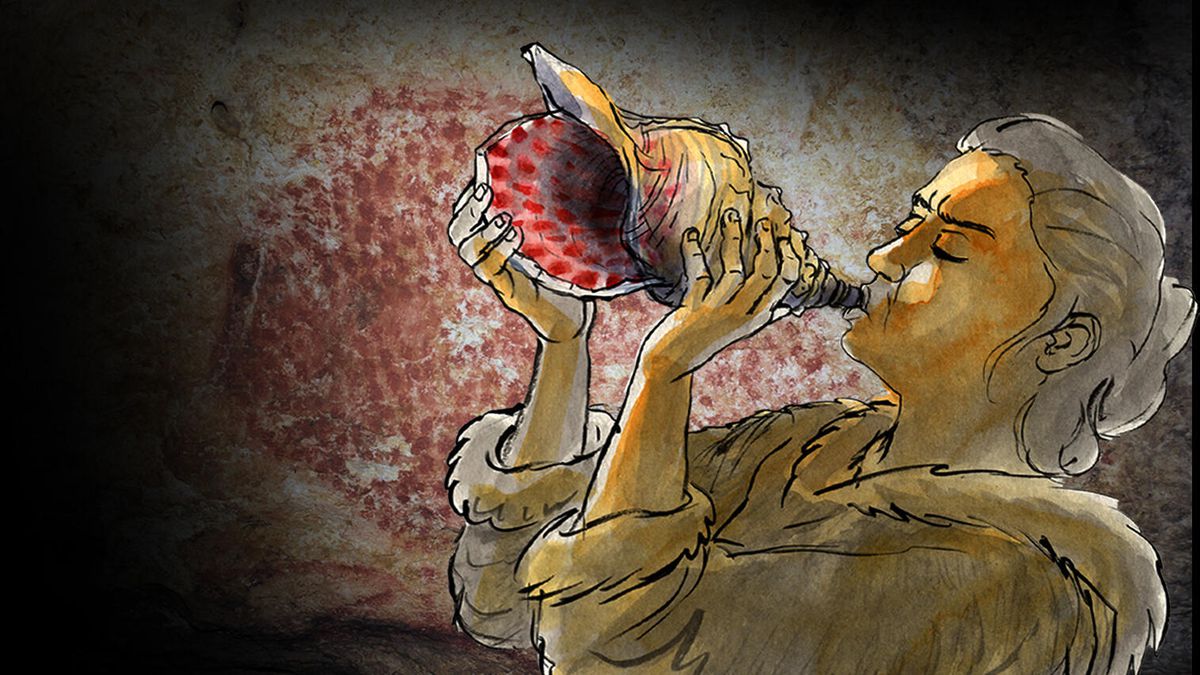
A team of scholars has recently reexamined a conch horn discovered around the Marsoulas Cave in southern France, the famous cave art site, and concluded that the conch was more than just an ornamental artifact used for a drinking vessel or any other trivial purpose in Upper Paleolithic Age, aka Old Stone Age, dating from around 17,000 to 12,000 years ago. It was an age when Cro-Magnons, a Homo Sapiens nomadic tribe in western Europe, emerged as formidable hunter-gatherers of reindeers and horses from a new cold and gray prehistoric horizon in the dawn of the ages of man. They were Magdalenian, named after a rock shelter located in the French Pyrenees where the artifacts and human remains were discovered. They left the prehistoric legacy in the form of the Magdalenian conch.

By using a carbon dating system and other state-of-art scientific apparatuses, the scholars posited that the conch horn was a musical instrument to enjoy the prehistoric Magdalenian symphony in the cave. The cause of reason for the hypothesis is a purposefully cut-off apex of the conch horn as if to adjust for blowing and making sounds. In fact, a modern music player tried playing it at its initial discovery and found out that the tunes were ranged close to the notes of C, C Sharp, and D, making it the oldest wind instrument of its kind to this date. Moreover, the conch patterns were similar to those appearing in the pictures of cave walls, which scholars deduced that they were significant in denoting cultural functions in the communes.

However, although the connections between the cave art and the conch horn are intelligent hypotheses, the idea of the conch as a musical instrument doesn’t quite hold water to me. First of all, the image of a conch horn always conjures up the dystopian vision of the boys in William Golding’s Lord of the Flies. In the story, boys blow the conch whenever they convoke meetings, which usually spring from sinister motives resulting in gloomy consequences. Also, the god of sea Poseidon blows a conch when he heralds his formidable divine presence, shaking the waves of the oceans. The use of the conch was to be more of notification of alarm for political or social events, not of a musical instrument for cultural appreciation. Besides, as aforesaid, a conch is often associated with the sea, unfittingly matched with hunter-gatherers in the mountain or sea-locked regions. Although scholars pointed out that the Magdalenian could travel to the shore and brought a conch as a souvenir, using it as a pastime wind instrument is a bit of stretch, a romantic imagination about the cave people differentiated from ruthless, animalistic, highly advanced kinds of ape.

If the scholars’ educated guess becomes a theory, then the Magdalenian conch horn will be entitled to the first place in the history of musical instruments. But considering the geographical reason and natural tendency related to a conch shell drawn upon historical and literary contexts, the Magdalenian conch shell must have been either a curiously collected souvenir from a trip to the shore or a valuable instrument to call upon meetings in the communes. Also, it could have been a convenient alarm to indicate a sight of animals for a hunt or protection. For melodious variations pleasing even to uncultured ears, the sounds of strings made from the leftovers of hunted animals hung on pieces of wood would be perfect for their hunter-gatherer entertainment.

To tell a story within you is an expression of yourself, an affirmation of your identity, in an expanse of will wielded by the spirit of freedom. Storytelling is, in fact, a way of logotherapy that helps you find meaning in life from your daily tasks to your traumatic experiences by sublimating the pains of the heart to the blessings of the spirit, in the realization of Amore Feti. In this book, Anita Sethi shoehorns her experience of racism in England into a rivetingly ingenious travel memoir in the spectacle of a beautiful natural landscape where she belongs.
Her narrative has a lyrical quality with a poet’s rhythm that reminds me of a Portuguese Fado song. Her words sing her story of an uneasy love relationship with her own country into a continuous fugue of love, betrayal, loneliness, and friendship vested with her experiences with people and nature. It is at once dolorous and enchanting as if to listen to a mysteriously elusive melody hummed by a ghost of a sad maiden who died in brokenheartedness. Yet, this doesn’t mean Sethi is a ghost damsel in distress bemoaning her betrayed love. She is a warrior who chose the pen to vindicate her attacker and other minor offenders of her South Asian ethnicity as a way to overcome her fear and anxiousness, arising from her ashes like Nietzsche’s noble phoenix.
Sethi’s narrative then becomes a eulogy to the natural landscape of Great Britain; she finds an elbow room, a niche, her library of wonder. As Shakespeare pointed out, nature is exempt from public haunt, finds good in everything. It is a grand luxurious spa free of charge to all, although that is not always tainted by the malice of incivility on the part of humans. However, Sethi, in her story, asserts that no one can take away her right to belong in the beauty of nature and the country she regards as a home and proclaims her self-identity by telling her personal story incorporating the words into the images of British mountains and forests, exempting her from a malady of social ills and elevating her to the citizens of the Universe.
The book is an excellent bedtime fellow when you want something thoughtful but not burdened with elements associated with scholarly apparatuses. The narrative is flowing melodiously, and the author’s spirit is within the texts, full of emotions but nuanced in her infatuation with the beauty of British landscapes that provide her with holistic healing power. They say you don’t protect what you don’t care about, and you don’t care what you have not experienced. To appreciate the value of this book doesn’t mean you have to be of a particular ethnicity, gender, or race. As long as you have taste and judgment universal in all humans, especially with a strong sense of empathy and a lover of nature, you will find her story alluringly gripping and feel her pains and loves as if they were your own.


You must be logged in to post a comment.