Tag: books

  • Queen of hearts

    500_F_274341335_PD5mMsZ0oscaOWx7diG52TCPi3hEhp3w

    Boldness can take you to unpathed trails and to undreamed lands, transferring all your yesterdays into all your tomorrows in one fell swoop. For we are such stuff made on dreams, hopes, and wishes however far-fetched they may seem. You live only once, so why not roll with it as you wish? And this touch of adventurism can make your soul emboldened to do things that you wanted to but couldn’t because the grit buried under the flotsam and jetsam of your aborted dreams and discouraged expectations begins to bloom in your secret garden of the mind.

    With the mysterious aura of haze vanished beyond the endless horizon, Judy suddenly felt a sense of destiny filled with adventures in the wild that set its unsullied beauty and quiet sovereignty apart from the crowded theaters of Reality where spectators and players hoot and holler for the most beautiful, powerful, and successful only she could not feel allied. And within this sanctuary of nature, this wondrous sense of go-aheaditiveness felt real but unbelievable. Rufus, Ben, Raphael, and Judy were all together in this joint adventure that was forming a kind of mental alliance among them, which was also felt but unseen. Forget Reason! For their faculty was more physical than metaphysical, less reasoning than instinctive in response to any such fantastical experience that delivers a burst of sensation to their beings spreading like a prairie fire sweeping every part of their bodies.

    “Gee, I wonder what it was. I know there’s something in the air because my gut feeling never failed me,” said Raphael, the Talker. “Yeah, I felt it too. Otherwise, the dog wouldn’t have barked at the thing in the air so persistently. You know, dogs and cats have special eyes to see ghosts and things we can’t. But whatever that was, it’s gone. Let’s get on with it and leave.” With this sententious statement, Ben started climbing up the saddle that was placed a bit too high for his stocky figure on his Californian mustang. His artistic inclination made him a believer of supernatural beings, but his work experience as an itinerary musician made him a practical dreamer with a view to match in the real world. But of course, his ability to cope with existential strains of daily life paled by comparison when it was juxtaposed with Raphael’s shrewdness pleasantly blended in his avuncular charm. While Ben was struggling to make it to the top of the saddle, Rufus was being pensive about the present and the future with a dream to make it big with the Aztec gold so that he could set up his younger brother Joe with a general store in their hometown. He was secretly in agreement with Ben that they should just forget about the free magic show to continue their journey for the buried treasure. My dear reader, you should not regard Rufus as a materialistic, footless young man hell-bent on being rich because once you get to know him more, you will want to be his best friend. Must I go further to affirm his character reference?

    Judy was looking and listening to this funny trio like Artemis, the goddess of hunting and the Moon, watching the comedy of the mortal from the top of Mount Olympus and thought they were indeed a curious band of wayfarers in quaintly old-fashioned attire and even more antebellum deportment and parlance, which piqued her historical curiosity feeding on her love of good old Westerns and stories of pioneers and gunslingers. To her big beautiful brown eyes, Rufus, Ben, and Raphael looked just like the characters from one of those Westerns starring Clint Eastwood, James Garner, Steve McQueen, and Lee Van Cleef. No, not John Wayne, Paul Newman, or Henry Fonda because they possessed no natural screen charisma surrounding their physical appearances as well as the mental force that could only be generated by real-life experiences and natural endowments. Judy was hooked on these characters still discussing and arguing about what to do next in front of her without regard to the pretty lass. If these men were a bunch of perverted thugs, she could have and should have known it at the first sight of them because she prided herself on her Sixth Sense inherited from her mother who was also spiritually gifted. All seemed intriguing and fascinating, thought Judy, who was on one-weeks’ vacation from her job as a secretary at a busy law firm. So, she approached the trio now all on horseback to offer herself as their scout. This gotta be fun. Judy secretly entertained the thought of being a frontier scout and thought her course had already been set for the Wild West.
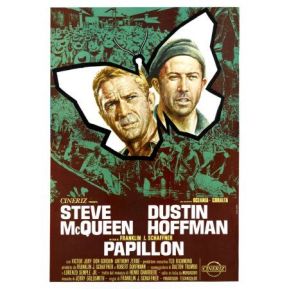
  • ‘Papillon (1973)’ – film review

    6daa8bbc3333a0740fe55fecd9b16439

    From Shakespeare to Hemingway, the resilient human spirit rising above life’s challenges is always a high human drama. Nietzsche said: “What does not kill you only makes you stronger.” This paean to a noble human spirit against the existential strains of life has been a paramount theme for masterpieces of arts, especially in literature and cinema appealing to the universal audiences, touching the deepest valleys of human consciousness and pulling at the heartstrings all in a polyphony of humanity. It is this very reason that Papillon (1973), directed by Franklin J. Schaffner, still evokes ineffable inspiration and indelible impression so powerfully displayed on the screen with the authenticity of a true story of a real-life character.

    DagmEaVV4AENyWE

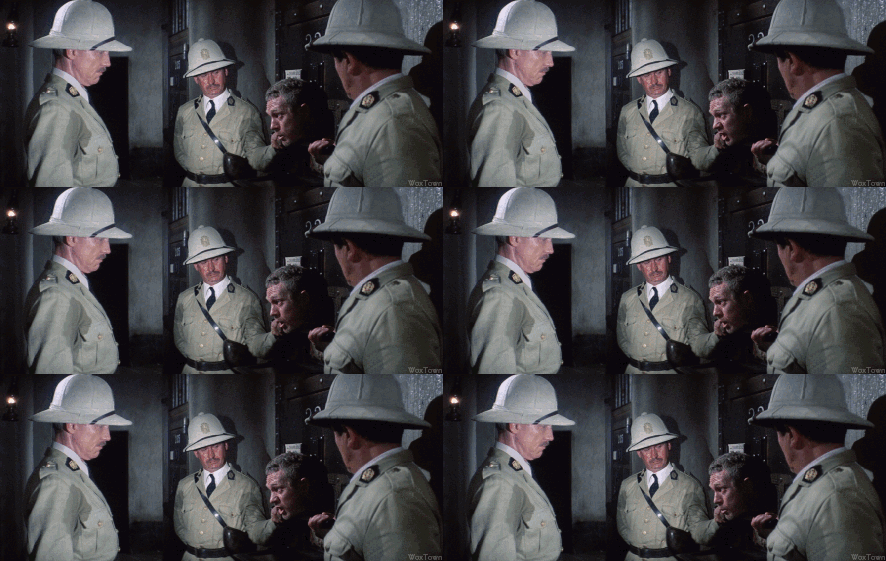
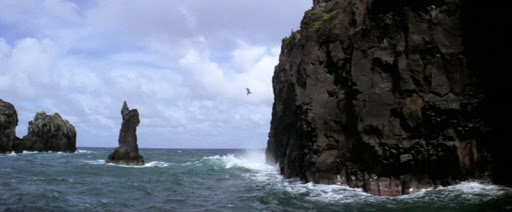
    Papillon, a butterfly in French, is a nickname of Henri Charriere (played by Steve McQueen), a safe-cracker framed for having murdered a pimp because he has a butterfly tattoo on his chest. Henri was sentenced to life imprisonment in French Guiana and decides to escape from the man-made inferno where death is the only way out of the murderous maltreatment doubled with dysentery and hard labor, which makes me wonder if the Nazis, especially Himmler and his ilk of the Final Solution, adapted the French Penal Colony system into concentration camps during World War II. And yet, Papillon’s will to escape and to live as a free man supersede the hellish daily realities fraught with endlessly cruel labor, inhumane solitary confinements, prolonged starvation, and deaths of his fellow inmates, all of which seem to conspire to break his will to live to conform to the totalitarianism of inhumanity in the name of punishment of his crime that he didn’t commit. Escape after escape, hope against hope, and betrayal after betrayal is fortune’s malice trying to overthrow his sovereign state. Still, Papillon’s sturdy mind exceeds the compass of her will, even if it takes him to the furious watery main and the murderous cliff in the Devil’s Island.

    source

    The stellar performance of Steve McQueen, playing the role of Henri Charriere, renders a sense of verisimilitude of the character and the story so convincingly that you dive into his emotions without realizing a boundary between a screen and yourself. Upon watching the film, you feel that you have contracted a severe biological strain of Stockholm syndrome with the Henri character on whose biography the film is based, which bestows the power of reality and the authenticity of truth upon your mind. Steve McQueen, often referred to as the King of Uber Cool, is excellent in portraying the convict with extraordinary feats of endurance and rebellion against the totalitarian penal system that wrongly imprisons his free spirit. McQueen’s abilities as a character actor shine when he commands his presence in a way that seems wholly authentic without overt gestures and contrived charisma but with his eyes sparkling even in the filthy prison uniform that speaks a thousand words surrounding him like a radiant halo as a token for his strong will to freedom.

    This film is, in a way, reminiscent of Ernest Hemingway’s ‘The Old Man and the Sea’ in terms of old Santiago’s indomitable burst of pep to fight the shark appropriating his hard-won big fish. The old man might look feeble and weak in comparison with the mighty power of the vast sea. Still, it is his will to win the battle against the force of sea that is sublimated into a victory of the human spirit with the resounding  dictum of this feat of humanity: “Man can be conquered, but cannot be destroyed.” That’s what comes to my mind while watching this excellent film about an ordinary human being with an extraordinary power of will to freedom. Hamlet uttered: “To be or not to be, that is the question.” To Henri Charriere, such contemplation is a meaningless echo of a defeatist. Henri is more of Macbeth working out on his plan for life as a free man with stubborn courage: “We fail! But screw your courage to the sticking-place, And we’ll not fail.” And Lo! Did he not take the advice of the Bard! And so, splendidly!

    unnamed

    Author’s Note: I watched the film last night and was immersed in the characters and the story. Not that I am an admirer of Steve McQueen but that he’s one of the greatest actors who vanished like a meteor gives a special meaning to this film. It is one of the best performances in his acting career and will always linger in our hearts. 

  • ‘The Remains of the Day’, by Kazuo Ishiguro – review

    The Remains of the DayThe Remains of the Day by Kazuo Ishiguro

    My rating: 5 of 5 stars

    Ask anyone and you will find everyone has something to talk about life with natural octaves from the highest note to the lowest and best registrar recorded over the vicissitudes of life as if living an ordinary life without a material curriculum vitae were a sign of defeatism synonymous with rootlessness. More often than not, a straightforwardly elliptical, honest-to-goodness narrative is not considered a smashing subject matter for a bestseller that merits an entire aisle of any bookseller, but the story of English butler Stevens shoehorns his ordinary work experience into a suitably fashionable stance for a modern-day memoir that reads like a continual fugue of flattering hopes, misguided beliefs, despotic self-denials, cruel disappointments, and smothered pleasures, all elegantly interwoven into a polyphony of life in The Remains of the Day by Kazuo Ishiguro.

    The Moment of Reckoning Stevens falls into, pace the general opinion of the mass, results not from his disillusioned loyalty toward Nazi sympathizer Lord Darlington but from his own disoriented value and belief systems in accordance with the changing zeitgeist in the wake of the two great wars. Lord Darlington epitomized what dignity and magnanimity meant to Stevens in a way that his position as a butler was as equally prestigious and sovereign as that of his aristocratic employer Lord Darlington, a figure of respectful English peerage that deserved of his dedication and devotion. It’s really a case of ‘Qualis rex, talis glex,’ meaning “As is the king, so is the people.” And it was this belief system that made Stevens endure occupational humiliation from arrogant guests of high birth, the grief of the death of his father, and tender feelings toward Ms. Kenton, a former head housekeeper at the Darlington Mansion. In fact, such belief system based on seemingly antediluvian values in the post-modern era was Stevens’ lifeline that had kept him going until he took a trip to see now married Ms. Kenton, a kind of Beatrice-like figure guiding Dante from Hell and Purgatory to Paradise.

    Stevens’s existential dilemma stems from his existential vertigo in the aftermath of the wars and the subsequent social changes that upended the foundations of the collective value and belief systems of society. Stevens’s inner world was put into an existential vacuum, a void that can only be filled by a sense of purpose and new attitudes toward life in search of finding meaning therein. Rather than bemoaning his life as a boring butler, Stevens kept trying to find meaning in what he had been doing, what he was still doing, and what he would do by asking himself the question of his own life to which only he could answer; that is, to a life he could only respond by being responsible. And it was not a reactionary response with his fists clenched in bitterness and a sprit of French Revolution against the privileged few, but his own examination of his life that felt a void in a sense of direction in life.

    Kazuo Ishiguro created a character whose existential dilemma is relatable and pitiable with his mastery of characterization, the wealth of imaginations, and study of human nature, in his signature elliptical narrative skills laced with nuanced emotions that never lay the whole character bare to the eyes of the public. He’s a fantastic writer who shows readers that a good writer is capable of travel and metamorphoses no matter where he was born or what he looks like. I wonder how many writers tried to break free from their biological planes and even dreamed about being who they wanted to be, confidently and naturally crossing the boundaries of culture and race just as Ishiguro did without branding his Japanese cultural and Asian traits as a convenient foundation for suitably fashionable “ethnic” literature. All in all, this is a fascinating book to observe how social changes can affect an individual and how one copes with such historic and cultural juggernauts in search of meaning in life. This book is a testament to the magical craft of writing that a writer should be all that he is capable of becoming no matter who he is. For a writer is also a magician of words, a wondrous sort of shapeshifter in letters.

    View all my reviews

  • dishes and books

    2c2cc0e944d117ab0561431f0cb8710a

    Agatha Christie once said: “The best time for planning a book is while you’re doing the dishes.” So did Jane Austen, who used to write before preparing a meal for her elderly father and after washing the dishes. And there was Laura Ingalls, an incredible pioneer woman tenaciously grasping on her aspiration to write while guiding her poor family to the long and winding climb to long-term financial security.  Then there was Lucy Maude Montgomery working full time as a teacher and writing full time to arrive one day as an established writer. Now enter Christine De Pisaner, a single mother of three children and mother, employed as a full-time supervisor at a scriptorium in the Late Middle Age France. What they had in common was the inexhaustible self-discipline and the independent will that drove them to spur their creativity on the craft of writing while juggling with their existential needs of life.

    In fact, the figure of Christine De Pisan stands scintillating amid the somber Gothic spheres of cathedrals and gargoyles in the Late Middle Ages. She was the first professional woman writer making a living out of writing to support her three children and mother on her own against the custom of remarrying as a widow. Pisan was a precocious, voracious reader at a very young age, wallowing herself in books, soaking up in knowledge gained from hours of reading at the royal place of the Louvre. Upon her husband’s death, Pisan worked at a scriptorium where she supervised the works of calligraphers, miniaturists, and bookbinders while writing in her spare time. It was during this time of employment Pisan began to write for livelihood under the aegis of King Charles VI, attracting European royal patronage of Phillip II of Burgundy, Queen Isabella of Bavaria, and England’s Earl of Salisbury, despite the fact that England and France fought against each other during the Hundred Years’ War. But Pisan’s feats of words and erudition triumphed over the vortex of the war and communicated to Taste and Reason universal in humanity by which her love of France and admiration of the Virgin Maid of Orleans were sublimated to the epic romantic poem “The Tale of Joan of Arc”.

    Pisan, Agatha Christie, Jane Austen, Laura Ingalls, and Lucy Maude Montgomery are soul sisters bound by the ambition, fortitude, and talents to express their inner voices in the peculiar alchemy of literature with a burst of pep in spite of their dealings with the existential world hostile to their sensitiveness. They were writers who knew how to strike the chords of readers with their artistic craft and admiring independent spirits that are contemporary with our time. For they write despite life’s challenges with a resilient sense of purpose in search of a meaning of life by actualizing dreams, hopes, and values in an expression of will across a blank page in divine madness of art. You see, washing and writing are not apples and oranges.

  • 150 miles to El Dorado

    foggy-morning-in-a-meadow

    Judy begins to feel like a whimsical paramour leaving for a new object of love at sight. What was pleasingly solitary in nature seems to be prolonged isolation from the world that Judy so wanted to escape, and her coquettish dalliance with the wild rugged nature is no longer wanted as the Sun is slowly moving westerly to cave into the Evening Star and the Moon. It might be still early for calling it a day to you with your weekend frolics still left to re-calibrate your kicks for another week, but it’s late for Judy, who would rather mourn for a passing of the last day of a weekend at home than rebel against it in a frenzy of nocturnal bacchanalian orgy elsewhere outside the comforts of her den. Now the anxiety holds a grip on her, and she begins to fret, and the miasma of the ill-feelings begins to effuse the uneasiness to Nena who begins to whimper and to the accidental trio of strangers observing every move that this girl makes as they are nearing to her, part perplexed, part bewildered. What a curious mixture of emotions she puts on her face! Rufus, Ben, and Raphael become curiouser and curiouser as they get nearer to the porcelain doll in their eyes.

    ‘Howdy! Lass! What are you doing here?’ Raphael, the talker, begins the talking. ‘We are headed west toward Los Adios Mountain. Do you know where it is?’ Judy incredulously looks up the mounted man with a mustache and a sombrero and thinks that he looks very convincingly like Sancho Panza, Don Quixote’s faithful servant. There’s something about the man, thinks Judy. The diction, the ambiance, and the deportment are rather anachronistic or incongruous even to the social media era where people flag their selfies on the internet as if they were on a popularity contest and compete for likes and comments as emotional security and collateral for their forged so-called self-confidence. My Dear Reader, don’t misunderstand that it’s immoral for you to hang your beautiful pictures on a digital platform for popular admiration. It’s just that this act of self-promotion serves as a springboard for testing your marketability and your mobility as a result of winning the competition for likability based upon looks and frivolous comments that do not mean much, much at all. Amid this train of thought, Judy despite being agitated by the lateness of the time warms to this amiable man and decides to answer him. ‘This is Wildwood Park, sir. Los Adios Mountain is 150 miles away from here. And you should go northward. You are far off from your destination.’ It is a sight to behold – the face of Raphael grimaced partly and bewildered partly, all in dazzling chemistry of emotions that is hard to describe. So much so that this display of indescribable human emotions on Raphael mollifies Nena’s agitation and puts the tempestuous waves of her emotions at ease. Now Judy feels refreshed and happy.

    Rufus and Ben are within an earshot of this dialogue between the pretty lass and Raphael and cannot but be disappointed by the fact that they are once again on the wrong track, which seems to be forever chasing after a phantom of the dead Union soldier obfuscating them lest they should find where the buried treasure is. Where’s the Aztec gold? When can they find it? Maybe the miasma of frustration and agitation that hovered over Judy must have been transmitted to Rufus and Ben on the stead because now their faces mirror the symptoms of a malady of broken hearts. Then suddenly, Nena now recovered from the plague of uneasiness, springs forward and wags its chubby tail and bark toward the firmament as if it were looking at a thing invisible to your and my human eyes. Nena keeps barking and looking at the puzzled crowd behind as though it were trying to explain to them that there is something in the air that only Nena can see but we can’t see. ‘What is it, Nena? What do you see?’ Judy knows that dogs and cats can see supernatural things because their eyes can look through the souls of the living and ghosts of the dead. Judy tries to follow the direction where Nena is looking and barking and sees a gossamer trace of haze vanishing into the air like the vestige of a propeller plane soon to be effaced across the skies. The more Judy tries to scrutinize it, the faster it disappears. And Nena keeps barking, looking in front of the curious crowd. What is it that the dog is seeing?

  • The Poesie by Titan: poetry in painting


    images
    Europa by Titan

    Although art is territorial, it’s never divisional; it crosses over the branches of art and begets a hybrid of wondrous beauty that spreads through the mind of the beholder and lingers there in alterations, evoking an arch of endless imaginations and a well of inspirations, appealing to our human faculty that is rather physical than metaphysical, sensual than intellectual. It’s a mating of the Senses, a marriage of Reasons perfected in letters or paintings, all in the mastery of stories, colors, and forms begotten by divine madness of artists copulating with a sensation of the flesh in putting a method of expression to its love bed of paper or canvas. Such a love child of arts results in Titan’s riveting masterpiece the ‘Poesie.’

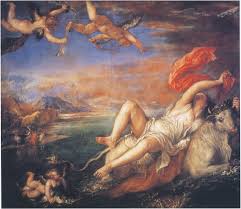
    Titan (1488-1576), one of the most celebrated artists of the Italian Renaissance, created the ‘Poesie,’ a cycle of 6 mythological paintings inspired by Ovid’s ‘the Metamorphoses,’ stories about famous mythological figures in poetry, which was the very reason that Titan chose it as his subjects. Originally commissioned by Phillip II, the life-sized portrait of whose father Emperor Charles V catapulted Titan to stardom in European courts, the ‘Poesie’ gave him the artistic freedom to experiment with different styles of painting incorporating secular subjects that attracted the welcome attention of intellectually ambitious aristocrats. The ‘Poesie,’ meaning poetry in French, is a hexaptych of human emotions expressed in mythological figures that are all too familiar and universal common to all human creatures. It displays the vagaries of human emotions, ranging from euphoria to anguish, passion to regret, and greed to pain, all the artistry in each of the paintings. Titan wanted to create the visual equivalent of the poetry in which Venus burning in passion for her young object of desire Adonis, Europa ravished by Zeus in a bull’s hide, Actaeon chancing upon Diana’s bath and other divine and mortal beings, such as Danae, Perseus, Andromeda, and Calisto intermingled in sensual pursuits were to be translated by strokes of a brush, plays of colors, and dramas of human feelings and emotions. In fact, it is this Titan’s talent both as a storyteller and a painter that sets him apart from his contemporaries and renders the work immortally enshrined in the atrium of universal arts.

    The ‘Poesie’ is currently on display in London’s National Gallery exhibition for the first time in over 4 centuries, following an example of Vatican’s concomitant display of Raphael’s tapestries at the Sistine Chapel. Notwithstanding the thematic and geographic differences, the works of the masters delight the eyes of ours as harbingers of art as artifacts of human civilization consisting of the standard of taste and reason universal in all human creatures as regards the principles of judgment and sentiment common to the eyes and minds of all mankind.