Looking out the window,
What does he see?
A little chubby sparrow
Twittering on the roof
in his cheerful vivacity
like a new good buddy
with an invitation to play
in their shared curiosity
of each other in loneliness.
Tag: cats
-
friends in loneliness
-
Theodore Tom’s Virgin Maid – ‘How To Be Owned By A Cat’, by Kate C. – review
How To Be Owned By A Cat: Simple Action Plan For First Time Cat Owners Who Have NO Idea What They Are Getting Into by Kate C.
My rating: 4 of 5 stars
Cats remind me of whimsical and capricious Greek gods and goddesses. Sometimes, cats are like Baroque European aristocrats with sophisticated finickiness. They are like spoiled children with no regard to manners in the sudden pulsing of stalking and jumping, rigidly dominated by their blindly unchecked ego. Whatever of the feline nature it may be, there is undoubtedly more than one of it; cats are convincingly intelligent, bracingly artless, and surprisingly affectionate with a display of individualities particular to each cat. No wonder there are celebrity cats as follows: A Cat in the Puss walking around as if he were man, Tom outwitted by Jerry, Garfield as laid back as his lookalike master, Felix the Car becoming a timeless icon of the style, and Theodore the Cat, who likes to challenge, “Who’s the Boss?” in this amusing read.
With an imposing name associated with a man of outstanding achievement, Theodore likes to think himself as a lifetime resident of a presidential suite attended by his matron-in-waiting Kate, a virgin cat owner without prior experience of raising a cat. Her meeting with Theodore, whom she happened to adopt from a pet shop, is a match made on earth, orchestrated by time and chance, aka Fortune. Or it may be the stars that shine brightly above their heads. The journey both Kate and Theodore has thus far embarked is akin to a real one of a road trip by a small caravan, consisting of bumpy drives, drive-ins, park-ins, give-ins, give-outs, etc. Kate’s relationship with Theodore parallels that of the Chef and his stray gourmet cat named Apollo in John Steinbeck’s “The Amiable Fleas” regarding the narrative’s realistic atmospheres illustrating the significance of ordinariness in daily life. Both works celebrate the values of simple pleasures that give a fresh hold upon our problems and different perspectives on life.
This charming little book also attests to Emerson’s tenet that thinking is the function, and action the functionary. In other words, the understanding of truth results from the successful union of knowledge and practicality on reality. Kate comes to the A-HA moment by realizing that her knowledge about cats from books and the media is not complementary to its applicability to tending her cat, Theodore.
I picked up this read because in reading its summary, I felt related to the author’s case for being a first-time cat owner without initial interest in cats. Her daily interactions with Theodore has taught her that there are no bad cats but only misunderstood cats due to a lack of patience or a deficiency in compassion on human parts. What will happen when what you read from books and watch from Youtube about cats contradict the realities of your Toms and Mollys at home? Just as lawyers do not learn their trade at law schools till they practice, pet owners will not know about their flurry fireballs till they clean their poops. In light of the above, this book is a lightheartedly vivacious and entertainingly down-to-earth read that makes you emphasize with her experience as a first-time cat owner.
Furthermore, for those who criticize the author’s poor writing style as posted on Amazon reviews, I want to tell each of them that being a purist regarding English Underfiled does not guarantee that you are not an ignoramus. Good writing means not in immaculate grammar but in the richness of sentiments and of thoughts. Therefore, I regard this book as an excellent read to read; especially, if you are a virgin cat owner like we are.
View all my reviews -
Our Mutual Friends
Some say animals do not have a faculty of mind that translates the sense into meaning. I always find it ironic that educated people can sometimes be heartlessly benighted, belittling a simplicity of nature. That they do not have the emotional spectrums, ranging from guilty to remorseful, and to resentful, gives free rein on arbitrarily judging animal behaviors according to human rational thinking that supersedes instincts common to all living creatures. Nor does it sound sane to cosset pets with outpourings of maudlin sentiments out of anthropomorphism for our convenience. We are fortunate to live in the age of the Brilliance of Science. Still, the overflux of information sometimes begets counterproductive results. Amid the deluge of information on animal behaviorism available on the Internet, I am often doubtful, if not fearful, of the way I am raising my cat.

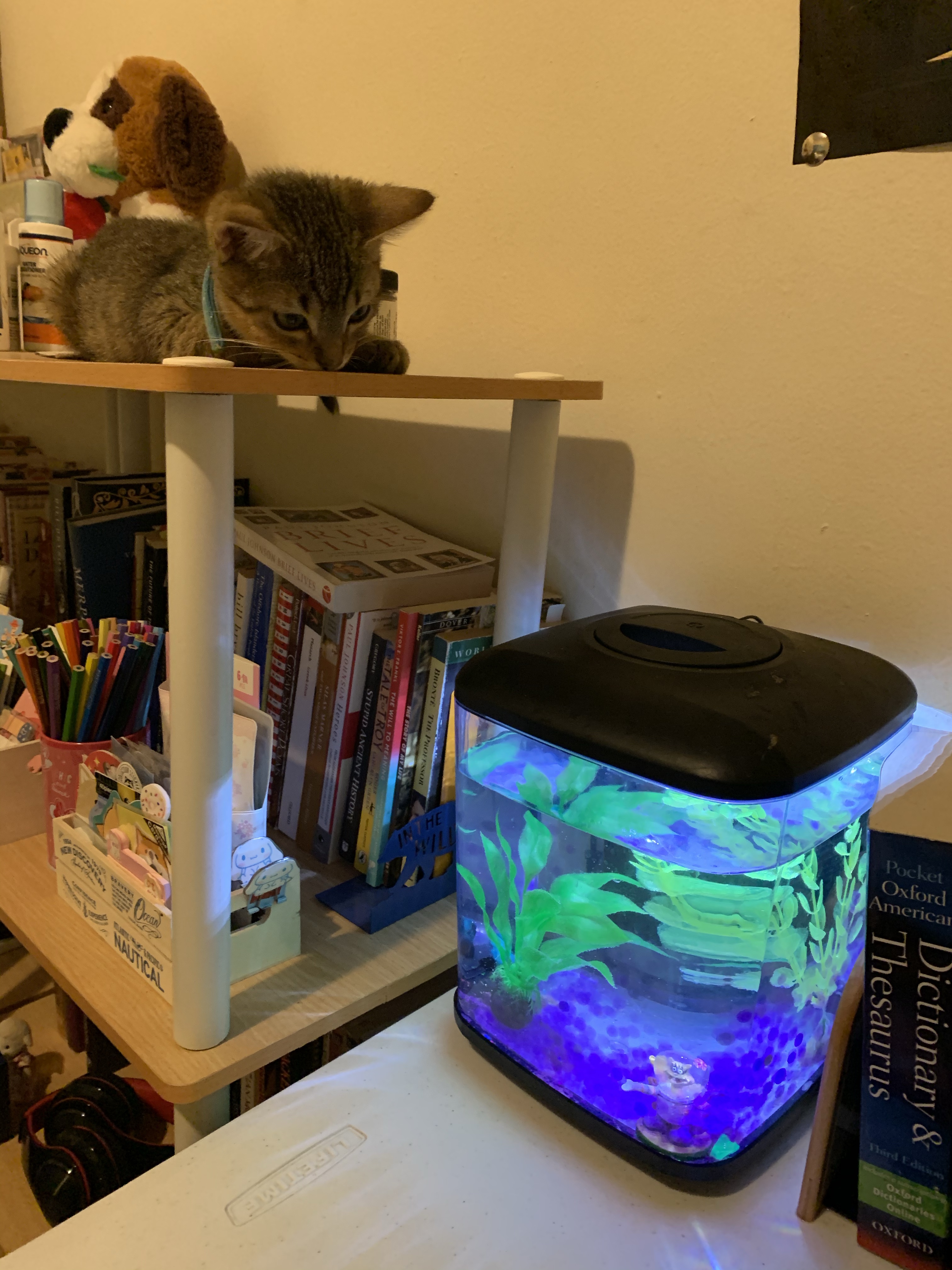
I observe how my 14-week old tabby Toro behaves from defecating in the litterbox to drinking from the water fountain, playing with his toys, and to watching his new finned friend, Hope, a Betta fish. Although they do not have the faculty to produce physiologically-driven emotional effects as complex as humans, my observation has yielded that cats exhibit a feline version of a continuum from pleasantness to unpleasantness. For instance, when I discipline Toro for not behaving, he does about-face and hides under the bed or goes to a corner of the room, sitting there like a mini sphinx statue, sulking and avoiding my eyes. Then in about 10 minutes or so, he slowly (and stealthily) approaches where I am while still keeping his feline pride in a way he doesn’t want to ingratiate himself with my favor. When finally arriving at his destination of Me, he announces his arrival with the unmissable “Meow,” with his eyes pleading for my petting. Cats may not have the same kind of grudge that we humans secretly harbor as in William Blakes’ ‘Poison Tree.” Yet, they possess the tactile feelings at the primary level, which can be akin to those exhibited by infants. Also, I don’t think raising a single cat will prevent her from socialization or emotional well-being. Most cats do not like to be with other cats unless they are littermates from birth.My a posteriori opinion about a myriad of scientific theories and expert dos and dont’s about raising cats happy and healthy is an intelligent hypothesis of feline nature. It attempts to explain why they act the way they do so that we, as caretakers, should take care of them better and more effectively. From my personal experience thus far, it is really up to individuals’ discretion to respond to their cats (or other pets) because each animal has different characters with particular likes and dislikes. So I try not to read more than I need in terms of feline care. (i.g., Toro likes no cat tree, no chasing ball but likes to climb on chairs, shelves, and tables that humans use.) Cats are solitary and egoistic, but that is why they are so affectionate toward us. As the Victorian British writer George Eliot said, “Animals are such agreeable friends, they ask no questions, pass no criticisms.” Therefore, I would treat my furry little friend as he is, rather than turn him into an obsequious, listless pet whose existence depends on the mercy of his master.
-
Tiger and Fish
Hope comes in blue wonder
Flapping its tails of vigor,
Little Tiger wonders in silence
If he can touch the brilliance. -
‘Writers and Their Cats’ by Alison Nastasi – review
Writers and Their Cats: by Alison NastasiMy rating: 4 of 5 stars
If dogs are man’s best friends with their childlike artlessness and uninhibited affection, what are cats? Lucy Maud Montgomery, the author of Anne of Green Gables, answered thus: “Cats are so nice and selfish.” Writers and Their Cats by Alison Nastasi is a delightful illustration of such a relationship between writers and their cats with peek-a-boo glimpses of the celebrity authors’ unknown personal aspects behind the public façade.
The fascination with the graceful demeanor and graceful capriciousness of cats is particularly intense among the volatile and imaginative writers as the muse of their lettered labyrinths. Edgar Allan Poe wished he could write as mysteriously good as his cat Catarina who liked to hover herself over Poe’s shoulders while he was writing. Mark Twain, whom I used to associate with something of a Dog Father, turns out to be a godfather of cats who rented cats to city dwellers during their holidays in the countryside. Twain also named his cats commensurate with his wicked sense of humor: Satan, Soapy Sal, Lazy, etc. Furthermore, Twain proclaimed that anyone who likes a cat is his friend. The imposing figure of rough and tough Ernest Hemingway may not match the delicate silhouettes of cats’ sophisticated society. Still, Papa Hemingway loved them with the tenderness he rarely showed even to his better halves.
The book also introduces readers to various writers of our digital era whose love of cats takes them to the world outside their comfort zones in selective solitude. Patricia Highsmith, a high-strung, highly opinionated, no-nonsense author of The Talented Mr. Ripley, reveals her Tate-a-Tate moments by greeting her cat, “We are going to have a great day today.” Marion James, who wrote A Brief History of Seven Killings, met Tom the Cat at a café in Brooklyn, New York, who, like the writer, enjoyed being outside among people because both of them thrived on the liveliness of the world around them as a creative force. Then Peeti Shency, the Indian novelist and artist, writes about the experience of sharing a terrific story about her trip to the Kedar-Gouri Temple dedicated to the eponymous goddess with a particular fondness of cats, thus elevating them to the divine status of the immortals. Shency resurrects the legends of holy cats in the temple to our digitalized reality of the world and connects them to our need for their presence for nature’s mysteriousness.
There are many other writers in the book whose love for their cats are touching. They all confess to their odes to cats that only cats can understand what they are and who they are. Whether or not cats have a supernatural sense of reading people’s minds, I have no intelligence. Still, I do know that a cat is good at observing your movement and facial expression from my observation of Toro, a 12-week old male brown tabby kitten, who likes to watch me what I am doing and where I am going. A cat is a curiously interesting beast, and it is this semblance of intelligence that makes a cat so attractive to the imaginative, high-strung writers. If you have a cat at home and a writer at heart, this book will present you with a delightful treat to your mind, packed full of beautiful pictures of writers and their cats not in grim portraiture but natural snapshots. Readers may tempt to show the writers’ photos with their cats to your cats.
-
Pets are not of a fad but for life.
I read the Guardian article “A dog is for life, not Just lockdown” by Donna Ferguson (September 13, 2020 issue) with intimately acquainted feeling shared by our understanding of pets as family members with care, not as luxurious commodities treated with whims and caprice. Her search for a Poochon puppy for her daughter reminds me of my own story of the recent adoption of a tabby kitten from a shelter.
As I was going to move into a pet-friendly apartment, I was excited to bring a dog into my new home to share companionship. However, during my search for a canine company, I became aware of the ugly reality of “pet business” intent on swindling and ripping off naïve would-be pet owners. Ferguson’s experience of encountering sellers of puppies suspected of scamming or deceiving chimed the bell of my experience in which a dubious welsh corgi breeder insisted on “shipping out” a puppy to me in the convenient pretext of Covid-19 protocol. Even legitimate ones are not exempt from my continued disappointment: Shiba breeders in Southern California had their waiting lists closed. One pet shop owner on the phone revealed to me that since the outbreak of the Covid-19 and California state made it difficult to sell and buy a pet at a pet shop. Hence the supply and demand for pets have become disproportionately unbalanced, skyrocketing the price of dogs immensely. Worse, the procedure of adopting dogs from shelters makes it excessively challenging and disheartening for bona fide would-be owners disappointed with the requirements of a near-perfection environment for dogs.
Maybe all the disappointments and disillusion of having a dog meant to lead me to the world of cats because now I have a 12-week old brown male tabby named “Toro,” a masculine form of Tora, meaning in a little tiger in Japanese. I brought him from Ventura Animal Services three weeks ago. He is a smart, capricious kitten charged with a sudden pop of energy to stalk and play with the toy rat and anything moving from the frills of my skirts to dangling straps of my iPhone cover. Watching Toro peacefully cuddle up on my laps or my desk when I read or write, I can’t agree more with Ferguson that our cat and dog are not for our pandemic solace but our wish to share our homes with the lovely creatures.


You must be logged in to post a comment.