Tag: creative story

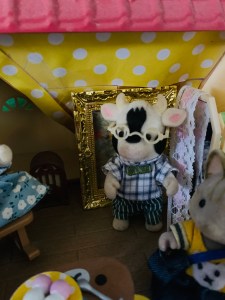
  • the changeling

    coastal_wildflowers_poppies_point_buchon

    If she is pretty, she is never lonely because she is wanted and loved. This much is truth, no? Beauty works a miracle in the eyes of a dull man without imagination and of a cruel man without tears. Oscar Wilde, who always had something to say about beauty, affirmed that it’s better to be beautiful than to be good because beauty captures your attention. So, if you are bereft of beauty, then you must work very hard to get people to know who you are. Beauty is indeed a joy for all seasons, rain or shine, and is also a privilege to be loved first before loving.

    Judy always must be in love with someone who didn’t even know of her existence because the feeling of love would transform her from a plain Jane to a sultry Cleopatra as if a pixie had cast a glamour spell on her, pitying her denied sense of pleasure and detachment from a constellation of lovers. Judy, despite some flattering feedback on her appearance from onlookers, was always discontent with what she saw in the mirror that seemed to reflect her what she didn’t want or couldn’t see in her true self. She felt that her features were in want of spectacular beauty that would make herself loved, and her solitary disposition dipped in an exclusive flavor of selectiveness doubled the inaccessibility of the worldly sensuousness that even not so pretty or homely women were allowed as their feminine rights.

    Judy was sitting like a pillar of melancholy at the dinner table embarrassed by the ordinariness of her appearance in the presence of handsome Fred who made Judy feel like an awkward wallflower that nobody would pay attention to. You would say she obviously lacked self-confidence, but self-confidence is also built upon the kind of feedback you get from others. Judy was a firm believer of existentialism which says that experience exceeds essence and of Robert Cooley’s sociological theory of “Looking Glassed Self” that you become the way how others treat you. Or you might say what she lacked in appearance could be compensated by her intelligence, wits, or those other “inner” qualities, all of which she did possess. But let’s be honest, my dear readers. Beauty is the power and the wisdom of women regardless of leaps of times, distances of places, and differences of races. Any man- rich or poor, bigoted or liberal, young or old- loves a pretty woman and will act on his best behavior with kindness. Likewise, Judy, who was not drop-dead gorgeous, always kept herself guarded with a stern look at the sight of a man who might be unkind or curt. However, Fred was different. He was being very affable to her with a genuine smile. This time Judy wanted to claim her right of happiness and make her existence visible to her figure of love, so she secretly wished for a glamour spell to change herself from an insignificant wallflower to a beautiful rose that would make Fred crazy about her.
     

  • fairy cowboy

    dogs-starry-night-3

    It is true; there’s magic in the web of all she saw at the moment even if it was just her optical illusion like a mirage of an oasis to a thirsty wayfarer or of an island to a land-searching seaman.  The tall beautiful strange man emerging from the inside was even stranger with a strangely radiant smile that was beaming from one end of his shapely formed masculine lips to the slightly slanted end of the enchantingly mischievous openings. He was wearing a blue long-sleeved shirt that matched his dancing blue eyes visible under a fluorescent light that filled the interior of the house and fashionably worn-off jeans held fast with a thick blue belt on the right side of which contained a holster to put a pistol in. It was the pair of light taupe-colored moccasins that seemed to give the man a status that fused the capricious power of an ancient pagan deity with the erotic charge of a modern movie star. The extraordinariness of the strange beauty was synonymous with witchcraft of love at first sight, the dangerous yet fantastical manifestation of her imaginations, desires, aspirations, and wishes, all the latticework of her spirit pining for the pleasures of the senses that Judy felt unjustly denied and ousted for outrageously unknown reasons.

    If the word ‘gobsmacked’ doesn’t give you a proper sense of realization because of its textual limitation, then one good look at Judy’s present face would make up for the incorporeal sense of the word: her big brown eyes were transfixed to the florescent blue lamps that riveted the man’s whole face. Her pouting lips were quivering with silent excitement concealing her pounding heart in the exaltation of her senses smothered under demands of daily duties imposed by the reality of life in which she had to carry many a burden that even a mule would long to emit a cry of exhaustion. All her worries were evaporating into the chilly nightly air, giving her instant anesthesia numbing the strains of her existential life. Judy was in euphoria, like the sailors of Odyssey who after eating the leaves of lotuses lost their memories, happy or unhappy, became unanimously blissful in an unknown land. She didn’t want to leave the moment, the place, and Him. It’s oh too good to be true, but it didn’t matter to her anyway because even if it had been a dream, she wouldn’t have wanted to wake up. Even the presence of her fido friend Nena by her side was forgotten to her. She was thinking of him, looking at him, him alone and him only, and none other in the world.

    Rufus, Ben, and Raphael were growing impatient about Judy’s prolonged initiation of being acquainted with the man of the house because they were all hungry and tired for hot meals and warm showers followed by good-nights of sleep to continue their always tomorrow journeys for the buried Aztec gold. So, as usual, Raphael went forward and broke the spellbound moment of enchanted silence: “Howdy, sir! We have been traveling all day long and would like to know if you have spare rooms where we could rest for the night. If there’s no such room, then we would be obliged to sleep in your stable.” Raphael couldn’t ask for hot meals which were what he and his buddies really needed with an increasing sensation of hunger that grew only stronger by a stronger rejection of the thought of food in their minds. For although Raphael was the most socially adroit of the trio, hubris was wanting in him, and a burst of momentous bravado was quelled by the resistant hunger. Raphael felt remorseful about foregoing the request for food, while his buddies were standing behind, watching the solicitation, and feeling famished.

    Maybe the pitiful sight of the whole scene might have moved even the mind of this strangely beautiful man, who finally greeted them with a jovial gesture. “Yes, sure! Guys, please come in, and I will let you use the second floor for sleeping. As a matter of fact, I was having dinner by myself. What great timing! Let’s have dinner together. I have some salad, oatmeal bread with butter and fruit jams, fresh milk, juices, wines, and water enough to feed us all. By the way, my name is Fred Faun, the foreman of Las Posas Ranch. It’s getting cold out here. Come on in quickly!” The jovial invitation from this strangely beautiful foreman of the ranch amounted to a discovery of gold in a derelict mine or a backwater of an insignificant stream running behind a haunted ranch. The consorted bliss of being accepted to a feast gave the traveling band instantaneous magnanimity of loving all humans, evil and good. With an alacrity of departure from a terror of uncertain rejection, Rufus, Ben, Raphael entered the house. Judy and Nena were the last to enter while Fred Faun was holding the door for them. Now Judy was inside of the man’s house, and her heart was pounding harder as the man was coming toward her closer. It was her first time for everything happening to her.

  • Life goes on

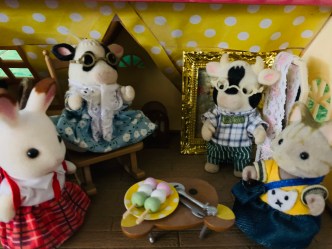
    img_1476

    Grandparents Mary and Hans Bovine are all properly concerned about the newest alert for the Kina-13 virus that the town’s mayoral government has addressed to its citizens on T.V., radio, Twitter, Facebook, and newspapers. Now a gathering of 200 or more people is recommended to be canceled or postponed to an indefinite date, including religious services and business conferences. Never did the power of a government feel so assuredly authoritative and legally bounding as now, and it has imposed on every one of them. 

    Mary: I can’t believe that it’s really happening now. When this pandemic panic arose at the beginning elsewhere, I thought that it would not come to our land. But now look at this commotion in our town. Masses are also suspended for three weeks from now following an announcement from the archdioceses of Sylvania. It’s unbelievable! 

    img_1475

    Hans: Yeah, can’t believe it myself, either. I went to the Pellmart right by the Chico’s this morning to get toothpaste and a roll of paper towel, and most of the shelves were empty! Besides, I had to get toilet tissues from Me-Bay online last night! What’s more, I must close my restaurant starting from tomorrow until the Mayor lifts the proscription. What a mess! Things are abnormal now. The panic reactions from the rabble remind me of the scenes from the movie “The Last Man on Earth.” 

    The grandparents think that the onset of the pandemic elsewhere in the world was really the baby figure of the giant mass of things according to the butterfly effect: the small falling of a butterfly’s wings can bring a hurricane on the other side of the world. However, nothing will break their resilient spirits united in humor, a handmaid to hope and courage.”Once more unto the breach, dear friends because though it is madness, yet there is a method in it. So take heart, and be brave – with a smirk against the fear. 

    htt

  • the California musketeers – double trouble

    GettyImages-139795856-58ece3fe5f9b58ef7e8344a0

    Your present fears are less than your horrible imaginings.  What you see now is what you get with, deal with, and live with. It’s no way around, and if you run away from it for an instant reprieve, you know it will come to you again sooner or later. This is it, thinks Judy. I must take it and bear it with a grin. These men, the trio looking like characters from a western movie, appearing from the wild high noon haze, she does not fear, but their impending intents of coming to her with mysterious questions she doubts. Surely, doubts are healthier than fears because fears can crush your strength, and the weakness emanating from within can double the strength of the foes. Judy is secretly asking God to come to aid her and make haste to help her as the images of the trio are entering her trembling irises of the big beautiful brown eyes and fill her eyes in entirety.

    ‘Howdy! Lass!’ Raphael, the talker, begins the talking. The two other men on the stead behind Raphael display the look of curiosity and amusement. They are pleased to see a pretty woman with a matching cute little dog in the middle of the wild. Quite an exotic kind of a bird, Rufus and Ben think in harmony. But the exoticness comes not from the demarcation of the race but from a uniqueness of beauty: innocence and sensuality are delicately concocted in her big brown expressive eyes decorated with long, thick Persian black eyelashes like black silk curtains. And the crown of her beauty seems to be bestowed on the tall slim figure that renders her graceful and respectful. There’s something about her, which sets her apart from the women they have seen in saloons, music halls, ballrooms, and any place where flowers of society gather and mingle to be wooed and wed. ‘The lucky bastard’, think Rufus and Ben, both of whom envy Raphael with admiration for his way with ladies. In terms of looks, Raphael is an epitome of your ordinary amigo: slightly chubby in a frame, a round smiley face that looks impossible to grimace decorated with a neatly trimmed mustache, all amicability personified that will save him from malicious gossips and wrongful accusations. Hence, Raphael is the talker of the trio and a sort of mother and father to Rufus and Ben with his practical sense of reality and survival skills.

    ‘We are headed west toward Doritos. Do you know where it is?’ Raphael asks the lass as friendly as possible. Judy incredulously looks up the mounted man with a mustache and a sombrero and thinks that he looks very convincingly like Sancho Panza, Don Quixote’s faithful servant. There’s something about the man, thinks Judy. The diction, the ambiance, and the deportment are rather anachronistic or incongruous even to the social media era where people flag their selfies on the internet as if they were on a popularity contest and compete for likes and comments as emotional security and collateral for their forged so-called self-confidence. My Dear Reader, don’t misunderstand that it’s immoral of you to hang your beautiful pictures on a digital platform for popular admiration. It’s just that this act of self-promotion serves as a springboard for testing your marketability and your mobility as a result of winning the competition for likability based upon looks and frivolous comments that do not mean much, much at all. Amid this train of thought, Judy warms to this amiable man and decides to answer him. ‘This is Wildwood Park, sir. And I am sorry that I have never heard that there’s a place called Doritos, except for a brand of chips.’ Upon answering, Judy could not but burst into a peal of laughter. It is a sight to behold – the face of Raphael grimaced partly and bewildered partly, all in dazzling chemistry of emotions that is hard to describe. So much so that this display of indescribable human emotions on Raphael mollifies Nena’s agitation and puts the tempestuous waves of her emotions at ease. Now Judy feels refreshed and happy.

    Rufus and Ben are within an earshot of this dialogue between the pretty lass and Raphael and cannot but be disappointed by the fact that they are once again on the wrong track, which seems to be forever chasing after a phantom of the dead Union soldier obfuscating them lest they should find where the buried treasure is. Where’s the Aztec gold? When can they find it? Maybe the miasma of frustration and agitation that hovered over Judy must have been transmitted to Rufus and Ben on the stead because now their faces mirror the symptoms of the malady of broken hearts. Then suddenly, Nena now recovered from the plague of uneasiness, springs forward and wags its chubby tail and bark toward the firmament as if it were looking at a thing invisible to your and my human eyes. Nena keeps barking and looking at the puzzled crowd behind as though it were trying to explain to them that there is something in the air that only Nena can see but we can’t see. ‘What is it, Nena? What do you see?’ Judy knows that dogs and cats can see supernatural things because their eyes can look through the souls of the living and ghosts of the dead. Judy tries to follow the direction where Nena is looking and barking and sees a gossamer trace of haze vanishing into the air like the vestige of a propeller plane soon to be effaced across the skies. The more Judy tries to scrutinize it, the faster it disappears. And Nena keeps barking, looking in front of the curious crowd. What is it that the dog is seeing? They all look at the barking dog and become curiouser and curiouser.

  • sound and fury – one

    3199384-NMUYYGNZ-6

    It is the eighth hour when things seem to go wrong, and your spirit feels bereft of knowledge of words and drained of zeal for creativity. It’s the dark night of the soul through no fault of your own, but a repertoire of existential self that collides with the forces of reality dealing with daily tasks of living. Many people cope with such a dilemma in a simulation of positive thinking and enterprising attitudes toward mental obstacles and physical labor. Alas! poor woman, I know her, my dear reader. She has none other than human frailties but always strives for the loftiest, the highest goal that is beyond her reach in the ether where the spirits of the learned and famous float and reign over the middling and underling infatuated with vain hopes and false valuations of themselves yearning for recognition from their intellectual superiors.

    Iris likes to write, which is the only legitimate and safe way to manifest her thoughts in anonymity. Anonymity is the rescue of the underdogs whose natural attributions and social planes prevent their souls from growing further. Wearing a cloak of invisibility from Hades guarantees safety and truth and power. It’s a bartering of the face with the voice, and it’s the tragedy of the underlings whose wills are stronger than their natural endowments. “Some are born great, others achieve greatness,” said the ever-wise William Shakespeare. He must have felt the same because Shakespeare, lacking formal education and not being born with a silver spoon in his mouth, was often ridiculed and is still criticized by his supposed plagiarism and dubious authorship of his plays and poems. For people who have criticized the Bard are the so-called intellectuals crowned with golden wreaths of academic olives, who want to discredit all his achievements and his natural talents due to his lowbrow backgrounds. They want to re-invent Shakespeare as a serious literary figure about whom only the elites can talk and appreciate or create a whole new Shakespeare by possessing his spirit with that of a man with high birth and academic accolades. George Orwell knew all about this fiasco surrounding the authenticity of Shakespeare’s authorship and jested: “If there really is such a thing as turning in one’s grave, Shakespeare must get a lot of exercises.”

    Iris believes that reading a book and modeling the writing style of the author is an act of social evolution by which dispersion of literary knowledge enriches our cultural enterprise and social progress. That is how human civilizations have evolved by constantly borrowing and creating as Hesiod’s Theogony succinctly described as thus: “Out of void comes night. From night comes the day.” Likewise, Iris likes to read the writings of her favored authors, such as Stuart Kells, George Orwell, Charlotte Bronte, Paul Johnson, and even Stephen King, so that she can write as good as her literary Olympians with Longfellow’s Psalm for life in mind:

    “Let us, then, be up and doing,

       With a heart for any fate;

    Still achieving, still pursuing,

       Learn to labor and to wait.”

  • Malaise – chapter ten

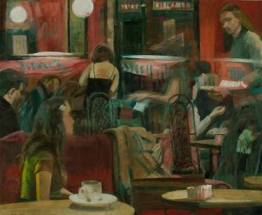
    cafe-sans-souci-sheila-kinsey

    ‘Everyone else is doing it, so why can’t I?’ Iris, the interrupted woman whose inverted elitism outed her of the quotidian pleasure, was finally on the verge of private rebellion against the lofty isolation from the world that beckoned her yonder with an alluring panoply of all things sensuous, tactile and visceral, like the tempting fruit from the tree of knowledge. The more she thought about the mysterious man’s Byronic face with Olympian physique, the stronger the flame of her heart grew. It’s really a foolish heart, thought Iris, but when she had no other than a woman’s reason and thought him so, who could berate her? Call it the affair of the heart or whimsical infatuation of the beauty that looked so patrician, so elated, and so untouchable. Yet, her heart was telling her that this time she should surrender to the power of the human nature by letting the force of desire besiege her solitary castle and infiltrate it in all corners without mercy of the inter-cultural code of ethics built on the puritanical dictatorship of the body and the soul.

    Consumed in the flame of passion, the soul of Iris was in communion with that of Dido, who loved Aeneas more than he loved her. Poor Dido- She deserved a better man who could return her love, for she was beautiful inside and out. Silly Dido- She should have moved on even after her lover deserted her for the glory of his predestined royalty in a new land. Dido was a woman of passion, and so was Iris. They lived on the idea of love and must have figures of love, for that’s what gave them perks of life. But at least, Dido had Aeneas, and her love was consummated in the cave on a stormy day, albeit it was all staged by Venus, the goddess of love and the mother of Aeneas, and Juno, the ever-jealous goddess. Dido’s love was actualized even for a short period of time when she was alone together with Aeneas. Alas! Poor Iris, I knew her, my dear readers. It all seems to me now that Cupid’s arrows took aims at her, but not the figure of her love. Her love was alone, her existence was always invisible, and she was not allowed the joy of love. Iris was dissociated from a parliament of Love, a congress of lovers.

    It was said that the idea of love to the classical Athenians was primarily erotic, rather than platonic, instinctual rather than spiritual, physical rather than mental. What we now understand about love was no more than a close bond between family members or a master and a horse or a dog. What Iris was feeling now was a combined love of Eros and Agape. She wanted the wholesomeness of love, as in the union of Cupid and Psyche. People would think that she was disinterested in love because of her beautiful but austere look that prevented people from being jovial with her. She never told her love to anyone but let concealment feed on her damask cheeks. She pined in thought with a green and yellow melancholy with solitude as her steady companion.