Tag: creative writing

  • Sunday Letter – 2

    Sunday, September 6th, 2026

    Hi Freddo,

    It’s September, and fall will arrive soon. In fact, the cooler temperatures are already its harbingers, and I am all for it. How’s the weather in Rome? And how are your projects coming along? Last time I heard, you were working on a translation of a certain book from English into Italian. Are you still working on it? Can you tell me what the book is about?

    I want to show you my prose poem I wrote yesterday. It’s one of my recent experiments with story-like poems. I write poems that read like prose. The best thing about prose poems is that there is no complication of characters with existential dilemmas and metaphysical questions about who they are—questions that not many people care about. But these days, too many poems and stories can read like ideological catalogs, social agendas, or personal traumas that are not easy to read and take to heart. While I get that shared traumatic experiences may help those who find themselves therein, that is not my cup of tea. I don’t want to write about my ethnicity or race in the context of living in America as an Asian immigrant woman. I don’t want to be labeled as an “ethnic” woman writer whose work is shelved outside of the so-called mainstream book sections in bookstores. That is why I admire someone such as Kazuo Ishiguro, who wrote The Remains of the Day. His background does not prescribe the consciousness, subject, or voice he is permitted to inhabit; you would not necessarily know that a Japanese-British man wrote it in posh British English. There are no boundaries of race, gender, or age in the language of the mind and heart. You can be whoever you want to be and show the world the way you are.

    Today’s letter reads like a rant from an anxious woman irritated by a boisterous party of popular or best-selling writers. So be it. I do not want to be restrained in the realm of written words where I can be myself. I do not like being boxed in by what people expect me to be and write, because that is not who I am. You would find it a bit hard to relate to my literary zeal to write the truth about myself because you would not feel the pressure of ink in your own color, but that is okay. I do not expect you to understand my stance. However, I would be incredibly happy to see you on my side when people scoff at my poems and prose.

    Dreaming of a dusk on the Aventino Hill looking over Rome with you,

    Stefania
  • Thursday, August 27, 2026 – Entering the Virgilian lottery (Reading Day)

    I am reading The Aeneid by Virgil, translated by Robert Fagles. Today I set off for Italy as a ghost to find the faults of the man who was irresistible to women and to examine his fate: everything seems to exist to fulfill his destiny—to found a city that would one day lead to Rome, whose influence would last for thousands of years. But then I see the image of him carrying his old father on his back, with his young son Ascanius at his side and his wife Creusa behind him as they flee burning Troy. That is why I have always wanted to know more about him. Is he really an egoist or a victim of fate?

    But first, I needed to know about the whys and wherefores of the man, Troy, and Italy. Reading the introduction was necessary. This was unusual for me because I usually skip introductions and read the book with a tabula rasa in order to form my own understanding of its content. Not the Aeneid. Not Virgil. Not Robert Fagles. For me, The Aeneid, Virgil, and Robert Fagles form a trinity. The epic has survived for two millennia. A second trinity shaped Aeneas’s identity—pietas (duty), gravitas (seriousness and moral weight), and auctoritas (authority earned through public service). It is even tattooed into his very identity as pius Aeneas—“pious Aeneas.” This is not solely religious but also conveys a sense of duty toward values deemed admirable and essential to being an admirable Roman man and soldier.

    Knox told readers his own story about why the Sortes Virgilianae and Virgil’s work entranced him. He was also destined to become a reader and a soldier of Virgil, both literally and figuratively. As a U.S. Army captain during the Second World War, he and the Italian partisans marched through regions of Italy once crossed by the armies of Octavian and Mark Antony. King Charles I was no exception to the Virgilian way: during the civil war, he read Virgil and tried to discover his destiny by playing the Virgilian lottery. This involved picking a passage from The Aeneid at random and interpreting it in light of his own situation—a literary equivalent of bibliomancy. It was regarded not merely as superstition but as a guide to what might happen and what one should do. Of course Knox did it too.

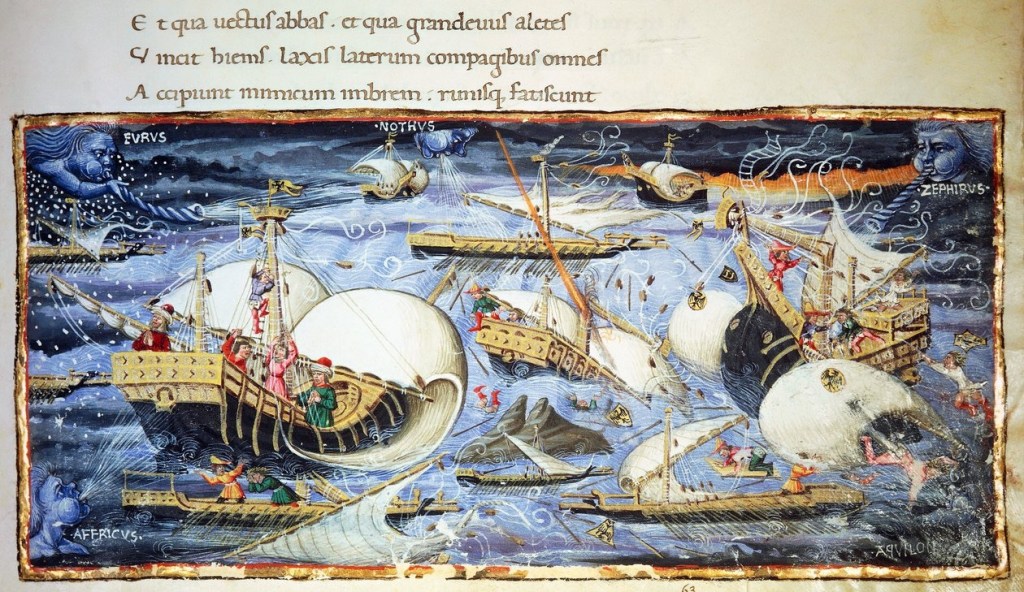
    Now that I am finally aboard the ship with Aeneas as I begin Book I, I want to decide whether to try the Virgilian lottery and join the king and the captain. But first, I want to see whether Aeneas deserves my accusation that he is a heartless man who, under the aegis of his sacred pietas, makes the women who loved him—his wife Creusa and Dido—face their fates.

  • Sunday Letter – 1

    Sunday, August 23, 2026

    Hi Freddo,

    I thought the heat had gone and had prepared for autumn clothes, but it was a vain hope. It was a trick of nature. The heat persists, and it is very hot. So, I have been staying in the living room with my cats because it is the coolest room and has an air conditioner. I hear that the heat wave has hit Italy, too. I hope you are okay.

    I just finished reading Elizabeth Taylor’s A View of the Harbour. It is about an English coastal village called Newby, where people’s lives are interwoven through weakness, treachery, and misunderstanding, for which they pay with loss and departures. It is written in the third person—an omniscient point of view that sees all and knows all. The perspective often shifts to that of the elderly, bedridden Mrs. Bracey, who watches people as if she were watching a television soap opera. But she can’t see the stories behind the people she watches, and, in fact, she doesn’t care. I wonder if God would be like her. He sees us from above but doesn’t want to interfere with our affairs, even when we want him to, because God couldn’t care less about them unless they relate to his worship.

    It seems that the sea always provokes the passion smoldering beneath conventions and norms, stirring the urge to let the flame ride the crest of the waves, clash furiously against wave upon wave, and then become one with the deep blue. In this regard, the sea alters none of it: human instinct, desire, the primitive id. The harbour is the superego because we know what we should and shouldn’t do under the community’s safe-harbor rule. Seen from the sea, the harbour is prudence.

    These are the things that came to mind after reading the book. I suspect that this multiplicity of interpretations is what Taylor wanted. In the post–Second World War era, people had lost their collective values and systems of belief, leaving them in an existential dilemma. But the sea doesn’t know it. The harbour keeps all of it inside, like a graceful swan with her legs paddling frantically beneath the water to preserve her poise.

    What do you think? Do you want to read the whole book? If you do, you will feel as though you are watching a British television drama, with various characters who seem ordinary yet harbor extraordinary secrets, and stories that unfold without ostentatious romance, extravagant affairs, or dashing bravado. For me, it’s viewable because it is relatable.

    Are you coming to California after the heat has subsided on both sides of the ocean? Let me know, and we can plan something together, like Prudence and Geoffrey in the book.

    Regards,

    stefania

  • So This Is It: The Glass and the Flame

    My First book ever selected and published by an independent press. I knew that one day I would have my own book published. It is not arrogance disguised as confidence. Writing has always been part of who I am.

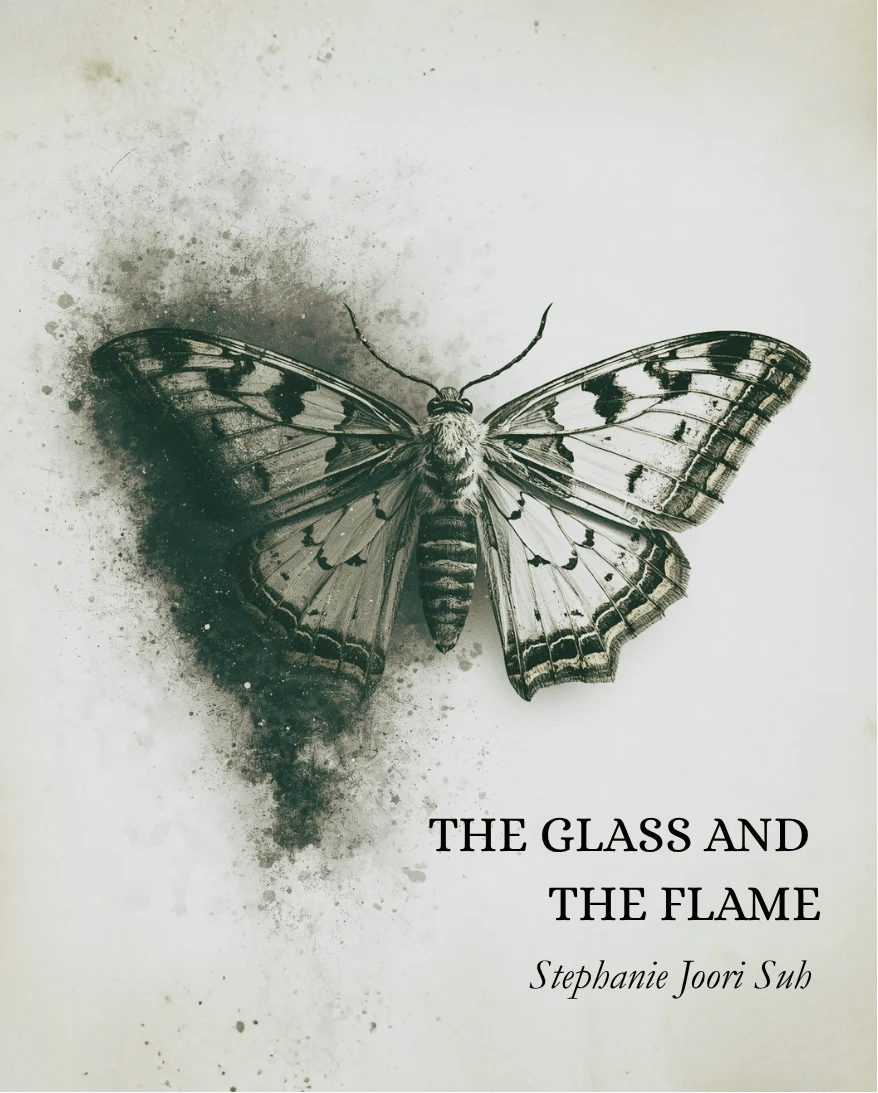
    The Glass and the Flame is a fugue of the heart, woven from multiple strands of longing and sorrow into a polyphony of eros and psyche. I have learned that you can write the felt without being met.

    The axiom that “you are who you are” is not necessarily true in my writing. Rather, I am what I write.

    In terms of Orwell’s reasons for writing, I write from aesthetic enthusiasm and sheer egoism. Neither political purpose nor historical impulse belongs to my work.

    If you dare, walk with me in the garden where Eros freely roams with Psyche.

    Listen to what I sing.

    The Glass and the Flame now lives in the world.
    You can find it here: https://dulcetshop.myshopify.com/products/suh

    Sincerely,

    Stefania

  • The Scent of Dusk

    I still have a bottle of Old Spice  
    and a bottle of Johnson & Johnson baby lotion;  
    I don’t know why.  
    
    I have left them on my vanity table  
    among my bouquet of perfumes.  
    
    To withhold the last vestige of you from time  
    is like keeping a child you have left.  
    
    Do you still use them  
    on the skin of your dusk?  
    
    The mixed scent of man and boy  
    is the imprint of your paradox:  
    shyness and boldness,  
    beauty and violence.  
    
    It’s domestic intimacy against time,  
    against its force of forgetfulness.  
    
    When I breathe in the scents together,  
    I see my long fingers tracing your cheeks.  
    
    Languor intoxicates the grammar of absence  
    I have learned  
    since you left the vertigo of you here.  
    
    I hope you have forgotten them  
    so that I can keep them here  
    in my bouquet of scents—  
    yours and mine.  
    
    I keep the alphabet of your name  
    written on the palimpsest  
    of the summer night.

    — Stephanie Joori Suh

  • prompt returns

    Daily writing prompt
    What’s a promise you made to yourself that you’ve actually kept?

    I collect promises like Swarovski jewelry, from necklaces to earrings, to bracelets, and more. I love pretty things, so I change them, but it all comes down to a few select ones that I usually wear to my heart’s liking. So are my promises. There are many, but only a few of them remain, and one of them makes it out to a World Cup final.

    I have always wanted to write a book that I can leave as my legacy, just so to prove I have lived, that I, Stephanie Joori Suh, lived, saw, and wrote. The thought that one day my body will become a speck of dust or ashes gives me a panic attack amounting to losing my eyesight completely. The ancient Greek poetess Sappho also felt the same, as found in one of her surviving fragments. Besides, there is something in me urging me to write as it is my nature. My father once told me that he had the same urge to write poetry, as his mother did too. Maybe it’s in the genes, like a family of practicing ancient secret rites.

    What I have done is to write my first chapbook of poetry this year. It is a collection of poems I wrote from my East Coast years to the present West Coast years. I auto-published a short story before as a Kindle Read, but this is my first time submitting a poetry chapbook to editors of ten presses. Some of them are for chapbook prizes, and some are regular chapbook submissions. And… one of them sent me an email last Wednesday that they wanted to publish my chapbook. I do not want to open a champagne early until I have an actual chapbook of mine in hand. Still, I feel I am in the procession of poets from the misty past and continuing as long as humanity remains.