Existence precedes
the secondhand identity;
Essence follows
the primary reality.
Where a fact finds a being,
Man defines a meaning.
P.S. The tenet of Sarte’s Existentialism is “Existence precedes Essence.” People love to criticize it because it lays bare to the starkest truth of life, even though they are all aware of it. Man defines himself where he stands in his life vis-a-vis his contemporaries, measuring himself against the burgeoning careers and just moderately settled lifestyles of his peers. I find this school of philosophy applicable to Charles Horton Cooley’s sociological theory of “Looking Glassed Self,” stating that you become what others think you are. Although I do not want to wholly subscribe to either of the thoughts, I can see where these thoughts come from: Human sentience, that is. Our faculty is rather instinctive than reasoning, physical than metaphysical because it reacts to an external stimuli much more than to internal principles of judgment. And I guess the age we are living in now is the apotheosis of sentient modus vivendi in many aspects…
“Our doubts are traitors and make us lose the good we oft might win, by fearing to attempt. – W. Shakespeare
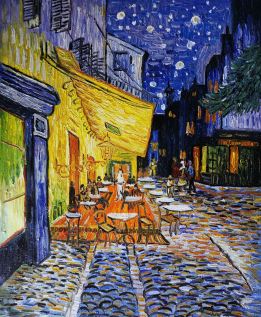
Cafe terrace at night by vincent van gogh
We all have our best registers, our natural octaves, and Judy’s was a flow of unsteady streams of flotsam and jetsam of peripatetic life that cut her adrift from the safe mooring in the orderliness of life. The detritus of contemporary life seemed to be piled up in her own Aegean stable, and she felt like Hercules to clear it all away just as he had been assigned to wash away the ancient filth of his Aegean stable. And she was at the moment of decision to figure out how to start it off. And it was at that moment when she was also befuddled with yet another indecision. Would she do it, or did she really want to do it? Or could she do it?
Judy was preparing for her initiation to the rite of conjuring up a fairy that was to serve her wishes and aspirations which she believed to be forfeited by her divisory lot. Whatever it was, whoever the perpetrator of such turpitude, Julie wanted to get things sorted out by encountering it face to face, even if that meant a risky business. She did not feel like a weird nor a devious satanist to get into the esoteric world of magic on the grounds of her knowledge about the history of religion and magic during the medieval and Elizabethan periods of England as well as the story of Dr. Faust. That those who were caught up in the existential vertigo of livelihood, literate or illiterate, rich or poor, man or woman, Christian or pagan, had often turned to the Other Side was a legitimate tendency, a sort of catch -22 attempt to grasp at a straw adrift on a life sea.
In fact, there was a veritable historical account of a Cambridge medical student in Elizabethan England who made a pact with the devil to procure money to repay his student loans. Whether or not he was dragged into hell upon his death was clandestine, but that was a fact of the matter. So why not? That was Julie’s self-rationalization. That was the proximate cause of her premeditated action. That was her own defense against the sordid fact of life that pushed her into where she was.
But here was Judy’s dilemma: what would a spirit be like? Would it be a female or male? What would it look like? Would I face an abominably hideous creature? Enveloped in a cloud of morbid speculations, Julie began to hesitate nervously, her spirit suddenly trapped in the intricate labyrinth of Anomie. Yes, the labyrinth, the one prodigiously built by the legendary architect Daedaius at the behest of King Minos of Crete named Knossos to lock up Minotaur, the half-bull and half-man creature born out of an unholy consummation between the Cretan Bull and Pasiphae, Minos’s beautiful wife, because Poseidon, the god of the Waters and the formidable brother of Mighty Zeus into the bargain made her madly in love with the Bull, which her husband had dared rescind the sacrifice of it to Poseidon and kept it to himself because of its magnificent beauty.
To tell you the truth, Judy felt sorry for the deformed hybrid of the bewitched union despite its bestial ferociousness calling for human sacrifice. The brutality in behavior was often a manifest result of violent upbringing in conjunction with a denial of love and absence of trust at an infant stage. The security net woven by a loving and caring relationship between a mother and a child was sine qua non of a well-being in both soma and psyche. That was the reason Julie had a sneaking, sympathetic opinion on the Ancient Monster. But she kept her sentiment toward the mythological beast to herself, lest she should be lampooned by others whose idea of justice was a draconian, Jacobean execution of justice that would take no prisoners. Or those whose minds were desiccated by a drought of humanities would declaim against Judy’s altruism. Nevertheless, Judy had no wish to simulate such sternness or gruffness to join the melee.
The whirlwind of thoughts was spinning like a potter’s wheel in her, and Julie was entranced into it rapturously. She let her mind dwell in it however long it would be. She loved the sensation of being drifted away into the world of fantasy, the world of dream, and fiction, as it was her a sanctuary amid the demands of everyday life. Was this the same kind of feeling E. B. White was feeling while he was looking at the beautiful young circus woman rider on a horse running around a grand circle during her performance? The Circle of Youth, the Circle of Beauty, that was. It was what enchanted White to follow her into the World of Magic, and it was what he felt the ecstasy of the sensuousness of Beauty.
It was synchronicity, a mental realignment to the mind of another sharing the same or similar intellectual or psychical formations by which Judy could connect with others readily and efficiently. As a matter of fact, it was one of her gifts of mind she possessed, but which was unrecognized. No, it was suppressed by the possessor. To acknowledge her uncanny ability would upend the course of her life. It would be a radical reconstruction of everything she had been grasping at, knowing that it would be a seismic turnaround of her insecure but sedentary life. And it was giving her a hard time all the more. And she knew it, but she resisted it, and that was her problem – a classic case of circulus in probondo
This is the beginning of my novella about a woman striving against the limitations imposed on her by reality with her fierce individuality and queasiness in her belief in destiny or fate. Her investment of spiritual discernment is her congenital gift, but that which makes her special defenestrates her to the perimeter of society like a cunning woman or herbalist in the Elizabethan England. Is she then a middling between an angel and a demon? Her search for the meaning of her so-called life, the secret of her existence is the linchpin of this daringly attempted story I have decided to conjure up in the peculiar alchemy of fiction.
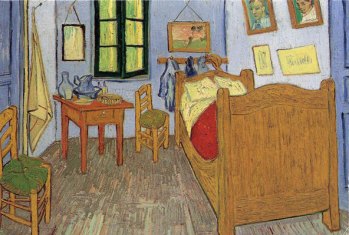
“Bedroom in Arles” by Vincent van Gogh
It was a cool, bright mid-Monday morning, but Julie was still in bed, in bed with her still tenebrous somber spirit returning to possess her once again because she – yes, that is Julie Faustine, a single, plain woman nearing to the acquisition of stoicism in life – fell into a reverie of perfidious rebelliousness. But let the description of Julie not complacently settle on your a priori premature postulation that she was one of those feckless, mediocre, and nondescript women deprived of what the world could offer to be a woman. Nary a bit. Her inner world was always in a perpetual restive tempest propelling her to sail adrift on her sea of life fraught with existential strains of life, which stunned her venturesome spirit and moored it in the stony stasis of inertia that was killing her softly. She was a hostage to fortune confined in existentialism that did not allow her all the privileges and rights of womanhood and femininity due to a covenant arbitrarily made and entered into by and among her ancestors and an ancient entity prior to her birth.
All this, all this preposterous truth was nothing but a real, physical one that was intractably lodged in Julie’s mind, and it was killing her softly. Nothing would be changed on my own, except the sure case of death, which would be a total force majeur situation. Christopher Malowe’s Dr. Faust was in league with me. And if I physically – and metaphysically – disappear from this earthly place, nothing would change. With such monologue in mind, Julie’s wish was to find herself in netherworld when she woke up in every new morning. No, it’s not pessimism or fatalism, but realism, whether you would agree or not with a sneer. W.H. Auden confirmed it in his poem, “Museum of Beautiful Arts.” Just as all the world’s great and terrible events, such as martyrdoms and nativities, took place amid everyday life, other people continued to do what they had been doing for their own interests. Whether or not you existed would not matter to the continuation of the world.
But as luck would have it, Julie woke up in this world yet again this morning, in this dysphoria of her failed and failing dreams, dwindled and dwindling aspirations, disappointed and disappointing facts, and frustrated and frustrating desires. How shall I die? It’s got be without inscrutable pains and gory details. Painless suicide will be the most cherished and coveted solution to expunge all my baggage. Thus contemplated Julie in her usual serious self. Then came the phantasmal display of the last day of Eva Braun and Adolf Hitler. When Eva and Hitler knew that their ends were impending as the Reich was soon to fall, they hastened to kill their lives together. Hitler chose a pistol, but Eva – being nothing but a woman herself with a reason none other than being a woman – mulled over which method she would employ to murder herself in the least painful but the most feminine fashion. Out of the musing came a method of poisoning herself because it would preserve her pretty face even after death in order that anyone, the Allied or her German volks, finding her corpse would still think she was a pretty being.
This story and image of Eva Braun still imprinted in Julie’s mind and imbued her with the selfsame way of beautifully saying adieu to her pitiful life. Nevertheless, this was never realized or did not seem to be realized at any time soon for some clandestine reasons made by the Fate, or the Fury, or the beautiful goddess Fortuna. And where would God be placed among these pagan elements? He would eventually come and vanquish all in the name of one Omnipotent, Transcendent, and Infallible of All in no time.
So much so that in Julie’s religiously conditioned mannerism of reconciling herself to the limits imposed by the Reality of This World, the image of God existed as a Bureaucrat aged somewhere between the fifties and seventies with a Victorian-style mustache and gravitas that would sting you to fumble with awkwardness, making you feel like a nincompoop. Julie was not a forceful character, and she would turn herself away from this humiliating embarrassment and would figure things out for herself, even though it meant a series of trials and errors over a long period of time all alone. That was her daring independent spirit. That was her most treasured possession. That was what kept her going against her senses and sensibilities. That was her lifeline and only one.
So it was another morning and the very first morning of a new week into the bargain. Intentionally waking up late in the morning, Julie forced herself to breakfast against her prior determination of foregoing food until she would find employment that would make her earn the bare necessities however little it would pay her. Would this be my home forever? Would I become visible in this new land? Would I start anew in this place? Then Julie’s innermost secret and hidden questions came to surface at last: Could I chance to love? Could a man love me despite my plainness? My paroxysm of moodiness? My humdrum presence? CUT THE CRAP, concluded Julie, for all these supplementary wishes and vain hopes were verbose and verbatim Without A Job. Surely, not all pretty women with jobs – good jobs like professional ones held by the writers of all those popular memoirs bestriding NYT bestseller list for weeks – promenaded with their beaus, but Julie, always angst-ridden and precariously sentient – moped around the whirls of her mental pagoda of melancholy. She could not help making parallels with her life, comparing herself with the illustrious careers of her peers.
The third week of unemployment was hard to bear, and it was daunting to bear even with her renowned stoicism, but her real passionate self defied it, cursed it, and bitched it. Still worse, radio silence following so-called officious interviews was the worst bitch. “Don’t take it personally,” was a bromide, a humbug, hokum out of human kindness, only to be cruel. Of course, it’s PERSONAL, when the parties engaged in the formal occasions were all humans made of blood and flesh, not robotics of steel and wire. That’s an infallible truth, n’est-pas? That’s a res ipsa loquitur case of negligence of truth, no?
All of this in her mind pushed her into the brink of a life’s cliff, leaving her one choice, and the only choice she could resort to: a Mephistophelean pact, it was. Yes, that’s darn right. She resolved to make a pact with the devil, and she was going to do it no matter what, either out of sheer spite against her fate or pure supernatural adventure or innocent curiosity. She’s up for it, and when she was in for the kill, she sure meant it. And it was today she would do it when the frivolous west sun was set, and the shadow of darkness began to cover the horizon in the way the sky god Oruanos covered the earth goddess Gaia to make love to her furtively in the dark.
A supernaturally pretty fairy deludes men’s hearts.
There are magical elements in religion, and there are religious facets to the practice of magic, as succinctly summed up by Sir Walter Raleigh: “The art of magic is the art of worshiping God.” That’s how I feel and what I see during my Dutiful Sunday Morning Masses, the ancient rite of the Church, a perennial panoply of syncretism with its splendid paraphernalia of prayers and the liturgical ceremony of rites and mechanical recitation of prayers; it is the melding of religions or beliefs of the similar elements but of different origins. Hence, to come upon an article in the recent issue of BBC History Magazine about an academic study by a certain British scholar of the existence of fairies in the context of the validity of cultural and historical artifacts gave me an uncanny pleasure.
The famous Dr. Faust, summoning Mephistopheles for his service
In fact, Religion (that is, Christianity) and Magic (in the forms of divination and sorcery) are not to be seen as polar opposites and antithetical systems of belief because they are interdisciplinary agencies of attempting to seeking and offering a panacea to our dilemmas – physical, metaphysical – competing for supremacy in propitiation. Such mysteriously syncretic elements of the two different agencies of beliefs became the academic subjects of intellectuals, such as Francis Bacon and John Aubrey who accepted the potentialities of physiognomy as an infallible guide to predicting one’s character and argued for the validity of non-Christian practice based on certain intellectual bases therein. With this in mind, you would not be surprised to learn that fairy summoning rituals were all the rage in the Renaissance period (15th~17th centuries), indiscriminately practiced by all strata of society, learned or ignorant, rich or poor, Christian or pagan. The author of the article informed the reader that the early Renaissance idea of fairies was pretty nebulous and varied with a wide arc of wonder and trepidation and that the dainty image of ever famous “Tinker-bell” was a Victorian construction of the whole fairy race.
Then, how did the “real” fairies look? Although there is no magisterial, definitive version of the physiognomy of a fairy, a collective description gleaned from various records boils down to it as a supernaturally attractive man/woman imperiling the souls of whoever it was summoned to, which is reminded of incubus/succubus, consecutively. Notwithstanding the dubious nature of fairies, the invocation of fairies halfway between angels and devils was widely used in hope to (1) acquire medical knowledge, such as whereabouts of herbs and their properties; (2) delight in the highest degree of sensual ecstasy; and (3) reveal the future and prevent from misfortune in advance. Be it as it may seem wholly pagan, the summoning ritual was surprisingly required for God’s intervention because it included periods of purification through abstinence, fasting, and prayer in preparation, all of which would testify to the sanctity of the performer ministering to the moral and ethical character. God willing, a fairy at request manifested to the summoner, but he should not come out of the circle he had drawn because it protected from sudden maleficence of the ambiguous fairy.
Delphic Sibyl from the Sistine Chapel fresco by Michelangelo
In sum, the article was an elegant primer for a further interdisciplinary study of literature, religion, and folklore from the medieval times to the Reformation period and possible stretching to this date. The exemplary texts that spring to my mind are Religion and The Decline of Magic by Keith Thomas and Christopher Marlowe’s version of the legend of Dr. Faust, both of which are excellent testaments to the contextualization of the esoteric knowledge on the grounds of intellectual bases into academic studies of social, cultural, and historical facets of different zeitgeists, which also serve as invaluable literary artifacts to epochal changes. But for all that is worth, this relation between religion and magic is commensal, exhibiting a mesmerizing consilience of gods and God, profane and holy, pagan and ecclesiastical, forbidden, and disciplined, as superbly unfolded in the Sistine Chapel fresco, prodigiously expressed by Michelangelo.
A wondering changeling
fairy-born ever drifting
bewitches beasts and men
and spirits them away in
one fell swoop then flies away.
P.S.: This very short poem about a woman whose peculiarities estrange her from groups of people where she goes despite her beauty due to a reason none other than her solitary nature born out of a pretty fairy mother and a peripatetic, feckless wayfarer. Plus, this poem of mine is an appendix to my prose entitled “Fairy summoning in Florentine Renaissance period”,” which is basically a review of a scholarly article about historical texts of summoning fairies in the Renaissance period, published hours ago.




You must be logged in to post a comment.