Tag: creative writing

  • The Collie Family

    The Collie family (Click here)

    I have written some episodic short stories about my Sylvanian miniature figures I have collected. Today I am posting the first episode of the Collie family which I wrote when I got them for the first time. Just click on  “The Collie family”, and it will lead you to the story in PDF format.

    I wish my blog geared by WordPress would show the writing with the pictures in its entirety without clicking on the link as above, but it does not seem to have such convenient function unless I change my current free plan to premium with a certain charge fee. (Yes, we all know the power of money in the capitalist society because it is a carte blanche.) Someday in near future I may change it to premium for more options for my blog. (Yes, I cannot help but conform to the norms of the society, as Aristotle says that humans are by nature social animals…)

  • Facing Unpleasant Facts by George Orwell

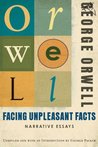
    Facing Unpleasant Facts: Narrative Essays (Before Orwell)Facing Unpleasant Facts: Narrative Essays by George Orwell

    My rating: 5 of 5 stars

    Eric Arthur Blair, better preferably known as George Orwell, wrote a series of essays that dealt with the subject matters close to the human life in the manner of a journalist with heart. This book is a definitive anthology of Orwell’s essays contributed to various magazines and newspaper that will invite the readers to the Orwellian world of reality as he saw and he liked.

    Orwell was capable of perceiving the absurdities of reality and truths masqueraded by ornamented political euphemism to obfuscate the masses for unscrupulous intentions. Of all his essays, “Why I write” is a paragon of his fineness as a great essayist. In the essay, Orwell provides the readers with sage guidelines for a writer, one of which is a choice of the subject matter that should be determined by the age a writer lives in. Such advice links with Leo Tolstoy’s view on great work of art to be closely related to the ethos of the time it is made. That is, a writer is unavoidably influenced by the ethos of the time he lives against his willful struggle to escape from solid reality.

    Orwell asserts that a writer should discipline his temperament lest he should be stuck at immature stage or depressive mood. A writer should think straight so that he can write clearly. This shows Orwell’s belief in writing not as a platform for babbling about his egoistically driven existential dilemma of daily life, for consuming his energy into such self-induced woes and pains will kill the creative spirit in him, the very impulse to express himself as he truly is. To my delight, Orwell further expounds 4 motives for writing as follows:

    (1) Sheer egoism: desire to be regarded as clever and much to be talked about. Writers are vain in the fact that they do want to be individuals, not compromising with the social conditions of reality. Writers can be egotistical and vain because of their elitist attitude toward the opinions of others and general opinions of the public, but are less interested in monetary reward.

    (2) Aesthetic enthusiasm: desire to beautify arrangements of words in pleasing manner by using a plethora of flowery words and rhythmical rhymes.

    (3) Historical impulse : desire to record historical facts of the time to pass the written records for the use of posterity.

    (4) Political purpose: desire to direct the world in a specific direction in order to influence people’s views on society in such direction as it should be

    The readers may find Orwell’s credo in writing rather anachronistic and dogmatic in consideration of the time the essay was written (1946). However, what rings the bell is the recognition of impulse to write as a sublime human act of expressing himself in connection with the time and society he lives in because as Aristotle put, “Man is a political animal.” This collection of Orwell’s poignant, honest, and witty essays will guide the readers into the mind garden of Orwell where moral obligation and the psychological facts are differentiated as pointed out in “Such, Such Were the Joys” and  where there is a pleasant, family-friendly pub called “The Moon Under the Water” with a privilege to appreciate Orwell’s brilliant display of language facility and power of facing unpleasant facts in his own words.

  • Waiting for Gotto

    rain.jpg

    Beneath the grey curtains of rain, there she was solo,
    Standing at a bus stop all alone where no one could find
    With her eyes gazing upon the road far away with eager mind
    Without a soul to join her solitary waiting for Gotto.

    But Gotto would not come in any minute soon to her,
    not coming forthwith, for she would have to wait longer,
    until her faith in him became flickering out and would disappear
    so that he would finally come and manifest her wishes so dear.

    And when Gotto came at his appointed time however uncertain,
    he would come incognito to make his adored presence certain
    by the conspicuous obscurity of the ordinary facade ever discreet,
    and her wishes to meet him would be fulfilled in secret.

    저장

  • Who am I?

    photoaaaaa

    Dear Readers:

    Hi there. Thank you for stopping by my blog. It’s always a pleasure communicating with people through writing, which I believe is the most authentic vehicle of expression of a self. My love of reading and writing inspires me to publish my thinkings in this blog. So Welcome All with my Whole Heart.

    My name is Stephanie Joori Suh, living in a suburban New Jersey town in the vicinity of the New York City. I work in the City for livelihood and write at home (or sometimes on the Second Floor in a Dunkin’ Donuts’ shop nearby my workplace) for selfhood. The great psychologist and thinker Viktor E. Frankl, who is also the founder of Logotherapy, has urged us that we strive for realizing our values that are: Creative Value, Experiential Values, and Attitudinal Values in order to arrive at meanings of our lives. How true it is! I believe those who write are united spiritually in fulfilling such noble deeds. We are kindred spirits.

    I may not write perfect English prose due to English being my second language. I may not sound ordinary in the sense that my writing speaks with certain streaks of foreignness. Nevertheless, it is my quest for actualizing what I possess inside by means of literary expression. And I have to purge it out, unravel the mystery in me that is dying for the discovery of the truth in me.

    Hence this little blog has come into being; it is the birth of my brain child, or rather the manifested ego qua meaningfulness as in terms of Logotherapy. So many thanks again for your readership, which is also meaningful to me.

    All the Best,

    Stephanie S.

  • Two Fellows – Part I

    two

    So there he was. You could always find him there at the same time, at the same place regardless of a change of four seasons, like it was his duty to do. Looking over the fence smartly seated on a rock on one balmy afternoon, Toto was calm and steady. His big brown eyes full of yearnings and visions glanced at the dancing leaves on the quince tree outside the fence where there were only a few fruits left because Grandma, being of generous and affable nature, had given the well ripe ones to the neighbors. However, such intermittently displayed quinces surrounded by the abundant leaves appealed to Toto’s inquisitive eyes: the way the leaves swayed to the tune of the breeze was a part of the nature’s orchestra that stimulated all of his senses, which ultimately led him to the outburst of his exhilaration in long howling like a wolf pup in the wild.

    Toto was a Jindo mix, aged 9 weeks or so. Toto came to Joe’s home on a cold winter afternoon a year ago with Pa who brought him in his jacket. He was a white puppy looking healthy but a bit apprehensive about the new surrounding. But mind you that there was no sign of fear in his eyes but intelligence. Joe named him Toto after a legendary dog in Korea who returned to his owner, an old woman who had given the dog to her nephew in a city miles away from her home in Jindo. So he wanted to have a dog whose faithfulness and loyalty would be equivalent of those of the legendary namesake. Joe wanted to keep his new puppy till the end of the world because he had lost Lana, a Samoyed mix puppy of 9 weeks old, to distemper 2 years ago. This time, Joe thought, would be the last time to let such thing happen to him and the dog. It was his new bound duty, a duty that suddenly appeared sacred and fateful to his destiny. Boy as he was, Joe was resolute in his new pledge to the life and protection of Toto as his guardian. Looking at Toto who was napping beside him on the rock by the quince tree, Joe could hear the whisper of the breeze that blessed his guardianship and fellowship of the human and the canine. What a nice afternoon it was to both the boy and the dog.

    “Joe, can you come here quickly?” It was Joe’s sister Judy. She was 16 years old, 2 years senior to him. Judy also loved Toto and dogs, although her favorite breeds were Labs, Border Collies, Shiba Inus, and Bichon Frises. She had been secretly entertained having a Bichon Frise until Pa brought Toto home. She had a soft spot for this particular breed since she had read about a homeless elderly man who sailed through the tribulations with his Bichon Frise dog named Willow; the image of the small, curly haired dog with large soulful eyes in the arms of the man still lingered in her mind. But it’s not that she did not lie their Toto. Toto was their another sibling, the youngest brother whom Ma had lost by miscarriage 6 years ago. Judy’s love of Toto was not to be confused with anthropomorphism because she loved Toto the way he was, the way Toto was the closest natural wonder. He was Judy and Joe’s guide to the natural world like Virgil to Dante in his journey to Hell, Purgatory, and Paradise. Through Toto, Judy and Joe could see the wonder of Nature in which all creatures existed and made the human existence all the more conspicuous by appreciating the pristine beauty which was to be beheld in the eyes of the innocent.