Tag: english literature

  • Lord of The Flies – When Id controls Ego

    hqdefault

    Lord of the Flies by William Golding is a mind-boggling story about a band of English young boys aged from 7 years and 12 years marooned in an island after a plane crush in the wake of atomic world war. Written in 1950s, the book questions the defects of human society in respect of the defects of human nature as symbolized by the stranded boys who have once civilized under the parental/societal guidance descends to savagery, the primitive state of human condition, which is operated by Id alone. And it only takes about 2 weeks or so to return to the instinctual stage of mankind. Which is all the more scary yet true whether we accept.

    There are two extreme characters in the story: Ralph, a headstrong, sophisticated boy whose father is a naval officer. His primary goal is to be rescued by a ship, to return to the the world of civilization where all’s will be normal and he will live normal. So his main concern is to keep fire ablaze to signal his existence, the last remnant of civilization, the surviving Ego that “wills” his societal existence struggling for existential meaning that a civil community confers upon his singularity and uniqueness for recognition. As Ralph asserts, “No fire, No smoke, No rescue.” To him fire is Hope that will save him from falling into savagery by which other boys blindly and almost unconsciously have become animalistic, acting on instincts to satisfy their most basic desire only: Eating by Hunting.

    The Hunters are led by obstreperous, belligerent choir leader Jack. In fact, the figure of Jack represents many interesting aspects of psychotherapy. In the respect of psychoanalysis by Fraud, he symbolizes Id that “drives” all his acts and modus operandi. To him fire does not seem to matter. He does not even want to be rescued. What he excites him is a process of hunting a pig – especially a female one – for provisional entertainment and survival on an island. In the view of individual psychology by Adler, gaining power over his “tribe” of the boys and becoming a chieftain by forcefully and unjustly abdicating the legitimate Ralph takes precedent of anything, including keeping fire and going back to the cradle of civilization. The limit of ego qua responsibility does not apply to Jack, who lets his Id dominate his being. According to logotheraphy by Viktor E. Frankl, Jack has ceased to fulfill his responsibilities as a cooperative cohort of Ralph to work together to protect themselves, to guard fire, to maintain their orders until a rescue comes their way.

    And there is pitiful Piggy. We don’t know the real name of Piggy. But we know that he does not want to be called such but that the boys, including the civilized Ralph, who can blow a conch by the encouragement of Piggy. The narrative tells us that it’s not that the accents or fumbling that makes him a buffoon of the boys; it’s his corpulent appearance that loses him respect among the boys. Besides, he’s the only one that wears a pair of spectacles are used as a magnifying glass to gather heat to make fire. In fact, I view the figure of Piggy as a voice of the intelligentsia.  As Ralph laments at the tragic death of Piggy, he’s the one who “talks sense.” In fact, his spectacles, cruelly damaged by the sneak ambush led by Jack and his savage tribe, symbolize the perspectives of the intellectual that view the state of human nature in danger of retrogression and decay to Zero, the raw, primitive nature devoid of existential meanings and values attached thereto. And the boys ridicule him, deriding his attempts to call their attention to reality of their situations and to address the substantial issues to be reckoned and resolved. Piggy is a Thinker, a voice of Rationality that does not seem to be a matter where Id and Ego stand in contention when human nature is stripped to its nakedness outside human society.

    To recapitulate, Lord of The Flies by William Golding attests to loss of humanity as a result of catastrophic event in which a survival of the fittest seems only true. This may include a war in consideration of the year the book was written; it’s 1954, only 9 years after WWII. Golding saw the evils of the war – the countless deaths, the famine, the ruins of houses and building and nature – the Wholesale Destruction of Humanity. What had once been a great civilization fell into a great catastrophe by the hands of Humankind.  A Paradoxical truth that ascertains decay of human society debased into brute savageness operated on ferocious instincts for survival… Lord of the Flies is the fable of the lost children for the adults.

    P.S. This is my another bygone writing about William Golding’s dystopian novel Lord of the Flies that I had written prior to the inception of my blog.

    저장

  • Tweet from Author Claire Fuller Again!

    Claire Fuller (@ClaireFuller2) Tweeted:
    @artemis1291 @wordpressdotcom:

    Thank you for reading it, and for writing such a lovely review.

    The morning began with another jubilee compliment, which I neither intended to solicit nor tried to canvass for, from no less a writer than Fuller herself! It doubled the aroma and taste of my regular morning coffee before heading off to work!

  • ‘Bitter Orange’, by Claire Fuller – review

    Bitter OrangeBitter Orange by Claire Fuller

    My rating: 5 of 5 stars

    Bitter Orange by Claire Fuller is a curious case study of a woman named Frances Jellico, masquerading as a fictitious memoir laced with escapism, voyeurism, narcissism, and eroticism, all glowing in the radiant color orange smothered by the shadow of forced guilt, self-loathing, and disorientation. Frances’s narrative is, however, far from being namby-pamby, importuning the reader with her litany of her woeful life. Rather, it is her remonstration of her failed dreams, rejected desires, and unfulfilled purposes with the world she believes has always turned its back against her in the most callous way. Her only revenge for the betraying world is her death, which bestows upon her the kind of liberty she wanted to purchase in one hot summer in an idyllic English suburb twenty years ago. It’s a mad, bad, and sad drama of Frances through which Fuller plays the last swan song of a deeply troubled woman in emotional distress with her masterful storytelling skills.

    Written in the first person narrative, the reader will directly glimpse into the inner world of Frances whose days are numbered without superabundance of mawkish sentiments. In fact, it echoes Edgar Allen Poe’s “The Tell-tale Heart” in a way that  exudes a momentum of gushing stream of consciousness of a narrator that feels a combination of anger and dismay, sorrow and loneliness, and illusion and paranoia. That feeling of abstract emotions becomes physical by the witchcraft of Fuller’s atmospheric descriptions of scenes and rich dialogues. Fuller does a beautifully nuanced job of capturing all the conflicting emotions that put you in trance, carrying you over to the psych of the other.

    In comparison with Dora, the subject of Sigmund Freud’s case study of hysteria, Frances’s dilemma is more existential, more corporeal, and more noogenic in terms of the cause and the nature of her Uber-Angst. To diagnose Frances’s symptoms as a typical case of female hysteria commonly associated with a timid, introverted middle-aged virginal woman does a disservice to the woman who struggled to right the ship of her drifting life all alone. IT goes against the grain to dismiss France’s story as a mere dalliance with a hedonistic couple named Cara and Peter during her brief sojourn or a pitiful attempt to break free from her socially gawky, ill-fitted rotund virginal self at the expense of her naivety. France’s narrative attests a sense of disorientation of her life without a clear vista of purpose in her life due to the lingering influence of her dead gloomy, domineering, sordid mother who bound her entire being under the rigidity of religion and morality.

    Subsequently, Frances suffers from noogenic neuroses, neither pathological not pathogenic of origin, but of existential distress. In other words, Frances is not a basket case, but a human derelict adrift on a sea of life, brutally defenestrated from the comforting mooring of loving relationship and social connections by her also neurotic mother who blamed her daughter for almost anything. No wonder Frances associates her rotund appearance with her weight of guilt that is in fact nothing but her delusional imago forced upon her. In this regard, France’s narrative outstrips Freud’s Dora case with far more in-depth interior monologue of the narrator endowed with high intellect, impressible curiosities for life, and unyielding desire of being connected with the world outside herself.

    Fuller is a riveting writer of dialogue and scenes, all the artistry in the marks upon the page after page, wielding a pen across the pages in an expense of her boundless imagination that seems wholly realistic and ingeniously creative, producing aesthetically sensuous ambiance of the story, as if she were painting a Renaissance triptych featuring three naked adults making furiously and frantically passionate love with one another in an Arcadian English garden tinged with citrus scents of oranges, which likewise symbolize lust, desire, and passion, all flatly denied to Frances in Bitter Reality. And it is in this subtle respect of Frances’s smoldering indignation at such cruel denial of her yearnings only natural to any woman – young and old, pretty and not-so-pretty, smart and not-so-smart – that Fuller’s vivid imaginativeness and keen observation of psyche of characters manifest to the fullest extent and hold the reader’s undivided attention throughout the book with gusto and pleasure that will make you become titillatingly insatiable as you go deeper into this arresting story.

  • Colony of Time

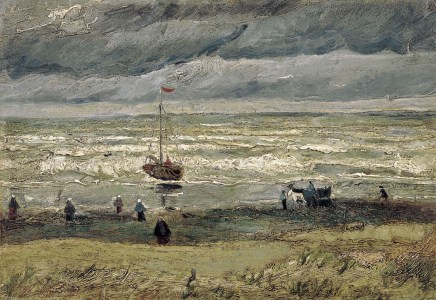
    160930092313-vincent-van-gogh-stolen-painting-sea-at-scheveningen
    View of the Sea at Scheveningen by Vincent Van Gogh

    Rapacious Time feasts on all things
    Commandeers it all within his reign,
    Ousts everything from its primeval place.
    Nothing is granted for long to remain.

  • Catch-22!

    Our doubts are traitors and make us lose the good we oft might win, by fearing to attempt. – W. Shakespeare

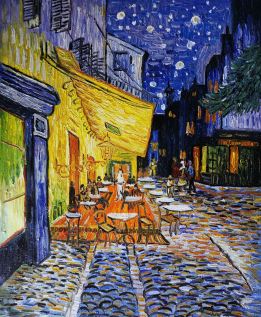
    Cafe-Terrace-at-Night-Oil-Painting-Reproduction-Canvas-by-Vincent-van-Gogh
    Cafe terrace at night by vincent van gogh

    We all have our best registers, our natural octaves, and Judy’s was a flow of unsteady streams of flotsam and jetsam of peripatetic life that cut her adrift from the safe mooring in the orderliness of life. The detritus of contemporary life seemed to be piled up in her own Aegean stable, and she felt like Hercules to clear it all away just as he had been assigned to wash away the ancient filth of his Aegean stable. And she was at the moment of decision to figure out how to start it off. And it was at that moment when she was also befuddled with yet another indecision. Would she do it, or did she really want to do it? Or could she do it?

    Judy was preparing for her initiation to the rite of conjuring up a fairy that was to serve her wishes and aspirations which she believed to be forfeited by her divisory lot. Whatever it was, whoever the perpetrator of such turpitude, Julie wanted to get things sorted out by encountering it face to face, even if that meant a risky business. She did not feel like a weird nor a devious satanist to get into the esoteric world of magic on the grounds of her knowledge about the history of religion and magic during the medieval and Elizabethan periods of England as well as the story of Dr. Faust. That those who were caught up in the existential vertigo of livelihood, literate or illiterate, rich or poor, man or woman, Christian or pagan, had often turned to the Other Side was a legitimate tendency, a sort of catch -22 attempt to grasp at a straw adrift on a life sea.

    In fact, there was a veritable historical account of a Cambridge medical student in Elizabethan England who made a pact with the devil to procure money to repay his student loans. Whether or not he was dragged into hell upon his death was clandestine, but that was a fact of the matter. So why not? That was Julie’s self-rationalization. That was the proximate cause of her premeditated action. That was her own defense against the sordid fact of life that pushed her into where she was.

    But here was Judy’s dilemma: what would a spirit be like? Would it be a female or male? What would it look like? Would I face an abominably hideous creature? Enveloped in a cloud of morbid speculations, Julie began to hesitate nervously, her spirit suddenly trapped in the intricate labyrinth of Anomie. Yes, the labyrinth, the one prodigiously built by the legendary architect Daedaius at the behest of King Minos of Crete named Knossos to lock up Minotaur, the half-bull and half-man creature born out of an unholy consummation between the Cretan Bull and Pasiphae, Minos’s beautiful wife, because Poseidon, the god of the Waters and the formidable brother of Mighty Zeus into the bargain made her madly in love with the Bull, which her husband had dared rescind the sacrifice of it to Poseidon and kept it to himself because of its magnificent beauty.

    To tell you the truth, Judy felt sorry for the deformed hybrid of the bewitched union despite its bestial ferociousness calling for human sacrifice. The brutality in behavior was often a manifest result of violent upbringing in conjunction with a denial of love and absence of trust at an infant stage. The security net woven by a loving and caring relationship between a mother and a child was sine qua non of a well-being in both soma and psyche. That was the reason Julie had a sneaking, sympathetic opinion on the Ancient Monster. But she kept her sentiment toward the mythological beast to herself, lest she should be lampooned by others whose idea of justice was a draconian, Jacobean execution of justice that would take no prisoners. Or those whose minds were desiccated by a drought of humanities would declaim against Judy’s altruism. Nevertheless, Judy had no wish to simulate such sternness or gruffness to join the melee.

    The whirlwind of thoughts was spinning like a potter’s wheel in her, and Julie was entranced into it rapturously. She let her mind dwell in it however long it would be. She loved the sensation of being drifted away into the world of fantasy, the world of dream, and fiction, as it was her a sanctuary amid the demands of everyday life. Was this the same kind of feeling E. B. White was feeling while he was looking at the beautiful young circus woman rider on a horse running around a grand circle during her performance? The Circle of Youth, the Circle of Beauty, that was. It was what enchanted White to follow her into the World of Magic, and it was what he felt the ecstasy of the sensuousness of Beauty.

    It was synchronicity, a mental realignment to the mind of another sharing the same or similar intellectual or psychical formations by which Judy could connect with others readily and efficiently. As a matter of fact, it was one of her gifts of mind she possessed, but which was unrecognized. No, it was suppressed by the possessor. To acknowledge her uncanny ability would upend the course of her life. It would be a radical reconstruction of everything she had been grasping at, knowing that it would be a seismic turnaround of her insecure but sedentary life. And it was giving her a hard time all the more. And she knew it, but she resisted it, and that was her problem – a classic case of circulus in probondo