Tag: english literature

  • Isn’t this irony?

    Our post-modernist culture is nuanced with anti-establishment of anything traditional and proper, such as decorum, mores, and codes of chivalry. The result of degradation of the values under the pretext of establishing a New Brave World is illustrated  in the following cases of Manifest Grand Irony of Liberalism that is supposed to be synonymous with altruism and niceness.

    ima
    A Nazi sympathizer? Are you kidding?

    According to this week’s edition of The Spectator, an anonymous former British Prime Minister revealed his hatred toward Theresa May by saying that she should be stabbed or done harmed in the most despicably atrocious fashion that reminds me of the gruesome murder of women by the Reaper of Whitechapel in the late Victorian period. Then there is a British conservative party leader named Esther McVey, who was maliciously excoriated by John McDonnell, a British Labor party politician instigating the mass in public to “lynch” her. Also, the First Lady of the U.S. Melania Trump was criticized for her supposedly apocryphal colonial fashion in Egypt by the media which also prompted the subsequent rebukes from the public. And this does not stop in the West. The first female president of Republic of Korea, Keun Hae Park was preposterously ousted by her radical left-wing contender Jae in Moon on the count of accepting bribery from a prominent business conglomerate based on unfounded grounds. Besides, Moon’s myrmidons maligned her reputation with indecent computer-generated photo-ops of her to destroy her political career as well as her personal life in prison because she was a leader of a conservative party.

    What the aforesaid ladies have in common is not only their conservative affiliations but also their social defenestration from their societies that show neither sympathy nor solidarity among the members of the parties and of the humanity in general. But then, woe betides anyone declaiming against the faults of the demagogues! Criticism of a political rival on different stances with courtesy is countenanced and actually encouraged in democracy, but contextualizing it in the egregiously violent words toward the women amounts to terrorism and therefore should be publicly deplored in full force and effect. Besides, however strong-willed and imperturbable the aforesaid women might seem in public, they are “ladies” deserving being treated with courtesy, for none other than being women because they are women. Where has all the honorable, respectful chivalry gone? It’s a code of honor, civility, respect toward womanhood that is transcendent of geographical, cultural, and racial boundaries. Just because they are conservative does not give anyone a license to harass them with malicious verbal remarks or gestures marshaling a mass prompting for the behoof of their political hegemony.

    To top it all off, the aforesaid betrays the usual faux-pas of declining against their contenders ad hominem, not on the ground of substantive factors or evidence, as Shakespeare corroborated thus: “Condemn the fault, and not the actor of it?” So it’s not altogether based on the standard of Reason but the manifestation of appetites, the raw emotions, the unbridled egos. Sounds antiquated, abstract, or even priggish? – Maybe so, but the men speaking about the women in the aforesaid manner are beyond the pale because it IS a violence of men in power against their women peers in a form of sordid verbal harassment. And it makes me wonder why #MeToo tweeters seem to connive at it, doing nothing to mobilize the supporters for pillorying the guilty men as usual.

    저장

  • Jane Eyre (1983 BBC TV Mini-Series)

    BBC_JaneEyre_1983
    Jane Eyre, the Timeless Classic

    Charlotte Bronte’s Jane Eyre (under the pen name of “Currer Belle” to discombobulate her biological determinism) is neither a romantic novel about a lonely young woman falling for her rich master nor a proto-feminist literature subtly championing women’s economic independence and choice to select their lovers on their own. It is a story of a resilient and noble spirit armed with education, clothed in a canopy of humanity, and adorned with reflective beauty of the mind that transforms physical plainness into comeliness. That’s what makes our heroine Jane Eyre timelessly unforgettable, undeniably attractive; perchance, that’s why this novel has been made into a series of film versions for television and cinema resurrecting the ambiance of the period and bringing the hauntingly impassioned characters into life. Of all the dramatized adaptations of Jane Eyre, this 1983 BBC mini-series version merits itself in the movie firmament as the authoritative translation of Charlotte Bronte’s original novel, wonderfully delivered by a cracking screenplay, a brilliant cast of performers, and a correct setting of the story, resembling none other than themselves altogether in this riveting panoply of Bronte’s dazzling creation.

    Dramatized by Alexander Baron, this TV series is composed of eleven episodes that faithfully capture the epochal moments of the passionate heroine Jane Eyre from the moments she was cruelly castigated by her callous aunt and her equally sordid cousins to her eight years of boarding school experience, to the fateful encounter with the brooding but vulnerable Mr. Rochester, and to the significant events packed full of surprises and serendipity worth every reward to the lonely Jane. The gem of this BBC miniseries is that each of the episodes is treated as a small story – that is, a story embedded in a whole story as if it were a short story itself – so you can skip the early years of Jane and jump into her employment as governess for Adele, the only daughter of Mr. Rochester at Thornfield without feeling adrift from the previous story that will defenestrate you to the middle of nowhere in the whole story. Of course, for those of us who have read and re-read the novel since the time immemorial, it’s a foregone conclusion, but even if you haven’t, take heart and play it fast forward to meet the grown Jane (although she’s only nineteen years old.) in her tantalizing, suspenseful moments with Mr. Rochester and even St. John Rivers.

    jane_1983_2_314x465
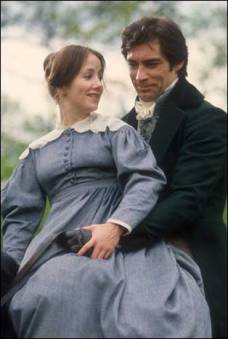
    Zelah Clarke as Jane Eyre and Timothy Dalton as Edward Rochester

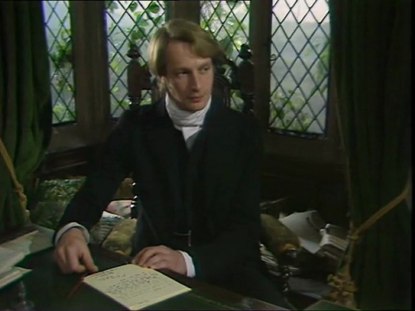
    At the heart of the drama lies the commendable performance of the characters: Jane Eyre, played by Zelah Clarke, Edward Rochester aka “Mr. Rochester,” by Timothy Dalton, and St. John Rivers, by Andrew Bicknell invest the drama with the beautifully nuanced dialogues and gestures, which are never outlandishly displayed, vying for individual attention, but harmoniously concerted that impart the enthusiasm and the verisimilitude to the story. The appearances, gestures, and diction of these three characters are exactly what I have always imagined them to be in my mind’s eye. Clarke’s rendition of Jane Eyre is the finesse itself that would make Charlotte Bronte happy with her performance as well as physiognomy. Jane is a passionate soul, but conservative, if not conventional. She is an intelligent woman who loves her gruff but deeply hurt and lonely Edward Rochester as her equal despite a sea of an age difference and his petulant past. Unlike other Jane Eyres played previously and posteriorly, Clarke’s Jane epitomizes the heroine of oddly beautiful enigma personified: the plain but pretty, expressive but demure, passionate but docile, sensitive but intense, patient but yearning… Which is befittingly summarized by St. John Rivers, wonderfully and unforgettably played by Andrew Bicknell: “She has an unusual face rather…The grace and harmony of beauty are wanting in her features. She is not at all handsome…” I have seen other film versions of Jane Eyre, but none other than this Clarke’s Jane Eyre has won my approval in terms of all things regarding the heroine of Charlotte Bronte’s original novel.

    x1080-VfL
    Andrew Bicknell as St. John Rivers

    That goes the same for Timothy Dalton’s irrepressible Edward Rochester and Andrew Bicknell’s stoical but misguided St. John Rivers. On a personal note, Bicknell seems to nail the role down as handsome and intelligent St. John Rivers, who prioritizes his religious duties as a parson over his human feelings and emotions for his beautiful and kind-hearted admirer Rosemund Oliver in the irrational belief that stoicism is the grist for the mill of vocation as a man of the cloth. He believes that it is his calling to be a missionary in India and that it behooves him to abnegate sensuous delights to which a man is naturally inclined with all his might. Watching Bicknell playing the character makes me wonder if the casting director or the screenwriter had the uncanny ability to conjure up the spirit of Charlotte Bronte and ask of her the fitting image of the character before the production of the drama. The tall, imposing manly figure of St. John Rivers with beautiful Grecian facial features and golden hair is just as the description created by Bronte in the novel as if she had seen Andrew Bicknell in the peculiar alchemy of literature that enabled her to look into the future and to view her character incarnate.

    All in all, this 1983 BBC miniseries of Jane Eyre will arrest your full attention to every scene of the episodes without infelicity and pomposity that classical period dramas sometimes tend to produce on account of obsolete diction and rude gestures that look incongruously emphatic to our modern senses and sensibilities. This is a quaintly gorgeous drama without the ostentatious glamor of television drama exhibiting luminous Vanity Fair; it shows that just simple good scripts based on the loyal adaptation of the original novel and excellent performance of the fine cast that seems to be destined for the roles can translate the imaginative world of the author into the visual firmament of television drama this beautifully and impressively in a way that makes you feel the emotions of the characters by passing over to their inner worlds.

    저장

  • All Things to All People: on the importance of education by Daniel Defoe

    Daniel Defoe (1660-1731) was something of a daring noble rebel. If the name does not ring a bell to you at first blush, the name “Robinson Crusoe” will dawn on you with the popular images of the character and his faithful servant Man Friday constellated in film and animation firmaments. Defoe’s timeless classic Robinson Crusoe popularized the form of English novel along with Samuel Johnson’s epistolary novel Pamela in the canon of English literature. A writer conscientious as well as prodigious, Defoe did not hesitate to put his credo into actions by wielding his pen across paper. His bounteous works were in fact used as his arsenal of intellectual arguments against the ills of the society he did not fail to notice in all aspects of everyday life, such as the mistreatment of women, the poor, and those whose beliefs did not conform to the Church of England in his time. Defoe was neither an intellectual snob nor a hypocrite; in fact, he was not afraid of speaking his mind in a most poignantly cogent way as manifested in this short prose “Charm School for Women” from his essay on The Education of Women (1719) in which Defoe pillories canonical discrimination against women as grave injustice against humanity.

    Defoe believes that it’s a lack of education that makes a woman proverbially turbulent, clamorous, and uncouth by comparing the soul in the body to a rough diamond that must be polished to its most naturally brilliant luster in order that its true beauty is manifested, just as the soul is thus distinguished from nondescript melee or even brutes. Defoe criticizes that men make women brutes by preventing them from being made wiser by dint of denying them the advantage of education because of the fear that the new enlightened womanhood will vie with the manhood in their improvements. Defoe then suggests that women be taught languages, especially French and Italian with a special focus on a subject of history so as to make them understand the affairs of the world and how they swing and thus wise.

    In my point of view, such emphasis on the study of history strikes the chords with John Milton’s provident observation that: “Poetry makes us witty, but history makes us wise.” Knowledge of history enables you to realize a commonality between the bygone eras and our time in the discovery of truth of human nature across a great divide of time and space, so that we may learn from the past and use the knowledge as to better the world in our time, which will be an ongoing cultural enterprise so long as the human race exists. The universality of truth in satisfaction of reason and the cyclical nature of human affairs have been manifested in the Holy Writ as follows: “There is no new thing under the sun” and “Old things are become past; and lo! All things are become new.”

    Defoe’s viewpoints of women’s education is far from patronizing or condescending in the capacity of a sympathetic or lenient master deigning to address to his maids. On the contrary, he speaks as an altruistic, eager academic who feels for the pathetic states of women deprived of the privileges of education that will do a world of wonder to womanhood if equitably given. He avers that proper education will teach women the proper management of their natural wits, so that they will prove to be very sensible and retentive. Therefore, to withhold women from the crown of education is injustice itself, which in my opinion also goes against Christian charity in terms of sharing what you already have with those who do not in order to double the joys and cut the misery in halves. Moreover, the refined women’s souls as a result of education are the grist to the mill of society with more culturally refined and publicly civil-minded individuals. In light of Defoe’s provocatively humanistic perspectives on the education of women that does not smack of flagrant political ideology to gain popularity of womankind and his beautiful allusion of a woman’s soul to a rough diamond in its primordial form, this brief treatise on the importance of education of women is an illuminating read worth the noting with a nod.