Tag: english literature

  • universal man: ‘Ben Jonson: A Life’, by Ian Donaldson – review

    Ben Jonson: A LifeBen Jonson: A Life by Ian Donaldson

    My rating: 5 of 5 stars

    I have always been drawn into a writer whose noble ambition and unswerving individuality are distinct from those of the officialized popularity of famed celebrities simply because of the sheer provocativeness of the author translated into the textual world of reality, which is a reflection of his conceptions by the barrier he establishes proudly and profoundly against those of others. In fact, it is this unapologetic individuality that enables the author to become what he is capable of in protean varieties; an alchemist of words, a high priest of the temple of Apollo, a mortal equivalent of Hercules, a neo-classist of a new renaissance, an independent scholar of the great leaning, and a humanist committed to the Classical principles to contribute to the new capital of the Arts. The hero of the splendid epithets is no less the poet and playwright than Ben Jonson himself, and it is in this superbly told biography Ben Jonson: A Life that his modern disciple Ian Donaldson resurrects the person of Jonson in flesh and spirit vividly.

    Ian Donaldson’s Ben Jonson begins with the burial ground of Jonson and then comes alive as Donaldson presents the protagonist Jonson through a phantasmagorical display of the epochal chapters of Jonson’s life as though to be screened for posterity in Immortal Theater of Art. Donaldson’s capacity of screenwriter and director of Ben Jonson’s dramatic life is deprived of blind idolization of Jonson as a suffering lone wolf-typed writer whose brightness was unfairly adumbrated by that of his contemporary peer William Shakespeare, nor is it intent upon accounting the greatness of Jonson over Shakespeare by elucidating the dichotomic feud between the two equally but differently brilliant literary stars in the constellation of Arts. Also, the book rejects the conventional mode of biography in the frame of “cradle to grave” by guiding the reader through specific epochal moments that profoundly influenced Jonson both personally and professionally during one of the most politically and religiously turbulent periods in the history of Great Britain.

    Rich in details of the political and social backgrounds of Jonson’s plays and poems in addition to his personal elements that make him stand out among the contemporary literary figures, Donaldson follows the Thucydidean way of examining the history of Jonson in attempt to transcend the subjectivity of the time and popular opinions on the subject and to balance scholarly objective equilibrium to test the validity of truth about the subject matter to the extent possible by holding his express personal opinion thereon. The result is myriad imaginations and images of Jonson as the reader likes to create, whether it be that of dauntlessly confident Achilles, wisely ambitious Agamemnon, divinely valorous Odysseus, or compassionately passionate Hercules.

    Upon reading this book, I saw the images of Rodrigo Mendoza played by Robert De Niro from the excellent film “The Mission” and Ben Jonson as himself springing from my mind’s garden as both of their faces a piece like a great Ancient Greek statue. Both of them are passionately devoted to their causes, unfailingly humane, and admirably courageous in fulfilling their destiny to achieve their noble ambitions for the good of humanity – one for the building of terrestrial heaven governed by deeds according to the Gospel in the case of Fr. Mendoza and the other in the person of Jonson for the reconstruction of British Renaissance based upon classical principles as a stratagem of moral and artistic reform. And behind this fascinating literary witchcraft lays Donaldson’s superb biography of Ben Jonson that successfully resurrects the noble and heroic spirit of his literary Hero whose work is enshrined in the Temple of Divine Arts as a scintillating star of the Humanities. And I am sure that Jonson is so happy with Donaldson’s account of his life that he introduces his biographer to the Immortals (including his chum Shakespeare) and that they are having a divine feast with heavenly wine in a constellation of literary stars evermore.

    View all my reviews

  • ‘The Secret Diaries of Charlotte Brontë’, by Syrie James- review

    The Secret Diaries of Charlotte BrontëThe Secret Diaries of Charlotte Brontë by Syrie James

    My rating: 5 of 5 stars

    Who would have thought that the woman with a calm and dainty exterior wrapped in an air of impeccable propriety was inwardly a passionate Dido, a willing Ariadne, and a beguiling Cleopatra?  Such a popularly conceived false shadow – by default of nature against her will – might have conveniently belied Truth and Nature of her substances to the eyes of the public, but her labors of love in the form of literary works bear the witness to the person of the Author. She is no less a person than Charlotte Bronte herself who created one of the most unforgettably iconic romantic characters of Jane Eyre, and who tells to readers of the millennium the stories of her own life in this beautiful and truthful The Secret Diaries of Charlotte Bronte by Syrie James.

    The Secret Diaries of Charlotte Bronte is neither nonfiction nor fiction eulogizing the greatness of the literary Titaness in the English literature. In fact, it is this mysterious ambit of the genre that gives to the book the status fused with the whimsicality of cross-over nonfiction in the likeness of fiction that reads like an enchanting novel. Drawn on the original diaries, miscellany, and poems written by Charlotte Bronte in frequent collaboration with her equally gifted sisters Emily and Anne, James does a superb job of weaving a tale of her admired literary muse as an admiring votary into one fascinating tribute narrated by Bronte herself as though to render her poetic justice on the truth and beauty of her person which had been largely unrecognized, if not ignored, in the discourse of the tale. In fact, reading this book, you will find yourself reading a posthumously published work of Charlotte Bronte with the style of writing, the tone of the narrative, and the sequence of the story, all of which superbly resurrect the atmospheric ambiance of the 19th Century English province. In this magical craft of writing, you will see Charlotte in the humble personage write in an expense of will and emotions, pages after pages filling them with heartfelt words, producing beautiful melodies of her heart and the soul.

    The beauty of this book collapses three centuries, five oceans and seven continents between Charlotte’s lifetime and our reading it, making us intimately acquainted with one of the most celebrated writers in the world. James is excellent in portraying Charlotte Bronte based on the extensive research on the original manuscripts and visitation to the places where she had trodden and lived as authentically as possible, with her immense admiration for the author delicately nuanced in the narrative, thus rendering the story the power of reality and authenticity of truth in the likeness of contemporary memoirs. That said, I am certain that Charlotte Bronte would have given the book the imprimatur willingly and wholeheartedly had she read it for review. And I also believe that her spirit would also love this book and bring it to the world beyond in all and mirth and merriment.

    View all my reviews

  • poesie – i dream myself alive

    cheret8

    Awake I know I dream not

    As the sense still alive

    Tells what is seen is not

    A fancy but a reality alive

    Of the wonder of the mind

    Working wonders of creation

    Of a fiction of the mind

    In a mind’s reservoir. 


    Awake I think when I dream

    As the pulses of sense weaken

    And the images seen past seem

    All but phantasmal panorama seen

    In a mind’s theater of illusion – 

    Fantastic beasts, wailing ghosts

    Enveloped in the cloud of dreams

    Lurking in the stupor of the sense. 


    Awake, awake, awake I become

    When the sense divorces fancies

    As the mind calls dreams hokum

    And claims a seat of imaginations

    Till it clears the clouds of ignorance

    Darkening the light of the mind wondrous

    Of creating the reality of its sovereign own

    With no assistance of chants and spells. 


    P.S.: Thomas Hobble (1588-1679), an English scientist and philosopher, excoriates in his essay “You and Your Dreams” the knavery of sham magicians and magical folk claiming to deal with supernatural beings to induce naive people to believe in superstitions and the power of magic for the promotion of their trades. Hobble enlightens readers that superstitions arise out of the ignorance of distinguishing imaginations, a second-hand reality, from dreams, a detritus of agitated part of the mind. The gist of his argument is that ghosts and haunted places ensue from an intractable combination of the images of the seen and the second-hand images that become distorted imaginations made look real.  In sum, Hobble’s theory of dream interpretation corresponds to the postmortem dream theories of Carl Jung. Hence this poem is my understanding of Hobble’s essay on the aforesaid subject. 

  • a league of their own

    2294848759_75990646f3_b

    Reading a section featuring a small, pleasant Q&A type of interview with a writer in The New York Times Book Review on restful weekends gives me a kind of voyeuristic fillip to be privy to the life of the writer; moreover, the usual question of whom to invite for dinner is the gist of such small pleasure. I’ve found it quite stimulating to think about my own list of people to have dinner with. Therefore, I have herein drawn up my own list of invitees to confabulate with. Here’s my list of guests:

    • Eleanor Roosevelt: The paragon of the First Lady of the United States with Intelligence that ministered to her moral character, she put her philosophy into action by actively participating in social services. Besides, Mrs. Roosevelt possessed a polished but common sense of humor and wits communicative to people of all social strata with her timeless adage: “No one can make you feel inferior without your consent.”
    • Joan of Arc: The Virgin of Lorraine, The Patron Saint of France… Such are the epithets of this patriotic French maiden who was burned alive on the counts of witchery and treason, which was of course conspiracy concocted by the French ecclesiastical dignitaries collaborating with the English against whom Joan of Arc fiercely and courageously fought to victory. She was neither a religious fanatic, nor a hallucinated mooncalf, nor a certifiable schizophrenic. She might be a simple peasant woman but a courageous, headstrong, and smart woman of faith who did not even protect her face during battles with the English amid the attacks of sharp arrows, axes, and lances. No wonder did Mark Twain praise the Virgin Knight forthwith: “Whatever thing men call great, look for it in Joan of Arc, and there you will find it.” Besides, her simplicity of faith excelled the pomposity of ecclesiastical knowledge by saying thus: “About Jesus Christ and the Church, I simply know they are just one thing, and we should not complicate the matter.” I can learn many things from Joan as a True Model Woman who embodied Intelligence, Femininity, Courage, and Faith.
    • Marilyn Monroe: Born as Norma Jean Baker, she was not a blonde bimbo whose physical attractiveness belied her ceaseless pursuit of knowledge concomitant with her pursuit of the meaning of life she desperately wanted to ascertain. Monroe enrolled in evening college courses in New York City when she had no schedules during the daytime. Behind her pretty persona of a movie star, there was a profound shadow of existentialist. Also, Monroe’s down-to-earth personality and kind nature would make her a lovely company striking up a convivial conversation at the table full of strangers.
    • Jane Birkin: Her bohemian look – that effortlessly sensual but charmingly delightful facade with simple French Chic style is always timeless and boundless, appealing to Womankind imbuing with a sense of emulation of the style. In fact, such qualities of Birkin had one time convinced me that she was French. She seems to wear sexuality like she’s wearing her favorite set of perfumes, which is never vulgar nor degrading. Once a shy English girl is now a sensuous cosmopolitan woman demonstrating admixture of art and individuality in the most fashionable way. She will be a delightful addition to my lunchtime table.

    In view of the above, my guests of honors are an eclectic company of women, past or present, surprisingly and strictly non-professional authors who make a living by writing only, although I did not intend it to be that way. Or maybe my preconception of professional authors – especially women – as highly volatile artists with inflated egos, dazzling intelligence, divine beauty, and impressive achievements might have played a vital role in excluding unconsciously any of them from my circle of companions. But so did Michelangelo; he was never befriended with his contemporary Leonardo Da Vinci, who in fact lambasted his untidiness as a sculptor in comparison with a baker. Nor did Michelangelo make friends with other famous artists. Instead,  he was a friend of some obscure artisan who helped around various artists by doing sorts of drudgery. It all boils down to the fact that having a good company of kindred spirits can do a favorable service to your soul, making you feel charitable and magnanimous, so much so that you can- to quote the swashbuckling Oscar Wilde- “forgive anybody, even one’s own relatives.”

    저장

  • fairy cowboy

    dogs-starry-night-3

    It is true; there’s magic in the web of all she saw at the moment even if it was just her optical illusion like a mirage of an oasis to a thirsty wayfarer or of an island to a land-searching seaman.  The tall beautiful strange man emerging from the inside was even stranger with a strangely radiant smile that was beaming from one end of his shapely formed masculine lips to the slightly slanted end of the enchantingly mischievous openings. He was wearing a blue long-sleeved shirt that matched his dancing blue eyes visible under a fluorescent light that filled the interior of the house and fashionably worn-off jeans held fast with a thick blue belt on the right side of which contained a holster to put a pistol in. It was the pair of light taupe-colored moccasins that seemed to give the man a status that fused the capricious power of an ancient pagan deity with the erotic charge of a modern movie star. The extraordinariness of the strange beauty was synonymous with witchcraft of love at first sight, the dangerous yet fantastical manifestation of her imaginations, desires, aspirations, and wishes, all the latticework of her spirit pining for the pleasures of the senses that Judy felt unjustly denied and ousted for outrageously unknown reasons.

    If the word ‘gobsmacked’ doesn’t give you a proper sense of realization because of its textual limitation, then one good look at Judy’s present face would make up for the incorporeal sense of the word: her big brown eyes were transfixed to the florescent blue lamps that riveted the man’s whole face. Her pouting lips were quivering with silent excitement concealing her pounding heart in the exaltation of her senses smothered under demands of daily duties imposed by the reality of life in which she had to carry many a burden that even a mule would long to emit a cry of exhaustion. All her worries were evaporating into the chilly nightly air, giving her instant anesthesia numbing the strains of her existential life. Judy was in euphoria, like the sailors of Odyssey who after eating the leaves of lotuses lost their memories, happy or unhappy, became unanimously blissful in an unknown land. She didn’t want to leave the moment, the place, and Him. It’s oh too good to be true, but it didn’t matter to her anyway because even if it had been a dream, she wouldn’t have wanted to wake up. Even the presence of her fido friend Nena by her side was forgotten to her. She was thinking of him, looking at him, him alone and him only, and none other in the world.

    Rufus, Ben, and Raphael were growing impatient about Judy’s prolonged initiation of being acquainted with the man of the house because they were all hungry and tired for hot meals and warm showers followed by good-nights of sleep to continue their always tomorrow journeys for the buried Aztec gold. So, as usual, Raphael went forward and broke the spellbound moment of enchanted silence: “Howdy, sir! We have been traveling all day long and would like to know if you have spare rooms where we could rest for the night. If there’s no such room, then we would be obliged to sleep in your stable.” Raphael couldn’t ask for hot meals which were what he and his buddies really needed with an increasing sensation of hunger that grew only stronger by a stronger rejection of the thought of food in their minds. For although Raphael was the most socially adroit of the trio, hubris was wanting in him, and a burst of momentous bravado was quelled by the resistant hunger. Raphael felt remorseful about foregoing the request for food, while his buddies were standing behind, watching the solicitation, and feeling famished.

    Maybe the pitiful sight of the whole scene might have moved even the mind of this strangely beautiful man, who finally greeted them with a jovial gesture. “Yes, sure! Guys, please come in, and I will let you use the second floor for sleeping. As a matter of fact, I was having dinner by myself. What great timing! Let’s have dinner together. I have some salad, oatmeal bread with butter and fruit jams, fresh milk, juices, wines, and water enough to feed us all. By the way, my name is Fred Faun, the foreman of Las Posas Ranch. It’s getting cold out here. Come on in quickly!” The jovial invitation from this strangely beautiful foreman of the ranch amounted to a discovery of gold in a derelict mine or a backwater of an insignificant stream running behind a haunted ranch. The consorted bliss of being accepted to a feast gave the traveling band instantaneous magnanimity of loving all humans, evil and good. With an alacrity of departure from a terror of uncertain rejection, Rufus, Ben, Raphael entered the house. Judy and Nena were the last to enter while Fred Faun was holding the door for them. Now Judy was inside of the man’s house, and her heart was pounding harder as the man was coming toward her closer. It was her first time for everything happening to her.

  • her name written in water

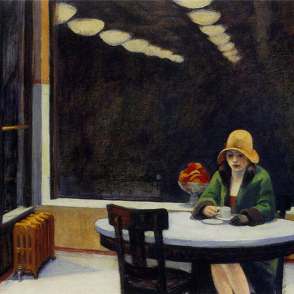
    Automat (1927) by Edward Hopper
    Automat (1927) by Edward Hopper

    The restless soul, the searching eyes,

    The wandering spirit, the remote hopes,

    The fleeting will, the false wishes

    become a phantasmagorical cinema

    she sees thru her image in the window

    listening to the song of Goddess Fortuna

    lamenting the lucky stars falling below

    and her name written in water evermore.