Tag: English writing

  • The young heart at flame

    Who would have thought of it? The evening was alight with pillars of fire, and Washington was burning. The heart of the young republic streets was filled with a cacophony of screams, footsteps, and hollers as the king’s soldiers from the old country unfurled the British flag over the capital city. It was August 24th, 1814, thirty-eight years after the U.S. become a sovereign independent country from Great Britain.

    The British invasion of Washington resulted from a combination of a longing to bring back its former colony and vengeance upon the former colony’s brazen-faced act of independence. The U.S. invaded the British territory of Canada in 1812, attacking the city of York, modern-day Toronto as well as Port Dover, which saw American troops destroy a large number of food supplies. However, thanks to the Canadian militia and the Native American forces, the U.S. attempt to take over British-ruled Canada flopped and only fueled the British fury for the imperious behaviors of the young country. To destabilize American power from within, the British supported the Native Americans, who continued to resist the U.S.’s westward expansion and impressed American merchant seamen to become crew on British ships, alluring them with better pay and higher career prospects. Moreover, the British could devote their time to the American affair when the war against France ended triumphantly, exiling the French leader Napoleon to St. Alba in 1814. So, it was ripe time for the British to march into the streets of the American capital city during the presidency of James Madison.

    However, the British army was not altogether barbaric in ransacking civilian houses and burning historical and cultural artifacts like the Taliban. For example, the Taliban destroyed the ancient Buddhas of Bamiyan in Afghanistan in 2001 that were incredible historical artifacts showing a spectacular combination of Indus and Hellenistic civilizations. The British didn’t harm the U.S. Patent Office, whose then-superintendent Dr. William Ornton’s plea for preserving the artifacts of humanity chimed the bell of the universal mind. They also didn’t set ablaze on civilian houses or buildings, except for the Capitol Building and the U.S. Treasury building. However, they did capture many of the valuable pictures and works of art, including the paintings of George III and Queen Charlotte from the President’s House (modern-day White House), later transported to Bermuda. How duplicitous it was to find the portraitures of the royalty from which Americans bled to gain independence owned by the American President’s House!

    That might have become a great war between the two countries ended in the British retreat, thanks to the American blessing of untamed natural climate. An unexpected tornado pushed the British back to their ships and carried them back to their motherland, the Queen’s land. Come to think of it, America has been blessed with luck and timing, not to mention everlasting youth. Yet, this relatively unknown part of American history I have recently learned from a history magazine confirms that history is a series of vengeance on generations upon generations, as Herodotus observed. In that regard, the British burning of Washington reminds me of Julius Caesar’s burning of the library of Alexandria, the Greeks’ burning of Troy, and Nazi Germany’s burning of Paris. American is certainly no exception to the natural cycle of human history, invading and invaded, continuous in cycle and epicycle.

  • ‘Forgotten Peoples of the Ancient World’, by Philip Matyszak

    Forgotten Peoples of the Ancient World by Philip Matyszak

    My rating: 5 of 5 stars


    Forty years on our evolutionary scale amounts to a microsecond on our twenty-four biological clock. The millennium years, even Before Christ, feel so alienly anachronistic from our modern sensibility. The sense of time builds upon a fundamental element of consciousness as molded into a collective emotional experience as contemporary citizens of the world, just as the peoples of the misty pasts we tend to overlook felt the same for the civilizations before them. They were the titans of the pre-ancient Egyptian, Greek, and Roman cultures. They, like the evening sun in its full declination, vanished in the hazy horizons of the time, still dazzling with its scarlet hues of radiating halo lingering on the remnants of human civilization to this date.

    Forgotten peoples of the Ancient World is an anthology of the peoples whose feeling of permanence and importance in their time of the world betrayed their fates buried in the tires of cities beneath the earth and returned to the dust in the winds. To illustrate, Akkadians were the first builders of the empire who elevated the Akkadian language to the cultural and political lingua franca of the late Bronze Age. The Hyksos were outstanding charioteers, and their military prowess benefitted their Egyptian subjects. The Bactrian culture was a delightful mixture of Greek and Indian heritages, while the Vandals gave a final, fatal blow to the already destabilized Roman Empire. These peoples affected the celebrity civilizations we are automatically associated with the ancient civilizations. As to why the forgotten peoples became peripheral in our realm of ancient history, it is a question of the immanence of the supreme being in the universe. However, what is certain is that they were the torch-bearers of the first civilizations passing the torch of society they had ignited and encouraged to the next in a relay run of collective humanity.

    The book is an excellent anthology of these ancient peoples in chronological order from east to west, showing how civilizations expanded from the cradle across the plains, mountains, deserts, and seas to the Isles of Britons. Divided into the eras marking the epochal changes of history, Matyszak succinctly elucidates the peoples of the misty past with his trademark witty ways of describing historical contexts. Moreover, the exciting historical trivia resurrects the eras in a phantasmagorical display of faces and places.

    To conclude, the stories about the forgotten peoples attest to the objectivity of truth applicable to any time of history that that which is here was there, has been, and will be. All things must pass, and there is nothing new under the sun. Our sense of time and culture is a likeness of truth, a matrix-like reality, because our facility is rather instinctive than reasoning, rather physical than metaphysical. Who would have known that people 100 years later now would think our time and us in this time anachronistic and antediluvian? Herodotus felt the same when he arrived in Egypt and saw the wondrous pyramids in awe that the people before his generations had built. So did the Babylonian king, who dug and discovered artifacts from centuries ago. We have seen the hungry ocean gain advantage of the kingdom of the shore, and the firm soil win of the watery main, increase with loss and loss with increase. The forgotten peoples and we are time’s subjects, and time bids are gone.


    View all my reviews

  • The Wings of Writing – on reading Samuel Johnson’s essay on writing

    Suppose a brownie or a leprechaun I happen to rescue from a Gargamel lookalike wizard insists what my three wishes are as a quid pro quo (depending upon how friendly the fairy is). In that case, I will say forthwith one of them is the Marvel of Writing, which I have lost somewhere in the course of life. I can turn myself into a great writer with the magical pyramid of power from a hodge-podge reality of indigested letters of reality as black as Persian Night.

    Johnson’s essay on the role of the scholar evolves from Francis Bacon’s adage: “Reading makes a full man, conference a ready man, and writing an exact man.” It rings a bell with the Nietzschean idea of Superhuman, superseding any mortals known for their erudition perennially enshrined in the history of human civilizations. A truly knowledgeable person I principally associate with a great writer can digest what he reads, explain it to others in facile terms, and substantialize it in writing, a mental Osmotic process that nourishes the mind and invigorates the body.

    Although I agree with Bacon as Johnson did, I am more with their ancient Greek teacher Socrates. Socrates warned his pupils about regurgitating what they heard from his lectures without putting it in their own words. That was one reason why the great philosopher disapproved of writing practice that had just emerged in his time. Copying letters of others without understanding them on his own would stun the cognitive powers rather than promote a broader and deeper range of cognition. Reading was not as popular in Socrates’ time as in ours because it was at the beginning of the new intellectual dawn of Greek Civilization. So, Socrates was a thinker, neither a reader of texts, nor a writer of tablets. Does this make him less of his students Plato and Aristotle?

    Does the amount of reading necessitate that of writing? Wouldn’t too many words go undigested inside and clog the pipes of thoughts when writing? For example, an ambitious amateur writer wants to write as if she were possessed by the spirit of Patience Worth, who transformed an ordinary homemaker into a brilliant writer. She adheres to a writer’s gospel of “Read a lot. Write a lot,” but it is easy to be said than to be done. The more she reads, the worse she writes. She wants to reason the perplexing reason with frustration and disappointment. She feels lost in the middle of midtown Manhattan where there are many streets and avenues but nowhere is her niche. Yet once she gets out of town, the state, the coast, her mind becomes clear, imbued with a fresh breath of inspiration that moves her hands on the keyboards automatically. Contrary to Johnson’s opinion that grandstands with all other established writers and academics, the amateur writer feels liberated from a siege of letters that intimidated her army of thoughts equipped in her design of armors and shields with her coat of arms sovereign and beautiful. Her reasoning power was buried under a chaos of indigested learning.

    Although Johnson’s magnanimous advice of the equilibrium of reading, writing, and speaking on a writer’s continuum is respectful and worth reading, its reality is subject to the individual aptitudes of learning, ways of reasoning, and natural dispositions. One may write better because of reading more, while the other has the opposite consequence. A hermit – let us say more realistically, an introvert – is not always an incompetent, anti-social, sullen loner whose airy petulance barricades against others whose intelligence may seem intimidating to be dealt with. I think to write more is far better critical than to read more because writing is a sovereign act of expressing an individual mind and spirit, free from the comparison of the florid words of others with the writer’s own that would dispirit the vivacity of the creative spirit. To conclude, I thank Thomas Mann for his affirmative saying:” Solitude produces originality, bold and astonishing beauty, poetry.” Truth is truth to the end of reckoning. Then it is yet another truth of others, not necessarily yours.

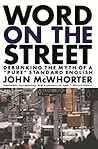
  • ‘Word On The Street: Debunking The Myth Of A Pure Standard English’, by John McWhorter – book essay

    Word On The Street: Debunking The Myth Of A Pure Standard EnglishWord On The Street: Debunking The Myth Of A Pure Standard English by John McWhorter

    My rating: 5 of 5 stars


    Sometimes, the courage to express my thoughts in English as a second language meets with insidious challenges between the grammarian Scylla and fault-finding Charybdis, lurking in the safety of anonymity on social media to stalk the prey with perverted joy. So, it is only natural for me to find encouragement from the books reassuring me that the mastery of language does not equate with intelligence. So, it is no wonder that I have the pleasure of reading  Word on the Street, an invigorating narrative told in scholastic zeal and impressive erudition flavored with street-smart audacity. McWhorter, who belongs to the constellation of brilliant linguists, such as Samuel Johnson and Steven Pinker, talks about language in terms of social and cultural contexts, making the academic subject a hot topic of a Charlie Rose talk show.

    McWhorter takes his view against language relativism that language shapes thoughts. The possession of words does not determine the thought process to contextualize the mentalese. Therefore, slang, idioms, and parlance outside the elite group of society and the educated middle class are not denigrated as improper English. In this sense, Pidgeon English, the quaintly charming admixture of scattered English words and a speaker’s native language, is not a corrupt version of pristine English but a hybrid of languages born out of the ingenuity of the human mind and changeability of language in nature. Isn’t English a living proof of the incredible amalgamation of languages still undergoing evolution? Who would have thought that English of the underclass would shine as a lingua franca?

    What strikes me most about the book, which concurs to his fellow linguist Pinker’s point of view on language not as a touchstone for one’s cognitive ability, is that solecism in spoken and written language does not reflect the user’s less desirable trait of academic ineptitude. To put it more bluntly, just because your grammar is besotted with errors doesn’t mean you don’t know what you are saying, or forthright, you are less intelligent. Take Leonardo da Vinci, the Renaissance polymath, who had no fewer than six grammar books on Latin and Greek to grasp the syntax of the classical dead languages he was so hopeless to learn thanks to his lack of formal education. In fact, da Vinci’s writings are ridden with misspellings and amorphous sentence fragments, just as Leo Tolstoy, Jane Austen, and Emily Bronte showed in their manuscripts. So, did their imperfect language skills overrule their force of imagination and contextualizing it in words? Does this betray that language shapes thought? 

    McWhorter can transcend the demarcation of race in the communication of this extensive knowledge about the subject drawn from a wealth of learning and scholastic industry with urban wit and debonair guy attitude to his readers, academic or general. His intelligence freely crosses over time gaps, chasms between class divide across continents and oceans with a universal theme of words that we, as human creatures, have spoken thus far. And he tells it using full of scintillating metaphors, examples, and anecdotes, which helps the reader comprehend otherwise monotonously academic subject without pressure and enjoyably. Samuel Johnson said that the possession of knowledge is to share it, and the possessor of the knowledge shines when he applies the knowledge to the crowd of life. Well, Word on the Street shows it all.


    View all my reviews

  • resonant and mirrored

    The polyphony of waves

    Writhes her with the fugue

    Of endless dreams and hopes

    In staccatos of unquiet passion

    As she gathers the tesserae

    In the unfinished mosaic

    Of memories of marbles,

    Pearls and opals, analcastic.

  • Liquid Rainbows

    The dewdrops from the leaves

    Of the grass across the meadows

    Beneath a winter sun in pale hues

    sparkle over the liquid arc of rainbows

    reflected on the crystal windows

    of her palace like ropes of diamonds.