Tag: essay

  • The Pope and the Heretic by Michael White

    I first learned about Giordano Bruno through a tweeter thread about Shakespeare discussing his one of many influences, including this Don Quixote-like miscreant Dominican priest who wrote The Art of Memories, the subject I was and still am keen on to improve my regressing memory. Since then, Bruno has resided in my memory chamber as an enigmatic pariah, a formidable rebel without compromise. So when I came across this book by Michael White, a former member of the 80s pop group Thompson Twins, I knew I had to read it.

    White describes Bruno as a martyr of enlightenment, thinking ahead of his time. Unfortunately, Bruno was born into the wrong place at the wrong time, so he suffered from the Catholic Church’s authoritarian rule that dominated the World’s knowledge. However, Bruno’s theory that Jesus was preternaturally a superb magician and therefore not the Son of God, not to mention that the Holy Ghost was the spirit of the World and that Satan would be saved, was sufficient to raise the eyebrows of the ecclesiastical figures. Also, he opined that the stars seen in night skies were actually suns and that there were other worlds in the universe where living beings like humans existed. I speculate such an opinion might have influenced a modern-day belief that we are not alone in this universe because there are extraterrestrial beings. All these ideas were indeed revolutionary. But unlike Galileo, who was said to murmur, “Still, the earth circles round the sun” after he was acquitted of heresy, Bruno was stubborn in his ideas. He proudly defied the Church’s intention to pardon him if he would recant before the death sentence. In his excellent lyrical portrayal of the dramatic confrontation, White sees it as the microscopic representation of the conflict between religion and philosophy, myth and truth, superstition and science.

    Notwithstanding White’s admirable wealth of knowledge used in defense of Bruno, I cannot help but think that White’s stance on Bruno overlooks or connives at some facts. The Catholic Church put him at stake on account of his theological errors, deemed dangerous to the spiritual formation of the Church and the Faithful as a priest to the Church. Bruno was not a willing martyr of his ideas but a Simon Magus-like figure trying to trade his knowledge for recognition in the arms of different sects of Christianity, such as Calvinism, Lutheranism, and Episcopalianism, across Europe.

    It’s an irony that rather than the man written about, the man writing about him turns out to be a genius in writing. Perhaps White, a former musician, attributes this to his lyrical rhythm of narration drawn from his emulous erudition. Moreover, he writes the language of the general reader in the panoply of academic disciplines, and the reader will find no time for disorientation or disinterest. This book carries a tone of what the Italian anti-Catholic activists campaigned against the Church, with Bruno as the symbol of persecution against what they believed in. Nevertheless, it is worth reading it if you are a proponent of Giordanism or just a curious bystander like me.

  • Hounds of Night

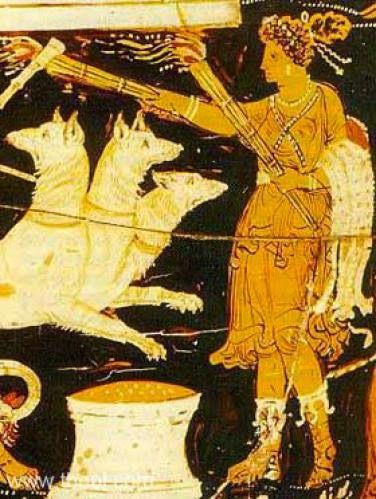
    The curtain of the night has drawn. Selene has started her nocturnal promenade with a moon mirror carried on her celestial chariot across the starry highway. Then the earth begins to bellow with great silent roars, trees to dance with leaves rustling in the wind as the chariot is racing, owls to call with their wings flapping, and the hounds howl from the end of the horizon in the glimmering light of the distant stars like lamps flickering in the desolate wilderness amid the haunting sound of Pan’s flute yonder. It’s Hecate’s Time, the Wandering Goddess of Night, appearing from the crossroads with her faithful hounds, heralding the staging of their divine mistress.

    Hecate has often been associated with all things witchery, magic, and death, not in the least due to modern-day Wicca practice identified heavily with the Greek goddess, but there’s more to her. She is a protector of the wrongfully accused, a goddess of retribution against injustice and impurity, and an advocate for underdogs. Perhaps, that’s why her animal is a dog, not a cat, which betrays a common association of the latter with someone like her. (In fact, Artemis is the only goddess whose animals are a cat because she was once transformed into it when chased by a besotted man.) Her hounds all have names: Kynegetis (Leader of Dogs from the Orphic Hymn), Kyneolygmate (Howling like a dog), Kynokephalos (Dog-headed), Kyon Melaina (Black Dog), Philoskylax (Lover of Dogs), Skylakitin (Lady of the Dogs). Of all the hounds, Kyon Melnia, aka Black Dog, used to be the wife of the last Trojan King Priam named Hekabe, who threw herself into the sea after the collapse of Troy by the Greeks. Hecate took pity on the queen and transformed her into a great black dog that became her familiar. What a manifestation of divine mercy it was.


    It is said that dogs and cats see the spirits of the dead, especially at night. If you have heard a dog howling, another howl, then another, and so forth, as if all of them sing in a canine polyphonic coda. When Hecate’s hounds howl, mortal dogs respond to their divine canine entity as the goddess and her entourage pass by. The hounds also bring victuals offered to Hecate to their mistress at a cemetery where she partakes her daily victuals. So if you think it’s just an ancient myth, listen carefully when your dog or any dog within your earshot howls. It’s either it sees a spirit or Hecate and her nine hounds. For me, well, I have a tabby cat named Toro, and he sees it and them but won’t participate in the chorus because he has her mistress at home.

  • Adieu, my friend

    A week has passed since the Beluga whale died in transit from the Seine to the sea. The question remains with the image still fresh on my mind refusing to fade away with my heartstrings pulled in all withers: did he break away from his kind to find a treasure island like Jim did? Or did malice of fortune take him away from the tribe on a lark to see if he could make it back to where it came from? What is the meaning of all of this anyway?

    He had no name because he had so little time to live in this world, and I mean the Beluga whale stranded in the Seine River in Paris, France, and ultimately died in transit to a sea last week. No one knew why he swam all the way up to the freshwater, which was not a typical habitat for the whale species. IT wasn’t the first time to see a whale end up in the river following an orca in May that died of natural causes, but the Beluga whale still lingers in my mind a week after his death. Maybe it’s because of his ever-good-hearted-looking appearance that oozes out a sense of pathos from my feelings. Whatever it may be, he endeared me like my two-year-old tabby tom Toro, and I had been following his tale of the river, which seemed to me his journey to the resting place – among humans with whom he might have cherished good memories. Maybe he disliked his kind, so he ran away from there. Come to think of it, do we also not do the same when we can’t take any more violence, disappointment, betrayal, and arrogance?

    Although I admire the efforts made to revitalize the Beluga whale and to send him back to the sea, I cannot help thinking that there should have been more professionally effective operations to achieve the noble human intention to save nature. We live in an information-saturated, expert-ridden global world, but why is no such help readily unavailable in dire need? Are outstanding vets only for YouTube channels and other media outlets via which they can amplify their view to lucrative celebrities? But the argument is futile since he’s gone. By recording what my heart feels about him, I want to pay tribute to his incredible journey to the human world by himself with kisses and tears. Good-bye, my Beluga whale.

  • Amaze Yourself: Take a Quantum Leap by Dr. Jill Ammon-Wexler – book review

    Amaze Yourself: Take a Quantum Leap… by Jill Ammon-Wexler

    My rating: 5 of 5 stars

    We know our brain is our body’s and mind’s control room, but how much do we know about the superlative organ and the supernatural power? So relax. Have no fear because Amaze Yourself: Take a Quantum Leap by Dr. Jill Ammon-Wexler will be your Cumin Sibyl to the mysterious world of the brain where the secret of the universe is locked in and waiting for you to unlock it if you believe in it.

    Dr. Jill is a doctor of psychology and a 47-year pioneer brain/mind researcher who has devoted herself to enlightening the public about the psychosomatic effects of the brain that are so wondrous and magical that they give the brain the status of a supernatural being. For example, stress isn’t just an easy, convenient excuse for our burned-out selves; it is, in effect, the evil of psychological and physiological ailments. Also, negative thoughts are not a metaphysical concept without a scientific foundation but are like a cancerous cyst that impedes the production of glucose (the brain food), which hampers a faculty of thoughts and a sense of imagination. The wonder doesn’t stop here. There is a third eye called the pineal gland in the brain that responds to altered mental states. So we all have some degree of ability to foresee the future, but that’s only if we consciously endeavor to access the subconscious mind. No wonder some of us can see and hear ghosts, and that’s true to the end of reckoning by way of a quantum leap from one sphere to another without effort.

    Suppose I am being captious by playing the role of Devil’s Advocate in the review of this admirably elegant and inspirational book. In that case, it is this: like any renowned figure of academic researchers, Dr. Jill’s successful experiments on positive thoughts confine to a pool of comparatively well-off human subjects with statuses. Of course, it’s unfair to cavil at her intention to find the truth, as her contemporary peers do the same. But I hope that someone like Dr. Jill, who writes with general readers in mind with her wealth of knowledge, includes a broad spectrum of classes in her study so that none of her readers will feel left out of the selected few. Nevertheless, Dr. Jill is a pioneer in her field, translating the mystery of brain power into our everyday language to make us realize that we are indeed starstuff harvesting sunlight only if we believe in ourselves. Therefore, this book is an excellent primer for the beautiful world of neuroscience, met with the supernatural power of the brain within us.


    View all my reviews

  • My Cat Toro and Samuel’s Hodge

    Toro is a very fine cat indeed

    Since I don’t like the word “pet,” I won’t say it when I refer to my two-year-old tabby, tom Toro, a family member. Toro pays a portion of his rental fee and is a controller of rodents in our dilapidated humble apartment we long to escape. But that’s another story, and this story I am going to unravel is for Toro.

    Toro before entering the clinic

    It was that time again to get Toro’s annual physical exam, also required for his Hills prescription Urinary care food. So we took a trip to the vet at Little Tokyo, and all’s well that ended well. His weight was steady at 11 pounds, the same as the last year (what an excellent dieter he is!). He got his FVRCP, FelV, and nails done and was proven generally healthy. What a relief because I had been concerned about his taking more naps than usual and tired expressions with half-cast eyes. The doctor told me that it was customary for cats to show such symptoms as they grew bigger. So albeit my mom thinks that I am overly concerned about Toro’s otherwise fine status quo, aren’t we all concerned about the general well-being of our flurry fur babies?

    Samuel Johnson and Hodge

    It all makes me think of the story of Samuel Johnson and his cat Hodge. Samuel Johnson, one of the greatest men of letters from 18th century England and the author of A Dictionary of the English Language, had his beloved sale-furred cat Hodge, who was immortalized in literary works and as a bronze statue outside his guardian’s once resident abode. We first come to know of Johnson’s cat Hodge thanks to his lawyer friend and biographer James Boswell’s Life of Johnson. Johnson used to go out to buy Hodge’s favorite food, oysters. He refused to let his loyal and faithful Jamaican-born master-servant Francis Barber because he felt that it would be degrading to Francis to do such errands for him. But I like to think that it was more affection toward Hodge, whom he called thus: “He is a very fine cat, very fine indeed.” When Hodge was nearing to cross the rainbow bridges due to his old age, Johnson would get valerian, an herbal painkiller extracted from the flower to lessen his fur baby’s pain. But the end of Hodge wasn’t lost in the inner circle of the ether, for his life was memorialized in ‘An Energy on the Death of Dr. Johnson’s Favorite Cat’ by Percival Stockdale, published in 1778:


    The general conduct if we trace
    Of our articulating race,
    Hodge’s, example we shall find
    A keen reproof of human kind.

    Samuel Johnson is one of my most admirable literary persons because of his humanist rules of thought articulated in his mastership of the English language. Hence it gives me a feeling of kinship with his love of Hodge. His affection for Hodge felt genuinely caring and familial, which was never mawkish or superficial. So, likewise, my cat Toro is a muse of my writings: whimsical, independent, intelligent, and affectionate. Sometimes, I wonder if Toro is really a little boy bespelled a tom. Well, what more can I say? Toro is a very fine cat, very fine indeed.

    Hodge’s bronze statue was inaugurated in 1997 by Sir Roger Cook, the then-Lord Mayer of London. Note the oyster at his paw as his eternal token of Johnson’s affection.
  • Live, Die, Repeat, Repeat…

    Life is still beautiful, even if it deceives you.

    I wanted to find the Church’s stance on reincarnation and, above all, what the Bible said about this seemingly endless shapeshifting until the purification of the soul is complete, so to speak. What about the Christian belief that we live only once and have no return of life?

    According to “A Concise Dictionary of Theology,” reincarnation is the belief or metempsychosis (“animate afterward”) that the soul preexists its embodiment. After death, the soul exists in a ghostly state before animating one again, a body of the same in a different state, which sounds a lot like a demon or malevolent spirit possessing the body of the living. It is this very belief in resurrection and official rejection of the preexistence of wandering souls without corporeal substance that denies reincarnation itself. By maintaining an endless series of chances, the doctrine of reincarnation reduces the seriousness of God’s grace and, most importantly, human liberty exercised in one life that is ended by once-and-for all death.

    Furthermore, in the Catechism of the Catholic Church, death is the end of man’s earthly pilgrimage. When the single course of our earthly life is completed, we shall not return to other earthly lives as “it is appointed for men to die once” [Hebrews 9:27]. Christianity defends the duality of the body and the soul. However, reincarnation defends dualism that both beings exist separately and that the body is simply an instrument of the soul; existence by successive existence as an altogether different body is repeatedly assumed each time one recycles life. Thus reincarnation denies the idea of the resurrection of the body, as evidenced by the resurrection of Christ, and most primarily rejects the Christian doctrine of salvation. Therefore, there is no reincarnation after death.

    I feel much better now than before. While I succumbed to the belief in reincarnation, I couldn’t accept the thought of my present life as punishment for my wrongdoings in my past lives. To think that I have to live in a miserable state of discipline until my subsequent due recycling puts me on the verge of lunacy in the form of murderous headache for which I recently found myself in the ER. Viktor E. Frankl, the survivor of concentration camps during World War 2 and the founder of Logotherapy, urged us to trust that there is meaning in suffering, which helps us lead to our purposes in life. Samuel Johnson, one of the most significant 18th-century English men of letters and the author of A Dictionary of the English Language, describes life as progress from want to want, not from enjoyment to enjoyment. Forget the arguments about the religious dogma dictating an institutionalized belief for mass mind control. Or it so, then so be it. After all, reincarnation is also another offshoot of mysticism developed into religious thought. Then I will follow the light that gives me a sense of hope. And for this reason, I proclaim that my body and soul are inseparable and that I live only once, and that’s it.