
Tag: essay

  • mission impossible


    It’s the busiest hour at the Union Station in LA. Trains decant crowds of people rushing toward their destinations like toy soldiers winded to the fullest marching forward at war. Among all this hoopla of rush hour actions, there goes Fido, an unlikely K-9 agent from Terra Canina. Fido knows no fear and always accomplishes its missions with fortitude and loyalty. One of the daily missions is to cross the frontline station to make a rendezvous with another  K-9 agent from Terra Canina. With the help of a human ally from Resistance against Confederation of Lumpish Rabble, Fido hurries the way to the rendezvous point with alacrity of speed and a burst of pep peculiar to the species known for fierce loyalty and universal magnanimity. The mission impossible became possible. 

    Author’s Note: I shot this video last evening at the station on my way home after work because (1) I loved dogs; (2) the dog was right next to me on the escalator to the upper level; and (3) I felt a sudden feat of venturesome temerity to film the trail of the dog. Watching the dog took my momentary existential worries off my mind. Benjamin Franklin must have felt the same when he said the following timeless adage:

    “There are three faithful friends – an old wife, an old dog, and ready money.”
    untitled
    Here’s Fido’s secret K-9 agent waiting for Fido at the rendezvous point
  • goodbye mr. lagerfeld

    s

    You would know him if your sense of style strikes the chords with his idea of beauty that seems a curious conflation of the ethereal with the down-to-earth. Or you would know him as a photographer whose world of beauty betrayed linear conformity in the most brilliant way. If none of the above belongs to you, then you would probably recognize him by his signature silver hair tied in the 18th-century man’s ponytail style in urban tight attire that looked strange but charismatic, decadent but conservative. In the fashion and beauty firmament, Karl Lagerfeld (1933-2019), the creative director of the French fashion house Chanel, was one of the principalities whose dazzling collection of creativity formed a legion of cult.

    The death of Lagerfeld seems a bit distinguished from those of other fashion designers to me based on my purely subjective taste and reason: First of all, Lagerfeld was a very intelligent man of culture, judging by his display of erudite knowledge on art and literature due to his voracious reading of books. I saw his interview with Charlie Rose several years ago and was delighted in listening to his conversing with the host because of his intelligence and quickness that was never a bore. Also, Lagerfeld’s world of style is not far-fetched and always mixed with individual attitude that looks so cool and stylish and emulative. Although a gorgeous but exorbitant Chanel tweed jacket is like Jason’s golden fleece to me, I can take a cue from Lagerfeld’s feasible but fashionable style to make it my own in everyday life. Besides, Lagerfeld’s controversial but honest opinion on thinness as an ideal beauty chimes with mine. Call me ever so superficial, politically incorrect, or even persnickety, but the emblem of the flesh as a forced common denominator of beauty and fashion is arbitrary and despotic.

    Karl Lagerfeld was the only fashion designer I admired, and his death saddened me when I learned it yesterday from this week’s issue of The Spectator. During his reign of the Chanel House, Lagerfeld used to say, “T-shirts for ten dollars are even more fashion today than expensive fashion.” Must I say more? That is why I liked and like Lagerfeld and his canon of style that is timeless and classic.

  • dare to be an egoist

    IMG_4047

    Charles Lamb (1755-1834), an English essayist and a clerk in the Accountant’s Department of the East Indies Company, rhapsodized about a solipsistic ritual of mealtime. “Oh, the pleasure of eating my dinner alone!” Seraphina also liked to have lunch by herself. No, she’s not antisocial or misanthropic into the bargain. It’s just that after enduring what with blaring tempers of her lawyer bosses and what with her worldly wayward female co-workers who shared none of her character and interest, a solitary lunchtime was her much-needed lull before the second part of a daily drama or comedy at work. However, these days Seraphina’s lunchtimes had been punctuated by almighty workloads and ceaseless insipid tweets of her co-workers, whereupon Seraphina wrote a letter to Wise Mary for motherly advice and received her heartwarming and feasible reply promptly.

    a1eed2a8a8445fd80513e9b2f14a0f43--peanuts-comics-peanuts-snoopy

    Dear Seraphina,

    What I gather from your account is that you yearn for romantic independence and existential freedom in the sense that this reality of daily life is unbearable to deal with to your introverted self that longs for pure selfhood defined by a proud indifference to social convention, forced socialization. I see your dilemma: whereas professional artists who earn their living by their pictures and letters achieve grace through their oeuvres, you can’t live your life like theirs that seem far-fetched, abstract, and impractical to lead a solipsistic life. Today’s world of hyperactivity and self-promotion has made an outlaw of silence. Hence, the contemporary culture pathologizes sui generis individuality, contriving a perfectly sane person into a classic basket case. Notwithstanding all this public animosity toward your deposition, you can still keep your studied solitude and sovereign independence by keep focusing your creative spirit on your reading and writing and making it as your primary reality, while fulfilling demands placed upon your daily tasks at work as an existential means to your ultimate cause for self-confidence and self-esteem. In this regard, modus vivendi is needful to make your life easier; you compromise your way of life with existential needs of life without losing your personal independence. And think simply and act smartly. Have patience with all things but first of all with yourself. Refrain from anxiety, turn from impatience. Do not fret, for it only leads to trouble. Hope this helps.

    Yours in Love,

    Wise Mary

    fe8e1396fdfe9fd607d647a2fce31842Upon reading this thoughtful and caring reply of advice from Wise Mary, Seraphina’s doldrums were cast away in her emotional course charted in the sea of unknown tomorrows. And her blithe, proud rendering of reclusiveness and independence encapsulated in her refrain of “Let it be me.” She recited that her wallowing egotism and studied aloofness were not toxic traits of punishable narcissism but a manifestation of human nature to glory in the sacredness of solitude to distill things heard, seen, and experienced in the world into her own realm of consciousness to construct a reality of the world from within. Dared to be a proud solipsist, Seraphina would make sure that she would enjoy her lunch alone reading and writing with a cup of coffee no matter what.
  • three philosophies

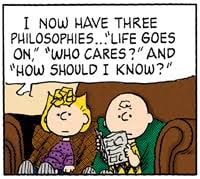
    images-1Before calling it a day to say hello to a new tomorrow on a hard day’s night, to happen on this comic strip of my all-time favorite Peanuts seems almost too pat. Provident, even. It chimes the bells of my heart and soul that are dented with the shrapnel of existential vertigo in the most impressively elliptical way: that none other than simple tenets of life are needful to live a less stressful life.

    As Sally elegantly puts: Life does not end at one fell swoop even if I stumble into an imbroglio of misadventures; any such mistakes or misdeeds betray that to err is human; and that I should not fall into the bottomless pit of worries and anxiousness, for tomorrows are always new with their own unknowns.

    What Sally blithely professes strikes the chords of Logotheraphy, a 3rd Viennese school of psychotherapy founded by Dr. Viktor E. Frankl based on existential analysis focusing on ego qua meaningfulness, a purpose of living a meaningful life. With these simple but potent tenets of life in mind, I can say good-bye to this spent day with the alacrity of departure for nightly dreamscapes to rest myself.

  • Spreading the Word knows no limits

    slrd-map

    According to Greek historian Herodotus, there was the Egyptian pharaoh Psamtik I ruling in the 7th century B.C., who was keen on finding humanity’s primal language. Ergo, the inquisitive Pharaoh gave 2 infants to a shepherd to raise and told him not to speak to them because he believed that the first words the children spoke would reveal the Mother Tongue of all of the Human Race. Quite creative, even feasible, but highly abstract; the hypothesis resulted in one of the children’s utterance of the word “bread” in what sounded Phrygian, the language older than Egyptian. Nevertheless, the Pharaoh’s the Up series-like experimentation on human linguistic origin tells us something of a human desire to find anthropological aspects of languages in their origins even before the proverbial Tower of Babel was set about to begin forming.

    Here in the States, one does not get bored with a mono language: English (American English, to be precise), Spanish with continental and regional variances, Hindustani, Pakistani, Mandarin, Cantonese, Japanese, Korean, French (mostly of former French colonies in Africa), Tagalog, and etc. So the story of Psamtik I’s ambitious experimentation to parse the root of all languages chimes with the cosmopolitan landscape of everyday life. Apropos of a diverse group of languages, Benjamin Franklin, however, seemed not to be in favor of multilingualism in the States in fear of the country’s being disseminated into a variety of different language communities. To Franklin, the importance of English as a unified official language of the States meant a national sovereignty and cultural identity that would bind people living in the States into one cohesive cultural group. In this respect, the English language as an official national language of the U.S. is the sine qua non for a lingual and social unity of a country as much heterogeneous as the States. That said, it is beneficial to know of the lingual root of the English language as well as of the other related language.

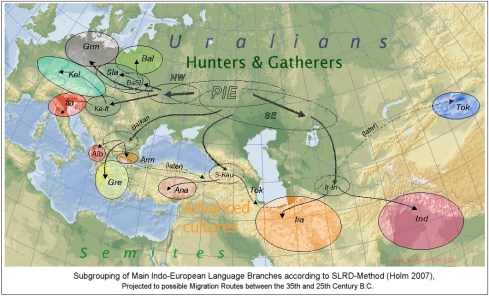
    One of the most popular Indo-European languages in terms of active speakers, English belongs to the Germanic along with German and Norwegian under the Indo-European lingual branch, which also includes the following groups of language:

    • Indo-Iranian: Persian, Urdu, Bengali, and Romani
    • Greek: belongs to its own family
    • The Italic: Latin and the Romance
    220px-sir_william_jones
    Sir William Jones (1746-1794)

    The reader may be surprised by the fact that Persian, Urdu, and Bengali spoken in the Near East Asia and Asia are also a lingual family with English, but according to British jurist and amazing polyglot William Jones in Calcutta, India, Sanskrit, an ancient Indic language, had common ancestry with Greek and Latin because many of the words were similar to those in Greek and Latin. For instance, take the word “Fathera”. The Indo-Eurpean term is pater. Sanskrit is Pitar; in German, Vater; in Latin, Pater; in French, Pere, and in Spanish, Padre. In fact, Jones’s elation of the ancient Indic language in his industrious study of its deep cultural influence as well as lingual traits on the Germanic paved a way to modern comparative linguistics. In terms of the cultural theme of Indo-European cultures, the idea of trinity in aspects of life that are sacred, social, and economic can be traced in the old caste system of India comprised of Brahmans (the Priest), Kshartyas (The noble and the King), and Vaishyas (the Commoner). Likewise, in Greek myth the 3 Fates who are the beginning, the middle, and the end of each mortal’s life and the Holy Trinity of Christianity adumbrate a cultural connection between the continents that look remotely different at a first sight and yet interestingly alike with deeper insight.

    To encapsulate, the relationship between language and culture is the sine qua non of human civilization, the inseparable archeological, anthropological, historical, and linguistic artifacts to study the origin of humanity and its misty pasts. The development of languages also relates to an expansion of its influence by means of trade, war, and migration that are still in progress in our time. It is a product of collective enterprise in the form of textual artifact. Otherwise, who would have thought that English, an obscure west Germanic language, would become a modern day lingua franca spoken across the five continents and six oceans? For what it’s worth, T.S. Eliot elegantly summed it all thus: “For last year’s words belong to last year’s language and next year’s words await another voice.”

    r20001117-aroundthewrld

  • The Significance of Unread Books

    47def1527c46a0b1c2136d2348a04421To come upon Word of The Day, Tsundoku, as I was checking messages on Facebook during my lunchtime at a regular Starbucks shop gave me a fillip to thinking of my unread books I have piled up, untouched, since my new job became my primary reality. A Japanese word for a pile of unread books, Tsundoku has become something of new word that describes a tertiary group of books  attempted but disinterested, or tried but forgotten. Which is what my tsundoku are comprised of. My books pending my reading speak to me: “Have you deserted us?” Nary a One Bit, My Dear Textual Friends.

    In fact, looking at a stack of unread or partially read books imparts me a sense of subtle satisfaction and small wonder: these books of mine indicate that there’s still unknown knowledge of the world I need to know and that my literary vanity is worth the indulgence. They are part of my personal library built upon flotsam and jetsam of sundry interests, which are similar to the Mathom-House in the Shire, inhibited by Hobbits. The Mathom House is basically a museum of paraphernalia, a sort of odds-and-ends things but not to be discarded for what they are worth. The House is ever-expanding as a Hobbit fills it with this and that to his heat’s content. Likewise, my library is ever-expanding as it is filled up with new ideas and fresh inspirations drawn from the world of writers with unique voices but who always manage to express the universality.

    Tsundoku, the Mathom-House… they are terra incognita in the mind of any adventurer of knowledge. The importance of unread books reminds us that reading is a never-ending activity but an ongoing process of becoming who we want to be because we become what we read. Reading is not a competition but a creation of a reality of the reader by passing over to the minds of the author and the characters. All books , finished and unfinished, are possible to help you get there too because they are unknown unknowns. Therefore, a sight of Tsundoku is not a sign of a failed literary or academic ambition but a display of a wondrous mind whose intellectual/academic/artistic odyssey is still on.