Into the dark of the night, we all travel
tranced in the eurythmics of rainfalls
outside the moving coach in a dazzle
of somebodies packed full of stories
to carry them over the westerly end
of our dreamscapes, half-assured but
willing to take on Fortune’s loose end,
as we head for our unknown Fortune.
P.S. Ralph Waldo Emerson once said, “Thinking is the function, and life (i.e., putting thoughts into actions) is the functionary.”
Along the line of this maxim, anyone who’s been on a long distance cross-continental bus travel contracts sociological and psychological strains of Stockholm Syndrome; that whoever rides on the same bus with you will be an aggregate of the ad hoc assembly of accidental passengers, a surrogate band of battle soldiers from all walks of life, vivacious or lugubrious, voluntary or unintentional, funded or impecunious, assured or doubtful. That’s also an elemental attribute of the travel because there’s always something unexpected that happens along the way, which is what makes it all the more interesting and enriching for our life experience.
After a long but worthwhile travel by bus, you will understand what made the former British Prime Minister Benjamin Disraeli during the reign of Queen Victoria declaimed about the lesson of travel thus: “Travel teaches toleration.” Which is also to be yoked into the ever truthful Nietzschean tenet of existentialism: “What doesn’t kill you can only make you stronger.” I can vouch for it on account of my own veritable veni vidi vici empirical learning acquired alone after five nights on two Greyhound buses from New York City, NY to Los Angeles, CA . I have lived thru it. I take the liberty of positing that I am now also become something of a student of life and literature following the existential experiences of George Orwell, Viktor E. Frankl, Henry David Thoreau, Stephen Crane, Bill Bryson, and Jane Eyre (the fictitious but realistic character) into the bargain.
I’m thrilled to read good stuff- I mean a real good one!
Oscar Wilde, the wonderfully strange writer with a keen eye on the panoply of human behaviors, knew about voyeuristic streaks on human nature when he said thus: “One must keep a diary when traveling anywhere by train or coach to read something sensational.” Maybe that’s why people like to read the lives of others. Maybe that’s why the memoir, which I regard very much as a diary written backward in time, always bestride the bestselling list of nonfiction of TheNewYorkTimesBookReview, which has become a formidably profitable genre of American literature. Admittedly, it’s awe-inspiring to read a success story of one whose hardscrabble background is a fortiori certifiable and renders a kind of feel-good sentiment with something of a vicarious experience to the reader sharing similar constraints of life in one way or another, or it may seem so. Frankly, any of the best-selling memoirs can hardly be less a modern version of Cinderella story than it seems to me, which is nothing but a proud exhibition of achievements by a select few (“The Chosen”) in the melee.
I might be cruel, only to be real. I am all the more respectful of anyone who has risen above biological/social inhibitions in his/her own fashion. But this topic of Triumph of Will over difficulties has become a literary fad, as though anyone who had rough and tough times in growing up somewhere in the backwater of downtrodden south or mid-western regions were suddenly in a zealous Olympic competition of writing the most heart-wrenching personal story on one cardinal condition: that the writer must have a very good career that provisions him/her with a nice place to live and loving, understanding significant other into the bargain. That is, unless a would-be writer of memoir is well-established in society, it’s not worth the writing of the story because after all, who’s gonna read your story if you still live among the melee with some ordinary, if not nondescript, job with meager income to barely get by despite your noble resilient spirit and evergreen hope to better yourself?
It’s all derivative of one model!
For example, the October 7, 2018 issue of TheNewYorkTimesReview carries an elegant book review of “Hey, Kiddo: How I Lost My Mother, Found My Father, and Dealt With Family Addiction”, a newest memoir of a certain popular illustrator-writer of children’s books named Jarrett Krosoczka, hailed as another survivor of economic and social determinism. The review presents the book as a courageous live-to-tell account of his childhood shadowed by his mother’s drug addiction and of his triumphant accomplishment as a successful artist who can presumably inspire many kids unfortunately mired in disadvantaged surroundings through no faults of their own. The spirit is commendable, but the gist is visceral. According to the elegant summary of the book, Krosoczka was better off than many other kids in his station because he had lumpish but loving grandparents who took care of him and encouraged his artistic inclinations, plus a cast of odd but good characters that complemented the other void of affectionate attention needed for a child. Back in our real nonfiction contemporary life, how many kids are fortunate to be endowed with the luck he had, and what if a kid struggling to escape from the plight with his intelligence and industry turned out to be just an ordinary adult still laboring to make the ends meet, while still secretly entertaining the thought of becoming somebody in his solitude? Would you think that his life is a failure? The memoir of this kind is more of a resume of individual experiences and achievements that, in a twist of irony, provokes a sort of catharsis in the reader as if he were watching a television drama that would made him feel like living in a holistic virtual reality.
In all fairness of my acerbic and arbitrary opinion on the review of the aforesaid memoir, it goes against the grain not to point out other popular memoirs perching on the best-selling list: Educated by Tara Westover is about her story of how she got away from her bohemian parents to immerse herself in scholarship; Hillbilly Elegy by J. D. Vance, another one by a Yale Law School Graduate recounting the struggles of the white working class struggles through the story of his own impoverished childhood; Heartland by Sarah Smarsh, a daughter of a poor wheat farmer in Kansas telling her poverty-stricken childhood into adolescence and the hard lives of the working class in the Mid-West; and finally, Glass Castle by Jeannette Walls, revealing her errant childhood and her struggle to be away from the rabble that led her to a gainful literary success. And I suspect that there will be more memoirs to be published in future like new soppy television movies in production.
Am I being too acerbic? But that is how I feel.
As someone who regards Courage, Endeavor, and Resilience as great American drama in three acts, I am all for reading about someone who would continue his/her secret aspiration, while keeping the foot firmly grounded in reality, such as Laura Ingalles Wilder, Lucy Maud Montgomery, Jane Austen, and Charlotte Bronte, all of whom continued to tend their ordinary daily duties and responsibilities even after their literary success. To say it’s an anachronistic and antediluvian mode of thinking in the 21st century is to depreciate their literary geniuses and modus vivendi peculiar to the ethos of their times. However, the love of the writing must not corrupt into the worship of the hero. It’s the sense of the writer’s spirit that addresses the spirit of the reader, not the pageantry accolades of material successes that seem to be the bedrock of the memoir riding on the crest of popularity of rags-to-riches telltale revelations. We might live in an Orwellian world of reality prioritizing the ostentatious display of wealth or power, but we shall not devalue the truthfulness and value of ordinary life where the meaning of life depends upon whether or not we fulfill the demands placed upon our daily tasks however insignificant or trifle they may seem. For this reason, I don’t subscribe to the popularity of the best-selling Cinderella memoirs in which the sacredness of ordinariness in combination with the peculiar magic of literature is conspicuous by its absence.
The essay as a respectful literary genre has not yet established its firm meritorious footing in American intellectual society where the novel, poetry, and journals featuring de rigueur social/political issues with gravitas, surrealistic individualism, or puritanical heroism that has recently morphed into a rags-to-riches memoir are the only select legitimate royalties worth being decorated with a laurel. Perhaps it has something to do with the level of American intellectualism being at its still developing stage in consideration of its relatively “youthful” history. For what is worth, despite its general cold reception from the literary hierarchy, E.B. White is nonetheless a quintessential American English writer and a very fine essayist of the twentieth century in the English language into the bargain. In this collection of his essays published in various magazines over the years (from 1920s to 1970s), Whites recorded the overtones of humanity, democracy, and social concerns in ordinary things and experiences described in elegant and crisp prose style that resembles none other than his, thus making him one of the central figures in the canon of American literature without dispute.
Being an essayist means something of a modern day literary troubadour, an independently-minded man with childlike streaks of artless interest in all things worldly and unworldly and innocent belief that everything he thinks about and everything that befalls him is of general interest. In a way, he’s a likable egoist with venturesome effrontery and verve to write a very egoistic essay on his whims and caprice. However, Whites gently rebukes us for our general perception of the essay as an expression of exalted rootlessness without self-discipline and an intellectual basis; rather, it is a panoply of sensibilities, senses, and intelligence, all broken loose from the hidden private closet of the essayist. For this reason of being egoistically concerned in a panorama of contemporary daily that many serious writers of the other literary genres tend to downplay, an essayist should accept his self-imposed role of small-fry writing gentry in the class of scribe, advised White with a kind of avuncular manner. However, it is this estate of an essayist Whites feels exhilarated about; it provides him with a valve of the emotional influx and outflow, so that he can wield his pen across a page in an expense of his curiosity, conviction, observation, and self-discipline, producing a dazzling delight of literary pleasure in its simplicity of language and subject.
To illustrate, White’s subjects of his essays vary from his experience of moving from New York City to Maine as in “Goodbye to forty-eighth street,” to the humorous political essay of “Bedfellow,” featuring his canine family member Fred, and from his keen and humane observation of a circus girl rehearsing her show in “The Ring of Time” to his youthful poetic experience of working as a waiter on a ship to Alaska in “The Years of Wonder.”All of the aforesaid deal with a cast of everyday character and contemporary daily life written in simple but perspicacious words to contextualize the inner realm of White. There’s no priggishness or pomposity in his prose style, which I find very appealing and endearing. For someone who’s as erudite and intelligent as White, such simplicity of writing betokens that he wears his knowledge lightly with a general reader in mind. In fact, White thinks it his duty as a writing man to record all items as though he would be held personally responsible if it were to be omitted. This idea of a writer as general secretary of humanity parallels the reasons of writing as posited by George Orwell: It serves as a platform of expressing our sheer egotism, aesthetic pleasure, political evidence, or historical record. A priori, both of the great essayist of the English languages strike the mutual writing chords in their hearts.
At the heart of the essays lies White’s love of the world where he collected the flotsams and jetsam of what our contemporary human life could bring to us, which were washed up by the waves of time and memories. This collection of essay by White, I think, bestows in spades its sovereign royal heritage of its own on the American essay that merits its own section in nonfiction aisles across the country. That is, in a wide stretch of literary imaginations imbued with historical evidence, the book has made itself the founder of new royal blood in a way that reminds me of William the Conqueror’s becoming the first Norman king of England by establishing a new royal bloodline in 1066. With a variety of topics, and the practicality of language, this book is a gem that holds the reader’s attention throughout the pages including the unforgettable cover featuring Fred and the author himself, which so fittingly and wittingly demonstrates the Element and Style of Essays of E.B. White. It’s a lovely read that warms your heart and piques your curiosity of the inner world of the writer whose thoughts and feelings chime the bells of ours own in one way or another because White is ageless in his writing and his writing timeless in his essays.
As the insurgence of #MeToo movement is now a daily recurrence in the media, taking no prisoners at all times regardless of statutes of limitation, it seems that men now live in vigilance of what accusations they might one day be faced with for the misdeeds of the past. In this predominantly matriarchal social epiphenomena born out of latent political dissensions in the background of virulent partisan ideologies, it’s only a woman’s story afflicted with her tearful narration of the tainted experience that we hear. It’s a no man’s world. It’s an amazonian world where women’s voice means dominance, power, and truth. But then we live (or like to think we live) in a highly civilized world of democracy where Reason takes precedence over Appetites (raw feelings and unbridled emotions) that leads to Judgment of Truth. However, this draconian #MeToo tribunal forfeits men’s chance to speak for themselves so that we can hear the other side of the story, whereas there are two sides to every story.
That all women are victims and all women are veritable is a dictum of the movement, which exempts all women from their blemish pasts. As a woman myself, I know that we women can become malicious, vengeful, flagrant, and mendacious if we are hell bent on doing harm on ones who have damaged our egos or destroyed our ambitions. There is no god-given dichotomy of human nature between man and woman. But this mobilization of alleged sexual accusations has, I think, gone too far. It reminds me of the craze of the Salem witch trials, the Jacobean Reign of Terror, and Bolshevik Regime in terms of the vitriolic sound-and-fury rhetoric and militant attitudes toward their sworn public enemies. Any man who has had even the faintest shadow of doubt cast on a supposedly unseemly behavior is now guilty of the generalization of the misdeed and deserves of social defenestration, let alone personal stigmatization for the rest of his life. In sum, he becomes a pariah wearing a scarlet letter till his death.
For instance, we all know the case of Bill Cosby, the legendary comedian who was charged with rape this week and sentenced to a 10-year term in prison, despite his attorney’s plea for leniency on account of his being 81 years old. I can’t say what the women accused him of was true or false, but his accusers do not seem very credible to me, either. Their manners of speech, deportment, and contents of accusations seem all but flamboyant and tritely bromide. And many of the accusations are over 10 years old. They say his punishment meted out justice. What a grand measure of justice, when there are even worse cases of injustice, such as evicting the poor out of their homes for the behoof of gentrification and systematically perpetrating sexual harassment tacitly against women of low social status at work, including female janitors whose stories once covered in the LA Times? These people seldom or hardly tweet the injustice they have experienced to lay it bare to mete out justice to the perpetrators.
Another example is the case of Ian Buruma, the editor-in-chief of NewYorkReviewofBooks, who was recently made to resign from his post because he published an essay by a certain Canadian DJ named Jian Ghomeshi, who recounted his personal feelings about being a victim of the #MeToo tribunal without being given a proper stand to tell of his side of story. Just as anyone defending any innocent aristocrat during the French Revolution or any guiltless bourgeois person during Bolshevik Revolution was also punished ruthlessly for being sided with the public enemies, Mr. Burma’s journalistic conscientious act of publishing the other side of the story was thwarted, being condemned for his courageous deed that was regarded as treachery.
I am not here to defend the unseemliness of all men reputed to be lecherous. Not an iota. But looking at this insurmountable #MeToo movement riding on the crest of demagogic wave emboldened by the gratuitous social and political tendency of accusing almost anyone for vindication, I am egged on to say that we should be critical in deciding the credibility of accusers in the context of regarding the nature and truth of all cases as reported based upon evidence, not supra-abundance of vehement hatred and malice to destroy a man’s life for good. The Greek historian Thucydides also knew mendacity of popular belief and warned of eclipsing impact on the truth of any such event; hence he always tried to find out the veracity of historic events by toiling to investigate them through records. Therefore, it is imperative that we also give equal chance to the other (that is, men) to decide who’s to deserve ignominy. That is why I find Cosby’s sentence and Mr. Buruma’s resignation a fortiori fiendishly harsh in the wake of bellicose textual campaign that seems less plausible and empathetic.
P.S.: This essay is based upon my review of an article called “Men should be angrier about #MeToo” by Lionel Shriver in this week’s TheSpectator. Ms. Shriver’s perspective on this subject matter strikes a chord with mine. This courageous article emboldened me to write this essay on the subject that I felt strongly about for its politically motivated element. Mind you that real victims do not reveal themselves in fear of retribution and ridicule in public.
His love was fixed but unsought
By the ostentation of Eros’s Play,
The casual making-love façade
With no precondition of the soul;
But that which it consummates
Is a union of the two existences
Of Body and Soul, the sovereign
Surrender of the self to the beloved
Becoming a whole, an ensemble
metastasizing “I” lovingly, willingly
Directed toward “Thou” entirely
In trust of one another wholeheartedly
making him of her and her of him magically.
P.S.: A short essay called “A Courtship of Twenty Years” by John Stuart Mill (1806-73) reveals his infatuation with his friend’s wife, who eventually became his wife. It’s a rhapsody of his admiration of everything about her, her moral character, intellectual gifts, and graceful beauty. This secret affair of the heart is not, however, tinged with a lascivious desire for his friend’s wife thanks to his elucidation of her virtues that benefited him to become wiser and more wholesome; his love for her is a sublimation of the ego, which was capable of integrating the sexuality of the id into the personality. Nowadays reductionism is responsible for interpreting love as a mere sublimation of sex and conscience merely in terms of the superego. But love is the precondition of sex, not the result of the sublimation thereof. What might have been his physical attraction to her at the inception of his love affair was elevated to the actuality of Love, the wholeness of Eros (Body) and Psyche (Soul), which is the essence of love between the lovers.
This was exactly what it was like while I was waiting for my bus to work.
The Kingdom of Rainfall, Dampness, Stuffiness, and Grimness reigns supreme all day long today without a ray of sunshine peering through the heavily downcast gray sky so lowly hung in the celestial ceiling of the Atlas that it almost looks like collapsing to earth. While basking myself in the typical Atlantic grayness of this somber weather, I could understand why the legendary lost Roanoke Colony was doomed to fail in the late 16th century; it was primarily due to this grim and damp weather condition only congenial to mosquitoes and other kinds of pest that thrived on the unpleasant sogginess. In the reign of the somber weather, to come upon an article in this month’s National Geographic History called “Killer in the Rye: St. Anthony’s fire,” which was also related to the gloominess of the weather seemed a tad pat.
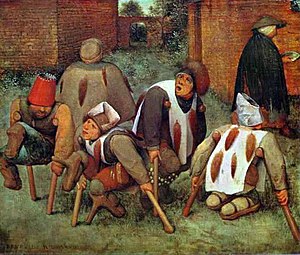
“The Beggars” by Pieter Bruegel the Elder is said to have portrayed the victims of rye poisoning, most likely of St. Anthony’s Fire, as shown herein.
Between the middle ages and the 17th century, inhabitants living in the proximity of the Rhine (Austria, Germany, and Flanders) where damp climate affected the crops adversely were frequently subject to a diabolical malady caused by a consumption of infected rye with symptoms of seizures, hallucinations, and infected limbs with excruciating agony that was said to be similar to the spiritual torment suffered by St. Anthony of Egypt. Hence the naming of the agricultural disease ensued. It all started with eating grain infected with a fungus called claviceps purpurea, black growths resembling a rooster’s spurs. This heinous fungus became ergot, toxic alkaloids cutting off the blood supply to the body’s extremities, which caused the hellishly burning sensations to the limbs. Since the cows were not immune from this fungus by dint of eating the infected crop as a staple diet, large parts of the population were exposed to the risk of contracting St. Anthony’s Fire. In fact, this rye poisoning was multifariously diabolic in the saintly names, such as “St. John’s Dance” and “St. Vitus’s Dance”; the victims displayed tantrums of bodily movements – also known as tarantism – as if they were possessed by demons. Although the rye poisoning began to die out in the Western Europe as wheat replaced rye in the kitchen, the most recent cases of the rye-poisoning disease were seen in the early 20th Soviet Union and Ethiopia and India in the late 2oth century.
Sun, Sun, Sun!
Indeed, to happen on the article such as the aforesaid while I was sulking in the unpleasant conditions of damp weather gave it an extra fillip. Maybe I am being grumpy about one of those lousy weathers that may be beneficial to the others on the other hand, such as farmers needful of precipitations for their parched land or vendors and manufacturers of umbrellas and rain boots whose businesses hinge on the whims and caprice of Mother Nature. But as the aforesaid historical records evidence, when dampness and cloudiness in partnership reigns supreme, it turns the world grim and dreary, listless and lethargic. And that is why the ancient civilizations began and prospered in the places where the gods of sun Ra, Apollo, and Helios claimed their sovereign powers among the dominant high gods and goddesses and retained their divine radiance.


 As the insurgence of #MeToo movement is now a daily recurrence in the media, taking no prisoners at all times regardless of statutes of limitation, it seems that men now live in vigilance of what accusations they might one day be faced with for the misdeeds of the past. In this predominantly matriarchal social epiphenomena born out of latent political dissensions in the background of virulent partisan ideologies, it’s only a woman’s story afflicted with her tearful narration of the tainted experience that we hear. It’s a no man’s world. It’s an amazonian world where women’s voice means dominance, power, and truth. But then we live (or like to think we live) in a highly civilized world of democracy where Reason takes precedence over Appetites (raw feelings and unbridled emotions) that leads to Judgment of Truth. However, this draconian #MeToo tribunal forfeits men’s chance to speak for themselves so that we can hear the other side of the story, whereas there are two sides to every story.



You must be logged in to post a comment.