Tag: fiction

  • Freya’s Chariot and Toro’s Aspiration

    Freya rides in her new celestial chariot driven by two Norwegian Forest cats named Bygul and Trjegu. The Norwegian forest cats came from a single-fathered family when their father felt unsure how to raise them after their mother left the family. So the father asked Thor for godly help. Thus Thor gave the kittens to Freya, thinking that they might be helpful to her as companions or messengers.

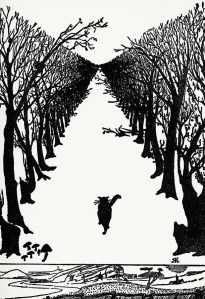
    But the intelligent and beautiful Freya has a better idea: they could drive her divine chariot to travel across the skies and seas, not to mention land given proper training and times of experience. So rather than smothering their natural agility, unfailing alertness, and admirable persistence, all of which are excellent traits for hunting prey, Freya finds the most brilliant way of a beautiful kind to let her cats drive the chariot. There’s no need to goading or hollering to spur Bygul and Trjegu because such application is unnecessary for performance when the cats love their roles with all their hearts, souls, and minds. When in doubt, read Old Possum’s Book of Practical Cats, and you will soon believe me. If you have cats, see for yourself, for they do when they like, not what you want them to.

    Toro, aka the Curious Tabby, is contemplating joining the team, imbued with high hope of running Freya’s chariot from sunrise and sunset, flying from one end of the horizon to the other, over the ruffling waves of the deep cobalt seas. As one year and three months old, Toro thinks he can apply for Freya’s training school, where Bygul and Trjegu are instructors. At the thought of it, euphoria envelopes his body in a vista of the magnificent chariot, and his spirit now soars up in the garden of ether, intoxicated with the weightless levity. No more boring days, no more need to call the attention of Judy, his human sister, to let him out to the living room, which is always and ever tiresome.

    It’s not that Judy lacks care and affection. Hardly so. It’s because of her cantankerous elderly mother, who doesn’t like him to roam around the living room where she usually stays, watching the repeats of talk shows on YouTube. Toro understands Judy’s dilemma between her willingness to let him out and her submission to her mother’s scolding because otherwise, she knows that the mother will discipline Toro with her walking stick. Toro loves Judy, but his curiosity doubles up with aspirations, whetting his desire for driving Freya’s chariot at least just for once. But then it would mean leaving poor Judy alone behind with the horrible old woman. Hence Toro is thinking hard again.

  • ‘The Kite Runner’ by Khaled Hosseini – book review

    The Kite Runner by Khaled Hosseini

    My rating: 5 of 5 stars

    Writing is the most solipsistic and democratic means to make people discover your secret histories or inner world so that they can understand why you are what you are. That is what Khaled Hosseini does enchantingly in The Kite Runner. It is a bildungsroman story reminiscent of the Au revoir, Les Enfantes-Esque ambiance surrounding the narrative of a grown-up boy who wants to reconcile with the stupendousness of mistaken guilt becoming a malady of the heart. But that doesn’t mean it is all too surreal or stark grim to make an accidental reader think it is a wrong choice. On the contrary, Hosseini vividly conjures up the faces and scenes, resurrecting the spirits of the places and times, by putting together the tesserae of his memories in this rivetingly heartrending read.

    The book incorporates the sociological theory of symbolic interactionist perspective focused on the relationships among individuals within a society and how political changes affect the lives of individuals and the sense of who we are and our relationships to others. The story’s narrator, a young Afghan boy of the upper-class named Amir Agha, gives the reader a ride to his childhood in Kabul to show the halcyon days of pre-soviet and Taliban reigned Afghanistan. First, you will see him and his best friend Hassan, a Hazara servant boy in his house, wallowing in reading stories and lost in kite flying. Then and thereafter, Hassan becomes a victim of the most horrific act committed by the half-German blue-eyed Afghan boy threatening him to win kite. Amir’s retrospective narrative becomes his public confession and ablation, all of which is a combined act of purging out the painful memories of the past and exorcising his demons tormenting him with the guilt of jealousy, ignorance, and cowardice. The whole narrative then becomes a plethora of pathos and empathy, resulting in a cornucopia of forgiveness and sympathy, drifting it all in a high-flying kite once and for all.

    It is a fitting story in this particular time of Afghanistan history and Abdulrazak Gurnah’s winning of 2021 Nobel Prize in Literature for his achievement of universalizing human travails transcendent of racial, cultural, and geographical differences. Vivacious at times but dolorous at most, the Kite Runner is synthetic literature that wears habiliments of memoir and novel. There truth and fiction dissolve into one another anchored in real life with factual geographical and historical facts smoothly amalgamated in the individual narrative account, which reminds me of Herodotus’s “Histories.” Or it is an alluringly pioneering memoir-making that resembles Realistic Fiction. For whatever it is, the Kite Runner bestrides the aisles of contemporary literature sections, alluring the public with simple language that magically juxtaposed in beautiful prose style with lyrical quality, all soul and mind in the marks upon pages evocative of the spirits of the memories materializing.


    View all my reviews

  • ‘Father Goriot’, by Honore de Balzac – reading notes

    Balzac’s Paris is no more different from today’s big cities like Los Angeles or New York City. It populates with the good, the bad, and the ugly, but mostly filling the in-betweens by the middling’s – the not-so-wretchedly poor yet decidedly needy with pride and prejudice –. The story about Father Goriot (no, he’s not a priest.) is about the people around him living inside and outside the Maison Vauquer. It is a boarding house in which the characters bring their stories to pay their dues of existence. The reader sees it as a microscopic view of the contemporary Parisian society where the poor, even in post-revolution, remains at the bottom of society—only the cold, indifferent climb up to the upper echelon.

    The residents of the widow Madame Vauquer are neither defiantly evil nor angelically good but realistically neutral. The house symbolizes the society of the somebodies who long for social mobility for respect and recognition. Balzac’s passionate narrative endures no sight of injustice and proudly averts the eye from inhumanity, making even egotism and selfishness move to a pity dipped in pathos.

    Balzac is a superb writer with detailed descriptions of the state of mind in the art of realism in a classical frame that makes scenes of everyday life a sight of history, banality of ordinary life a profundity of human life. Indeed, any of his famous fellow writers could have done it, but none of them can do it as blatantly well as Balzac does. For he knows how to make a villain sympathetic with an insightful eye looking into the depth of his wounded soul.

  • ‘Howl’s Moving Castle’, by Diana Wynne Jones – review

    Howl's Moving Castle (Howl's Moving Castle, #1)Howl’s Moving Castle by Diana Wynne Jones

    My rating: 5 of 5 stars


    Whether it is for the pursuit of artistic aestheticism or indulgence in sheer egoism, writers tell their stories in books where, in the peculiar alchemy of words dipped in imagination, they blend the real with the ideal. That said, Diana Wynne Jones’s Howl’s Moving Castle is a beautiful world of magic and witcraft that cast a spell on the gloomy reality to make it a gorgeous fantasy.

    A melancholy of vertiginous existential crisis in a life fraught with responsibilities and duties morphs into a fantastic narrative of the imaginary world where magic, wizards, witches, and demons mingle with ordinary people and even fall in love with them like those of Olympus gods with mortals until Hesiod’s Heroic Age. Sophie Hatter, the book’s heroine, is Jones’s alter ego, only younger in age and freer in status. Still, everything else about her is Jones herself, most prominently her being the eldest child responsible for all things adult – by alas, birthright. Sophie’s self-analysis of being the oldest for the principal cause of misfortune applies to Jones’s family background, being the oldest of three sisters just as Sophie is for Martha and Lattie. I remember reading elsewhere that at the time of writing this book, Jones was going through the crisis in adulthood: a sickly husband, live-in mother-in-law, friends in need, children to take care of, etc. Despite Jones’s degree in English Literature from Oxford University, she felt injustice for her talent and mind eroding in the seemingly endless Sisyphean maneuvering of rolling up a daily boulder. So she took a pen to paper and wrote the book to spur her reservoir of existential frustrations on writing her story in the guise of fiction.

    However, after the book’s success, Jones withstood from telling it a reflection of her inner world. She referred it to a certain boy who wanted to create a moving castle. Although the integrity of the inspiration belongs to the author’s literary license, Jones appeared to be reluctant to admit that she told her story in the book due to her celebrity. On a personal note, I could understand her volition to employ a more lovely pretext in safely hiding her existential frustration in privacy. Still, the book’s background written at the time of a crisis of adulthood puts together tesserae in a fanciful puzzler. The agency of magical elements in the story enables Jones to free herself from the mental inhibitions to depict the world’s realism, which seems too dreary and drab, gloomy and harsh, for the reader to be burdened with the author’s frustrations. Instead, Jones created the world populated with witches and wizards not looking like creepy worshippers of the devil and a fire demon far from being diabolic. All the menageries of wondrous characters neutralize the pathos of Sophie.

    I read the book with a kindred spirit of being the firstborn child in the family, so it was a pleasure to know that I was not the only person who felt burdened with family and others’ cares. Witch of Waste’s turning Sophie into a ninety-year-old spinster adumbrates Jones’ feeling of oldness in her soul that affects her appearance due to her continuously solitary labor of care. Yet, Jones is kind to Sophie with the eccentric but wonderful Howl and other helpful characters, including Calcifer, a fire demon, all of whom recognize Sophie’s worth and beauty of heart with respect and care that she deserves so much. Jones does a fabulous job of transforming a vehement narrative of angst as an adult in the real-world into a fairytale of love and luck, where those who feel burdened with the weight of life will be awarded fabulous surprise long overdue.


    View all my reviews

  • ‘The Amiable Fleas’, by John Steinbeck – review

    John Steinbeck was all man. He was a writer of muscles. I meant the powers of strong individuality that disagreed with grandstanding with the political in-vogue trends of his time with his writing as literature for an ideology of grand cultural context, not for the mind’s pleasurable satisfaction. In a word, Steinbeck appears to be in touch with the real world, with the characters realistic and stories palatable, not confined in the seclusion of a leisurely abstract world of the elite. The Amiable Fleas conveys all of the charms described above of Steinbeck as an attractive raconteur at his best: humorous, heartfelt, and honest in his tough cowboy appearance in a strange city filled with quaint aromas of the old civilization.

    The Amiable Fleas is Steinbeck’s testimonial narrative of the truth found in life’s ordinariness; the meaning of life realized in the joy of small pleasure against provisional needs of instant fame and worldly prestige. It’s an innate folly of human nature trying to reason against the significance of Serenity, Courage, and Wisdom as if they are remotely associated with Intellect. As Steinbeck held against criticism about avoiding the political and social issues of his time, he tried to reason his own reason for writing about such simple truth of life.

    The Amiable Fleas is the res ipsa loquiter of the value of small things that Steinbeck treasures, for it is what keeps the troublesome, pugnacious, bickering human tribe tamable and bearable with humor, which is a handmaid to hope and resilience. The amiable fleas represent the idyllic but oddly likable bunch of professionally intellectual people whose existence is a canvas of abstract painting that lacks a touch of realism. The poet, the architect, and the painter occupy their self-designated seats in the eponymous restaurants in Paris, doing nothing but contemplating about their artistic works in the selfishness of intellectual stasis. The excellent chef of the restaurant M. Amite embodies an artist whose ambition is the stir that his honest mind raises. The desire for fame is the infirmity of his admirably good, hearty nature. The star of the Michelin Guide is the apple of the discord, a symbol of outside influence that incites M. Amite’s ambition, not from his love of cooking to please his feline friend named Apollo. M. Amite is the image of an artist swayed by the great things of the world, even if it would cause him a loss of joyful dailiness.

    Originally published in the historically renowned French newspaper Le Figaro on July 31, 1954, as the tenth weekly installment of “One American in Paris,” The Amiable Fleas was published in English for the first time July-November 2019 issue of Strand Magazine. The background of this charming and heartwarming short story was that Steinbeck wanted to be himself, not how the French media imagined him to be or wanted to create their version of him from the counterproductive interviews with the American writer. And so he wrote a series of short stories that only he could tell with his quintessentially American way of storytelling. Yet the result is beyond the territorial boundaries and cultural enclaves, for the narrative reaches the hearts of not only the hard-to-please sophisticated Parisian readers but also the universal readers of all ages. Steinbeck is undeniably American to the core. Yet his love of realism that gives a new viewpoint upon dailiness of life enables readers of the world to get a fresh, bright hold upon our problems. Given that perspective, everything is something, and everyone is someone.

  • ‘Planet of the Apes (1968)’ – film essay

    71oadYuBx+L._AC_SY879_

    Imagine this. You are the only person marooned somewhere far away from your world. You have all heard the dystopian chimes of every brave new world from George Orwell’s totalitarian society of 1984 to William Golding’s terrifying Lord of Flies and Aldous Huxley’s eponymously prophetic Brave New World. Yet, you have not realized how it would be like until you enter such a world alone. The world you face now is the amalgamation of all the worlds described above that exist in the selfishness of lettered cases. What would be your impulsive action toward the stupendousness of the incredible event? Besides, what if your best work a la your reason and hope as good as your pride and hubris can present turns out to be a grand Faux pas?

    planet-of-the-apes-soldiers-pose

    Planet of the Apes (1968), directed by Franklin J. Schaffner, is a crackling Sci-Fi movie that translates the dystopian thematic of a world in a phantasmagorical display of primal humans and intelligent primates that upends the existing hierarchy of creations and reconstructs the fundamental doctrines of the Origin of Species. It is an advanced society of chimpanzees and orangutans that talk smart, which the 20th-century American astronaut George Taylor (played by Charlton Heston) is hard to stomach with human pride. He then becomes a deformed kind of human slave of the apes in this new brave world where from their God to a prison guard, the apes are the master of the humans. What a wonder this brave new world, that has such apes in it.

    maxresdefault

    The movie is a visually compelling Juvenalian satire that mercilessly but humorously mocks the targeted human hubris that brings about its destruction in an attempt to replace the role of God. The thinking, talking, and even kissing apes mirror the social behaviors that are no more particular to humans who fail to preserve humankind’s prerogatives by the self-destruction of humanity from catastrophic nuclear war. Taylor embodies the hubris in the optimistic veneer of audacious hope that he will find a way home, to his kinds. It is this hubris that causes the downfall of humankind and himself. He hunts desire and hopes together in the constant resistance against the apes despite the impossibility of returning to earth with the defunct spaceship. His faith is nothing but a waking dream, haughty defiance against the reality, dreaming an awareness of odds in his favor.

    charltonhestonplanetoftheapesgeorgetaylor

    The figure of Taylor is one oddly fascinating mixture of panache and wit, sarcasm, and heart, wrapped in the likeliness of Shakespeare’s Macbeth. Talyor represents dramas of human characters wonderfully packed in the imposing physique, towering the apes as if to manifest the sovereignty of man over the apes. The pathos of Taylor in the climactic denouement of the movie reveals his frailty in recognization of the collapsed grand narratives of hope, disillusioned wishes, and shattered dreams as uttered by Macbeth: “Life is but a walking shadow, a poor player that struts and frets his hour upon the stage. And then is heard no more. It is a tale told by an idiot, full of sound and fury, signifying nothing.” Will this be an empty outcry of failed civilization, echoing the collective pathos of the human consciousness for the corrupt world at its heart?

    planet-apes-ending