When I was a child, Danish writer Hans Christian Anderson’s light tales were more fun than German Brother Grimm’s comparatively dark tales. Now that I have read Grimm’s Fairy Tales: 64 Dark Original Tales as a child in a grown-up body and mind conditioned in the anfractuous tidal waves of life, I now know why the Grimm’s tales are regarded as classic literature, not just for children for also for adults, especially those with defiant spirits of abandoning power to believe the mysterious and magical, all the spellbinding enchantment springing from these fascinating fairy tales the Grimm Brothers provide to readers.
The book contains 64 stories originally published in the Grimm’s The Nursery and Household Tales from 1812 to 1814 as separate volumes. The original intention of the compendium of oral German folk tales is to study German culture and literature that can also be referenced as an academic text. Both Wilhelm and Jacob were philology students, lexicography, history, and Germany’s literature while studying law at university. For this context, during the Third Reich, the Nazis liked to use the book as a token propaganda textbook to promote their racial ideology against Grimm’s volition to preserve the cultural artifacts and heritage in anthropological perspectives. Suppose the Grimm indeed meant to use the tales to prove Aryan superiority. Why would they include the sinister and even immoral contents of some of the collection’s stories without rewriting them to immaculately vivacious and blissfully happy fairy tales suitable for the best race endowed with goodness and beauty?
Some of the tales are shockingly straightforward about lacerating and killing characters, mostly with axes, even though the wickedness is worthy of such cruelty and urges readers to abandon pity. Even a king wants to marry his beautiful daughter in his beloved deceased queen wife’s likeness, who asked him to marry her mirror image. The incestuous labyrinth story is the queen’s stratagem of not letting her husband marry some other woman than her blood and flesh in the daughter’s form. To my dismay, the daughter at the end finds herself in the arms of her father – as a lover. The tale is too spectacular to suspect my cognitive faculty’s malfunction, but the tale’s re-reading confirms the truth of the incredible love story of father and daughter. The Grimm would have decided not to redact it from the collection to invoke such stupendousness of incestuous infatuation blinded by lust and envy nuanced in the simplicity of words. Otherwise, the tale itself remains a point-blank apocalyptic drama that leaves readers in the spinning saucers to the point of no returning of the senses at wonderland.
All the tales from this book are not, however, akin to the tales from the crypt. The Grimm’s tales are the fairy tales where animals talk, and humans listen, fairies and humans can bump into one another on the way home or work, and peasants marry royals with the help of magical instruments, all of which look common and natural. The Grimm’s fairy tales’ characters inhibit somewhere in the gray world of mirrored reality where the wheel of fortune is spined against in our favor because of the blindfolded goddess Fortuna’s whims and caprice in the game of chance. But however unlucky it may seem, time and opportunity happens to all of us at unexpected times and can multiply the delicious fruits with wits and touches of humor, which are the handmaids to a happy life. Grimm’s fairy tales are not pessimistically gloomy enough to attest to the harsh, treacherous reality of life. Instead, the tales are lessons for insatiable greed, insolent hubris, and uncontrollable passion that bring about downfalls, which are also principal narratives of Stephen King of our time.
One of my blog readers, “Dark Tales,” read my short story and gave shining 5.0 out of 5 stars in Amazon UK! Thank you so much! It’s such a great encouragement and supports out of the blue! I have quoted the delightful description of my book herein:
“A dreamy, engrossing short story well worth the read
Reviewed in the United Kingdom on 4 January 2021
Thoroughly enjoyed this short story from an author with a unique and characterful style that lends her prose an almost musical quality. Fans of folklore and mythology, in particular, will enjoy the host of references from a writer with a clear passion for fables and a talent for weaving them into her work.”
Ireful old woodcutter castigating a not so menacing Dokkaebi
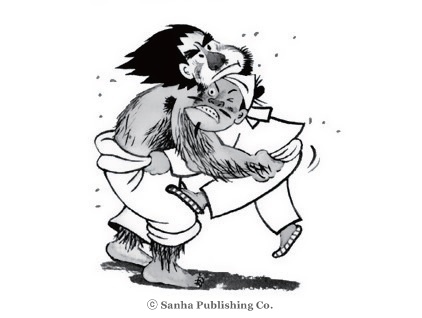
The Dokkaebi is a mischievous, playful fairy-like spirit that is equivalent to the western counterparts of leprechauns in capricious temperament and of goblins in formidable appearance. The legend says it that an old broom made out of dried bush clover with bloodstains on will turn into a Dokkaebi, who will hold a spell over the mind of an unfortunate passer-by at night in the field or on the mountain. Befriending with a Dokkaebi can bring you a fortune at a house that he has lived as your protective spirit, but you must live there for precisely ten years only. Otherwise, the Dokkaebi will leave you with the ruins of your fortune and health. There are still people in Korea who believe this belief tradition by offering the Dokkaebi buckwheat cakes, spirited beverages, and steamed pork when they open businesses and move into new houses. Some people even report seeing them when walking alone in the thoroughfares or any lonely path where lights are dim at night between midnight and 4:00 am.
A Dokkaebi likes to challenge a passer-by with a wrestling match.
The Dokkaebi may seem to possess the caprice and whims natural to fairy-folk. However, it embodies the human characteristics of compassion, selfishness, naivety, shrewdness, durability, and formidableness. The Dokkaebi reflects the pathos of life indelibly embossed in the collective consciousness of the Koreans. They have endured the anfractuous national tragedies and yet maintained their unique language and culture.
Faerie tales often belong to the days of yore before the advents of industrialization, and the fairies are either imaginative creatures or exaggerated figures of fashionably esoteric religions in the west. Still, the Dokkaebi is a living spirit in the minds of the Koreans and has wept and laughed with Koreans.
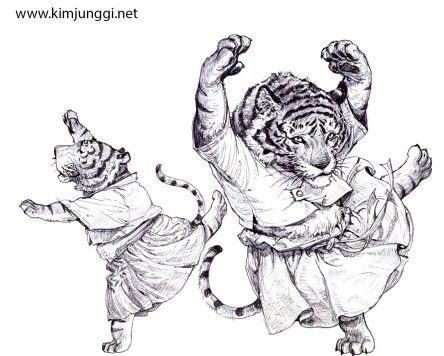
A tiger is a Korean totemic animal that can mimic human voices.
P.S. This post is my solipsistic response to #FariytaleTuesday, whose theme for today is the Asian fairies/spirits in folklore. The community is inundated with the wondrous tales of Japan and China but scarcely Korea. Koreans, like the Irish, love to talk and laugh with precious human sentiments, which result in the creation of the Dokkaebi. The Korean culture, as evidenced in the language, is closer to the cultures of the Ural-Altai language family, including the Finnish, the Japanese, the Turkish, the Hungarians, and the Mongolians. Since there seems to be a scarcity of Korean spirits represented in the tweets, I felt responsible for writing about this playful Korean spirit with human characteristics.
The story of man and beast decorates the wondrous latticework of the enchanting casement of Greek mythology. The ancient Greek weavers of stories used their poetic license to mirror the human traits, both attractive and unattractive, through the figures of the beast in scintillating ways. The resultant mythology created an aura of mysteriousness wonderfully anchored in reality whose thematics were originated in, such as the following tales from Greek mythology that reflect the nature of humankind as mirrored in the perspectives on the natural elements of animals and the relations to it.
The Cretan Bull
The Cretan Bull and the Minotaur
The story of a half-bull and half-man monster known as the Minotaur epitomizes the primordial thematic perspectives of mankind juxtaposed along with the law of nature representing the mysterious force. It became a subject of belief tradition peculiar to its natural and cultural environs. The conflicting sentiments of reverence toward the awe-inspiring nature’s creatures and the ambition for domineering them as the ruler of the universe give birth to the bestial creature in the figure of the terrific Minotaur who was fated to be slain by the Athenian hero Theseus.
The Minotaur
King Minos betrayed Poseidon by keeping his beautiful snow-white Bull, instead of sacrificing it to the expectant god, who, in turn, made his wife Pasiphae unquenchably infatuated with the Bull. She copulated with the beast by taking herself into the form of a hollow wooden cow designed by the Athenian architect named Daedalus. The result was the Minotaur kept in a Labyrinth by the selfsame designer of the wooden cow. The Minotaur showed no human feelings or emotions as the mythology did not treat him any more than a horrible bestial creature from the unnatural union of a woman and a beast.
A Bull in the ancient Greek culture was a chthonic animal associated with fertility and vegetation and also represented the sun and the might. In fact, the famous figure and paintings of bull-leaping are seen inside of the Minoan mausoleum in Knossos as first discovered by the eminent English archeologists Arthur Evans, who also found Linear A and B letters, the mother of the ancient Greek language, at the turn of the 20th century,
Argos finally uniting with Odyssey.
The dog – the best friend of mankind
The perspective on the dog as the loyal canine companion collapses the millenniums between the ancient Greek’s time and ours. Even the Cerberus, the three-headed guard dog of the Hades look tamable with a piece of sweet cake, making it look less of a menacing beast necessitating the blood and flesh of man. This goes without saying that it was Argos, the paragon of the faithful canine, who recognized his travel-weary employer Odyssey after 20 years of absence from home and put forth what might think he had to approach him with a wagging tail. He died as his long-waited boss in incognito passed by him with his heart pounded by a surge of pathos dubbed in warmth. Of all the gods, goddesses, heroes, and even his family, it was Argos who showed genuine, artless unconditional affection to Odyssey and thus rendered his heroic owner all the more humane and sympathetic.
Laelaps, the dog that never fails to catch
Speaking of loyalty, Laelaps, a Greek mythological dog that never failed to catch what it was hunting, also denotes how the ancient Greeks perceived the dog as their life companions. Laelaps was initially a gift to Europa from Zeus, then bequeathed to Minos, who gave it to his concubine Procris whose sister included Pandora. She gave the hound to her husband Cephalus as a token of her unbroken love for him Cephalus used the hound for hunting the Teumessian Fox that could never be caught. Then Zeus turned both of the animals into the stars as the constellations Canis Major (the dog) and Canis Minor (the fox).
The Eternal Catch-Me-If-You-Can between Canis Major (the Dog) and Canis Minor (the Fox)
Consequently, the use of the animals above in the thematic context in the Greek mythology evinces that mankind cannot exist alone as part of nature. Man finds his meaning of what it means to be a human and its purpose in life by rendering the values and precepts of natural law emblazoned in the human consciousness to the meta figures of the mythology. The mythological animals, whether wild, imaginary, or ordinary, are the reflection of the human traits interbred with imaginary creatures from the Elysium of Fancy. It became the substratum of a belief tradition administering to the modes of social behaviors in society, and thus developed into an organized religion by way of syncretism in the era of Christianity.
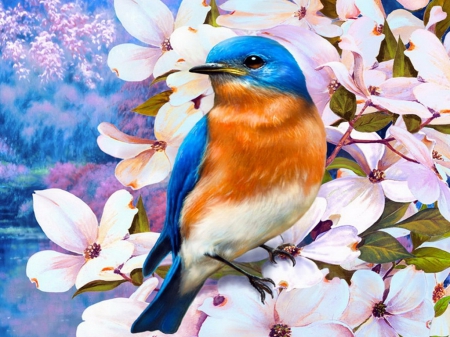
P.S.: The bluebird, as a symbol of hope and happiness because of its fanciful prettiness and rare presence in nature, has been a popular element of folklore. Albeit the French version by Mme D’Aulnoy is famous, my choice is a Russian version of the bluebird, as called upon by Anton Denikin, a military leader of the Volunteer Army in the Russian Civil War during the ill-fated Ice March. And this is my version of recreating the bluebird as a paragon of beautiful hope, the last saving grace for the forsaken left in Pandora’s Box, twinkling like the stars in the Milky Way embroidered on the nightly sky.
Many moons and suns ago when the Nymphs of the West
Tended and guarded the Garden of the Hesperides,
In the city of Alcantara, there lived a king, the most
Loving father of all who loved his only child in spades,
So utterly ugly in every possible variety of imaginations
That her presence made the beholders into muted stones.
They called her Ugly Altamira, but the king called her Love,
Showering her with Bounty of Beauty, Treats of Tenderness,
Telling her how beautiful she was as a magic spell of love.
Whereas the princess in her father’s glamour spell drove men away –
Prince Alanbam, the hundred knights in armors, and the barber –
All fleeing with horrors of taking her hand and kissing her lips.
Then the king told the princess to marry the Church in a veil
To which she retorted, “I will not marry the Church but find
A husband in the land beyond the sea where the day never dawns
And the night is eternal, so beauty is seen common in darkness.”
Therewith, the princess amounted her beautiful white horse
For departure to the land of equality when the elegant figure
Suddenly appeared at the gate of the castle whose visage was
Beaming with beatific beauty with a voice sonorous and melodious.
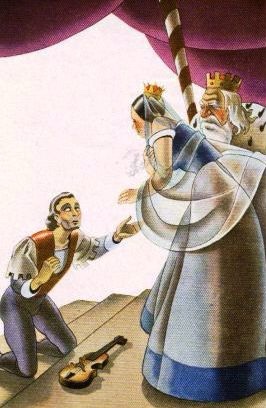
Felisberto, the blind fiddler, exclaimed in the bliss of love mysterious:
“Princess, you need not look anywhere else but to behold one
To whom night and day, ugliness and beauty are all but one.
Since all your suitors are too bashful to marry you so beautiful,
Allow me to be of your service as a husband who makes you happy,
For beauty is as beauty does, so is the pleasure of love in all fancy.
Thereupon, the princess dismounted her beautiful white horse
walked to the handsome fiddler and touched the beautiful face
of the man with tenderness and love full of passion and felicity
by which the man became ecstatic with the sensuous touch
of the delicate beauty of the princess and kissed her tenderly.
Thereafter, the princess and the fiddler married and lived happily
In a castle from the window from which they could see the Hesperides
Water the garden of divine golden apples and dance around the tree always.
P.S. The subject matter of this poem comes from a Spanish folktale of ‘The Ugly Princess” who was so homely that everyone except her loving father couldn’t stand the sight of her presence as though she had been a violation against the natural law. The father’s indoctrination of confidence as a positive reinforcement into his daughter is worth noting as a proto-clinical behavioral therapy in relieving the patient’s depressive obsession with her unattractive physical trait. In fact, the king’s therapy was so successful that the daughter’s identification with prime beauty that was deemed too high for the underserved was remarkable and seemed simply magical.
From movies to novels to the profiles of the authors and of the administrators of social media platforms, the social spencersim of the beautiful champions the law of attraction, whether or not you will vehemently disagree with that usual enforcement of the mantra of self-confidence equipped with a feminist armor and a diversity-rule shield. For beauty gives confidence to a woman in a social setting, and that’s the truth. No wonder folklore treats beautiful women as a rewarding virtue that handsome men are worth fighting for.
Although the ending of the Ugly Princess is unrefutably sweet and happy, I cannot helpbutrelate it to the ending of ‘Plain Girl’, by Arthur Miller – reviewin which the not soattractive but intelligent protagonist Janice Sasson ultimately finds the consummate love of eros and psyche in the figure of the handsome blind musician. Does the happiness that Janice so cherished have to be in the form of blindness? Can’t a woman deprived of glamour and the matching social adroitness meet and fall in love with a handsome man full of warmth, tenderness, and understanding? Does it have to be a blind man to whom nothing is different, hence an absence of beauty is acceptable? Does love agree at best only at night?
 Grimm’s Fairy Tales: 64 Dark Original Tales by Jacob Grimm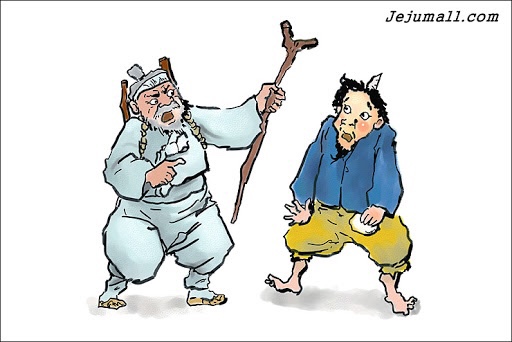




You must be logged in to post a comment.