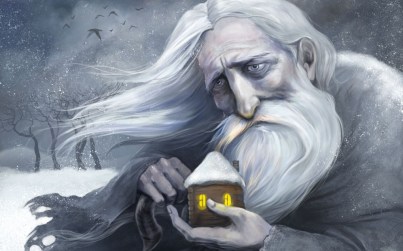
Behold his mighty wind power
Whirling leaves in eddies,
Rattling trees in terrible temper!
Boreas still remains in defiance!
Listen to the gale hissing, howling
Loud and hard, growing louder harder till
It becomes ranting of the god going
Mad with his utmost resistance to nil!
For the law of nature he cares none,
The principles of the Olympus he defies,
Boreas in great white ire against the Sun
Talks sound and fury in a whirlpool of gales.
P.S. : Boreas, god of winter is still here because even though we have officially entered Spring, the weather conditions of yesterday and today fraught with torrential rains accompanied by gale force winds betray the law of nature. I hope to see spring skies in no time.
The funeral offerings by a sepulcher for Eternity to a soul departed,
Crossing the River of the Styx to the gate of the Underworld,
Paying a fee to Charon for carrying the soul of the departed,
For without it, he will refuse to let him board his ferryboat indeed,
And the soul will wander around the shore for a hundred years stupefied
By Eternal Slumber in the amidst of the laments sung by those left behind
Until they are heard no more, seen no more, believed no more, and banished
Into the ancient all with his shattered dreams shuddered with fear – all in nil ended,
Are burnt in the funeral pyre as the embers spirit away in great red.
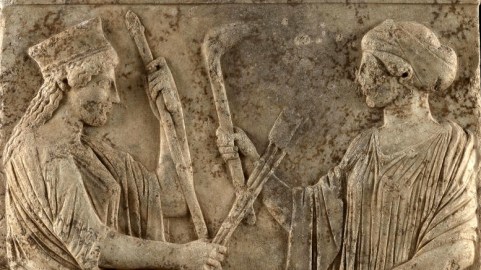
Veiled in the ancient shrine of the mysteries,
Robed in the esoteric knowledge of Olympus,
There appeared a numinous woman on the altars
Of a great temple built by Keleos, King of Eleusis
At the instruction of Demeter, the disguised goddess
Presiding over grains and the fertility of earth in distress,
For her daughter Persephone, deflowered by Hades,
The god of the Underworld was still retained in Hades.
The tale of woes so lachrymose with her eyes so dolorous
With the tears of the goddess welled with pains of heartaches
Began as Demeter called Keleos and other priests by the altars,
All of whom were equally intoxicated by her divine humanities
Of Anguish, Despondency, Dolefulness, and even Wretchedness
And listened to the elegy of their goddess of sacred grains
Of earth where now was barren and fallow for she was without grace .
“My daughter Persephone, the apple of my eyes, Flower of Flowers
On earth was ruthlessly ravaged by Hades, that dreadful Hades,
Of the Underworld, who then abducted her to his realm of darkness
Where only shadowy spirits wander with eyes depraved of lights,
Where the shadowy spirits importune for drops of blood for prophecies
To those a few mortals of valor destined for performing heroic feats.
There, Persephone, my beautiful daughter, was bound to Hades,
Who was also a brother of Zeus, god of gods, the ruler of the Universe,
Who was also an accomplice of this great crime, this god of gods!
Alas! Where’s Justice? Where’s Nemesis? Where’s God of the Universe
When this god of gods connived at his brother’s crime and sealed the mouths
Of other gods and goddesses who were nothing but divine cowards?
Thus, I searched high and low for my dear Persephone for nine days,
And on the tenth day, Hecate, a daughter of Rhea, and the sun god Helios
Came to me, for their pangs of godly consciousness disturbed by the pathos
Of my grief and lamentation was more divine than their divine essences
To tell me the crime of Hades and where my Persephone was that was
Hard to bear, harder to believe when my divineness was betrayed in Olympus,
Where all but I, the goddess of grains and fertility on earth was left amiss!
Thereupon, I fled Olympus, the ghastly place of godly beings in idleness
Who were nothing but abductors of fair maidens, manipulators of wars,
And conspirators of jealousy, all of it was against my nature and sacred office
With righteous contempt for all of it, I left that place of lewdness,
With no regrets, but with a longing heart for my Persephone in darkness.
Into this land of Eleusis, your land of Eleusis I wandered with hopes
Of meeting my Persephone one day as an old slave woman in disguise
Named Doso and met your wife by an old well near your splendid house
Where I became a burse to your son whom I fed ambrosia at nights
For Eternal Youth and put in the center of fire for Immortality, my Graces
To your kindly family till your wife full of foolish speculations
Betrayed my sacred appreciation and divine intentions and thwarted your son’s
Gifts of Eternal Youth and Immortality, the essence of the Immortals in Olympus!
Here, you built me my temple in honor of me, to initiate the Eleusinian Mysteries,
My Persephone will also preside for her four months’ stay on earth from Hades,
Alluring her to eat four pomegranate seeds, so she can’t stay here in bliss
For ever, forever with me, when the land will abound with crops and flowers,
And when you will purify yourselves with nine days of fasting and celibacy
with a consecration of the first grain harvested first of the year for the rites
In honor of me and Persephone, the goddess of spring of blissful liveliness.
Thus was a tale of the goddess, who was the goddess of humanities in essence,
Who was the goddess of the Eleusinian Mysteries with full of arcane principles
Of Purity, Morality, and Humanity, sealed in ancient secret rites so mysterious,
With sacrosanct pledges of select a few mortals mystified by the Mysteries
That would elevate the excitement of the souls and the passion of the hearts
Like no other in this world and in that world, afterlife where the spirits
In bliss promenading in the Eleusinian Fields boundless into the Mystic Universe.
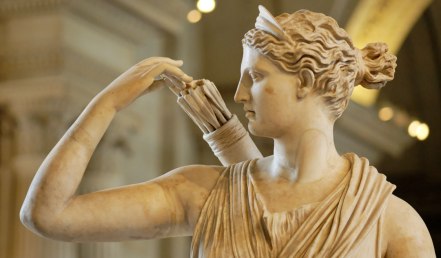
Over the relics of the marvels that belonged once
To a sacred dwelling of a Lunar Goddess, a divine
Maiden of Wild Beauty and Eternal Chastity destined
To chase the wild from dawn till dusk with her golden
Arrows missing nothing even from the top of Olympus,
A High Moon spoke with full of pathos of her immortal story.
“I once lived on the isle of Sicily with Athena and Persephone,
Gathering flowers in the Elysian Fields during the days,
Weaving our father Zeus’ robe at nights under the Moon and Stars
Enjoying our muliebrity unscathed by the lust of amorous men
Whose lascivious desire of women would forever be inordinate,
Spurning Eros, Aphrodite, Songs of Love, and Bliss of Marriages.”
“Then heard was no more; a mirth of our Persephone was heard
Nowhere, for Hades, the god of Underworld, swiftly abducted her
In his chariot and disappeared into the pit of the world down under,
Where I and Athena could not penetrate even with our divine aide,
Ending the blissful companionship of sisterhood for once for all – forever!
And thus I left the isle in quest of eternal pursuit of wild beasts alone.”
“Immune from the spells of Aphrodite and the arrows of Eros,
I am an eternal maiden who is free from marital obligations
So that I can chase down wild beasts with my ever loyal hunting
Companions of a Bear, A Wolf, and a Stag behind me all day long
And dispense my vengeful justice to all devoid of decency and civility,
Like the ones who were cruel to my mother, my brother, and me!
Such was the litany of woes told by a Goddess of the Moon
On a night when a Full High Moon filled the night alone,
Shining brightly alone above a lonely traveler listening to her
Tale of her divine destiny of solitude chasing her objects of
Pleasure for ever- forever continuing till her father Zeus takes
Away her immortality in pity and makes her a star next to Orion.
Thousands of years ago when gods and goddesses
Lived among the mortal and made love to them,
There lived a man in Greece across the oceans
Whose muscles invincible, confidence supernatural,
His spirit all greatness, all sincerity, all eagerness,
Untainted by the vanity of his divine heritage of Zeus.
A fruit of lustful possession of the mortal beauty
Named Alcmena by Zeus, the god of gods, in slumber,
The son of god, the infant prodigy toying with a snake,
Grew out to be on a par with the strength and esteem of gods
That was the sacred prerogative exclusive to the Olympian.
But lo! It was nothing but the elitism of the gods, for he could
Threaten the Sun to make it cool, waves when his boat’s tossed at seas,
And his music teacher for forcing him to play the lute against his will.
But alas, this man of incorruptible pride, of exceptional valor
Was to be pierced by the unquenchable flame of jealousy and
Hatred of Hera, the wife of Zeus, for his being the love child of
Her ever amorous husband whose objects of passion knew
No boundary between the mortal and immortal evermore,
Which she couldn’t bear at the sight of Heracles, nevermore.
Thus, Hera cast the spell of Madness upon the son of Zeus,
Making him blind with terrible rage, talking sound and fury,
And exciting him to slay his wife and their three sons with a sword
smeared with their blood so crimson, so warm with their last breaths,
Leaving the wretched man in a bottomless pit of guilt and shame
In his awakening from the bewitched madness driven by the sulphurous
Envy of the wife of god, who sired this son of god, who loved his mother.
The great surge of remorse swept over Heracles with wells of tears,
The sublime wish to expiate his sin suddenly urged him to go
To the Oracle of Delphi for Apollo’s guidance for his penance,
Where the sacred priestess in fits of divine frenzy told him to
Eurystheus, King of Mycenae, his cousin, the inferior to his being
To purge out his sins of Matricide, Uxoricide, Prolicide, and Filicide,
Once for all, in the name of Apollo, god of the Sun, Truth, and Healing.
Thus obeyed Heracles, our wretched but genuine man of courage,
Who, at the command of Eurystheus, his loyal cousin, undertook
The Twelve Great Labors so impossible, so unthinkable, so incredible
By himself, alone, in act of penitence that was so brutal, so primordial as thus:
Killing the Lion was met by vanquishing the Hydra;
Then he had to capture the Stag and the Boar;
He even deigned to clean the filthy Stables in a single day
To kill the monster Bids, followed by capturing of the bull;
Thereupon, he rounded up the Mares to steal the Girdle;
Herded the Cattle so unmanageable and untamable;
Went to fetch the Apples and then captured the Dog of the Underworld.
The Greatness of the Spirit, the Purity of the Soul,
Far excellent, far above the Reason clothed in cowardly pride,
Far higher than arrogance and hypocrisy in the guise of intelligence,
Was the name of Heracles to whom no fear and intimidation did appear,
Nor the impossibility, nor injustice did exist in therein eternally evermore
enshrined in the memory of the half-man, half-god who once lived among us.
The essence of myths is threefold: it is a branch of natural science, trying to explain what humans saw around them. It is also a genre of pure classical literature. Besides, mythology is religion, the deepening realization of what human beings needed in their gods and goddesses. That is, mythology is a way to show us the way the human race thought and felt untold ages ago. Through mythology we are connected to the men who had close relationship with nature, who had no real distinction between the real and the unreal, unchecked by reason but with the spirit. In this light, Edith Hamilton’s Mythology breathes life into the Greek, Roman, and even Norse myths, which are the bedrock of the western civilization – the stories of gods, goddesses, and heroes that have imbued the humankind with multifarious creativity from time immemorial to present.
The aim of this book is to produce knowledge of the myths that had been recorded by ancient writers and poets. In fact, the myths as we know now are the creation of great poets, one of which is the Iliad by Homer. Unlike the Egyptian, the Greeks made their gods in their own image and breathed them with their emotions and feelings. It is uncertain how the genesis of the Greek mythology came into being; however the earliest Greek poets arrived at a new point of view which had never been dreamed of in the world before them. It was at this point that mankind regarded itself as the center of the universe, intent upon producing the beauty of human, which was the very consummation of reality.
According to Hamilton, what distinguishes Greek mythology from others is it’s foundation on the factual reality. The nonsensical took place in a world, which was essentially rational and matter-of-fact. For example, Hercules always had his abode in the city of Thebes, save when he took of a journey to accomplish his twelve labors; Aphrodite’s birthplace was just offshore from the island of Cynthera; Pegasus’s comfy stable was in Corinth. There was a sense of reality in the mythological world but no place for magic.
Mythology is not a tome that requires of modern readers perquisites for scholarly knowledge of academic languages, intellectual superiority, or historical knowledge of the ancient time. It is an anthology of entertaining and inspiring tales of gods, goddesses, nymphs, and mortals who fell out of favor with the divine, written in plain English; it’s like listening to a very well-read story-teller. In Mythology, we meet all from the mercurial gods and jealous goddesses on the Mount Olympus even to Norse gods in Valhalla. We are fascinated with tales of Cupid and Psyche, Odyssey’s Golden Fleece, and forlorn Clytie whose love for Apollo pined away. We discover that Paris of Troy used to live with a nymph called Oenone before deserting her for Helen of Sparta. Also, we listen to the legends of constellations of the stars as well as many other references for literature, paintings, and music that have been deeply inspired by Greek mythology.
Mythology is the most comprehensive and lucidly accounted tales of mythology based upon Hamilton’s extensive collection of the sources from great ancient poets and writers. Of all other books on mythology of the western civilization I have encountered, this book is by far the most excellent in providing readers with both entertainment and knowledge without academically esoteric approach or literary pompousness. Mythology succeeds in offering education and appreciation of art that has been passed down to our present time for thousands of years. For this reason, Mythology by Edith Hamilton is a touchstone for books on mythology.




You must be logged in to post a comment.