Tag: Greek mythology

  • poesie #

    ff76df2297dfacf05d029d5abb4988d3

    When the night gently descends upon the day on the earth’s bed

    And he silences her secretly with a force of darkness

    Whispering softly in delirium, murmuring faintly in fever

    blinding her with an extraordinary frisson of ecstatic fear

    the spirts of tragic heroines of love – Dido and Ariadne-

    run to the top of the hill where the sky lies above the earth

    and lament their earthly journeys that ended in love alone

    as Hounds of Love howl beside the beautiful losers in love

    till the lovers’ tryst ends in a mist of passion and intoxication.


    P.S.: I am always inclined to the stories of beautiful losers whose loves for their figures of the affairs of the hearts are not returned because there’s something tragically beautiful in them. Dido, the beautiful queen of Carthago, was cruelly forsaken by trojan refuge and founder of Rome Aeneas and chose to end her own life thereafter. Ariadne was a Cretan princess who helped Athenian prince Theseus to kill the Minotaur and to bring out the Athenian youths from the labyrinth with her inscrutable ball of threads as a guide to a route out. But Ariadne was also later deserted by Theseus and let alone on an island and forced to marry Dionysus, the god of wine. Hence this poem about those who are unlucky in the affairs of the hearts. 


  • Ballad of Dido and Aeneas

    6858611048029cebdb3615280c191a3a--oil-on-canvas-dido
    Aeneas leaves Dido, courtesy of pinterest

    From a land ravaged by a wooden horse with a golden apple for the fairest of the divine beauties appearing to a prince so young, so impetuous in judgment thereof,

    There came a poor beautiful stranger destined for the supernal fate to rule the mortal to the diamond eyes of a maiden queen ethereal in beauty, graceful in act and hapless in love.

    Blindsided by Juno’s machination, swept by passion growing strong, growing stronger for the stranger,

    The queen bade him with tears and roses in succession day and night, in desperate attempt to keep his presence, his body and his soul, all but an entreaty so futile,

    So forlorn, with a promise of her kingdom and her fidelity in return for nothing but his surrendering of himself to her and herself to him till the mortal fate was ended, till one had to cross the River of Styx.

    Alas, but the queen’s to be thwarted, she’s to be abandoned by the divine plan forced by the arrival of Mercury, god of war whispering to the poor stranger for the imminent departure for destiny far more magnificent, far more supreme,

    As dictated by Jupiter, god of all regions crossing death and life forever who put forward a divine plan over mortal feelings however pitiable.

    Thus did the stranger set to sail the seas full of perils ever more.

    The queen defied, she cried, she pleaded, but all ended in nought as the poor stranger was to depart cruelly with no tender words of love that’s planted, nourished,

    And admired by the queen so now distraught by his betrayal of her love with her plea wreathed in tears and flowers.

    Now her love became her poison consuming all of her ever more,

    Now he became her foe ravishing all of her in surrender of love.

    But what of it when all’s ended in a sea of heartaches thousand times, with no reason to reign as a queen without her lover by her side?

    Nothing, nothing’s to remedy her spirit that’s broken thousand times, for nothing, nothing would console the lonely queen in cruel abandonment,

    But the last will to burn her body and soul consumed in madness of passion on an ancient funeral pyre that engulfed every part of her whispering to her departing spirit that love would come never more – Nevermore!


    저장

  • Afterthought

    I didn’t anticipate her response, let alone her thanks. After all, she’s a celeb in the constellation of high stars, a goddess in the pantheon of divine knowledge, and a grand master in alchemy of literature, Or in recognition of her self-titled epithet, she’s the Comma Queen who will not/does not suffer from the grammatical benightedness of ambitious literary proclivity. But it happened, and she did; Mary Norris, author of Greek to Me about which I wrote a review, responded thereto in the following fashion:

    Well, it’s nice to be complimented for my work by someone who is famous, and I certainly wouldn’t mind being rich and famous if I turned into an overnight sensation in literary firmament. Yet, I do not write to make a living nor to be popular with hundreds of likes. Writing to me is an act of sovereign remedy for the existential ills, of personal treatise on the workings of the mind and of sheer egotism of relieving the creative urge from within. Come what may, a little tweet from the celebrated writer will not turn love of the book into worship of the writer. For it is the work of her intellect manifested in her literary craftsmanship, not the person herself. Whether or not the author liked my review does not/will not/should not affect my reason for and act of writing with a million dollar memento from Kurt Vonnegut: “To practice art, no matter how well or badly, is to make your soul grow. So just do it.”

  • ‘Greek to Me: Adventures of the Comma Queen,’ by Mary Norris – review

    Greek to Me: Adventures of the Comma QueenGreek to Me: Adventures of the Comma Queen by Mary Norris

    My rating: 4 of 5 stars

    The ancient Greeks knew what appealed to the senses. The cult of beauty was the caryatid pillars of the culture that sublimated the human body into a divine canvas of the mind. So much so that they codified the value of beauty in their belief system, ranging from mythology to philosophy, in pursuit of kalokagathia , the harmonious combination of physical beauty with spiritual goodness. The perennial upshot of this Greek admiration of kalokagathia is Mary Norris’s charming Greek to Me: Adventures of the Comma Queen, a wonderful cabinet of her infatuations with all things Greek, ranging from awesome Goddess Athena to dashing Sean Connery as Agamemnon, to the whimsical variations of Greek pronunciation, and to her exhilarating skinny-dipping in Aphrodite’s Beach. With her gift of scintillating narrative skills flavored with accessible erudition, Norris warmly invites the reader to her own delightful Greek festival of words, gods, romances, and delicacies.

    It is said that when you love, you want to know. An erotic impulse charged from the imposing physical presence of Sean Connery as Agamemnon became a stimuli that galvanized a shy celibate Catholic bluestocking into her never-ending solo odyssey in pursuit of a mystical ambrosia, the food of the Greek gods, for the sensuous delight of the arcane Eleusinean Mysteries. Part memoir, part travelogue, and part reference book, Greek to me is a lovely treatise on Norris’s lasting affairs of the heart with words and adventures in the land of the capricious Olympians, olive trees, and phonetic alphabets with infinite varieties. The scholarly subjects of mythology and language of Greece are never dealt with academic superciliousness or elitist snobbishness that separates them (and the author) from a general reader. Contrariwise, Norris is an intelligently gorgeous writer who wears her erudition lightly and writes in plain language felicitously topped with her artless witticism that makes her a winsome literary troubadour. If Edith Hamilton, author of Mythology and The Greek Way, has an aura of dour-faced platonic conservative teacher of the ancient Greek mythology and the culture, Mary Norris is of a coterie of amiable Socrates, sharing her knowledge with the public – literate, illiterate.

    In the exhilarating sensation of naked freedom astride the gushing foams of wild waves in Aphrodite’s Beach, the reader feels connected to the author’s paroxysm of pleasure and transformed into a votary of the goddess of love. Norris’s solipsistic adventure becomes a tour of coterie, traveling beyond the territorial borders into the mythological world of gods and goddesses in search of the Golden Fleece fit to one’s appropriate need. Although the chapters devoted to the lexicons of the Greek language can be taxing to comprehend to whom it all looks Greek, most of the book is invested with the vicarious Eureka pleasure of going there, being there, and seeing there, all made possible by Norris’s goddess Athena-like literary prowess. Besides, if the reader happens to be a quiet solo Catholic woman graduating from Rutgers University in New Brunswick, NJ (more specifically, all-women Douglass College therein), secretly desirous of solitary skinny-dipping in Aphrodite’s Beaches basking in freedom from insecurity, this book will feel like a new friend.

  • The classical love

    1035

    It would be devastating to know that the heart of your beloved has already parted with you. It would be even more catastrophic to learn that your love has been unrequited and consumable because it was never on equal terms for what’s worth to your once beloved. The affair of the heart is the common human trait that transcends the subjectivity of time and space, the boundary of ethnic, racial, and territorial demarcations. The truth of the matter is that when you are consumed with a burning passion sans the mind and the heart, you play fast and loose with your own life as collateral. In the ancient times, the unconstrained passion lured the desperately love-stricken to turn to the supernatural dependencies of magic spells or love potions at the expense of their own lives in the hope of making their beloveds fall in love with them. Such was the case of one slave girl in ancient Greece who made love a dangerous game.

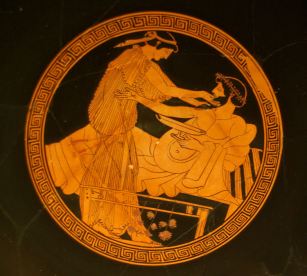
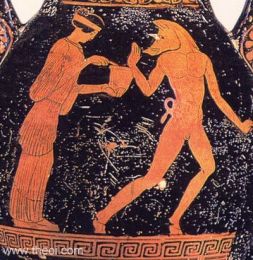
    T35.1Kirke
    the goddess Circa on the left

    Her name was Dilitra, and she was in love with her wealthy master named Philoneos, whose interest in her was to satisfy his libido and nothing more. For she was his faithful and obedient bed-mate at his command. And she was in turn assigned to a relatively comfortable domestic drudgery, such as tidying up chambers and assisting in cooking in the kitchen, while other slaves toiled to the bone, as befitted what they were. As a concubine, Dilitra wanted no more and only wanted it to last as long as his master wanted her. Then all seemed to be a denouement of her happy concubinage when she found out that Philoneos would sell her to a brothel because he was simply “bored” with her. That was a total blow to Dilitra’s faith in Philoneos whom she loved and trusted. Blindsided by her lover’s betrayal, Dilitra resorted to the magical use of herbs and potions – called pharmaka as believed to be empowered from the goddess Circe – from a sorcerer who guaranteed her that he would fall back in love with her. So she poured the potion into wine, which Philoneos voraciously gulped down at dinner. The result was the instant death of her treacherous lover and the execution of the distressed poor Dilitra after the horrible torture by the authority on the count of punitive nature of the crime against her master.

    The historical record of the tragic event tells a variety of facts prevalent in classical times. First, the idea of love was primarily erotic rather than platonic, sensual rather than holistic. In fact, what we now understand about “love” would have felt alien to the ancients in terms of the relationship between man and woman because such a modern idea of love was no more than a close bond between family members or a master and a horse or a dog. That is to say, love in the minds of the ancient meant the physical play of desires – Lust. In this regard, Dilitra’s desperate measure of using the magic potion betokens her attempt to awaken the flickering erotic love in Philoneos so that he would not sell her to a brothel to let her become a pornail – a common prostitute. Hence the potion was really meant to be an aphrodisiac that went awry.

    Second, the use of spells and love potions was something of a norm in ancient Greece, where religion and daily life were inseparably bound together. It is said that there were two ways of inducing lust in a person: (1) an agon spell, which included magic, through the power of a demon to drive the desired one mad with lust for the one who initiated it. The effect of the spell, I think, could amount to the image of a fanatic band of maenads accompanying the wine god Dionysus.  It was known to be mostly used by men; and (2) pharmaka, which was regarded as drug-induced love preferred by women because of the supposedly less mortally dangerous than the employment of a demon. However, anyone who opted for this “mild” form of craft did not know that its effect could be more fatal than an agon spell because it was a chemical intoxication consisting of various herbs that could be lethal when mixed improperly as is illustrated in the story of Dilitra.

    It would be an anachronistic or impudent mistake of assuming that Dilitra’s tragic end resulted from her own foolhardy, rash decision to turn to quackery and superstition if we were pitchforked backward in time. It was her only choice to secure her life under the aegis of her lover-master whose lust for her was the only guaranty of the cherished wishes. On one hand, the story of Dilitra tells us how we as humans have evolved in understanding the meaning of love, many special thanks to philosophers and psychologists, that it complements the body and the mind (as represented by Eros and Psyche, respectively, in Roman mythology.) On the other hand, it shows us at the heat of the passion, we can return to our animal nature governed by id only. Now, that would be quite a thespian tragedy.

    Author’s note: This writing is based upon my reading of an article about the history of love spells and potions in ancient Greece from a history magazine. The woeful life of the slave girl who depended upon her master’s desire of her was pathetic enough to put pen to paper. What if she just ran away when she found out her master’s intention to sell her to a brothel, instead of resorting to the drastic measure of getting the drug? No, she should have just escaped from his household forthwith. It seems to me that it was her lack of self-confidence that chained her down to the voluntary enslavement that ultimately led her to death.