Tag: history

  • ‘Humorists: From Hogarth to Noel Coward’ by Paul Johnson – review

    Humorists: From Hogarth to Noel CowardHumorists: From Hogarth to Noel Coward by Paul Johnson

    My rating: 5 of 5 stars

    It’s gobsmacking to see how people misidentify humor with mockery or sarcasm in their misconception about laughter (the loud the better) as a product of a merry heart. Whereas humor should be appealing not only to the senses but also to Reason with a natural assistance of wit to discern the light side of life and to elevate it to wisdom of life it bears, people tend to derive funniness from faux-pas and gaucheness of targeted individuals as if they were Olympian gods and goddesses laughing at the sorrow and travail of mortals on earth. That being said, this aptly witty book by Paul Johnson is an intelligent receipt against the philistine understanding of humor drawn on his erudition and sharp witticism.

    Johnson sees humor as a handmaid to hope in life that gives a jolt to a meaning of life, a mental and physical therapeutic means to make the strains of existential malaises bearable, and presents us a society of famous artists who shares the same views on the pristine essence of humor. Life is indeed a comedy in a long shot and a tragedy in close-up. If our human existential life is a tragedy at the core, it also has a periphery of comedy, which helps us to understand and embrace the attitude of “Amore Fati” Love of Fate, regardless of a boundary of classes, races, and genders. Accordingly, finding humor in human suffering is one of the manifest functions of arts in sublimating human emotions and thoughts into the aesthetically pleasing and intellectually satisfying artifacts.

    From Johnson’s humorists, the persons of Charles Dickens and G. K. Chesterton strike me as scintillating artists of classless humor whose abilities to draw humor upon people of all walks of life and to look upon the bright side of existential life and kindly side of human nature, for human nature is the same in all professions as it is in water, not stone. Even madness does not look grim and dismal in the eyes of amiable Chesterton: “The mad man is the man who has lost everything except his reason.”

    This is the fourth book by Paul Johnson I have read, and it never ceases to amaze me with his erudition and wit manifested across pages after pages at the expanse of his will to enlighten general readers in plain English accessible to all. If you think abrupt peals of boisterous laughter in disguise of hearty mirth in public places are none other than a sign of incivility and citizenship, then this is a fit read that you will enjoy to your quiet hear’s content.
    View all my reviews

  • Cabinet of Curiosities

    ff76df2297dfacf05d029d5abb4988d3Scrolls of ancient sagas

    Pictures of strange faces

    Folios of collected letters

    Sealed in the misty wonders

    of the antemundane treasures

    awoke her delight in the senses

    in phantasmagorical displays

    of the cabinet of curiosities.

    Author’s Note: Looking at our family album suddenly brought me back to the time when my father opened an old cabinet in his library where the interesting artifacts from our ancestors were kept and explained to me what they were; At the tender age of childhood, it was a sight to behold in awes and wows engraved in my memory shrine. For it was truly a Cabinet of Curiosities.

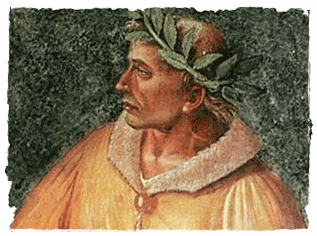
  • On Ovid: The Exiled Poet in Woe

    oviduo

    People tend to think that the books of antiquarian authors are far-fetched from the reality of our digital era, whereas our calendar years on the evolutionary scale amount to microseconds on the twenty-four-hour biological clock. Apart from a great divide of time, great writers of all time show us the wounds and mirth at the heart of humankind and stand observant of the anfractuous human lives as though to be seen through opera glasses. In this respect, Ovid, author of Metamorphoses, can be regarded as an ancient trailblazer of popular literature whose subject matters, such as cause and effects of love and devotion, are still appealing to readers.

    Ovid first gained popularity with The Ars Amatoris (The Art of Love), a kind of self-help book for men on how to woo women and keep their love with practical tips under the guise of a formal didactic reference to avoid censorship. Heroines, a series of dramatic monologues centering on mythological women, including Penelope, Dido, and Ariadne, lamenting on their mistreatment at the hands of their men, earned him the sobriquet of best-seller writer of his time. However, what Ovid secretly and really craved was a learned readership vis-à-vis the reputations of his peers Horace and Virgil whose works were regarded in high intellectual esteem by the elites. Hence, Metamorphoses, a series of 250 stories of gods and immortals intertwined in a vortex of love, lust, grief, and terror, was his magnum opus, a kind of literary vindication of mass demotic literature. It seemed that Ovid as a man of flowering Roman letters arrived at his pinnacle of literary career until fortune’s malice overthrew his state.

    Ovid suddenly fell out of favor of the emperor and exiled to Toms, a city on the Black Sea. Whys and hows of Ovid’s exile are still clandestine to this date as Ovid also never recorded any details about what caused the emperor to banish him to the backwater of the empire. As with many a conspiracy story, there are hypotheses of the cause of this unfortunate event: (1) Ovid had a love affair with Livia, Augustus’s wife, while married with children; (2) Ovid knew of an incestuous affair between the emperor and his daughter Julia; or (3) the error might have been of political nature because Ovid might have gossiped about certain political factions. But then any of the above can be a figment of imagination.

    Notwithstanding the above, I like to think that Ovid is a great benefactor of mankind with his dazzling reworking of Latin and Greek myths and entertainingly vibrant guidance of practical love. In fact, he was far more gentlemanly in treating women regardless of their age and looks than any of our contemporary man writers are. To Ovid asking a woman’s age was highly improper and telling a woman of good things about her were a must to keep her love ongoing. In light of the above, none of the aforesaid presumptions rings true to me, and it is my presumption that maybe Ovid’s jealous contemporary despising the well-deserved success of Metamorphoses conspired against him and pushed him to banishment in the outpost of Rome, the city Ovid loved so much.

  • ‘The Husband Hunters: American Heiresses Who Married Into the British Aristocracy’, by Anne de Courcy – review

    The Husband Hunters: American Heiresses Who Married Into the British AristocracyThe Husband Hunters: American Heiresses Who Married Into the British Aristocracy by Anne de Courcy

    My rating: 4 of 5 stars

    They were the Beautiful Buccaneers dressed in fine dresses a la Parisian mode, expensively educated in Europe, and exclusively cultivated in the upper echelon of the Classless Class Society. They were American women seeking English aristocratic men who could promise them with prestige of class distinction with a complementary endowment of stately country houses, royal banquets, and a general carte blanche to basically all social occasions, events, and establishments exclusive to a select few. Although it wasn’t exactly akin to the plebeian idea of “Mail-in Bride,” the wealthy American women were vying for the lordly attention of the English bachelors of peerage at the ballrooms of high social clubs. These celebratory high society American women are unveiled in Anne De Courcy’s telling episodic vignettes of The Husband Hunters.

    At first, De Courcy’s portrayal of these American Cinderellas is deemed to be cast in rather favorable light despite their manifest materialistic intent on marrying peerage not for love but for necessity. De Courcy eulogizes the idea of “American Beauty” whose circumstances conspired to make her feel that she was mistress of her fate and who always got what she wanted, the remarkable American character that looked so irresistibly attractive and desirable in the eyes of high-class English men. In addition, American women were said to always adonize themselves with fashionably beautiful dresses with a natural air of confidence blurring the boundary of arrogance, which was also oddly very alluring about them. De Courcy is unfailingly sympathetic toward these young beautiful American social arriveste, for theses women fell by the wayside of the highest circle of social class by their birth and ranks, such as whose daughters they were, despite the constitutional credo of freedom to all without hereditary succession of peerage and the entitlement of prestige equal to the inherited ranks. In De Courcy’s humane perspective, these American Cinderellas were in one way or another victims of social discrimination per se of their time.

    The book has also nice diversions in contextualizing the cultural and social ambiance of the time, including the introduction of one Charles Frederick Worth, the progenitor of modern-day fashion house designer and trailblazer of hauteur-coutre. Working as a ship assistant at a London tailor shop until the age of 12, Worth went to Paris alone and set up his design studio with exquisite choice of fabrics and gorgeous design that soon caught the eye of Empress Eugene, a tall, slender, beautiful woman who was a great model for Worth’s fabulous dresses, and thus became the most sought-after designer in the Western Hemisphere. Of course, the American young women of the moneyed class were intent on buying the dresses made by Worth in Paris to adorn themselves at social balls to woo their desirable aristocratic suitors from England. For these women firmly believed if they were not worth the wooing, they surely were not worth the winning in consideration of Shakespeare’s fierce observation of beauty as a standard of woman’s merit to escalate social status by marriage: “She’s beautiful, and therefore to be wooed. She’s a woman, therefore to be won.”

    The gem of this book is its cleverly nuanced subject matter underlying the hypocrisy of American credo of Independence, Equality, and Freedom, vis-a-vis European, especially their former colonial English, class snobbishness. inherited entitlement of landed peerage, against which Americans claimed to fight and guarded. The American moneyed class needed titles to level themselves with dignitaries to display their flowing hard cash. What it used to be inter-class marriage became intra-class marriage by uniting the well-heeled bourgeoisie with blue-blooded aristocrats. But what good of it if such without end businesslike marriage was loveless, heartless, and soulless? The fear of falling into unwanted spinsterhood might have been deemed miserable, but the repining at the prospect of being an old maid shouldn’t be the main force of being wed at leisure. For marriage is indeed a matter of more worth than to be dealt in by attorneyship as the Bard keenly observed. The Husband Hunters to me is more of a social context of American moneyed class of the time and their economic power that could acquire centuries-old ranks and titles. Such a marriage was regarded as a biblical bond of objectives (money) and prestige (title) in the minds of the American rich families of the time when it was believed that women’s fortune depended upon strength of men. In light of the above, this book is provocatively revealing and cleverly ironic to learn of these American Princesses.

    View all my reviews

  • ‘Michelangelo and the Pope’s Ceiling’ by Ross King – review

    Michelangelo and the Pope's CeilingMichelangelo and the Pope’s Ceiling by Ross King

    My rating: 5 of 5 stars

    After Pope Julius II saw the Pieta installed for the tomb of a French cardinal, he wanted the same awe-inspiring adornment for his tomb. Hence, Michelangelo Buonarroti from Florence was summoned for the work. That’s how Michelangelo at age thirty-three reluctantly embarked on his Herculean task of frescoing the vault of the Sistine Chapel. This book by Ross King recounts such background stories of the making of the Sistine Chapel frescoes and descriptions of the personal traits of Michelangelo.

    Michelangelo’s work on the frescoes resulted from part Divine Providence of endowing the humanity with an awe-inspiring masterpiece of art to delight the senses of mankind throughout the ages, and part secular ambitions to mark the names of both the commissioner and the artist themselves. Pope Julius II also wanted to renovate the Sistine Chapel that had been used as a living quarter for the guards, a fortress against papal enemies, and a jail. As no one pours new wine into old wineskins as said in the bible, the pope’s plan to revert the chapel to its original place of worship, which made him drop his tomb project, was met by his idea of frescoing the vault in its entirety. Michelangelo, who was a breadwinner of his family, accepted the commission with good amount of salary and commenced four-year of labor of woes and dramas on the vault of the chapel.

    There are revealing truths that should be known concerning the process of frescoing the Sistine Chapel as follows: Contrary to popular belief that Michelangelo did the work while lying prone on his back, he worked with his upper body bent backward like a bow. Also, it wasn’t done by Michelangelo alone but by a team of his assistants chosen by Francesco Granacci, a close friend of Michelangelo, even though he was innately a solitary worker who had a strong distrust of others who worked with him.

    Michelangelo was said to be a man of  homely appearance without sociability in comparison with his contemporary and rival Raphael Santi whose beautiful look, even-tempered, and sweet character topped with artistic ingeniousness endeared him to the many. Also, Michelangelo’s direct altercation with Leonardo da Vinci as described in this book was amusing to discover. Both of the masters of the arts did not like each other publicly, but it was on the part of da Vinci who instigated such heated feud. He disregarded sculptors, including Michelangelo, as mechanics in the appearance of unkempt bakers.

    It is also interesting to pay special notes on the figures Michelangelo used for the frescoes, which shows his ingenuity of selecting unique subject matters distinguished from his contemporaries. To illustrate, he used 7 prophets from the Old Testament and 5 sibyls from pagan myth to decorate the Sistine vaults. He was fascinated with prophetic knowledge of the sibyls who had dwelt in sacred shrines and predicted the future in fits of inspired madness. This offered a riveting link between the sacred and the profane, the church and the esoteric pagan culture by reconciling pagan mythology with orthodox Christian teachings.

    Readers will find that the position of a painter/sculptor was not esteemed highly; he was more of a skilled laborer, a craftsman given exact orders how to produce his work by his commissioner or patron. In fact, he image of a solitary genius who would wield his brush and pallets to portray his world of imagination from the fathoms of his soul was a romantic fable. In Michelangelo’s time, an artist’s creativity was fettered by the demands of marketplace or his patron. Nevertheless, Michelangelo often disagreed to the pope’s own artistic direction and even had a temerity of broaching the shipping charges incurred in transporting the marbles from Carrara for the aborted tomb project at a dinner table with the pope .

    All in all, this book has its magical way of transporting readers to Italy in the early 16th century and invites readers to meet with Michelangelo as he was without sprucing up his personal character. Upon reading this book, I avert that Michelangelo is an artist bizarre fantastico whose magnum opuses on the ceiling of the Sistine Chapel have both the beauty and the sublime that produce in the spectator a kind of astonished wonder so formidable and so fantastic transcendent of time and place.

  • ‘Fairies: The Myths, Legends, & Lore’ by Skye Alexander – review

    Fairies: The Myths, Legends, & Lore

    Fairies: The Myths, Legends, & Lore by Skye Alexander

    My rating: 5 of 5 stars


    They are the hidden children of Adam and Eve. They are the minions of Lucifer fallen from Heaven into this terrestrial world when the gate was being closed by the Archangels at the time of the great celestial rebellion. No wonder they are neither good nor evil, although their amorality is felt more akin to treachery and terror to our mortal sense and sensibility. The ancient Greeks called them nymphs, and we call them fairies, frolicking and romping, feasting and dancing deliriously in their own fanciful realm: the slice of seacoast between tides, the deepening foliage between field and forest, and the sloping land between plain and mountain – a parallel universe existent in in their liminal four-dimensional world. Skye Alexander’s Fairies: The Myths, Legends, and Lore tells us all of it with her wealth of knowledge and introspection of these mystical beings as though it were her literary enchantment.

    The ambiguous nature of fairies endows the mystical folk with wonder and terror, glamour and danger, all in the veil of mysterious invisibility that has protected them since the time immemorial. They can be friends or foes, depending upon their moods. In fact, fairies have a status which fuses the capricious powers of demoted deities with the erotic charge of modern celebrity in the kingdom of myth and folklore. So much so that they have consistently appeared in literature and movies, such as ‘The Fairy Queen’ by Edmund Spencer, ‘A midsummer night’s dream’ by William Shakespeare, ‘Rip Van Winkle’ by Washington Irving, and ‘Peter Pan’ by Walt Disney. Unlike educated Christianity of angels and demons, these mystical celebrities have lived among humans because they embody our certain human traits, which are the good and the bad, and wishes that we cherish secretly to live better life. Take the case of glamour spells that will make a plain-looking lady beautiful to impress the onlookers in a favorable light. Fairies are the embodiment of our what-ifs in a land of imagination where our strains of existential life can be forgotten, if not eradicated. This also relates to historian Keith Thomas’s analysis of myth and magic as a mental analgesic. That the concept itself can account for such misfortune explains any conspicuous discrepancy between merit and reward and thus helps to reconcile anyone who believes it to the environment in which he lives. That is, it helps a man to take decisions when other agencies fail him, not jeopardizing his self-esteem because it does not relate existential dilemma to his ascribed social ranks and conditions.

    Changelings, Sleeping Beauty, Pixies, Brownies, Elves, Dwarfs, Selkies, Leprechauns, and Tinker Bell come alive pages upon pages of this enchanted book in an expense of the author’s charmingly kind guide to Fairyland we all have once believed. Since writing is also a peculiar alchemy of literature, this book is a magical concoction of the author’s knowledge of fairies and her alluring invitation to the liminal netherworld that will make the read even more enjoyable and lovable. Believers or unbelievers, this book is a good primer for the world of folklore and myths that we feel losing or lost.


    View all my reviews