
Let nothing disturb you,
Let nothing frighten you,
All these will evanesce.
Patience will harvest all things.
Your credo will obviate fears.
The courage to change scintillates.
Let nothing disturb you,
Let nothing frighten you,
All these will evanesce.
Patience will harvest all things.
Your credo will obviate fears.
The courage to change scintillates.
 Pretty Girl: How To Be Really Pretty, Even If You Don’t Think You Are by Bronwen Skye
My rating: 4 of 5 stars
Let’s be honest. Apart from the hypocrisy of feminist manifesto of defying patriarchal, patroilineal views on ideal feminine beauty, being beautiful can be a confidence factor, and it can make a world of difference to a woman. That’s why there is a myriad of self-help books on beauty, most of which I find insipid, redundant, and banal on the basis of superficiality and presumptuousness of the subject matter that in fact deserves of a certain respect and serious approaches. Hence Pretty Girl by Bronwen Skye whose beauty advice is rooted in psychology and neuroplasticity in the form of Law of Attraction.
The author tells us that acting like a pretty girl is the elemental It, even if you don’t think you are. This could be met with a wave of casual scoffing, for we have heard of this mass advice from self-proclaimed beauty advisors. But Skye is different in the aspect that she sets forth details on discovering your beauty buried inside by practicing Law of Attraction which are comprised of: (1) Affirmation of what you want to achieve (i.e., feeling pretty no matter what); (2) Appreciation of what you already have even though you don’t recognize it; and (3) Visualization of the Real Confident, Pretty You. In fact, these factors are scientifically proven as the effects of neuroplasticity, the brain’s forming and rewiring of neurons that continue until we die. In other words, what we think all the time can become a solid reality, as Ralph Waldo Emerson once said, “A man is what he thinks about all day long.”
To elucidate, this mind-control mantra relates to quantum physics. Affirmations are positive statements constructed by our intuitive mind (System 1) and believed by the conscious mind (System 2). Affirmations are like partly mantras and partly magical spells. But they are not the products of some obscure fad quasi-religious chants. In fact, affirmations are part of a very profound psychological process that occurs in your mind. As you repeat them, they become “entrenched” in your subconscious mind, and when it happens, you will be transformed or morphed into whatever or whomever you like to be. For example, Aristotle once said, “We are what we repeatedly do. Excellence is, then is not an act, but a habit.” All the aforesaid is a testament to the effect of the law of affirmation, which links right back to the subject of the book of finding a pretty girl in you struggling to be manifested.
Skye’s writing style is simple, unpretentious, straight to the point, and persuasive. This is what I call truly intelligent writing in which the author’s thoughts and opinions are logically coherent without a display of magniloquent vocabulary to wow the readers. Reading this book would give the readers a sense of gaining a set of magical spells from a white witch who proffers practical and effective methods of affirmation that is both scientifically and psychologically proven to work in reality.
Interested in this topic or not, this is a read worthwhile to be chewed and digested for a refreshment of your soul. Practicing Law of Affirmation on the grounds of neuroplasticity does not only have to be focused on physical beauty but also on any area of your life you want to improve for betterment because you are indeed worth it.
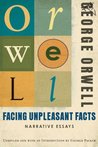 Facing Unpleasant Facts: Narrative Essays by George Orwell
My rating: 5 of 5 stars
Eric Arthur Blair, better preferably known as George Orwell, wrote a series of essays that dealt with the subject matters close to the human life in the manner of a journalist with heart. This book is a definitive anthology of Orwell’s essays contributed to various magazines and newspaper that will invite the readers to the Orwellian world of reality as he saw and he liked.
Orwell was capable of perceiving the absurdities of reality and truths masqueraded by ornamented political euphemism to obfuscate the masses for unscrupulous intentions. Of all his essays, “Why I write” is a paragon of his fineness as a great essayist. In the essay, Orwell provides the readers with sage guidelines for a writer, one of which is a choice of the subject matter that should be determined by the age a writer lives in. Such advice links with Leo Tolstoy’s view on great work of art to be closely related to the ethos of the time it is made. That is, a writer is unavoidably influenced by the ethos of the time he lives against his willful struggle to escape from solid reality.
Orwell asserts that a writer should discipline his temperament lest he should be stuck at immature stage or depressive mood. A writer should think straight so that he can write clearly. This shows Orwell’s belief in writing not as a platform for babbling about his egoistically driven existential dilemma of daily life, for consuming his energy into such self-induced woes and pains will kill the creative spirit in him, the very impulse to express himself as he truly is. To my delight, Orwell further expounds 4 motives for writing as follows:
(1) Sheer egoism: desire to be regarded as clever and much to be talked about. Writers are vain in the fact that they do want to be individuals, not compromising with the social conditions of reality. Writers can be egotistical and vain because of their elitist attitude toward the opinions of others and general opinions of the public, but are less interested in monetary reward.
(2) Aesthetic enthusiasm: desire to beautify arrangements of words in pleasing manner by using a plethora of flowery words and rhythmical rhymes.
(3) Historical impulse : desire to record historical facts of the time to pass the written records for the use of posterity.
(4) Political purpose: desire to direct the world in a specific direction in order to influence people’s views on society in such direction as it should be
The readers may find Orwell’s credo in writing rather anachronistic and dogmatic in consideration of the time the essay was written (1946). However, what rings the bell is the recognition of impulse to write as a sublime human act of expressing himself in connection with the time and society he lives in because as Aristotle put, “Man is a political animal.” This collection of Orwell’s poignant, honest, and witty essays will guide the readers into the mind garden of Orwell where moral obligation and the psychological facts are differentiated as pointed out in “Such, Such Were the Joys” and where there is a pleasant, family-friendly pub called “The Moon Under the Water” with a privilege to appreciate Orwell’s brilliant display of language facility and power of facing unpleasant facts in his own words.
 How to Be Your Dog’s Best Friend: The Classic Manual for Dog Owners by Monks of New Skete
My rating: 4 of 5 stars
One of my favorite saints of the Church is St. Francis of Assisi because of his humanity, compassion, sweet nature, and his love of animals with whom he is believed to communicate based upon the story of his converting the Wolf of Gubbio to a tamed animal. The story goes that while living in the city of Gubbio around 1220, St Francis volunteered to take leave and meet a ferocious wolf who devastated the country by attacking people and livestock. When St. Francis finally met the wolf, instead of punishing him for the offenses, he gently admonished the wolf to cause no more plight to the people and the livestock and promised him that he would be fed daily by the people of the city. The wolf was grateful for the compassionate promise and put his front paw on the saint’s hand as a gesture of accepting the advice. Thereafter, the Wolf of Gubbio kept his promise with the saint and became a tamed pet animal of the city.
With this evocative image in mind of the gentle saint and the tamed wolf I had once seen on a prayer card, I selected to read this book by Monks of Skete of the Eastern Orthodox Church. In this regard, I was piqued by the facts that (1) these monks were reputable German Shepherd breeders and acclaimed canine-human relationship teachers; and that (2) the monks lived with the dogs in accordance with the teachings of the Gospel manifested in their healthy relationship with the dogs. However, the monks of Skete carefully avoid religious jargon in the book lest the book should be interpreted as a promotion of their faith. Instead, their faith is carefully incorporated into the belief of fostering their ideas about dogs with a philosophical and spiritual foundation for personal change because dogs mirror who we are by responding to the way we treat them without deception.
The gem of this book is the monks’ views on salubrious human-canine relationship as appreciation of truths of the two worlds: one world of our own human prowess as a caretaker and one world of their own pristine nature as a guide to the wondrous natural world from which we have gradually distanced. While we provide them with food, shelter, and veterinarian care, dogs enable us to appreciate the beauty, the warmth, and the compassion that are deeply rooted in our humanity we often overlook or even try to suppress in the face of existential dilemma. In consideration of the aforesaid, I believe that the story of St. Francis of Assisi and the Wolf of Gubbio is not a myth but a truth.

Dear Readers:
Hi there. Thank you for stopping by my blog. It’s always a pleasure communicating with people through writing, which I believe is the most authentic vehicle of expression of a self. My love of reading and writing inspires me to publish my thinkings in this blog. So Welcome All with my Whole Heart.
My name is Stephanie Joori Suh, living in a suburban New Jersey town in the vicinity of the New York City. I work in the City for livelihood and write at home (or sometimes on the Second Floor in a Dunkin’ Donuts’ shop nearby my workplace) for selfhood. The great psychologist and thinker Viktor E. Frankl, who is also the founder of Logotherapy, has urged us that we strive for realizing our values that are: Creative Value, Experiential Values, and Attitudinal Values in order to arrive at meanings of our lives. How true it is! I believe those who write are united spiritually in fulfilling such noble deeds. We are kindred spirits.
I may not write perfect English prose due to English being my second language. I may not sound ordinary in the sense that my writing speaks with certain streaks of foreignness. Nevertheless, it is my quest for actualizing what I possess inside by means of literary expression. And I have to purge it out, unravel the mystery in me that is dying for the discovery of the truth in me.
Hence this little blog has come into being; it is the birth of my brain child, or rather the manifested ego qua meaningfulness as in terms of Logotherapy. So many thanks again for your readership, which is also meaningful to me.
All the Best,
Stephanie S.
 Before I Go by Catherine Cookson
My rating: 5 of 5 stars
This is my first encounter with Mrs. Cookson in her writing. What a world of writing she immersed herself in out of the melee! The book is one of her post mortem work discovered by her estate with the other unpublished novel, and I can see Mrs. Cookson must have intended to have this memoir published after she’s long gone because of the self-evident title of “Before I go”. This book is filled with her innermost feelings towards her family – her mother whom she called “Our Kate” and her dearest husband Tom and the people who entered her life, such as Nan Smith, the various doctors who attended to her lifelong health frailty, and her faith as a doubting Catholic. As an illegitimate child of an unwed mother from a poverty-stricken family, Mrs. Cookson however did not yield herself to the the bare necessities of life as it demanded.
Mrs. Cookson was a true example of a triumph of will and hope over experience and condition. Working as a manageress in a laundry, the author did not resign herself to the complacency of her social class. Instead, she raised herself above the hubbub of life and arrived as a fine writer who wrote about people whom the readers could relate to based upon her experiences. Also, her Catholic faith, which she had been fighting with reason to no avail, was the bedrock of her character and shaped the way she looked at the world around her. For it was her faith to which she held on in times of trouble and from which her compassion, pity, and forgiveness sprang.
What I like about Mrs. Cookson is her feistiness and pride which distinguished her from her peers and people of similar social origins. But this does not mean that she became haughty and untouchable with her literary success; on the contrary, Mrs. Cookson still retained her charitable nature although she often lamented about it because of people’s appropriation of her compassion and pity gratuitously.
The reader will be able to read the mind and heart of this fine and very human writer. It’s not about her lifelong health problems of nose-bleeding, 8 miscarriages, and a peripheral vision by advanced age; this memoir is about Mrs. Cookson’s resilient spirit that enabled her to rise above the planes of biological hindrance and societal prejudices.
 Flame, Glass and Ink are Poems, essays, and reading notes by Stefania Joori Suh
You must be logged in to post a comment.