Tag: journal

  • Cat Mom’s Diary – 1

    My babies -Toro and Camille-

    I spent the whole day with my two babies, Toro and Camille at home. Initially, I planned to go to the gym in the morning, but since Camille became a family, I had been working full-time more than 8 hours a day outside the home, so I changed the plan. Besides, Toro has never seemed to be off guard of his young brother whom he punches with his front paw whenever he feels irate. In light of the above, they needed me all day today.

    2-year old Toro

    Toro is a timid tabby who tends to be startled by a sudden change of movement. He wasn’t like this when he was a kitten, though. Toro was and still is an affectionate, sweet, and lovely cat, but he doesn’t like a change in his environment. He needs constant care, which is impossible for me because I have to make a living outside the home. Besides, I have a mother who is the most difficult person to live with. I feel guilty for not providing an ideal environment for Toro, but I try to dispel the weight of guilt with the love of Toro. I wish he would know it. I hope he will understand my purpose in bringing Camille as his younger brother to play with.
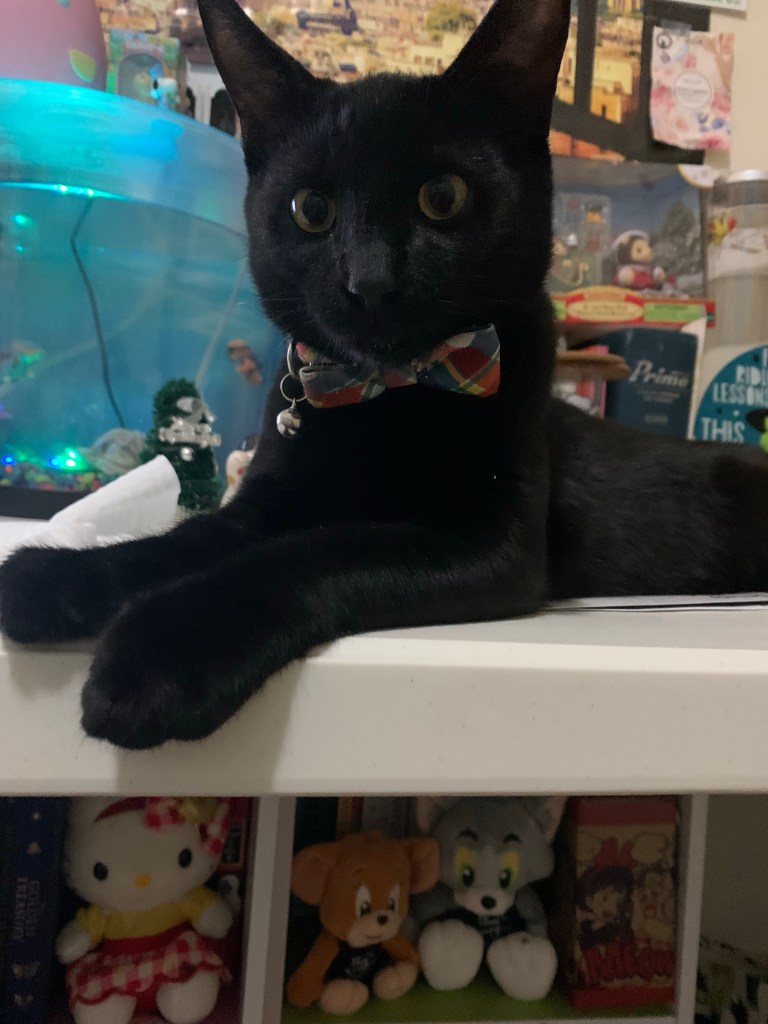
    7-month old Camille

    Camille is an unbelievably affectionate and sweet black cat whom I believe of a Bombay cat breed because of his velvety shiny, ebony fur. And he eats like an elephant. I always have to give him at least two cans of wet food per meal a day. Last night, I woke up to his throwing up sound, which made me swear that I would be more strict about satisfying his voracious appetite. But that was only a fleeting caution. He’s back to his usual self, which means eating like an elephant.

    Although Toro and Camille are not the best cat duo, there’s hope when I see Toro let Camille devour his plate of wet food. Also, they sometimes sleep side by side on my dilapidated bed sofa. Rome wasn’t built a day.

  • Adieu, my friend

    A week has passed since the Beluga whale died in transit from the Seine to the sea. The question remains with the image still fresh on my mind refusing to fade away with my heartstrings pulled in all withers: did he break away from his kind to find a treasure island like Jim did? Or did malice of fortune take him away from the tribe on a lark to see if he could make it back to where it came from? What is the meaning of all of this anyway?

    He had no name because he had so little time to live in this world, and I mean the Beluga whale stranded in the Seine River in Paris, France, and ultimately died in transit to a sea last week. No one knew why he swam all the way up to the freshwater, which was not a typical habitat for the whale species. IT wasn’t the first time to see a whale end up in the river following an orca in May that died of natural causes, but the Beluga whale still lingers in my mind a week after his death. Maybe it’s because of his ever-good-hearted-looking appearance that oozes out a sense of pathos from my feelings. Whatever it may be, he endeared me like my two-year-old tabby tom Toro, and I had been following his tale of the river, which seemed to me his journey to the resting place – among humans with whom he might have cherished good memories. Maybe he disliked his kind, so he ran away from there. Come to think of it, do we also not do the same when we can’t take any more violence, disappointment, betrayal, and arrogance?

    Although I admire the efforts made to revitalize the Beluga whale and to send him back to the sea, I cannot help thinking that there should have been more professionally effective operations to achieve the noble human intention to save nature. We live in an information-saturated, expert-ridden global world, but why is no such help readily unavailable in dire need? Are outstanding vets only for YouTube channels and other media outlets via which they can amplify their view to lucrative celebrities? But the argument is futile since he’s gone. By recording what my heart feels about him, I want to pay tribute to his incredible journey to the human world by himself with kisses and tears. Good-bye, my Beluga whale.

  • My Cat Toro and Samuel’s Hodge

    Toro is a very fine cat indeed

    Since I don’t like the word “pet,” I won’t say it when I refer to my two-year-old tabby, tom Toro, a family member. Toro pays a portion of his rental fee and is a controller of rodents in our dilapidated humble apartment we long to escape. But that’s another story, and this story I am going to unravel is for Toro.

    Toro before entering the clinic

    It was that time again to get Toro’s annual physical exam, also required for his Hills prescription Urinary care food. So we took a trip to the vet at Little Tokyo, and all’s well that ended well. His weight was steady at 11 pounds, the same as the last year (what an excellent dieter he is!). He got his FVRCP, FelV, and nails done and was proven generally healthy. What a relief because I had been concerned about his taking more naps than usual and tired expressions with half-cast eyes. The doctor told me that it was customary for cats to show such symptoms as they grew bigger. So albeit my mom thinks that I am overly concerned about Toro’s otherwise fine status quo, aren’t we all concerned about the general well-being of our flurry fur babies?

    Samuel Johnson and Hodge

    It all makes me think of the story of Samuel Johnson and his cat Hodge. Samuel Johnson, one of the greatest men of letters from 18th century England and the author of A Dictionary of the English Language, had his beloved sale-furred cat Hodge, who was immortalized in literary works and as a bronze statue outside his guardian’s once resident abode. We first come to know of Johnson’s cat Hodge thanks to his lawyer friend and biographer James Boswell’s Life of Johnson. Johnson used to go out to buy Hodge’s favorite food, oysters. He refused to let his loyal and faithful Jamaican-born master-servant Francis Barber because he felt that it would be degrading to Francis to do such errands for him. But I like to think that it was more affection toward Hodge, whom he called thus: “He is a very fine cat, very fine indeed.” When Hodge was nearing to cross the rainbow bridges due to his old age, Johnson would get valerian, an herbal painkiller extracted from the flower to lessen his fur baby’s pain. But the end of Hodge wasn’t lost in the inner circle of the ether, for his life was memorialized in ‘An Energy on the Death of Dr. Johnson’s Favorite Cat’ by Percival Stockdale, published in 1778:


    The general conduct if we trace
    Of our articulating race,
    Hodge’s, example we shall find
    A keen reproof of human kind.

    Samuel Johnson is one of my most admirable literary persons because of his humanist rules of thought articulated in his mastership of the English language. Hence it gives me a feeling of kinship with his love of Hodge. His affection for Hodge felt genuinely caring and familial, which was never mawkish or superficial. So, likewise, my cat Toro is a muse of my writings: whimsical, independent, intelligent, and affectionate. Sometimes, I wonder if Toro is really a little boy bespelled a tom. Well, what more can I say? Toro is a very fine cat, very fine indeed.

    Hodge’s bronze statue was inaugurated in 1997 by Sir Roger Cook, the then-Lord Mayer of London. Note the oyster at his paw as his eternal token of Johnson’s affection.
  • Musing on Earth Day

    Glass globe photographed in a moth forest

    With the power of the mind put into practice for conserving nature, we can make the whole world a better place because we are part of nature, made of fire, water, earth, and air.

    In our annual celebration of this year’s Earth Day, we want to spread the spirit of Mother Nature. We want all to find the beauty of life in music from the trills of birds in the rhythm of running brooks, words of wisdom in the susurrus of trees, and books in the vivid scarlet twilight of the sunset lingering in the west. The wonders of nature tame belligerent brutes and soften the hardened hearts of cynics.

    One-touch of nature makes the whole world kin. In the arms of Mother Nature, we are all her children, so keeping the earth clean and livable is our filial duty to her.

  • Believe it or not

    The morbidity of cannibalism is often associated with the primitive obscure tribes living on a faraway island or in the deepest heart of the darkest jungle over the other side of our comparatively Atlantis-like world. To put it more blatantly trenchant, it was a practice of uncivilized non-European races reported by European explorers of the age of voyage until the mid-twentieth century. As it is always dark under the lamp, the idea of eating human flash ipso facto overrides the fact of consuming it in one way or another yet purposefully. The evidence is the existence of mummia in recent Europe.

    Mummia was human flesh or excretions mostly imported from the Middle East as medicinal palliatives in apothecaries’ shops, a prototype of a modern-day drugstore. It was made of desiccated human corpse matter from mummified bodies and ingested for its supposed healing powers in the same sense that the ancient Egyptians and Romans crushed up mice to put on cavities to cure toothaches. Farther to the east, people believed that the leg of a fresh corpse was to be a panacea to any incurable disease during the Chosen Dynasty in Korea. For mummia in the 16th and 17th Europe, it was recently deceased bodies of executed criminals, a youth of violent death, or unfortunate socially disfranchised. The former two kinds are the flash of passion that rushed thru the veins to the brain, resulting from a sudden frenzy of instantaneously leashed sensations. Such corpses were believed to possess magical feeling power akin to aphrodisiac or love potion, aka pharmaka, enveloped in an Egon spell with the aid of a demon. Mummia of the corpse was famous for abscesses, carbuncles, menstrual problems, and pestilence, all of which are directly or indirectly connected to blood circulation-related illness.

    Believe it or not, the presence of mummia was conspicuous in British pharmaceutical catalogs until 1908. I think some people might have bought it without the information about the source. But even if they knew about it, if the poor people could not afford to see the doctors cure their painful illness, the abomination of a corpse would yield to the need. The intuitive preference of judgment by resemblance applies to the folk religion, especially in the form of magic or witchcraft to which ordinary villagers often had recourse in need of an instant response to their wishes without rigidity and arrogance of the church putting dogmas before hearts. So, I like to believe that the use of mummia was on the same continuum. After all, it was different from Druids, Mayans, and Aztecs, who killed humans in the most defiantly brutal ways as sacrifices to their devil gods.

  • ages of man

    No matter how many leaves have fallen from a tree as the wind of changes has been blown – sometimes placidly and many times harshly – I still feel like a girl who has refused to enter into adulthood, shunning away from the nature of things. Cicero said the ages of man have their stages of nature with sovereign rights, so anything you fly in the face of them will ask for troubles. But then Cleopatra declared to reject the forces of mortality, and Shakespeare thus praised her courage and fortitude by saying: “Age cannot wither away, nor customs can stale her infinite varieties.” Oh, and there is also Cher, now rightly revered as a dame of celebrity, and she has recently decried acknowledging her age on our evolutionary scale. So why not me with my consistent resistance against the fate of a mortal in all aspects with all my might, with all my soul, and with all my heart?

    It’s not only the inevitable awareness of the passing of generations by me. With the recent death of Sidney Poitier, the eminent actor famous for his unforgettably charismatic roles in ‘In the Heat of the Night’ and ‘To Sir with Love, it has begun to dawn on me that those who lived through WW2 and pre and post Second Vatican Council are now gone with the wind to the haze of time, a new breed of generations has germinated, sprouted, and dispersed across the lands and oceans, just as mammals began to stage after the extinction of dinosaurs. It’s a nature of the universe, but still hard to accept it, especially when everything else but I change, or seems it so. The difference between the millennials and the Me generation seems as far and wide as that between the Victorians and the Flappers, so to speak. Less than 50 years must have felt a great leap of 100 years to the opposite generations, I gather. But that’s not hyperbole, I believe.

    Greek gods knew too well about such a human yearning to be agrasia and played the weakness in favor of their everlasting egoism. Otherwise, why did they keep nectar made with ambrosia to themselves on the Mount of Olympus? Demeter, the goddess of harvest and corn, put the baby of her master who took the goddess in the guise of a poor woman as her baby son’s nurse in a sacred flame on the pretext of making him ageless as a favor to the kindness of her lesser mortals. And it doesn’t end with Greek gods. Jesus never became old, preserved in his prime days of preaching travels with stylishly long hair that reminds me of a famous musician or poet. So was Mary, the mother of God. In the end, only humans stand in the audience, appreciating the agrasia beauty and immortality, comparing the presence of eternal youth to the absence of it.

    What with the flow of time and what with the present state I am in now, inching toward the end of the era, is already enough to blow me away into the twilight zone, where things are unlike Alice’s Wonderland but Vincent’s Price’s Haunted House. Magic is no joke and is real for sure, but you always have to pay for what you wish for. But I think it’s a mindset that significantly impacts physical reality, which is magic turning you forever young.