Tag: journaling

  • On Netflix’s “Making a Murderer”

    Brandan Dassey – “The place again. Where none. Try again. Fail again. Better again. Or better worse” – Samuel Beckett

    Maybe I should not have watched it, but alas, I did, and with the afterimages of the faces and scenes still haunting the brain chambers, refusing to leave, I am writing about the Netflix documentary to cast them out to the wilderness of forgetfulness – but with a voice of the heart.

    The documentary revolves around the death of Teresa Halbach in Manitowoc, Wisconsin, who the county and the state justice believe was murdered by Steven Avery and Brandan Dassey. Since the stories about the accused are readily available online, I will not delve into whether they are innocent or guilty in this post. But I cannot help thinking this: Prejudice by social class prevails over the carriage of justice and the great cultural divide between rural and urban, working and middle classes, and state and federal governments in the States. America is arguably a country of no aristocrats, yet class distinctions are apparent, and stratification is broad. 

    In the case of Steven Avery and Brandan Dassey, although they were not poor, their parents were deemed fit to caricature characters of laborers equivalent to medieval serfs or pre-industrial European peasants speaking with the class jargon in heavy dialectical accents. Would the police and courts act differently toward the accused and their families were it not for their family backgrounds and social statuses? Hollywood celebrities and those with money and power can do anything and yet get away with their wrongdoings because they have the status and best lawyers who can make innocence of murderers, and vice versa. 

    That is why I’m not too fond of police profiling, which always seems to accuse those from unhappy childhoods tainted with physical and verbal abuse, especially and mostly from parents. It’s not only about sexual violence but, most of all, about parental verbal and physical abuses that bludgeon their children’s psychs. You can’t just typecast someone because they fit your profiling for a particular crime type. Where is the goddess of justice? Remember, even the goddess of fortune plays the Wheel of Fortune blindfolded to give everyone a fair chance of a lot because she can’t see who is rich, bright, or beautiful to look at. 

  • Prompt 31

    What principles define how you live?

    Ask any acclaimed mountaineers, such as Edmund Hillary and Reinhold Messner, why and how they climbed up the highest mountain in the world, Mount Everest. Their answers were simple: there was a mountain to climb, and they had to move forward. Likewise, here are my life’s three guides: imagination, creativity, and hope that accompany me in this life’s journey.

    I am a figure of paradoxes, contrasting light with dark, ideal and worldly, bright and melancholy. I see myself trapped in the Labyrinth of Crete, where the Minotaur lurks in the corner of the maze, waiting to ambush, yearning to eat me. (It is more poetic than being lost in a level of the dreadful Backrooms, as it were.) Normal is not default, and insecurity constantly stalks me like a haunting revenant, resisting departing this world that it longs to remain for an unfinished business. And yet, there is always this impalpable, mysterious sense of what-if flickering in its iridescent halo from a distance. So, I follow the light, walk forward, and never look back because moving forward keeps me alive. Didn’t Stephen Hawking also collaborate with it by saying that it is possible for humans to travel to the future but impossible to return to the past?

    Creativity is essential because it gives a sense of existence, of what it means to be a human. Viktor E. Frankl said three values shape a meaningful life, which are creative value, experiential value, and attitudinal value. I enjoy appreciating the artistic works of others and learning to accept who I am. But I am also delighted in creating my own creations, however good or bad they may be. Writing is such a means of expression by which I can express myself. It is fearful of disappearing like a speck of the world, and I am not nothing.

    I can imagine myself one day arriving as an acclaimed memoirist, diarist, or essayist. Novels are not my forte because I can’t write things I pretend to be or know. That is why I prefer reading nonfiction, and I like to think that I can write it well.

    Thus are my principles – or, more fittingly, my guides – in life. I am a Dante who imagines, a Virgil who creates, and a Beatrice who hopes through life’s journey.

  • Prompt 22

    What does freedom mean to you?

    People think of freedom as a philosophical concept in belief when it is the fundamental right to exercise humanness, the state of being human. Freedom is not a prerogative of specific class or status or group, but a sovereign privilege of every human being to be who they are and to express themselves under the aegis of regard for individualities that can be at their most creative and effective when well-guarded by enlightened society with humanism.

    Freedom to speak against injustice, freedom to keep one’s character, or freedom to think differently defines freedom in a civilized society characterized by low unemployment and high long-term employment rates. Unlike Europeans, Americans are unashamedly puritanical about the rights of at-will workers, meaning they are always expendable at the whims and caprice of tyrannical employers. Here in the States, an employer can let an employee go any time out of the blue. A yearly leave of absence with pay averages ten days, which can’t be used at once but sporadically. Would it be a bit of a stretch to see a feudalistic or ancient slavery system in today’s American employee-employer, which includes all those foreign-born doing business in the States, relationship?

    Jean Jacque Rousseau lamented that we were born free but are in chains everywhere. Activists clamorously campaign for Freedom” to showcase their political causes in the media, but they may also have been perpetrators of someone’s freedom. Freedom is not a cause celebre but a fundamental right to practice a will to live. Abraham Lincoln called the “Jewel of Freedom in the Family of Liberty.” Ditto. Freedom is accessible only in a civilized society.

  • How they stole Christmas spirit

    hqdefault

    They dispirited Joy to the World; no more Christmas carols, no more resplendently colorful lights of Christmas trees, let alone no more exchanges of Christmas gifts. Instead, they brandish a Five-starred Red Flag, chanting party doctrines and Chinese cultural manifesto amid a flow of flashy foreign imports and an ostentatious charade of manufactured exports produced in high volume sales at a low unit margin of profit in world market. To paraphrase the universal Shakespeare, I must be cruel, only to be kind: Thus truth begins and reality remains behind. It is indelible truth that in this time of global community, indispensably interconnected by mutual needs and benefits, what is reckoned an Orwellian idea of totalitarianism as fabulously satirized in Animal Farms and 1984 is really happening in our time.
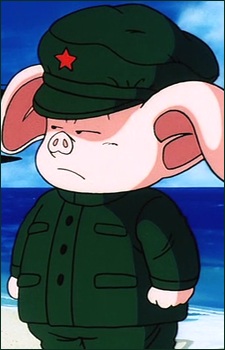
    110179To come upon an article from the Internet issue of The Guardian on Chinese government’s banning on Christmas celebrations spurred me on to write this piece of short essay. The journalist objectively reports that the Communist government crack downed on Christmas celebrations, dismissing as “western festivals” that have no cultural values on their Chinese cultural heritage, which should be in turn actively promoted among the comrades. The governmental institutions, schools, and bureaus relayed a directive at the behest of Xi Jinping, disapproving of observation of Christmas as well as practice of Christian religions, under the pretext of “maintaining stability” and cohesiveness of Chinese cultural legacies. Moreover, the myrmidons of Xi, the cult of Communism, ingratiate themselves with old-fashioned propaganda that urges Chinese people to refuse all other foreign (especially, western) festivals because they will corrupt the purity of their culture and weaken their party ideals.

    However, such is not a sudden raid on non-Chinese customs or anything that might look threatening to the despotic hegemony of the Communist Chinese Party. It has always been there, but now the tip of the iceberg is beginning to show by Xi’s political ambition conflated with his proud Chinese ethnocentrism. With respect to religious freedom in China, it has not been changed since the Cultural Revolution. For instance, China does not have diplomatic relations with the Vatican, and it has its own version of schismatic Chinese Patriotic Church of China, which the Vatican does not recognize. Not only the Catholics but also other Christian denominators are persecuted. The article informs the reader that the police raided a children’s Bible class, shut churches, and arrested the members because they practiced the religions outside of officially sanctioned institutions, which are in fact none other than governmental institutions vested with the ostensible canopy of a few de rigeur religious objects.
    db-oolong_0

    Woe betides Xi, his myrmidons, the extreme Chinese jingoists, and their sympathizers who blindly declaim about their cultural superiority and proud ethnocentrism lasting for centuries despite their historical losses against the British, the Japanese, the Americans, and the Koreans. According to Ma Jian, a Chinese-British writer whose wife Flora Drew is his English translator, in China Dream, a satire about the Chinese communist totalitarianism, the Party developed a neural implant called the China Dream Device that is inserted to a person’s brain to wipe out his entire memories and dreams and to enter the Party ideals for the glory of New China built upon a gauche mixture of blatant consumerism and blind nationalism. The result is a Big Overfed Child who only thinks for himself and behaves without a decorum of civility common to Civilized Man.

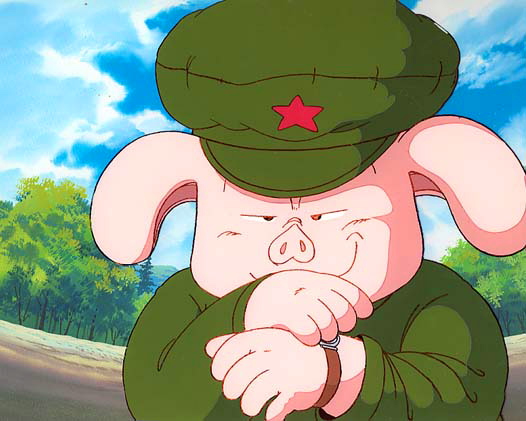
    Xi and the Party should first learn by heart that Christmas is not a byproduct of western materialism – which ironically has become their chief god – or an epiphenomenon of western imperialism under the aegis of European Christendom. Christian or non-Christian, Western or Eastern, Christmas is a joyful, a feel-good day that has been celebrated for centuries. It’s a most celebrated holiday season around the world that imparts a sense of warmth, togetherness, love, and hope. It does not require of anyone a special membership to enjoy the spirit. Besides, Jesus of Nazareth was not western but eastern because Israel was and still is geographically located in Asia. In light of the aforesaid, what the leaders and its Leader of the Party should understand is the cultural, religious foundations of not only Christmas Day but also all other legacies of humanity that transcend the subjectivity of time, territory, and tribe because as Edmund Burke also attested: “The standard of reason and taste is universal in all human creatures as regards principles of judgment and of sentiment common to all mankind.” Without the knowledge, China will still be clothed in the Old Mao Suit that does not fit.


    저장

  • On keeping a journal

    99200c36127f0bc3abd6452ca892b451
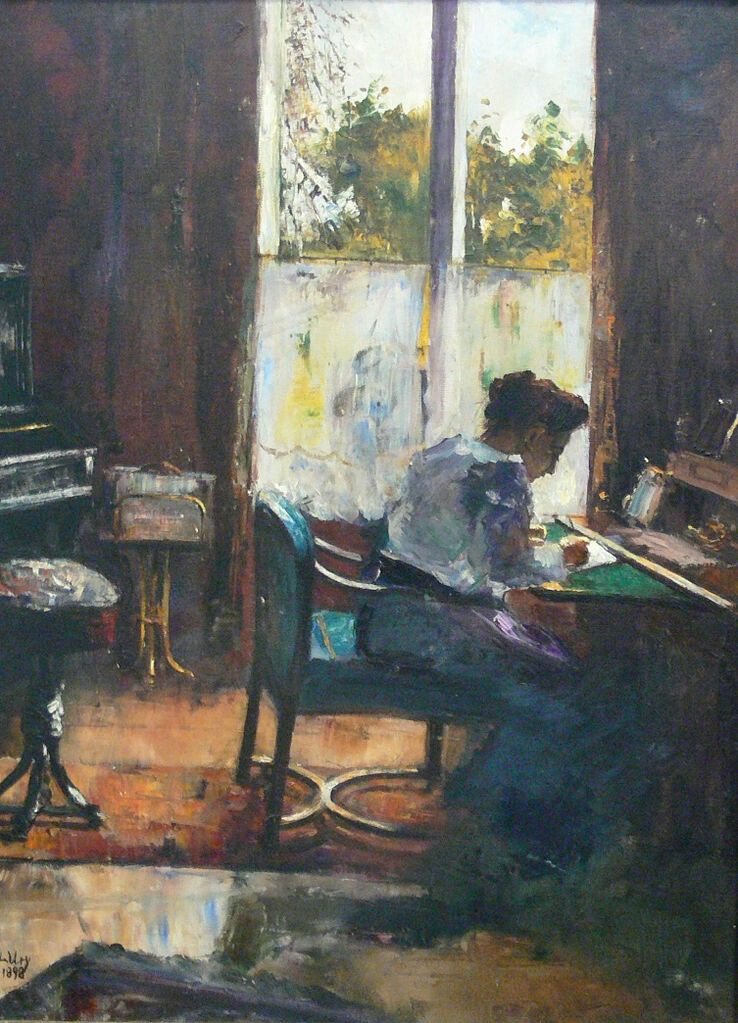
    Frau am Schreibtisch (Woman at writing desk ) by Lesser Ury

    Keeping a journal is, I believe, a vehicle for creating myself, my sense of selfhood. Every page of my dairy is to be breathed with my heart that does not have to entertain anybody but myself.  It’s also proof that I have lived situations which today would seem uncertain and fretful, that I have climbed up the paths of my life thus far to reach the peaks so ambitious, so adventurous. Above all, I want to bring out every treasure that is buried deep in my heart. So writing day in and day out in my Midori Traveler’s Notebook is my daily ritual to remember what it is to be me, which is always the whole point of doing it.

    I carry about my traveler’s notebook  everywhere I go to write my journal and reading pointers from books I read, and some occasionally attempted drawings for practice. There are three notebooks: One is used categorically for my freedom of thoughts, feelings, and just about anything that is to be kept only for myself. It’s not to be shared by anyone, so my soul can rest herself there. Another one is for notes I take from reading that I need to refer to when I write book reviews. And the last one is reserved for jotting down anything out of brainstorm, from devising storyboards for my short stories, to scratching some images of my poems, to making bullet lists to do, and to practicing my newly inspired drawings for more balanced nourishment of my soul. Most of the times – that is 5 days a week – before heading into my job, I usually go to a coffee shop and write in my beloved Midori. It is during this writing time when I feel creative and special out of the melee, out of the existential horrors of every day, and out of the humdrum of daily life.

    I love combining drawings and a variety of crafting to my writing to heighten the expressions of feelings and deepen the depths of thoughts in the way I want them to. The only obstacle I have to huddle is drawing. As someone whose aesthetic standard is as high as that of Pope Julius II, who commissioned Michelangelo to fresco the Sistine Chapel,  I only wish I could draw things I see to its exactness with fine details. But then I always remind myself of the adage: “A flower does not compare itself to other flowers. It just blooms.”

    SAAM-1929.6.52_2
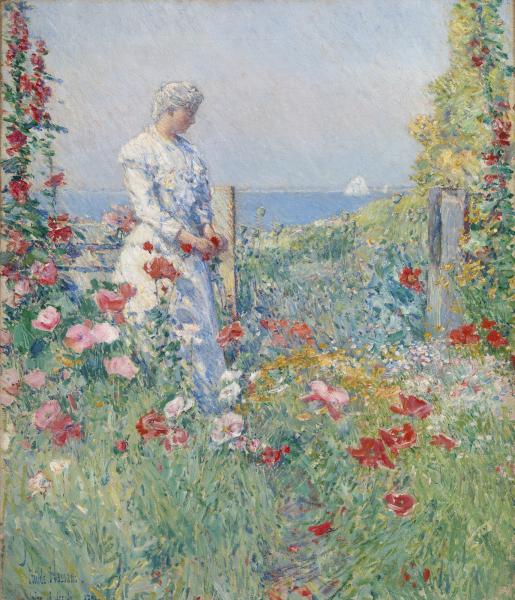
    In the Garden by Celia Thaxter

    Therefore, keeping a diary is a veritable record of myself, a personal treaties on the breadth and depth of being who I really am. It sounds grandiose, but writing in my Midori gives rise to the elevation of my weltanschauung in reflection of contextualizing concepts and beliefs kept in me and also helps me unearth hidden treasure in the realm of unconscious mind. And by creating a kind of work relating to the crafts of the arts, I like to think that I am fulfilling my purpose of life to live a meaningful life, for the sake of ego qua meaningfulness. That said, I like to cherish Kurt Vonnegut’s advice that the arts are what makes the human life bearable and livable in dealing with existential matters of daily lives, for practicing any form of the arts – however clumsily or amateurishly done –  is a noble means to attend My Secret Garden of Mind full of Begonias of Fancy, Roses of Beauty, Tulips of Passion, Lavenders of Devotion, all blooming and bountiful around Spring of Eternal Youth.


    저장