Alhambra (Alhambra de Granada): image credit from viator.com
He came down from the throne of the crescent moon
with the key to the paradise his ancestors gardened
for eight hundred years of harmony in Saracen haven
to the hands of the pious proud king and queen posing
to accept it as the Christian champions emboldened
by the surrender of the ruler of the Iberian paradise;

Yesterdays, yesteryears, and to the last of the time
crept upon the waters of the palatial fountains thence
and began to fill the heart of the sultan of the palace
whose eyes billowed streams of nostalgia’s longings
on his hallow cheeks and to the back of his horse
together, leaving the fortress of a thousand memories;

And Fate, whose wings did he fly? Now, all’s bygone-
Those melodies of sweet sojourns beneath visting suns
in the neverending abundance of warmth and mirth-
when every regret, every sorrow turned back his looks,
Every look shed tears in the shadow of the evening sun,
lingering in the recollection of the Alhambra Palace.
There are stairs called “Nancy’s Steps” at the London Bridge on the Thames where Nancy used to walk up and down from her den to the world, back to the den to live a life God cared less with neglect with nothing more than her untainted heart flowing milk of kindness and compassion into the neverending faith of humanity alone Even if it betrayed her and bullied her in tatters; She pitied an orphaned boy named Oliver And protected himself from the world under Until the blindfolded Goddess Fortuna span The Wheel of Fortune to the fateful turn To which all her wishes were forefeited As her already wretched body was battered With the compass of the wheel bludgeoned Her life with the heart cherished with love; With the blows upon her still young head all her hopes for the beauty of life shattered and her tears rolling down her cold cheeks turned into liquid drops of pearls and crystals, and then, with a cry of the heart, she departed. or thought she, for she knew not what happened from dusk till dawn, wandering and waiting on the fateful steps, asking if you’d seen the boy.
Rudyard Kipling described the nature of a cat as a creature that walked alone. The graceful pose, the noble demeanor, and the aristocratic solitude make the feline kind all the more mysterious and charming. Cats are so loving and, at the same time, so selfish, which makes them exuberantly human. It is no wonder the ancient Egyptians turned them into goddesses Bastet for womenkind. To make the long story short, the association of cats with women is natural and inseparable as if the two kinds are supra-natural companions.
Three years old Toro
The feline imagery has been complimentary and cautionary depending on the purpose of its application to societal conventions. For example, black cats are typically associated with devious single women practicing witchcraft (or, for God’s sake, cantankerous spinsters) because of their formidable ambiance of darkness, which significantly contrasts with their wonderfully fierce eyes and quiet solitude. While feminists would disagree with the application of such feline imagery to femininity (“How could you use such a demeaning word?!”), one can’t eradicate the visible traits that are so unlike their counterparts, including the canine. The coquettishness of feline characters and the capriciousness of behavior conjures the images of Cleopatra charming Julius Caesar, Mark Anthony, and the like. And what about Michelle Pilfer’s Cattleman? Then there were Charlotte Bronte and Lucy Maud Montgomery, whose feminine sensibilities were replete with fiercely independent creative spirits, and the fascinating power of words still mesmerized the readers of her times and ours. They were lovers of cats, and their best friends were cats who could share secrets because cats were the only true secret keepers.
Tori and Camille
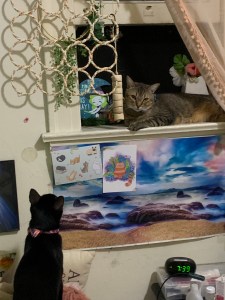
Some people seem to take pride in publicly announcing their dislike of cats as if there were some virtue in doing it. They say cats are treacherous and capricious. But that is precisely why I like cats because, like us, when they are good, they are very, very good. Yet when they are bad, they are horrid. I never get bored with my two cats, Toro and Camille, because they are very responsive to my talking by vocalizing their needs when they want to play, go out to the living room, and eat. But you know what? They are also my best friends who always stay with me, even when I am blue and gray under dark spells.
I first learned of the author from a Korean television documentary about her search for a natural mother in Korea. A successful food editor of a cultural magazine and a writer, Kim returned to the land with the tears of the past and the hope for the future in realizing her ideal figure for the unconditional love she longed for, which piqued me to read this book to know more about her story, hoping to acquaint another kindred spirit.
So I hoped it was, but her story betrayed my hope. It was about her affair of the heart with the CEO of a famous French beauty product, L’Occidante. Kim seems to have the magic power of charming men – the higher and the smarter – without effort, and she’s never alone, although she wants to think she is. She has never been in poverty of love, money, and opportunity, yet she complains about a lack of love and total freedom. Her parents, who adopted her, have taken care of her, and her sister is also a Korean adoptee. They may not be perfect, but no one is perfect, and they certainly didn’t burden her with the weight of economic support or, worse, the total abandonment that happens to some of the other adopted children. And that’s not it. Kim always escapes from the responsibility of love when the further half showers with love and warms her with kindness. You can’t treat love as it is a business deal. Unconditional love is altruistic and agape. Love is giving and sharing, not owning and demanding. A sense of abandonment envelops Kim like a wandering ghost wailing in perceptual disappointment and howling in forever resentment. Ultimately, Kim finds herself alone, and it’s too late to regret the ancient bliss of love.
To think that jealousy resulted in such an acrid train of thought is to miss the accurate impression of my heart on the narrative itself. My power of empathy wallowed in the sympathy of humanity and propelled me to read it, in addition to the Korean heritage the author and I shared. The tears I saw from the program pleading for help to find her natural mother in Korea were heartfelt, so I wanted to hear the cry from the heart to know about the death and breadth of her soul. Yet, her story resonates with the outcry of her never-ending angst and constant chasing of mirages springing from the imaginary ideal of love.
I have always thought of the Catholic Church in the U.S. as a league of immigrant churches founded by the faithful of the old world diasporas uprooted in the New World. The American Catholic Church is, in a way, an outpost of the Roman Catholic Church in Europe, with its offsprings sprouting and flourishing in their ethnic enclaves, thus resulting in less spiritually cohesive, culturally solidifying characteristics in the form of different ethnic Catholic communities within the Church in the U.S. Perhaps that might be one of the reasons that there are so few black Catholics, excluding the immigrant blacks from the overseas because the Church ignored their existence as human beings except for their labor as a lucrative resource to expand their organizational dominance.
Swarns is also mad and sad about the cruel truth about the Jesuits, whose motto was to educate the souls to train as God’s soldiers were the leaders of the slave trading in 19th century America in efforts to create America’s finest Jesuit high-education establishment called the Georgetown University. The number 272 signifies the number of blacks traded as slaves to fund the university’s administration in zealous ambition to build the Jesuit Empire in the New World. While Pope George XVI condemned slavery in his apostolic Church in 1839, blindsided by the expansionist vision, the American-born and bred Jesuits continued to ship out the blacks in their care to Louisiana by disintegrating the black families and communities to form their cultural identities and heritage.
Catholicism is a family religion because it is usually inherited through generations. Mothers teach their daughters to say the rosary prayer and the First Communion is a family celebration. But without the secure bond of family in a stable environment, Catholicism is complex to thrive and faces discontinuation of legacy with no parents to teach it to their children. Consequently, the disintegration of black families is the sine qua non of the decline of black Catholics in the U.S. to this date. Even if the American Jesuits, including the present Georgetown administration, have expressed their regret and condolence to the 272 black people they sold for profits, the American Catholic Church should continuously endeavor to reconcile with the racialism within the Church by making all races of people welcome when they come to the Church by reaching out to the concerns of each that are universal to all of us.







You must be logged in to post a comment.