Tag: literature

  • 150 miles to El Dorado

    foggy-morning-in-a-meadow

    Judy begins to feel like a whimsical paramour leaving for a new object of love at sight. What was pleasingly solitary in nature seems to be prolonged isolation from the world that Judy so wanted to escape, and her coquettish dalliance with the wild rugged nature is no longer wanted as the Sun is slowly moving westerly to cave into the Evening Star and the Moon. It might be still early for calling it a day to you with your weekend frolics still left to re-calibrate your kicks for another week, but it’s late for Judy, who would rather mourn for a passing of the last day of a weekend at home than rebel against it in a frenzy of nocturnal bacchanalian orgy elsewhere outside the comforts of her den. Now the anxiety holds a grip on her, and she begins to fret, and the miasma of the ill-feelings begins to effuse the uneasiness to Nena who begins to whimper and to the accidental trio of strangers observing every move that this girl makes as they are nearing to her, part perplexed, part bewildered. What a curious mixture of emotions she puts on her face! Rufus, Ben, and Raphael become curiouser and curiouser as they get nearer to the porcelain doll in their eyes.

    ‘Howdy! Lass! What are you doing here?’ Raphael, the talker, begins the talking. ‘We are headed west toward Los Adios Mountain. Do you know where it is?’ Judy incredulously looks up the mounted man with a mustache and a sombrero and thinks that he looks very convincingly like Sancho Panza, Don Quixote’s faithful servant. There’s something about the man, thinks Judy. The diction, the ambiance, and the deportment are rather anachronistic or incongruous even to the social media era where people flag their selfies on the internet as if they were on a popularity contest and compete for likes and comments as emotional security and collateral for their forged so-called self-confidence. My Dear Reader, don’t misunderstand that it’s immoral for you to hang your beautiful pictures on a digital platform for popular admiration. It’s just that this act of self-promotion serves as a springboard for testing your marketability and your mobility as a result of winning the competition for likability based upon looks and frivolous comments that do not mean much, much at all. Amid this train of thought, Judy despite being agitated by the lateness of the time warms to this amiable man and decides to answer him. ‘This is Wildwood Park, sir. Los Adios Mountain is 150 miles away from here. And you should go northward. You are far off from your destination.’ It is a sight to behold – the face of Raphael grimaced partly and bewildered partly, all in dazzling chemistry of emotions that is hard to describe. So much so that this display of indescribable human emotions on Raphael mollifies Nena’s agitation and puts the tempestuous waves of her emotions at ease. Now Judy feels refreshed and happy.

    Rufus and Ben are within an earshot of this dialogue between the pretty lass and Raphael and cannot but be disappointed by the fact that they are once again on the wrong track, which seems to be forever chasing after a phantom of the dead Union soldier obfuscating them lest they should find where the buried treasure is. Where’s the Aztec gold? When can they find it? Maybe the miasma of frustration and agitation that hovered over Judy must have been transmitted to Rufus and Ben on the stead because now their faces mirror the symptoms of a malady of broken hearts. Then suddenly, Nena now recovered from the plague of uneasiness, springs forward and wags its chubby tail and bark toward the firmament as if it were looking at a thing invisible to your and my human eyes. Nena keeps barking and looking at the puzzled crowd behind as though it were trying to explain to them that there is something in the air that only Nena can see but we can’t see. ‘What is it, Nena? What do you see?’ Judy knows that dogs and cats can see supernatural things because their eyes can look through the souls of the living and ghosts of the dead. Judy tries to follow the direction where Nena is looking and barking and sees a gossamer trace of haze vanishing into the air like the vestige of a propeller plane soon to be effaced across the skies. The more Judy tries to scrutinize it, the faster it disappears. And Nena keeps barking, looking in front of the curious crowd. What is it that the dog is seeing?

  • The Poesie by Titan: poetry in painting


    images
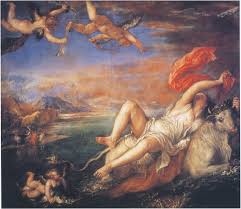
    Europa by Titan

    Although art is territorial, it’s never divisional; it crosses over the branches of art and begets a hybrid of wondrous beauty that spreads through the mind of the beholder and lingers there in alterations, evoking an arch of endless imaginations and a well of inspirations, appealing to our human faculty that is rather physical than metaphysical, sensual than intellectual. It’s a mating of the Senses, a marriage of Reasons perfected in letters or paintings, all in the mastery of stories, colors, and forms begotten by divine madness of artists copulating with a sensation of the flesh in putting a method of expression to its love bed of paper or canvas. Such a love child of arts results in Titan’s riveting masterpiece the ‘Poesie.’

    Titan (1488-1576), one of the most celebrated artists of the Italian Renaissance, created the ‘Poesie,’ a cycle of 6 mythological paintings inspired by Ovid’s ‘the Metamorphoses,’ stories about famous mythological figures in poetry, which was the very reason that Titan chose it as his subjects. Originally commissioned by Phillip II, the life-sized portrait of whose father Emperor Charles V catapulted Titan to stardom in European courts, the ‘Poesie’ gave him the artistic freedom to experiment with different styles of painting incorporating secular subjects that attracted the welcome attention of intellectually ambitious aristocrats. The ‘Poesie,’ meaning poetry in French, is a hexaptych of human emotions expressed in mythological figures that are all too familiar and universal common to all human creatures. It displays the vagaries of human emotions, ranging from euphoria to anguish, passion to regret, and greed to pain, all the artistry in each of the paintings. Titan wanted to create the visual equivalent of the poetry in which Venus burning in passion for her young object of desire Adonis, Europa ravished by Zeus in a bull’s hide, Actaeon chancing upon Diana’s bath and other divine and mortal beings, such as Danae, Perseus, Andromeda, and Calisto intermingled in sensual pursuits were to be translated by strokes of a brush, plays of colors, and dramas of human feelings and emotions. In fact, it is this Titan’s talent both as a storyteller and a painter that sets him apart from his contemporaries and renders the work immortally enshrined in the atrium of universal arts.

    The ‘Poesie’ is currently on display in London’s National Gallery exhibition for the first time in over 4 centuries, following an example of Vatican’s concomitant display of Raphael’s tapestries at the Sistine Chapel. Notwithstanding the thematic and geographic differences, the works of the masters delight the eyes of ours as harbingers of art as artifacts of human civilization consisting of the standard of taste and reason universal in all human creatures as regards the principles of judgment and sentiment common to the eyes and minds of all mankind.

  • thank-you from author Ian Mortimer

    Although Abraham Lincoln said, “Don’t worry when you are not recognized, but strive to be worthy of recognition,” it’s always delightful  to hear when a writer whose work you value highly and like very much appreciates what you have done in connection with the work. For recognition is a great motivator for a dilettante, especially an amateur hobbyist writer, to keep it going in the awareness of her abilities that are in many times smoldered, undervalued, and simply ignored.

    So naturally, I am pleased to find my review of The Time Traveler’s Guide to Elizabethan England by Ian Mortimer gets noted and even quoted on the author’s Twitter today.  Mind you, my dear reader, that I am not an autograph hunter, chasing that usual Thank you- I really- appreciate-your -kind -reviews- on-my-book facade, which I find conceited and empty even, nor do I canvass any such vain cajolery from authors of books like a destitute attention-seeker. Rather, I am glad to know that there are people who appreciate my works however humble they may be, and the happiness becomes twice when such recognition comes from those whose works I like. So it’s a mutual respect between a Reader and a Writer, and vice versa.

    On writing, Stephen King and J.K. Rowling advised in harmony that a good writer requires disciplines and perspiration. True that some of the best writers are natural with their craft bestowed upon them by a supernatural being. But I also believe that many of the great writers work hard by writing continuously and reading copiously. That gives me a ray of hope, and so should you.

  • Raphael’s Tapestries

    Tapestries-in-the-Sistine-Chapel
    The Tapestries by Raphael

    Art can never be old. It is a piece of work that transcends the subjectivity of time in the discovery of the universality of Taste and Reason in the eyes of all human creatures as regards the principles of judgment and sentiment common to all mankind. The beauty of art spreads through the mind of the beholder and stays there in such alterations that it almost feels physical. It is this kind of sensation when we look at Michelangelo’s Sistine Chapel that penetrates deeply into the fortress of Reason surrendering to the force of the Senses. And what if such sensual feast of beauty is doubled by more pleasure that will make it sound sybaritic, and sinful, even? But it is happening now and is happening in the Sistine Chapel in Vatican City.

    To celebrate the 500th anniversary of Raphael’s death, the Vatican has all 12 tapestries designed by the artist hung on the lower walls of the Sistine Chapel. The tapestries were weaved and kept in an art studio in Brussels, and this time they are back in the Sistine Chapel, where they were when Michelangelo, Raphael’s contemporary rival, worked on the frescoes, which eclipsed the silky and shiny tapestries that allude to the affable and delicate nature of the creator. The tapestries are said to have been restored by Vatican Museum conservationists in the last 10 years. It is also said that the last time all of 13 tapestries were on display was in the late 1500s.

    The magnificent display of Raphael’s tapestries was originally Pope Francis’s idea that the beauty of art should be shared and appreciated by all coming from all over the world, the low and the high, the ignored and the admired. Likewise, art should not be a prerogative of a few select or the haves who pride themselves on possessing and knowing a thing about art. Art is not a thing, but a way in life that nourishes our minds, imbuing us with a breath of artistic inspirations to create an art of our own. The Pope knows that through the power of art, the Mysteries of Faith will be understood in manifold ways, which chimes with Shakespeare’s view on art as thus: “The object of art is to give life a shape.” Right on. Rock on.

  • ‘The Time Traveler’s Guide to Elizabethan England’, by Ian Mortimer – review

    The Time Traveler's Guide to Elizabethan EnglandThe Time Traveler’s Guide to Elizabethan England by Ian Mortimer

    My rating: 5 of 5 stars

    People tend to make an anachronistic mistake of assuming that their times are more culturally and socially superior to their previous generations’ times, whereas forty years on an evolutionary scale amounts to a million second on a twenty-four-hour clock, the amount so infinitesimal that it makes you smirk. What makes us set apart from the predecessors of our human civilization is not how they looked but how they looked at the landscapes surrounding their everyday lives, which led to the creation of the ethos of society peculiar to the different historical periods of time. This Thucydidean approach to history as a branch of social science as well as humanity strikes the chords with Ian Mortimer’s perspectives on his Elizabethan ancestors in his scintillating book, The Time Traveler’s Guide to Elizabethan England.

    Rich in details and splendid in descriptions that successfully and naturally resurrect the period, Mortimer’s vividly atmospheric accounts of the era transform the people and the landscapes of Elizabethan England from one-dimensional textual elements to animated figures in his engagingly vivacious narrative that strut in the mind’s theater of the reader, commanding attention in every chapter in a way that looks virtually real, evoking a phantasmagorical display of the periodical images. Mortimer is a knowledgeable and witty guide well versed in the English Renaissance with a practical sense of reality, which makes him something of Dr. Who, who pitchforks his wide-eyed volunteer reader to the subject time and then materializes when the reader is in a pickle. He shows the reader both the beauty and the beast of the Elizabethan society at its core with his wealth of knowledge drawn upon extensive research on the period and general erudition without putting a supercilious air of a highly learned man and stands in awe with the reader of the cultural and social progresses of Elizabethan England that began to define the “Englishness,” with which we tend to associate when the name “England” chimes the bell of literature, religion, and geography, all in the collective image of being “English.” Mortimore does this wonderfully with his engaging narrative skills that will not make you bored and skip a page.

    Mortimer as a literary Dr. Who aims to bring the gaps of time and space between the reader and the populace of Elizabethan England to elucidate his stance on the truth about unchanging human nature wrapt in a periodical costume; in fact, history is a branch of literature made by artificers and artists with stories full of events, persons, and places that are woven into a tapestry of time, which also reflects how we have become what we are. In light of this, Mortimer is a cross between Herodotus with his entertaining narrative skills and Thucydides with his objective analysis of the historicity of society and culture. At the end of the book, the reader will find William Shakespeare, one of the most notable figures of Elizabethan England, holding up “a mirror to Mankind and shows people what they really are.” This is a cracking read packed full of interesting tidbits on the ways of life in Elizabethan England which he relates with wonderfully lucid insights into the turbulent but magnificent era that marks an indelible landmark in the history of England, and ultimately, of the world.

    View all my reviews