
Imagine
The visions
Summon
The letters
Conjure
The words
Inspire
The Muses
From within.

One leap into the starry air
Beneath the visiting moon
When ghosts begin to roam
This world of sense everywhere,
She lands with paws and meows
With a mask from a ghost paddler
A cat wandering in night’s delight.

For one hundred and twenty years
Trapped in the maze of this mirage,
Where I began, I can go back never;
Here I stand and face the bare fate
Or is it nothing but the illusion ever?
As Aurora releases the first dewdrop,
I go high over, down under
From one end of the horizon to the other
Across the five continents and six oceans
Above the heavens, below the abyss
Far into the milky ways and back to earth
with the jewel of hope in beatitude.

The wizard of rain, the knight of nature,
Goes to the hill in the twilight of the dawn
With a falcon sitting on his right shoulder
And rising to the virgin sky before a new sun
in search of the meadow where a moon was drawn.
The wizard of rain, the collector of wonder,
Gathers dewdrops from the fresh frost of grass
Into a crystal bottle and reads his grimoire
As the falcon flaps his wings in the air
And brings the forces of nature in abundance.
The wizard of rain, the wondrous sorcerer,
Calls the names of gods, demons, and angels
Wielding his wand in a symphony of nature
Amid the swaying leaves of the grass and trees,
All in harmony bringing rains from the sky.

“The Conjuring: The Devil Made Me Do It” (2021) is the newest in the Conjuring Universe Series, a new artifact to the Museum of The Haunted All and Sundry. The legendary Ed and Lorraine Warren are as inseparable as a couple in love and benevolent as rescuers of souls afflicted with the forces of evil as ever. But the mysteriously noble and spiritually convincing atmospheric elements are barely there, albeit the mix still has the thematic Catholic flavor. They said that when fact becomes legend, publish legend. So the story of the movie may be based on an actual event that has become American folklore, a modern legend, and it is the legend that the movie published.
As with the tradition of the Conjuring World, the movie evolves from the actual event of the supernatural phenomenon beyond the reasonable explanation on what the eyes only can see. First, an insidious ambiance surrounding a family house that seems strangely alienated adumbrates a sinister force lurking behind the bathroom door, over the shower curtains, and finally inside your head. Then comes a Catholic priest, thanks to the rite of exorcism popularized by The Exorcist and the Warrens’ association with the religion as their spiritual base. But he is usually not too much of significant help, if not a trouble, so it is always the Warrens’ job to ghost-bust with a style of a medieval magician who used to reconcile esoteric paganism with Christian faith. In this installation, Lorraine proves to be a mighty Christian mystic and a white witch in crossing over the space and reading memories of the dead, all for the fighting the devil’s deputy in a tunnel that promised to capture as many human souls as possible to fill up Hell’s Circles.
The essential thematic elements of good v. evil, love v. hatred, violence v. peace are unfailingly ubiquitous in this installment. Still, more violence and hatred make up the scenes than the others, making the movie more aligned with screaming scary movies than classified as supernatural horror. Perhaps the application of Catholic elements as a credible supplementary spell on the movie’s ambiance might have slightly fared well with the director’s intention (or the producer James Wan, the original creative director) to make the film elevated to a canon of classic supernatural movies. But it doesn’t give much of the movie’s intended effect when the Warrens can do what priests can do. Besides, the characters other than the Warrens themselves are not convincingly real, sympathetic, or natural. Instead, they are either surreal or theatrical to the point of playing a masque in Elizabethan time, so to speak, which would have been excellent.
I watched the movie with high hope when it first started showing on HBO Max last Friday night. But my expectation was already turning ominous when I had trouble viewing it at first for some unknown technical reason. Once I got into the third world of Conjuring Universe, I knew it wouldn’t be what I had expected. The real Warrens have become the ghosts themselves, and I wonder what they would have thought about the movie. Judging from their celebrity status in the society of paranormal investigators, I think they would probably have been thrilled about their being the creative subject of the movie. Then maybe, it’s time for me to leave the Conjuring Universe in search of a new world of the supernatural without celebrity.
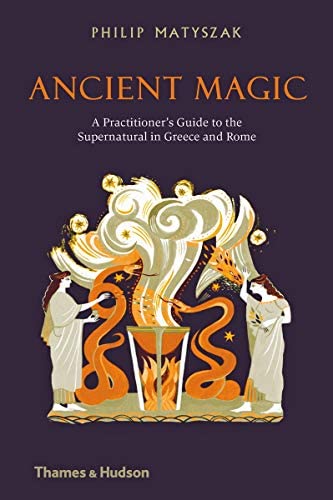
Ancient Magic: A Practitioner’s Guide to the Supernatural in Greece and Rome by Philip Matyszak
My rating: 5 of 5 stars
Magic in ancient Greece and Rome was an art of crafting natural force with a bit of help from the world of gods and spirits wonderous to the user without fully knowing them. Contrary to traditional orthodox Christian teachings, magic was not associated by default with sorcery privileged to an esoteric spiritual elitist often dark and sinister. To the ancient Greeks and Romans, magic was their belief system, part of their modus vivendi in everyday life from slaves to emperors in the sense that we go to doctors or counselors. In a word, magic, as we understand now, was not so much deviltry as a variety of rituals of individual petitions pleaded for the fulfillment, which even the tremendous ancient minds regarded worthwhile to record.
Before the era of Christianity, the concept of magic was often interchangeably used with the knowledge of natural and supernatural worlds, which the ancients saw as not impossible to cross in between and thus believed the ghosts and the afterlife. Plato and Pliny, the Elder, advised no mortals go to graves alone after dark because there the restless souls of the dead not crossing the Styx, wandered. The most significant of the ghost story is Pliny the Younger’s letter to his friend Licinius Sura. He tells of the philosopher Athenodorus, a stoic astronomer and tutor to Octavian, the future emperor, witnessing a ghost of an old man in shackles showing his improper burial site.
Magic encompasses auguries and omens by the flights of birds, spells, and potions to charm the figures of desires, and the astrological signs in the ascendant at births and the sun, all of which to make uncertain futures known as guides to walk the paths of life to arrive at the fates. Matyszak tells the reader in the capacity of a Virgil leading Dante to the Underworld that seers at Delphi and Cumae were relatively easy to foretell the futures, which were unchangeable. Their acute intuition took a dreamy leap to poetically versed oracle pronouncement in the background of ethylene atmosphere and told what the petitioners could do at their best to deal with what laid ahead of them because there was no more than one fixed future.
The book invites the reader into the world of magic like never before because knowledge is a composite of Herodotus, Plutarch, Pliny the Younger, Socrates, and Plato. They took the extraordinary subject seriously because it was part of their daily lives bordering on a thin line of the spiritual world that was as real as they were. The book is written in a language accessible to all spectrums of education and walks of life. It is philosophy, religion, and history magically mixed in the author’s magic potion of erudition that significantly produces learning charmed in natural wits.
View all my reviews


You must be logged in to post a comment.