Tag: mythology

  • prompt 34

    Name your top three pet peeves.

    Pet peeves are subjective, and they say something about the personalities of the narrator. I have mine, and here they are:

    1. Poor listening skills – I hate when people fidget with their bodies or smartphones when I talk to them. To see them behaving in such ways is downright disheartening. It shows they are not interested in what I am talking about or who I am. Or even if they seem to listen to what I am taking, when I check what I have told them, they don’t remember any of it.

    2. Discrimination of expressing greeting – I see it very often that when you smile, the world will not smile unless you are within their cliques or type of favor. It plunges my spirit to a dismal low. For instance, in stores, you see store associates greeting and helping customers with their likes. I mean it in the context of appearance. If you are attractive, you will be treated nicely. This meritocratic tendency extends to workplaces. Most readers may disagree with this statement, but the dissenters may be of the Attractive Club.

    3. Loud people – They are absolutely a disgrace of community life. From my apartment to workplace, people who disregard the quite peace of mind of others by opstrepeously bellowing, hooraying, and laughing as if they were a center of the universe should be put in a stone-made castle kept by a malicious witch in a deep forest until they cry for Mercy.

    I wonder why people who have contributed to my pet peeves and thus galvanized me into writing this during my lunchtime at work continue to behave as they do. Do they think such behaviors are cool and an expression of freedom? Indeed, they are not educated well enough to learn that freedom and responsibility go hand in hand. Hence, these are my three pet peeves, and I hope you will understand me.
  • Prompt 19

    If you could be a character from a book or film, who would you be? Why?

    I am one of those sentimental folks who tend to make a parallel with themselves to the characters of a story in a book or film due to an uncanny spiritual ability to channel into the psyche of another. Methinks this could be something of an ancient Greek or Roman Sybil, who foretold the prophecies at holy places in ecstatic mania. Accordingly, my choice of avatars is of independent, strong-willed, but mistaken women whom people could not fail to notice out of the melee: Cassandra and Ariadne.

    Cassandra, the daughter of the last king of Troy Priam and his wife Hecuba, was a priestess of the god Apollo, who bestowed the gift of prophecy on her. However, when she refused the god’s amorous advance, the cruel god fated her not to be believed in her predictions. So when Cassandra warned her people of the fall of Troy, they didn’t deign to acknowledge her but to scorn her for such hokum. Alas, poor Cassandra! I knew him, Ariadne, for your beautiful deed and heart was betrayed by Theseus, whom you helped kill Minotaur and save the Athenian youths from the labyrinth! Theseus abandoned his beautiful savior on the island of the Naxos and sailed on to Athens. Why did he forsake her? It’s because the goddess Athena told him that Ariadne would be nothing but a nuisance in his way of constructing her namesake city-state! Before being the sacred and immortal goddess, Athena was also a woman, but how could she force Theseus to bloodlessly forsake the poor Ariadne, whose benevolence saved the youths of Athens?

    Both Cassandra and Ariadne’s benevolence and strong will were not appreciated by those whom they helped or tried to help. What a tragedy it was! Likewise, my heartfelt intention and humanity meet with cold shoulders or the least respect from the people I help and have helped. Sometimes I wonder if nature bestowed beauty on me, would they be unkind or appreciate who I am? Then I think of Cassandra and Ariadne and cannot help but feel for what they had been through.

  • Hounds of Night

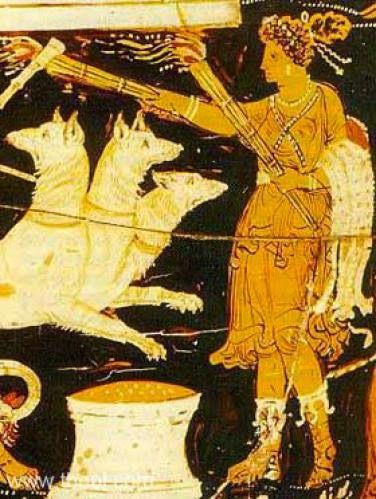
    The curtain of the night has drawn. Selene has started her nocturnal promenade with a moon mirror carried on her celestial chariot across the starry highway. Then the earth begins to bellow with great silent roars, trees to dance with leaves rustling in the wind as the chariot is racing, owls to call with their wings flapping, and the hounds howl from the end of the horizon in the glimmering light of the distant stars like lamps flickering in the desolate wilderness amid the haunting sound of Pan’s flute yonder. It’s Hecate’s Time, the Wandering Goddess of Night, appearing from the crossroads with her faithful hounds, heralding the staging of their divine mistress.

    Hecate has often been associated with all things witchery, magic, and death, not in the least due to modern-day Wicca practice identified heavily with the Greek goddess, but there’s more to her. She is a protector of the wrongfully accused, a goddess of retribution against injustice and impurity, and an advocate for underdogs. Perhaps, that’s why her animal is a dog, not a cat, which betrays a common association of the latter with someone like her. (In fact, Artemis is the only goddess whose animals are a cat because she was once transformed into it when chased by a besotted man.) Her hounds all have names: Kynegetis (Leader of Dogs from the Orphic Hymn), Kyneolygmate (Howling like a dog), Kynokephalos (Dog-headed), Kyon Melaina (Black Dog), Philoskylax (Lover of Dogs), Skylakitin (Lady of the Dogs). Of all the hounds, Kyon Melnia, aka Black Dog, used to be the wife of the last Trojan King Priam named Hekabe, who threw herself into the sea after the collapse of Troy by the Greeks. Hecate took pity on the queen and transformed her into a great black dog that became her familiar. What a manifestation of divine mercy it was.


    It is said that dogs and cats see the spirits of the dead, especially at night. If you have heard a dog howling, another howl, then another, and so forth, as if all of them sing in a canine polyphonic coda. When Hecate’s hounds howl, mortal dogs respond to their divine canine entity as the goddess and her entourage pass by. The hounds also bring victuals offered to Hecate to their mistress at a cemetery where she partakes her daily victuals. So if you think it’s just an ancient myth, listen carefully when your dog or any dog within your earshot howls. It’s either it sees a spirit or Hecate and her nine hounds. For me, well, I have a tabby cat named Toro, and he sees it and them but won’t participate in the chorus because he has her mistress at home.

  • Polaris

    Remember, when you see the North Star
    On a high cold night drifting away at sea,
    Your destiny isn’t doomed altogether
    Even the spell on your life fades away;
    Hope leads the path most brilliantly,
    Humor cheers a sailing most pleasingly,
    And tomorrow is always a new adventure;
    No fortune’s malice can cover the Polaris
    Nor can sorrow dim the diamond light
    With heart even for the fate unkind ever.

  • Wanderlust

    For one hundred and twenty years
    Trapped in the maze of this mirage,
    Where I began, I can go back never;
    Here I stand and face the bare fate
    Or is it nothing but the illusion ever?

    As Aurora releases the first dewdrop,
    I go high over, down under
    From one end of the horizon to the other
    Across the five continents and six oceans
    Above the heavens, below the abyss
    Far into the milky ways and back to earth
    with the jewel of hope in beatitude.

  • at the sea

    I have seen the insidious sea
    Lull the children of the shore
    With the sweet aeolian lullaby
    And the pretty nymphs appear
    From the bottom of the ocean
    To bring them into the palace
    Where their father, Poseidon
    Keeps the souls of the sea
    As is his mighty brother Zeus
    For the world above and beyond;
    Woe betides those who forego
    The fates of the young souls,
    For their grandfather, whose eyes
    See the insidious machination
    Fascinate the innocent hearts
    In the whirlpool of rapid waves!
    The old man’s fury is greater
    Than the furious god of the sea;
    He dives into the angry waters,
    Fighting against the god in spades
    With his bare arms cutting the waves
    Like swords that could kill ghosts
    And wins of his two grandchildren;
    From the god whose wrath sees
    No end until it grows the waves
    Into the myrmidons of madness
    And carries the old man into the abyss.

    P.S.: This poem is based on my reading of a newspaper article that a sixty-one-year-old British grandfather died while trying to save his two grandchildren, aged seven and ten, in the sea off the island of Crete, Greece. The man got into the sea, fighting with the rapid, treacherous waves like Caligula, who declared war on the sea, whipping the waves furiously to invade Britain. Finally, his grandchildren got out safely, but alas, the old man was engulfed by the wrath of furious waves and drawn to the bottom of the sea. I could not just forego my feelings upon reading the story with poetic elements that also bring me the mythological image of Laocoon, the Trojan priest punished by Poseidon who sent the great serpent engulfing him and his two young sons for his discovering the Greek ruse about the wooden Trojan horse. Hence this little poem is in memory of the brave and loving grandfather.