Share a photo of your pet and tell us one thing that makes them uniquely them.
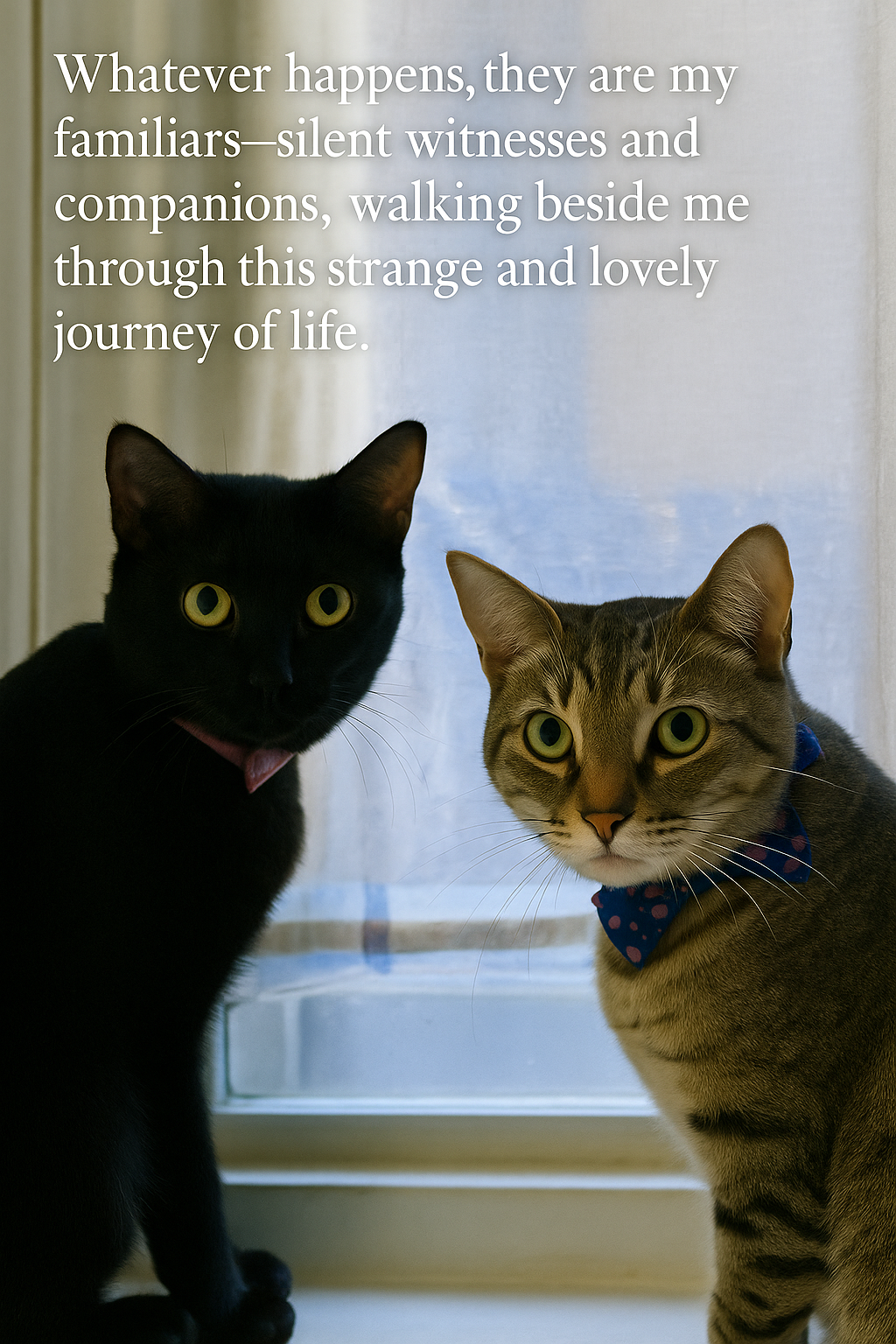
Camile (L) and Toro (R) on their look out from Queen’s Castle
My cats think they are human. They like Häagen-Dazs ice cream and want to lounge in the living room with me, let alone jump on my bed when I say good night each night. Did I also mention that they’re bilingual?
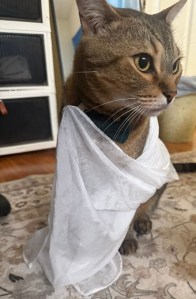
Toro in Toga channeling into an ancient Roman aristocrat
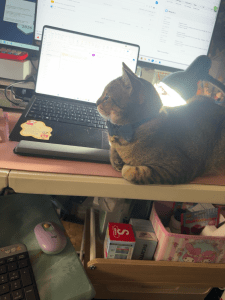
Toro, the 6-year-old tabby, is a little tiger who wants to help me when I work from home, always insisting on typing emails and notes on my work laptop, which need my spellcheck. He takes breaks and lunch with me, so I am never alone at home. And Toro’s being human doesn’t stop there. He knows when my brother calls because he always sits next to me, his little furry body resting on my side.
Camille’s magic eyes
Camille, the 4-year-old black cat, is a little black panther who looks just like Gigi from Kiki’s Delivery Service. Although Camille speaks no Korean, he understands when I tell him my secret wishes and how grateful I am that he lives with me because I am lucky to live with such an adorable black cat.
Toro as my assistant
Whoever says cats are naturally independent and feral has not seen Toro and Camille. They are very affectionate and loving. I see their spirits in amber and emerald eyes. I feel their little hearts on my chest and at my feet.
And they slowly blink their big eyes and bunt their little heads when I say, “I love you so much in every universe.”
On returning to the quiet joy of reading, one discovers that some stories are not only theirs but yours too. Annie Ernaux’s A Woman’s Story was one of those stories—hers and mine.
It was one of the days I visited my mom at the convalescent hospital for the elderly when I started reading this story, sitting by her bedside. Call it providence if you are religious or coincidence otherwise, but I wasn’t expecting it to become my story as well about my mom, who had been hospitalized since her stroke in January of this year. It was as though Ernaux was speaking to me as a daughter to daughter about her mom and mine, collapsing time and place and the cultural and social differences between us. No wonder I wanted to finish reading it at one sitting.
This book is not of a certain literary genre. To call it a biography of her childhood and her mom’s influence on her misses the point of why it took her a year to finish the book. It’s much more than that. The absence of her mom made the author realize her mom’s place in her memory. Her mother was the first witness to Ernaux entering the world naked, and later, to her becoming the woman she is. It’s both a biological and an existential view of the author’s raison d’être. That there is no longer anyone on the other side of the first relationship, which has ended forever. It aches. It lingers. It evanesces. And before all of this will vanish into the ether, Ernaux lives to tell about the presence that was so familiar with her being that not seeing, hearing, and feeling it is painful to bear without letting it take the form of writing because writing is personal yet public, pensive but assertive, and quiet but powerful.
I can understand the kind of ache the author felt after her mother’s death. Whether you loved her or not, you would never see her in life again. She may live in your vision of the past, but her person as a presence does not exist in this world. And that realization of forever disappearance would throw you into the abyss, stifled, blinded, and muffled—by the ineffable sorrow mixed with mystical longing.
I think about my mom and me. What if she leaves this world soon—tomorrow, the day after, or anytime soon? Oftentimes, I wake up with indescribable terror at the thought that soon I will lose her to eternity if I breathe, like a panic attack. And it dawns on me that it is this feeling of detachment from the relationship, as the bond between mom and daughter is severed forever.
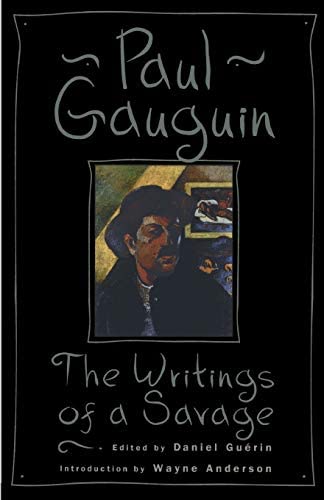
With sixpences beneath a visiting moon, Gauguin could produce wonder. He was an artist in an endless pursuit of the rising sun at the dawn of a day with a flaming glory in dazzling magnificence. He was an intellectual with a wealth of knowledge drawn from a wide range of reading and classical Jesuit education. Gauguin was a man of irony, with contrasting colors reflected in the soul’s spectrum, from the passionate red to the sanguine blue, hopeful green, and melancholic purple, which is why he left Vincent Van Gogh alone in Arles, in never-ending loneliness. He craved recognition in a grand salon, yet he longed for independence on an island beneath an ancient sun. So, naturally, I wanted to know about Gauguin from his own writings, not from another in the form of a biography. Hence, The Writings of a Savage by Paul Gauguin.
The book is an attractive compendium of mostly letters to his select few friends and, occasionally, to his wife, as well as essays and articles on the arts and religion, demonstrating Gauguin’s erudition and introspection. While reading the book, I could not help but think that if he had been a professional journalist or an art critic, his artistic talent would have basked in the glorious dawn sun rather than a struggling painter always on the verge of starvation. But most of all, what I wanted to know was if Gauguin had cut off Gogh’s ear, as I heard the rumor. Before reading this book, I had already assumed Gauguin was a man of temper because his image was incompatible with the Dutch painter’s delicate, sophisticated, and sensitive appearance and temperament. But while my prejudice was not entirely faulty, Gauguin proved himself innocent as he talked about it before his impending death away from civilization. Besides, my reading of Gauguin’s writings convinced me that he was not culpable for the injury, even if some like to assemble circumstantial rumors to make the French pariah artist appear jealous and violent toward the suffering Dutch genius. Gauguin might have been passionate, but his passion is directed toward his artistic creation of the worlds he sees in his mind, while the snobbishness of critics and bureaucrats curates the works of painters who know nothing about the arts.
Imagination, innovation, and independence are the jewels of Gauguin’s prime colors that create his artistic Elysium. Gauguin was liberal in social stance, especially against clericalism, but sovereign in his artistic philosophy that how to draw doesn’t mean an exact copy of the figure because that’s not the purpose of art for art’s sake. As the title suggests, Gauguin was a noble savage who, as a disciple of Rousseau, returned to a primordial state of humanity to escape the over-intellectualized inertia of civilization, which depreciated and ignored his art. I still can’t say the book converted me to the cult of his paintings, which differ from those of Renoir, Monet, and Pissarro. But the book is a medium of looking through the labyrinth Gauguin has built, leading to his secret garden, wondrously vibrant and dazzlingly radiant.
They say pets reflect the personalities of those who care for them. The way they respond to others and express their feelings seems to mirror how they’re treated at home—or perhaps how their owners reveal the rawness of human emotion, unfiltered and instinctive.
My two cats, Toro and Camille, mirror my ego and superego, respectively. Toro is a sensitive soul, easily shaken by the outside world and never shy about his emotions, almost like a little human. Camille, in contrast, is calm and observant. He watches me in silence, as though he sees through to the very center of me. At times, I think of Toro as the General Cat from Cat’s Eye, and Camille as Jiji from Kiki’s Delivery Service.
Sometimes, I wonder if they are the little brother and sister who were never born—that they somehow returned in fur and paws to be near me… and, strangely, near my mother, who once chose not to bring them into the world.
Whenever they curl beside me, their small hearts pulsing gently against mine, I feel the wonder of life swell within me—a quiet awe at its vividness, like a tide of feeling stirred with reverence for the mystery of creation, and the One who makes all things beautiful.
Rudyard Kipling once said that a cat walks by himself. But perhaps he never met mine.
Whatever happens, they are my familiars—silent witnesses and gentle companions, walking beside me through this strange and lovely journey of life.
It was the best of my time, the highest of my time. I had a great job back then with a great package of benefits, working in a prestigious firm in New York City. It was my gliding age.
I wish I could go back to that time and stay there. Then, I would not have to come to California. I was too young to understand the real world and bear the responsibilities for myself and my family. Walking away from stress on a rash decision yielding to gushing emotions was not the wisest choice. Instead, I should have taken a vacation and traveled to lovely places to relieve work stress and see the world’s beauty. That way, I could separate the work from my life, lest I should bring the stress home and spend the whole time sulking.
Now that I have walked for half a century, these things appear from the past, like ghosts of the dead who resist leaving this world.
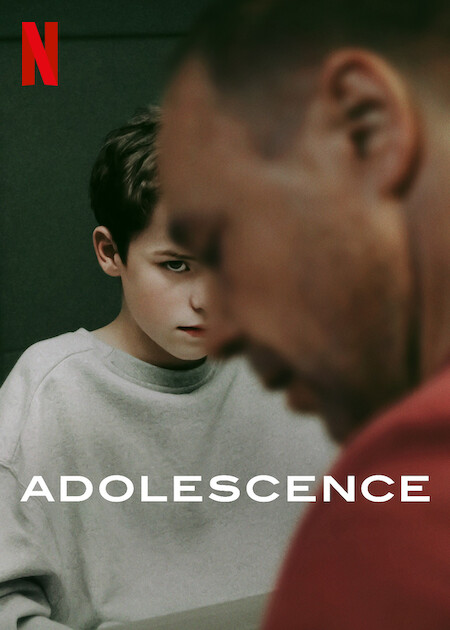
This Netflix drama series does not focus on an activist narrative that many might passionately debate from various political or social perspectives. Instead, it explores how something unimaginably tragic can affect anyone or any family, regardless of their socioeconomic status, race, or cultural background. Committing a crime is not solely the domain of a degenerate or disturbed mind; rather, it can be seen as a sickness influenced by a combination of social factors and the inherent predispositions of individuals. And yes, this reality includes all of us.
Here is an adolescent boy from a hardworking family whose father may have a temper but is kind and understanding and has a strong responsibility for his family. Hardly a likely candidate for the head of the dysfunctional family contributed to producing a psychopathic killer. Having a temper doesn’t mean you are automatically attuned to criminal minds. To that effect, the father of the boy is neither a saint nor a sinner, and his son’s problem is not of family but of peers; it’s from peer pressure under heavy intoxication with social media where your worth is valued by lookism and agism vying for popularity as key to success. A loser is an Incel whose insecurity is forced by the number of likes destined for a public whipping boy or walking sandbag. Yeah, it’s easy to label anyone who is not within a safe zone of being accepted, and you become a new outcast. If you are a woman outcast, then you are a new witch to be persecuted.
The problem with the boy here is his consequence and punishment, but that should not be relegated to the family. To ostracize the family of the sinner is a time-honored practice that never changes, just as there’s no new thing under the sun. While the drama shows the brutally realistic portrayal of the crime, the doer, and the family without overt display of emotions or elaborated scripts, it does not give the boy light of redemption in the person of the psychologist interviewing the boy. I cannot help but think that she’s there to get what she wants, which is to extort confession that he did kill the girl, and that is why he did it, not trying to help him cure the mind disease. She does not seem to be happy with herself either.
It was mind-disturbing and painful to see how the police handled the boy and the preponderance of shock that his family encountered on what might have been one of those ordinary mornings. Seeing his father criticizing himself for not being perfect broke my heart. Yet, no one is perfect; he is a good father with a strong sense of responsibility for his family and a good heart. That’s good enough. You see, bad things can happen to good people. Dad, please don’t blame yourself. You are a good father: good night and sweet dreams.







You must be logged in to post a comment.