Tag: Nonfiction

  • prompt 35

    If you didn’t need sleep, what would you do with all the extra time?

    A deprivation of sleep would be a nightmare to me. Sleep is the most natural and safest palliative to forget worries, however temporarily it is. But if there should be any other props for this natural medication, I could keep my promises.

    I want to read and write as much as I should after returning home from work and generally at home. I used to work in an office where I could write during the lull, but for this year, the cognitive processing activities have been reduced to about 10 percent of my daily life because I have been feeling mentally exhausted. It has become psychosomatic by preventing me from sitting at the desk when I am home. My best regular place has become a sofa bed, watching YouTube continuously. I don’t even play with my cats as much as I should because of this sense of powerlessness combined with the weight of existential despair. When writing – which I am doing now during my one-hour lunch at my workplace – I feel so much better with the fogginess of the mind cleared and the heaviness of the spirit relieved.

    Therefore, engaging in activities that use the body and the mind would be the best thing I should do during the extra time because, as the ancient Greeks called it, Mans Sana in coporore Sano. (“Sound Mind, Healthy Body”)

  • Prompt 33 – why cats are women’s best friends

    What are your favorite animals?

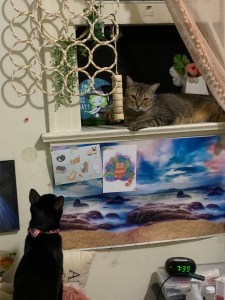
    One and a half years old Camille

    Rudyard Kipling described the nature of a cat as a creature that walked alone. The graceful pose, the noble demeanor, and the aristocratic solitude make the feline kind all the more mysterious and charming. Cats are so loving and, at the same time, so selfish, which makes them exuberantly human. It is no wonder the ancient Egyptians turned them into goddesses Bastet for womenkind. To make the long story short, the association of cats with women is natural and inseparable as if the two kinds are supra-natural companions.

    Three years old Toro

    The feline imagery has been complimentary and cautionary depending on the purpose of its application to societal conventions. For example, black cats are typically associated with devious single women practicing witchcraft (or, for God’s sake, cantankerous spinsters) because of their formidable ambiance of darkness, which significantly contrasts with their wonderfully fierce eyes and quiet solitude. While feminists would disagree with the application of such feline imagery to femininity (“How could you use such a demeaning word?!”), one can’t eradicate the visible traits that are so unlike their counterparts, including the canine. The coquettishness of feline characters and the capriciousness of behavior conjures the images of Cleopatra charming Julius Caesar, Mark Anthony, and the like. And what about Michelle Pilfer’s Cattleman? Then there were Charlotte Bronte and Lucy Maud Montgomery, whose feminine sensibilities were replete with fiercely independent creative spirits, and the fascinating power of words still mesmerized the readers of her times and ours. They were lovers of cats, and their best friends were cats who could share secrets because cats were the only true secret keepers.

    Tori and Camille

    Some people seem to take pride in publicly announcing their dislike of cats as if there were some virtue in doing it. They say cats are treacherous and capricious. But that is precisely why I like cats because, like us, when they are good, they are very, very good. Yet when they are bad, they are horrid. I never get bored with my two cats, Toro and Camille, because they are very responsive to my talking by vocalizing their needs when they want to play, go out to the living room, and eat. But you know what? They are also my best friends who always stay with me, even when I am blue and gray under dark spells.

  • ‘Trail of Crumbs’ by Sunee Kim – Book Review

    I first learned of the author from a Korean television documentary about her search for a natural mother in Korea. A successful food editor of a cultural magazine and a writer, Kim returned to the land with the tears of the past and the hope for the future in realizing her ideal figure for the unconditional love she longed for, which piqued me to read this book to know more about her story, hoping to acquaint another kindred spirit.

    So I hoped it was, but her story betrayed my hope. It was about her affair of the heart with the CEO of a famous French beauty product, L’Occidante. Kim seems to have the magic power of charming men – the higher and the smarter – without effort, and she’s never alone, although she wants to think she is. She has never been in poverty of love, money, and opportunity, yet she complains about a lack of love and total freedom. Her parents, who adopted her, have taken care of her, and her sister is also a Korean adoptee. They may not be perfect, but no one is perfect, and they certainly didn’t burden her with the weight of economic support or, worse, the total abandonment that happens to some of the other adopted children. And that’s not it. Kim always escapes from the responsibility of love when the further half showers with love and warms her with kindness. You can’t treat love as it is a business deal. Unconditional love is altruistic and agape. Love is giving and sharing, not owning and demanding. A sense of abandonment envelops Kim like a wandering ghost wailing in perceptual disappointment and howling in forever resentment. Ultimately, Kim finds herself alone, and it’s too late to regret the ancient bliss of love.

    To think that jealousy resulted in such an acrid train of thought is to miss the accurate impression of my heart on the narrative itself. My power of empathy wallowed in the sympathy of humanity and propelled me to read it, in addition to the Korean heritage the author and I shared. The tears I saw from the program pleading for help to find her natural mother in Korea were heartfelt, so I wanted to hear the cry from the heart to know about the death and breadth of her soul. Yet, her story resonates with the outcry of her never-ending angst and constant chasing of mirages springing from the imaginary ideal of love.

  • ‘The 272: The Families Who Were Enslaved and Sold to Build the American Catholic Church’ by Rachel L. Swarns – Book Essay


    My rating: 5 of 5 stars

    I have always thought of the Catholic Church in the U.S. as a league of immigrant churches founded by the faithful of the old world diasporas uprooted in the New World. The American Catholic Church is, in a way, an outpost of the Roman Catholic Church in Europe, with its offsprings sprouting and flourishing in their ethnic enclaves, thus resulting in less spiritually cohesive, culturally solidifying characteristics in the form of different ethnic Catholic communities within the Church in the U.S. Perhaps that might be one of the reasons that there are so few black Catholics, excluding the immigrant blacks from the overseas because the Church ignored their existence as human beings except for their labor as a lucrative resource to expand their organizational dominance.


    Swarns is also mad and sad about the cruel truth about the Jesuits, whose motto was to educate the souls to train as God’s soldiers were the leaders of the slave trading in 19th century America in efforts to create America’s finest Jesuit high-education establishment called the Georgetown University. The number 272 signifies the number of blacks traded as slaves to fund the university’s administration in zealous ambition to build the Jesuit Empire in the New World. While Pope George XVI condemned slavery in his apostolic Church in 1839, blindsided by the expansionist vision, the American-born and bred Jesuits continued to ship out the blacks in their care to Louisiana by disintegrating the black families and communities to form their cultural identities and heritage.


    Catholicism is a family religion because it is usually inherited through generations. Mothers teach their daughters to say the rosary prayer and the First Communion is a family celebration. But without the secure bond of family in a stable environment, Catholicism is complex to thrive and faces discontinuation of legacy with no parents to teach it to their children. Consequently, the disintegration of black families is the sine qua non of the decline of black Catholics in the U.S. to this date. Even if the American Jesuits, including the present Georgetown administration, have expressed their regret and condolence to the 272 black people they sold for profits, the American Catholic Church should continuously endeavor to reconcile with the racialism within the Church by making all races of people welcome when they come to the Church by reaching out to the concerns of each that are universal to all of us.


    View all my reviews

  • Prompt 31

    What principles define how you live?

    Ask any acclaimed mountaineers, such as Edmund Hillary and Reinhold Messner, why and how they climbed up the highest mountain in the world, Mount Everest. Their answers were simple: there was a mountain to climb, and they had to move forward. Likewise, here are my life’s three guides: imagination, creativity, and hope that accompany me in this life’s journey.

    I am a figure of paradoxes, contrasting light with dark, ideal and worldly, bright and melancholy. I see myself trapped in the Labyrinth of Crete, where the Minotaur lurks in the corner of the maze, waiting to ambush, yearning to eat me. (It is more poetic than being lost in a level of the dreadful Backrooms, as it were.) Normal is not default, and insecurity constantly stalks me like a haunting revenant, resisting departing this world that it longs to remain for an unfinished business. And yet, there is always this impalpable, mysterious sense of what-if flickering in its iridescent halo from a distance. So, I follow the light, walk forward, and never look back because moving forward keeps me alive. Didn’t Stephen Hawking also collaborate with it by saying that it is possible for humans to travel to the future but impossible to return to the past?

    Creativity is essential because it gives a sense of existence, of what it means to be a human. Viktor E. Frankl said three values shape a meaningful life, which are creative value, experiential value, and attitudinal value. I enjoy appreciating the artistic works of others and learning to accept who I am. But I am also delighted in creating my own creations, however good or bad they may be. Writing is such a means of expression by which I can express myself. It is fearful of disappearing like a speck of the world, and I am not nothing.

    I can imagine myself one day arriving as an acclaimed memoirist, diarist, or essayist. Novels are not my forte because I can’t write things I pretend to be or know. That is why I prefer reading nonfiction, and I like to think that I can write it well.

    Thus are my principles – or, more fittingly, my guides – in life. I am a Dante who imagines, a Virgil who creates, and a Beatrice who hopes through life’s journey.

  • Prompt 30

    What details of your life could you pay more attention to?

    Dear Reader,

    After a long and tiring day at work, I look back today and regret not doing things the way I wanted – yet again. Since I spend more time in an office full of strangers with nothing in common with me other than working for the same employer, reflecting on today’s memories and actions brings me a feeling of sorrow and sympathy. It’s always this matter of diplomacy of interacting with others without offending them, which is what I should pay more attention to.

    The art of social interaction is hard enough for me to achieve without having a poker face or a public mask – persona. I have seen people who ingratiate themselves with those whom they regard as socially beneficial and politically influential. I see them, all of whom are women, but I don’t see beauty in their visages, nor their minds and hearts. Those able-bodied, fair-weathered friends or sycophants are unashamed of their deeds, acting as if they were all above others, thinking themselves better than others.

    Not that I begrudge them such a skill of flattering, but I realize that having the diplomatic forte may help me to live a more comfortable life for me and my two beautiful cats. Indeed, smile is the best global language where no spoken words are required. I can smile and smile beautifully, but my beautiful smile is unrelated to currying favor from the powers that be, so to speak. Still, it would work wonders if I could pay more attention to my facial expression and the whole demeanor of my body in a polished way so people would not be rude to me.

    My wish is someone’s daily life or just a fancy, but it is still my wish to induce a good impression on me, no matter where you are from.

    Good night. Carpe Diem!