Tag: novella

  • deer hunter – chapter 7

    in-birreria-guido-borelli

    5:15 PM to Florencia. Iris looked at her iPhone clock and felt secured because the time was working nicely with her wish to stay longer until the train departed. The cappuccino was still pleasantly warm in her hands, and she loved the aroma that enveloped her tall slender figure like a shimmering halo of rainbow sunshine. The iridescent mist of instant euphoria was clothing her with a veil of poised status that fused mysterious confidence with graceful humility. Emboldened by this sudden transformation, Iris pulled herself out of her glass castle and lifted her beautiful deep liquid brown eyes to the outside the world of her own. Into the sea of her diamond eyes, the images of love and beauty were cast like magical apparitions, bewitching her senses and sensibilities which were otherwise harnessed like a pair of tamed horses. Iris felt that she could forgive all and love all at that moment of euphoria. It showed that a cup of good coffee could do wonder to anyone as it had done to Johannes Sebastian Bach, Albert Camus, Napoleon Bonaparte, Jonathan Swift, and Ralph Waldo Emerson.

    In this caffeine-induced euphoria, Iris did not know she was radiant with her pretty smile. The smile was her most prized jewel. When she smiled, she was sweets to the sweet. It was like a flower blooming around an oasis in a desert, and everyone liked it. It’s as rare as a pearl found in a clam, and it’s this rarity of her smile that kept herself distant from the melee who demanded of her frequent smiles. And who would have known that her pearly smile would have caught the sight of Hector? Yes, it was Hector, the mysterious man with a Byronic face and Olympian physique sitting three seats away from Iris, the smile enchantress. Reader, you should understand that Iris was usually a skillful driver of her Chariot of Mind, keeping a tight rein on the always recalcitrant Horse of Appetites. But at that moment, Iris’s chariot was shaking, and the impudent horse was not responding to her stern command to behave. The harder and more she hit the horse with a goad, the more and harder the horse rebelled against the pain until it became mad with a wild cry of agony. It was the cry of the restrained nature. For the nature of the impudent horse was to act according to its beastly desire, the primal cry of the wild. The ancient Greeks regarded love involving man and woman as the most passionately sensual emotion in which only Eros dominated because it was primarily physical, encompassing carnal pleasure. Was it that Eros and Eros only that reigned in Iris’s entertainment of this rebellious chariot of the mind with the wild cry? Iris did not think so and liked to believe it wasn’t. After all, Iris was chaste, and she believed that she would live as a living goddess like Artemis or Athena, independent of men, of children, flying outside the boundary of marriage and attachment.

    Hector was watching this curious woman all along. He did not know why, but something was telling him that she was different from other women whom he had known and lived with. She looked both woman and girl in her tall thin body. She was beautiful with her chiseled face and large dark brown eyes that looked rather serious and dolorous. Her high-bridged straight nose gave her an impression of a patrician woman whom no one could easily be jovial with. The beauty and the grace of her were not in want, and yet she wasn’t exactly the fairest of all the women he had met. Besides, there was a touch of beyondness to her, which was oddly attractive with her rather sophisticated urban demure. The graceful estrangement emanating from this unknown girl/woman reminded him of a deer that lost a track of her kind in a deep forest. Or did she look like a she-wolf voluntarily detached from the pack? Whatever it was, he was hooked on it and wanted to know more about it. It was in her, and she was in it. He wanted to be in it, willingly and madly. Was it an illusion or just a whimsical mood of a bored artist? Hector was all for the adventure, and he’s up for it like Odyssey in preparation for his adventures between the sea and the devil.

  • chapter 4 – hunter

    italian-landscape-sketch_we

    Cumae.

    Whoever denominated this city must have been either inspired by the ancient Roman spirit or just plain high, having a momentary kick of phantasm just as Cumaen Sibyl had experienced in the cave filled with hallucinating gases and vapors. But this Cumae was nothing of the sort. 4 hours of drive from Rome, populated by yuppies, young technocrats, and artists of all kinds, it was typical suburbia that middle-class liberals would like to claim as their permanent residence. No wonder liberal politicians took their winning of votes from Cumae for granted. Which was quite a symbiotic relationship between the constituents and the politicians because young people with money and artists tended to subscribe to liberalism. It was not because they were particularly zealous for the liberal causes, but rather because it suited their modes of life.

    Into this largess of liberality, Hector was driving fast. Driving was never an annoying drudgery, but today it was. He needed to think about his next oeuvre which he did not even have the slightest idea of what it would be. Yet, the image of beauty, that mysterious entity formed by the midsummer’s moonlight sonata two nights ago was keeping him restless, making him breathless, and turning him resistless.  The passion dashed him to the finale of his journey as he was trying to think deeper about his secret imago. ‘Finally, I am at home.’ Hector felt safe and relieved at last when he entered the studio. It was well-kept by Mrs. Maria Martinez, who came to clean on a weekly basis. The paintings and sculptures of his creation welcomed him silently, but that was even more liking to Hector. He felt free from a leviathan of stress, obligations, morality… He was intoxicated with a sudden urge to sing a hymn to Dionysus and wanted to be among the cult of his temple. Out of the bliss of solipsistic presence came his ritual bath filled with an aromatic fragrance and warm water that would melt any man of steel or wood into a captive of euphoric oblivion; it smeared Hector’s manliness with an enchanting perfume of calm and soaked it in Sea of Forgetfulness. So much so that Hector wanted to proclaim such euphoric moment to be part of his Eleusinian Mysteries by hollering “Eureka,” just as Archimedes had done. My dear reader, it all seems that taking a bath would lead one to brilliant enlightenment.

    It was almost 6:00 PM when Hector decided to take an evening promenade. He was a perambulator, taking delight in walking a long distance, which put him in a league with Henry Thoreau, Edgar Allen Poe, and Robert Browning, all of whom walked with pleasure for hours. He could walk far and wide without specific destinations. Wandering like a cloud across the vast skies, Hector returned to his true self as a hunter. He was a hunter again, and he was a want of fresh blood that gave him vitality for life in which he with wife Moira and little daughters had given hostages to fortune. So, like a lone wolf that intentionally broke away from its pack, into the dusky horizon Hector started to walk as his instinct ruled over his way.

  • swept away – chapter two

    Hector was wide awake in the middle of the night. His bare chest was covered with beads of sweat, and his lips wet with drops of water from the jar beside their bedside. Hector looked at his wife sound asleep: Moira’s pretty face looked lifeless in the moonlit darkness, and her silhouette of the slender frame even more soulless against the luminescent lunar beauty from her celestial abode in the nightly sky. Maybe it was that moon, the Full Moon in the midsummer night that filled his heart with a tempestuous desire of a dangerous liaison, of violent passion, of primitive instinct, all of which was a forbidden play for a man like Hector whose status and condition could move heaven and earth, as it were, whose valiant beauty also matched the sweetness of his mind. He was indeed a curious conflation of innocence and worldliness, an enchanting consilience of Platonism with Eroticism, in the manifestation of those thousand actions, those thousand expressions that flew from his own person, fascinatingly interacting with his irresistible manhood.

    Hector was looking at the lunar beauty at the terrace, hypnotically infatuated with an indescribable yearning for a secret escapade from the confinement of his conjugal life. No, it wasn’t just one of those whims and caprices that a married man bored with his marriage usually craved. Moira was a loyal and dutiful wife with a practical sense of the world who bore him two beautiful daughters. She was a daughter of a well-to-do merchant in Rome, assisting her father at his shop where Hector used to visit for his trade. Pretty as she was, she wasn’t exactly a Helen whose faces launched thousands of ships. Yet her sensible words and lively actions were what prompted Hector to pursue her as his would-be wife who could settle into his way of life. Funny that, my dear reader. For someone like Hector had remained unattached for long despite his beauty, talent, and character. No, he wasn’t a shameless cult of sybaritic Bacchus, nor did he attempt to, nor was he inclined to cross over the boundary of Eros in any mode of preference. He was rather an idealist, a romantic follower of Apollo in search of endless love consummated by Eros and Psyche. Call it cloddish, vagarious, or hokum even, but that was what he was, really. That was how he kept his wild horse of desire in him, still. That was why he wanted to release it from its rein, now.

    The story of Eros and Psyche was his favorite, reverberating down to the bottom of his heart. But then it was more of Eros that sparked his dormant passion locked into his mind’s cabinet. For he was a man after all whose sensory organs would react to the stimuli of the seen, the beautiful, the enchanting, the mysterious, and the fatal. He’s all up for it, waiting for it, and going for it. The moon was still high above all the lives of the nightly world, and as its soft white luminescence was glowing and glowing harder, and penetrating his Olympian body deeper, Hector’s desire of a dangerous liaison was growing bigger, louder, and bolder in an ineffable ecstasy of unknown love as mysterious and adventurous as the ones shared by Goddess Circe and Odyssey and Eros and Psyche. He was in the theater of this solipsistic midsummer night’s ecstasy, swept away by his violent passion that knew no restraints with all his vigor, with all his virility, and with all his vitality.

    The phantasmagorical display of the sensual dreamscapes was beginning to fade as Chariot of Apollo was approaching yonder in the dusky distance. Forget Shame. Perish Fear. Curse Fate. Hector wouldn’t let his passion for his unknown love dissipate into one night’s dream, safely ensconced in the complacency of his life. He would look for her, wherever she might be. As the dawn finally broke, Hector’s eyes sparkled with brown marbles, so beautiful that they could be sinful to look at. He decided to go to travel to Cumea, where there was his studio of paintings and sculptures. But first, he was going to tell Moira that he’s going to stay at his studio alone until he finished creating his new work of art. And he knew it would be a magnum opus following his unstoppable heart.


  • [updated] cheery sunday

    Mr. Fred Holstein (hereinafter “Fred”) visited his good friend Mr. Paul Collie (hereinafter “Paul”) on this beautiful Sunday afternoon. Paul had a pretty garden in his backyard, and being a good friend of his, Fred even helped him water the home-grown vegetables. After their joint labor, Paul and Fred had a good time with their favorite snacks at the garden. In fact, Fred’s new jokes were so funny that Paul fell out of a chair. Then they parted merrily before the sunset. Tolstoy would have enjoyed himself if he had joined them at the garden, for it was his kind of nice restful time.

    Author’s Note: Since downloading the video from the app seems to take forever, I have included its Youtube version in my Blog.

  • Morning Train

    15624886771_c2ecc92688_b

    She should have caught the first-morning train to the city instead of debauching her first cigarette of the day upon her arrival on the platform. She knew smoking as the first thing in the morning wasn’t the most salubrious thing to do, but she had to. It was her way of relieving her mind of its cares, anesthetizing her strains of everyday life for the moment of her sybaritic indulgence, which was the only hedonistic practice Julie insisted on keeping because no other things were permitted to her, literally, apart from all the virtuous and sensuous delights of all human creatures that denied her access. That’s probably a pathetically lame excuse for smoking, and the militantly health-conscious, priggish, and principled public would love to lambast her and her smoking habit not because they really care about her health but because they just do it since anti-smoking is now the ethos of this ostensibly egalitarian era, the zeitgeist of New Social Totalitarianism that dictates Social Science Model Behaviors. And although Julie was never a forceful character, she was a free spirit with proud individuality, declaiming against the mob psychology that was grounded on suitably fashionable stance for demotic mores. She defied it in her own way, in her own solipsistic way.

    The act of smoking could be conceived as one of the most highly advanced forms of humankind ever since the dawn of civilization when Prometheus, an ingenious and recalcitrant Titan, a fashioned man out of clay and water, and then stole sacred fire for mankind to kindle civilization. In this regard, manipulating fire in the ritualistic process of lighting a cigarette and emitting smoke from it can be regarded as a sacred ritualistic performance to pay homage to the benefactor of civilization. Also, Ahura Mazda, a lord of heaven and light and the only true god of the prototype of Judaism, Christianity, and Islam – Zarathustra, aka Zoroaster by the Greeks, was manifested in the form of Sacred Fire, symbolizing Purity, Illumination, Warmth, Enlightenment, and the Zeal. And there were also the Vestal Virgins, the ancient Roman priestesses who kept the celestial fire of Hestia, the virgin goddess of the hearth, home, and domesticity.

    Like the tortured thinker Kierkegaard anguishing over his existential conflicts caught between actions and religion, Julie was wretched in this world of collapsed grand narratives, fake news, volatile subjective opinions, hypocritical truths, and inflated egos, all fallen apart and adrift on a sea of the postmodernist detritus. What are am I in now? Is humankind really progressing for betterment or gearing up for its own destruction?

    According to the ancient Greek peasant/poet Hesiod, known for didactic elements in his poems, there are Five Ages of Mankind: the first one is a “Golden Age,” governed by the Titans, the first generation of Greek mythology, where no words for sickness, war, and discord existed. You see, the Titans were alright for humans although their own children raised war against their parents, even castrating Uranos, the first ruler of the universe, the sky, Titan of Titans; the second one is a “Silver Age,” a reign of Zeus and the Olympians who were very much like us in temperament and characters with the exception of supernatural endowments of immortality, talents, and beauty (but not in the case of Hephaestus, the lame and ugly god of fire and blacksmith, and the husband of Aphrodite). Humans lived only 100 years, most of which was suspended in childhood, consequently making them sophomoric, childish, and disputatious; then came a “Bronze Age,” chockablock with warriors and more warriors spending their time in the office of war and conflict; the next “Heroic Age” was a modified version of Bronze Age in the sense that the characters of war were tinctured with noble and epic elements as in the case of Homer’s “Trojan War” in which Hector, a Trojan prince and the greatest warrior and Achilles, the Greek version of Hector, Odyssey, the timeless voyager, and Aeneas, a Trojan refuge who later founded Rome, the ancestor of the feral brothers Romulus and Remus; and the last and the lasting one is the “Iron Age,” in which we all live now. Hesiod might have foreseen where we are now in his poet’s eye; it’s a world of vehement contenders vying for the sponsorship and the possession of the beautiful, the powerful, the fortunate,… THE FITTEST. It’s a world of social Spencerism that yoked Darwinian evolutionism into philosophy to champion eugenics. And what will be the next age be like? Julie was curious, but then she was soon past caring because she wouldn’t live to tell anyway.

    All of the aforesaid musing triggered by her smoking kept her occupied while waiting for the next train to the city. Julie looked around her at the station that began to be full of another batch of commuters, more men than women at a glance. Funny, Julie thought. Are there more men working in the city than women in this town? Or is it because there are just more men than women in this town? Anyway, the men looked just average without distinguishing outward appearances. Julie knew that beauty was only skin deep, but being a highly aesthetically person, she could not help but observe physiognomies of whoever she saw in view. As a matter of fact, even the intellectual like Francis Bacon also took a person’s physiognomy into consideration that he even rationalized phrenology, a divinity by shapes of skulls. And then there was Karl Lagerfeld who realized that the look was what others made interested in your soul.

    Woe betides anyone who would disagree with this dictum of our time, for she or he would be a downright hypocrite! The human faculty is instinctive, sentient, and physical. Beauty is an essential objective of intelligence that calls a beholder’s attention to the other elements of its possessor in the sense that the poster of a movie gathers spectators to the doors of the movie theater.

    Moreover, Julie could see what others could not see or decided to ignore because it’s regarded as a trifle. Her sense, sensitivity, and sensibility were extraordinary to the point of exquisite uncanniness. Then, she jeered at the thought and dismissed it as hocus-pocus, all jumbled up with meaningless bits of harebrained abracadabra in a shambolic array of grim masks that languished with faint tweaking in the left corners of their lips. That was another way of visceral escapism she sometimes took to bring herself to a different place from the rabble that seemed to belittle her nondescript exotic existence that didn’t fit their circle, their legion of the beauty. That’s the existential issues Julie had to face every day – an acute sense of isolation, an unquenchable feeling of rejection, and a sentient awareness of her aloneness… To escape from the excessively dour, namby-pamby sentimentality, Julie looked at the magnificently rustic beauty of mountains and hills outside the moving windows of the train and fell into a reverie of the 19th century Wild West where she as a Pony Express Rider was riding on a rapid mustang across the land to deliver a Letter of Hope to a final station in the city.

    저장

  • trumpet volunary – beginning

    This is the beginning of my novella about a woman striving against the limitations imposed on her by reality with her fierce individuality and queasiness in her belief in destiny or fate. Her investment of spiritual discernment is her congenital gift, but that which makes her special defenestrates her to the perimeter of society like a cunning woman or herbalist in the Elizabethan England. Is she then a middling between an angel and a demon? Her search for the meaning of her so-called life, the secret of her existence is the linchpin of this daringly attempted story I have decided to conjure up in the peculiar alchemy of fiction. 


    van_gogh_vincent_5
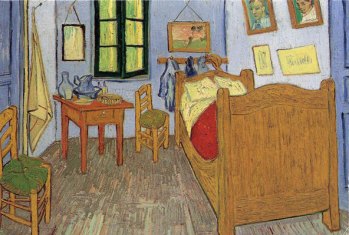
    “Bedroom in Arles” by Vincent van Gogh

    It was a cool, bright mid-Monday morning, but Julie was still in bed, in bed with her still tenebrous somber spirit returning to possess her once again because she – yes, that is Julie Faustine, a single, plain woman nearing to the acquisition of stoicism in life – fell into a reverie of perfidious rebelliousness. But let the description of Julie not complacently settle on your a priori premature postulation that she was one of those feckless, mediocre, and nondescript women deprived of what the world could offer to be a woman. Nary a bit. Her inner world was always in a perpetual restive tempest propelling her to sail adrift on her sea of life fraught with existential strains of life, which stunned her venturesome spirit and moored it in the stony stasis of inertia that was killing her softly. She was a hostage to fortune confined in existentialism that did not allow her all the privileges and rights of womanhood and femininity due to a covenant arbitrarily made and entered into by and among her ancestors and an ancient entity prior to her birth.

    All this, all this preposterous truth was nothing but a real, physical one that was intractably lodged in Julie’s mind, and it was killing her softly. Nothing would be changed on my own, except the sure case of death, which would be a total force majeur situation. Christopher Malowe’s Dr. Faust was in league with me. And if I physically – and metaphysically – disappear from this earthly place, nothing would change. With such monologue in mind, Julie’s wish was to find herself in netherworld when she woke up in every new morning. No, it’s not pessimism or fatalism, but realism, whether you would agree or not with a sneer. W.H. Auden confirmed it in his poem, “Museum of Beautiful Arts.” Just as all the world’s great and terrible events, such as martyrdoms and nativities, took place amid everyday life, other people continued to do what they had been doing for their own interests. Whether or not you existed would not matter to the continuation of the world.

    But as luck would have it, Julie woke up in this world yet again this morning, in this dysphoria of her failed and failing dreams, dwindled and dwindling aspirations, disappointed and disappointing facts, and frustrated and frustrating desires. How shall I die? It’s got be without inscrutable pains and gory details. Painless suicide will be the most cherished and coveted solution to expunge all my baggage. Thus contemplated Julie in her usual serious self. Then came the phantasmal display of the last day of Eva Braun and Adolf Hitler. When Eva and Hitler knew that their ends were impending as the Reich was soon to fall, they hastened to kill their lives together. Hitler chose a pistol, but Eva – being nothing but a woman herself with a reason none other than being a woman – mulled over which method she would employ to murder herself in the least painful but the most feminine fashion. Out of the musing came a method of poisoning herself because it would preserve her pretty face even after death in order that anyone, the Allied or her German volks, finding her corpse would still think she was a pretty being.

    This story and image of Eva Braun still imprinted in Julie’s mind and imbued her with the selfsame way of beautifully saying adieu to her pitiful life. Nevertheless, this was never realized or did not seem to be realized at any time soon for some clandestine reasons made by the Fate, or the Fury, or the beautiful goddess Fortuna. And where would God be placed among these pagan elements? He would eventually come and vanquish all in the name of one Omnipotent, Transcendent, and Infallible of All in no time.

    So much so that in Julie’s religiously conditioned mannerism of reconciling herself to the limits imposed by the Reality of This World,  the image of God existed as a Bureaucrat aged somewhere between the fifties and seventies with a Victorian-style mustache and gravitas that would sting you to fumble with awkwardness, making you feel like a nincompoop. Julie was not a forceful character, and she would turn herself away from this humiliating embarrassment and would figure things out for herself, even though it meant a series of trials and errors over a long period of time all alone. That was her daring independent spirit. That was her most treasured possession. That was what kept her going against her senses and sensibilities. That was her lifeline and only one.

    So it was another morning and the very first morning of a new week into the bargain. Intentionally waking up late in the morning, Julie forced herself to breakfast against her prior determination of foregoing food until she would find employment that would make her earn the bare necessities however little it would pay her. Would this be my home forever? Would I become visible in this new land? Would I start anew in this place? Then Julie’s innermost secret and hidden questions came to surface at last: Could I chance to love? Could a man love me despite my plainness? My paroxysm of moodiness? My humdrum presence? CUT THE CRAP, concluded Julie, for all these supplementary wishes and vain hopes were verbose and verbatim Without A Job. Surely, not all pretty women with jobs – good jobs like professional ones held by the writers of all those popular memoirs bestriding NYT bestseller list for weeks – promenaded with their beaus, but Julie, always angst-ridden and precariously sentient – moped around the whirls of her mental pagoda of melancholy. She could not help making parallels with her life, comparing herself with the illustrious careers of her peers.

    The third week of unemployment was hard to bear, and it was daunting to bear even with her renowned stoicism, but her real passionate self defied it, cursed it, and bitched it. Still worse, radio silence following so-called officious interviews was the worst bitch. “Don’t take it personally,” was a bromide, a humbug, hokum out of human kindness, only to be cruel. Of course, it’s PERSONAL, when the parties engaged in the formal occasions were all humans made of blood and flesh, not robotics of steel and wire. That’s an infallible truth, n’est-pas? That’s a res ipsa loquitur case of negligence of truth, no?

    All of this in her mind pushed her into the brink of a life’s cliff, leaving her one choice, and the only choice she could resort to: a Mephistophelean pact, it was. Yes, that’s darn right. She resolved to make a pact with the devil, and she was going to do it no matter what, either out of sheer spite against her fate or pure supernatural adventure or innocent curiosity. She’s up for it, and when she was in for the kill, she sure meant it. And it was today she would do it when the frivolous west sun was set, and the shadow of darkness began to cover the horizon in the way the sky god Oruanos covered the earth goddess Gaia to make love to her furtively in the dark.