Tag: philosophy

  • ‘Tiny Habits: The Small Changes That Change Everything’ by B.J. Fogg

    My rating: 4 of 5 stars
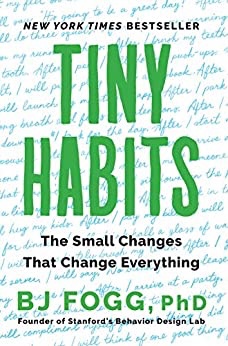

    When you feel that something important about your approach to your current life isn’t working, you should adopt a new way of sailing your ship at life’s sea. Hence, following my read of Aristotle’s Way by Edith Hall, I continued pursuing the answer in Tiny Habits by BJ Fogg, a self-help book based on Aristotle’s dictum that virtue is a habit in 21st-century parlance.

    Fogg’s approach to habit-forming practice is categorized into small steps that require no intellectual, or philosophical commitments, as in the case of new year’s resolutions. He refers to motivations and willpower as “fair-weathered” friends who hooray and holler at our resolutions to change at first but disappear into the lost memories of the first initiation when our souls plunge at the lowest later. Instead, we must befriend “Aspirations” and “Outcomes” as faithful friends who will help us build a Behavior Design that best matches our disposition and lifestyle by which we can realize our affirmation as the functionary of noble ideas. For example, if you want to save $500 as an emergency fund, you can start by curtailing your Starbucks visits or bringing your lunchbox to work, rather than saving a lump sum of money from your paychecks; as the saying, “Drop by door fills the tub.” Fogg refers to such small practice as the principle of “Golden Behavior,” which you can do when you feel like calling it a day, even on your most challenging day.

    Notwithstanding the noble intentions and the greatness of simplicity in Fogg’s guide to habit-forming, some carbuncles I find incongruent in his examples of his successful people who are comparatively well-off business owners or professionals. Of course, that is not to avert his excellent idea that the simple is the best. Still, I hoped to find examples of everyday working-class people struggling to make their lives better who have fewer resources, such as seeking help from a person like Fogg, a Behavior Scientist at Stanford University. Maybe I could inadvertently judge his study results only with limited information based on my reading. Still, I only wish that he would include a broad social spectrum of subjects in the advantage of Golden Behavior. But then I could be a captious reader feeling left out of the selected successful achievers.

    In all fairness, the book is worth reading if you are especially keen on Aristotle’s way of happiness, which I regard as personable and approachable, compared to Plato’s metaphysical way of interpreting how to live a perfect life. But let’s forget about the ancient Greek school of philosophy. Still, Tiny Habits do matter.


    View all my reviews
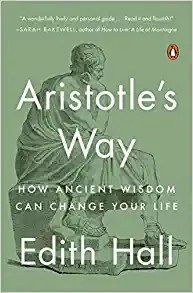
  • Aristotle’s Way by Edith Hall

    Tolstoy in Anna Kararina knows a thing about the Aristotelian school of subjective happiness thus: “All happy families are alike; each unhappy family is unhappy in its way.” Happiness is an antidote to depression out of hopelessness and envies out of disappointment in a purely subjective sense. It requires only self-will to choose the light and to follow it by constantly taming your brittle spirit via lifelong habit until you find a sense of why you are here in this world. If you doubt it as a cliche, then meet Aristotle, the student of Plato, who was the student of Socrates, and the private tutor of Alexander. 

    Along with his great predecessor Socrates, Aristotle was a thinker who billeted Philosophy from the heavens at the houses of mortals so that she could show them how to cope with the harsh realities of the world that discombobulated a sense of purpose in life. Aristotle’s main concern was that people weighed heavily on the outward material success as a sign of well-being and a carte blanche to happiness, which would lead people astray with a sense of emptiness inside. For example, we can’t know if all those glossy selfies on Facebook and Instagram reflect the real lives of those uploading them. Or the lives of Hollywood stars who predicate on images and styles are not, in fact, worth admiration, as revealed in the recent defamation trial of Depp v. Heard, in which Depp’s braggadocio of recalcitrant drug and alcohol uses combined with alarmingly repulsive backstage personality, is simply disgraceful. On the contrary, the Uber drivers I have come across appear to be more satisfied with their lives, content with their independent work mode, and love of families. This Aristotle refers to a state of eudaimonia, a feeling of bliss, however small it is, because it comes from a higher sense of pleasantness from within. 

    Of course, Aristotle’s way is not instant magic and may not show visible effects in one fell swoop, but it is a long-term remedy like a physical therapy that will show improvement. Aristotle’s way is not fanciful but practical with two recipes for the malady of hearts: (1) to keep everything in moderation, called the “Golden Mean”; and (2) training yourself continuously and actively to do the right thing like a habit. Aristotle reminds us that excellence is not an act but a habit. This happiness school parallels Emerson’s dictum that thinking is the function, and action is the functionary. So this is Aristotle’s simple but sophisticated stairways to your happiness, and I think it’s worth trying. No wonder his student Alexander became great. 

  • Smile again

    Happiness is her poetry
    In a world where reality
    Is likeness of truth only
    With her flights of fancy
    That vies feverishly
    Though they sometimes flee
    And vanish into the high sky;
    Fleeting dreams pass by,
    Budding despair creep by,
    But the seeds of hope stay,
    Happiness, that is why.

  • ages of man

    No matter how many leaves have fallen from a tree as the wind of changes has been blown – sometimes placidly and many times harshly – I still feel like a girl who has refused to enter into adulthood, shunning away from the nature of things. Cicero said the ages of man have their stages of nature with sovereign rights, so anything you fly in the face of them will ask for troubles. But then Cleopatra declared to reject the forces of mortality, and Shakespeare thus praised her courage and fortitude by saying: “Age cannot wither away, nor customs can stale her infinite varieties.” Oh, and there is also Cher, now rightly revered as a dame of celebrity, and she has recently decried acknowledging her age on our evolutionary scale. So why not me with my consistent resistance against the fate of a mortal in all aspects with all my might, with all my soul, and with all my heart?

    It’s not only the inevitable awareness of the passing of generations by me. With the recent death of Sidney Poitier, the eminent actor famous for his unforgettably charismatic roles in ‘In the Heat of the Night’ and ‘To Sir with Love, it has begun to dawn on me that those who lived through WW2 and pre and post Second Vatican Council are now gone with the wind to the haze of time, a new breed of generations has germinated, sprouted, and dispersed across the lands and oceans, just as mammals began to stage after the extinction of dinosaurs. It’s a nature of the universe, but still hard to accept it, especially when everything else but I change, or seems it so. The difference between the millennials and the Me generation seems as far and wide as that between the Victorians and the Flappers, so to speak. Less than 50 years must have felt a great leap of 100 years to the opposite generations, I gather. But that’s not hyperbole, I believe.

    Greek gods knew too well about such a human yearning to be agrasia and played the weakness in favor of their everlasting egoism. Otherwise, why did they keep nectar made with ambrosia to themselves on the Mount of Olympus? Demeter, the goddess of harvest and corn, put the baby of her master who took the goddess in the guise of a poor woman as her baby son’s nurse in a sacred flame on the pretext of making him ageless as a favor to the kindness of her lesser mortals. And it doesn’t end with Greek gods. Jesus never became old, preserved in his prime days of preaching travels with stylishly long hair that reminds me of a famous musician or poet. So was Mary, the mother of God. In the end, only humans stand in the audience, appreciating the agrasia beauty and immortality, comparing the presence of eternal youth to the absence of it.

    What with the flow of time and what with the present state I am in now, inching toward the end of the era, is already enough to blow me away into the twilight zone, where things are unlike Alice’s Wonderland but Vincent’s Price’s Haunted House. Magic is no joke and is real for sure, but you always have to pay for what you wish for. But I think it’s a mindset that significantly impacts physical reality, which is magic turning you forever young.

  • ‘Enlightenment Now: The Case for Reason, Science, Humanism, and Progress’ by Steven Pinker

    My rating: 5 of 5 stars

    Gods may be crazy, as the tribal men thought when they picked up a bottle of coke dropped from an airplane. But the world is not crazy and will not be crazier unless you wish it. So you’d better lose faith in the doomsday industry that prompts you to think so because our faculty is intuitive rather than reasoning, rather physical than metaphysical. Steven Pinker points out in this book that we need rationality or a habit of rational thinking to aspire to objective understanding lest we should fall back on the doomsday scenario of a dystopian world.

    To begin with, the enlighten movement is not a product of the west but rooted in human nature as the universal feature. The spirit of the enlightenment movement is “Dare to Understand,” which means applying knowledge to understanding our world to enhance our human welfare to the full effect and force. Enlightenment is comprised of Reason, progress, science, and humanism. However, the currents of modernity flow into global populist tractions that champion totalitarian relativism from individual modes of thinking to social and political policy-making in the name of progressive liberalism or conservatism, when it is not with the absence of Reason and humanism. The proponents of the ideologies described above take precedence of faith over Reason, nation, or culture over individualism and metaphysical over real because they couldn’t care less about it.

    The most impressive finding that I have described from this book is Pinker’s perceptive analysis of the counter-enlightenment movements run by both conservatives and liberals, especially in the States. As many people might conjecture, Pinker is not an ultra-right-wing intellectual because his view on former President Trump and his cult is logically solid and intellectually revoking. He explains that the philosophical roots of Trumpism are a synthesis of a militant derivative of Nietzchean school of philosophy and anti-enlightenment humanism. It’s not conservatism but racism lite, shading into authoritarian populism and romantic nationalism, harping on the good ole days, which weren’t good in respects of the quality of living conditions and level of human rights.

    Amid the bipartisan world of ideologies, the heightened pessimistic opinions of our planet from the environment to social services, Pinker’s education on what Enlightenment means on human progress shines like a beacon of light on Slough Despond. This book gives the world a sense of self-confidence in our cultural progress this far as a collective human enterprise. The history of the world is not cyclical or linear, but progressive and in progress as long as humanity continues. It is this humanity that Pinker emphasizes in the truest sense of Enlightenment that the thinkers such as Voltaire and Kant also professed to be an inseparable element of human progress. Progress without humanism is not progress. Humanism is not a sign of shallow intellectual culture akin to pastoral romanticism or unproductive ideals. Humanism represents the sense, as science reason, which are universal human traits common to all. That is what this book wants to teach us.

    View all my reviews

  • New Odyssey

    Sail away to a new beginning
    sail away from an old harbor;
    Sail, Ship of Destiny, ongoing
    Across life’s wide oceans
    Thru the tides of fortune;
    The year has swiftly gone
    let her go, and look at the star;
    Sail away to the bright anon
    Sail away from the dark afar.