
The curious cat wonders
On the top of the glass palace
If he can touch the finny faeries
With an eyeful of curiosity
Thinking curiouser, curiouser.
The curious cat wonders
On the top of the glass palace
If he can touch the finny faeries
With an eyeful of curiosity
Thinking curiouser, curiouser.
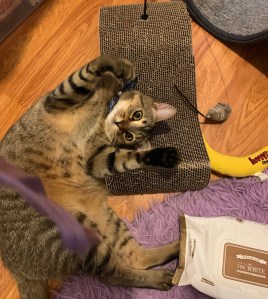
St. Frances de Sales’s advice, “Have patience with all things but first with yourself.” is no more so than with the three weeks’ heartbreaking ordeal to win back my cat Toro’s trust in me. His traumatic visit to the veterinarian now seems to dissipate across the feline Elysium slowly, or so I want to think. He is not hiding under the bed in my presence, becoming a sweet writing company on my desk once more.
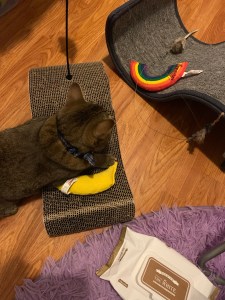
I have recently watched a YouTube that goes viral about an unlikely friendship between a stray cat and a young woman, which makes me think of my relationship with Toro and what it means to build trust between two lives. The woman found a stray tabby cat around her house and began to acquaint him with food. She named him “Tiger,” not least due to his perspicacious tiger stripes and adorable feistiness, giving him a distinct personality and charms that were all the more endearing to the sensitive woman who was also in need of company in her solitude.
Thenceforth, they became complementary to each other for consolation, security, and most of all, love. Tiger is still his feisty self, and the woman is still trying to adjust herself to his whims and caprice. Still, they feel comfortable in their presence and love. The tears welled in the windows of her soul when she said that building trust between two took time and patience. You can’t make someone love you arbitrarily by force. You don’t need a love spell or magic potion to enslave someone into your desire of possessing the body and mind, as the ancient Greeks and Romans used to. Without Psyche, Eros would not/could not have culminated in perfecting the art of love as a primordial god of Love.
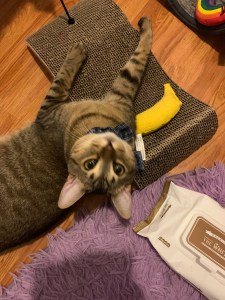
Toro is in some way like Tiger: his name means a little tiger in Japanese with his distinctive stripes, and M signature proudly marked on his little forehead. Although not as feisty as Tiger, Toro has a remarkable personality of adventurousness, curiosity, playfulness, and resilience, all affectionately wrapped in his good nature. But I don’t take for granted that wonderful Toro is my cat, and therefore, I deserve his trust and love. Animals, especially pets, also have hearts that pump up the blood and feel the feelings. I regard them as friends, companions to enrich our existential human lives with a touch of sentimentality that we hardly express when we are among our species in fear of being regarded as a sign of weakness. And I am always thrilled to feel his little heart at my feet as a friend.

When my eleven-months old cat Toro started drooling in white foams last Wednesday evening after swallowing a tiny flying insect in my bedroom, I was in a panic. I called nearby emergencies, describing the state Toro was in, but they told me his symptoms were not regarded as critical. Instead, they told me to monitor him, so I did. He stopped drooling the next day and drank a lot of water. Nevertheless, my concern was still growing, doubled with regret that Toro should have met an owner in a vast, spacious home with that which would make him happy. The pang of grief punctuated my already broken heart, and I was distraught.

Luckily, a vet to whom I had previously taken Toro for his difficulty in excreting in Little Tokyo said she could see Toro on Saturday morning. The waiting period until the appointment was an ordeal by the torture of the heart. My spirit was sunk in a sea of sadness, blaming myself for not providing Toro the optimum environment to thrive in his best feline nature. The bedroom is so tiny that it is more of a den, and the living room where my elderly infirm mother spends most of the day intermittently is off-limit to Toro by keeping him alone during the day when I am working. My evening playing with him might probably bore him to death because my lack of creativity fails to invent more stimulating kinds of play that will perk up his energy. I cannot help but think that I am becoming a bane of Toro’s existence, the cause of his unhappiness.
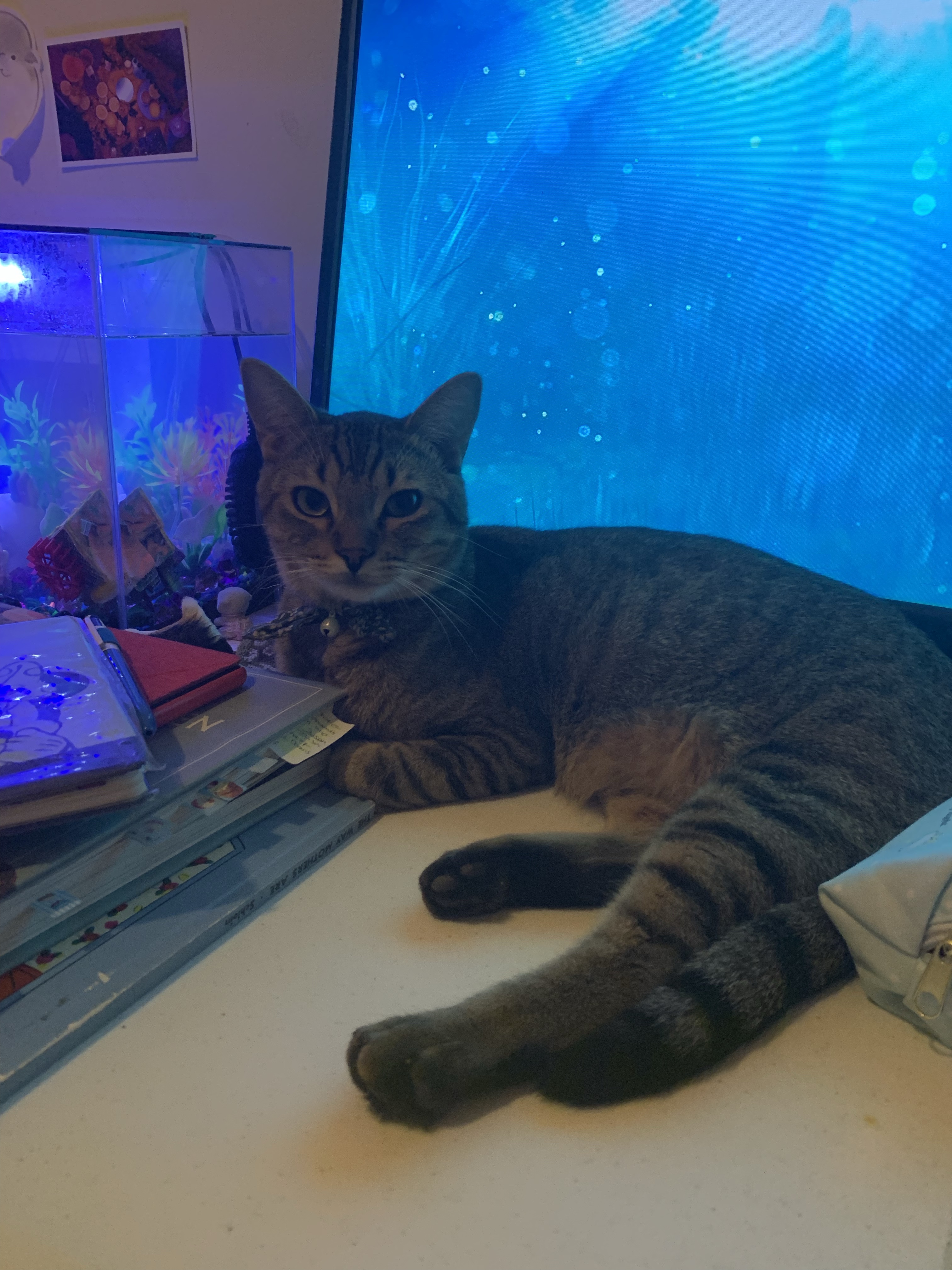
To pour lead on my open wound in the heart, when I finally took Toro to the vet on Saturday, she diagnosed him with idiopathic cystitis. She showed me a scanned copy of Toro’s mildly swollen bladders with information on the illness caused by stress. That’s it. The diagnosis realized my imagination and shattered a slim hope of something other than STRESS. I see all the cares I had given to Toro as best as I could beyond my measure by taking him to vets and telling him how much I loved him as much as I could dissipate into the elusive dreams of my little happiness with Toro. My happy moments with Toro vanished into yesterdays, bidding farewells to tomorrows.

It’s been a week since the diagnosis, and now Toro has changed. Toro now hides under the bed, doesn’t come up to my bed, and avoids me when I am home. Besides, he doesn’t eat as much as he used to, about which the vet told me to be patient because that could be the effect of changing his prescriptive diet from gastrointestinal to urinary care. What is strange about his sudden change of behaviors is that he was never like this from his previous visits to vets. Come what may, Toro seems to be unhappy, and I am very downtrodden for his changed behavior. He was the only one who showed me his affection.

I still remember his adorable, curious big eyes peeping out of an opening from a box carrier when I brought him from Ventura Animal Shelter last August at the age of nine weeks. Purring and kneading are long gone. My reason suggests that re-homing Toro is the best I can do for his happiness, yet my heart tells me not to listen to it and look for another place for a better living environment. Nevertheless, I yield to my heart’s voice and want to believe that there is still hope for us to be happy in a better living condition. I hope to see mirth wonton around us and happiness sparkle before our very eyes soon.
Think. What do Kubler-Ross Model of Five Stages of Grief, Spinoza’s Amore Dei, Nietzsche’s Amore Feti, and Logotherapy have in common? That it is all about how to accept fate as it is, the stupendousness of truth, the veracity of suffering as a way of finding meaning in what you have to endure. Religion is a poetic way of describing the suffering, a burden of life, another intuitive interpretation of looking at the pain and yielding to it as a destiny. But it is easier to be said than to be done when your spirit is plunged at the lowest tide of life and sees no hope of descrying a land of opportunities in the doldrums. And it betrays your noble hope and begins to shoot albatrosses then become like the Samuel Taylor Coleridge’s Ancient Mariner. Or so it seems.
All the wise in the civilization of humanities told their progeny the reason for bearing the unbearable because they all knew about one thing: that’s what life was about. It is what it is and will be as long as humans exist. In his theory about Amore Feti, Nietzsche posited that evil was what prevents us from striving toward our goals and that power to affirm what we have is the only way to move on in the sailing of life, however terrible it would be. Knowledge and its pursuit are a must-have to shape an essential feature of our consciousness to keep sanity in contextualizing the whys and wherefores of struggles in life with an active mind. It is indeed a noble psychological philosophy, but what about people who are not intellectual as the renowned philosopher but just ordinary earthlings stuck in the existential backwaters of the rut? Did Nietzsche, Spinoza, or Kubler-Ross have to worry about livelihood? Well, Spinoza was a watchmaker, so he should have known something about making a living, but still, he was autonomous in pursuing his intellectual Elysium without having to worry about the burdens of daily life.
I had not known what the darkest night of the soul until now, and the fear of losing myself has finally descended upon me. C.K Charleston said madness is when you lose yourself except for your reason. Shakespeare quipped when nature, being oppressed, commands the mind to suffer with the body, and you would become derailed from norms of behavior and faculty of cognition. I prefer the latter version of madness because if I lose myself, then it should be all or nothing for the complete liberation of my spirit from the chains of enslavement. From insidious dominion of gaslighting to dreadful ascribed duties that I didn’t choose, to endless sadness, and cursed estrangement, I now know why the Ancient Mariner killed the sacred albatrosses whom seamen believed to be the souls of the dead sailors. Ire for the delusion of hope, retribution for the betrayal of faith, and freedom from the pain of unrealized dreams drove the Ancient Mariner to execute the birds and then become one of them, never returning but always wandering.
If only. I long for a sign, omen or augury, that can show me what to do or if I can break this vicious circle of unhappiness that has been cursed on me. No Ouija Board. Why? I don’t trust bargaining with the Devil because he, as a henchman of Satan, is like an angel of God in reaping as many souls as possible to build their armies or populate their cities of the Beyond. Then why do I find myself pleading to God by default while writing this for not ignoring me when he prefers the beautiful and the pleasant? Spinoza and Nietzsche, I beseech you to persuade me with your best reasonings of why I should believe that life is still worth living!

Like muffled drums in rains of thunder and lightening, her heart was still beating as the intuitive leap within her was on the verge of falling into the crevice of darkness. She hoped that life would be better or that if life wasn’t unresponsive to her hope, she could seek an elbow room in her writings blog, her glass castle of the soul. In this regard, her purpose of writing and that of George Orwell agreed that it was for sheer egoism of being an individual and recognizing it. For all she had read and seen, her spirit wanted to record it in writing before leaving the world without a trace. How pathetic it would be!
If only. The girl hoped to articulate her thoughts to the unseen public somewhere out there. But above all, the girl used her writing practice as an autodidactic exercise to improve writing skills in the language she fell for. She loved the English language so much that she was ready to forsake the native language if she must choose one. She would have wished to possess the art of English Writing if a benign fairy had asked about what gift she would want. Perhaps she would have made a Mephistolean pact for the craft. Yet her love was alone because she loved the language more than it reciprocated the appreciation to her. How cruel it was!
To pure lead into an open wound, the girl realized her brain was not as alert as it used to be in the locomotive of thinking. As thoughts shape language, she reasoned that a slowly deteriorating neuroplasticity in her brain might have contributed to her difficulty in reading and writing. Something ominous was happening to her, and it was gripping her spirit under its diabolic aegis for the sheer pleasure of tormenting the soul in hopelessness. Words she saw refused to make a coherently complete sentence and enter a faculty of thinking. The circuits to the control center of the brain felt blogged or damaged to the point of making telegraphic phrases swiveling at a vortex of frustration. It had never happened until last year. But why was it happening to her? Alas!
She tried to find reasons for the ghastly maladies and self-diagnosed the following:
She further decided that the existential frustrations were exhausting her will to essay her creative and experiential values in fulfilling her meaning of life to be expressed in writing. All of it was tantamount to the enormous boulder Sisyphus had to roll up on a steep hill in Hades as punishment for his trickery on gods. But the girl was more akin to a Caryatid, a sculptured female figure used as a pillar supporting an entablature of a building on her head.
But what then was her solution to untangle the web of the menacing spider? She had nothing but her will and resilience born of eruditeness and level-headiness. It helped her sail through some of the difficult adventures between the Scylla and Charybdis in her life’s odyssey. Like an earthling who never gives up hope on getting a signal from an extraterrestrial being via radio transmission, every day, she would write even if it would receive no response. Thereby hangs a tale told by a mad girl in hopeless love with words, full of words and madness, but signifying something.

A dreamer’s shadow in search of the star
It had seen falling over the mountain
Met a stranger’s shadow with a star
It held in the hands, brilliant golden
And asked it wherefrom.
“Over the mountain, and nowhere else.”
The head collapsed, the heart shattered,
A dreamer’s shadow at one fell swoop
Flied to a stranger’s shadow in heartbeat,
Grabbed with its hands the star, brilliant golden
and swallowed it in pride of lions anon.
The star entered its heart’s chamber,
And the shadow became a fire demon.


You must be logged in to post a comment.