


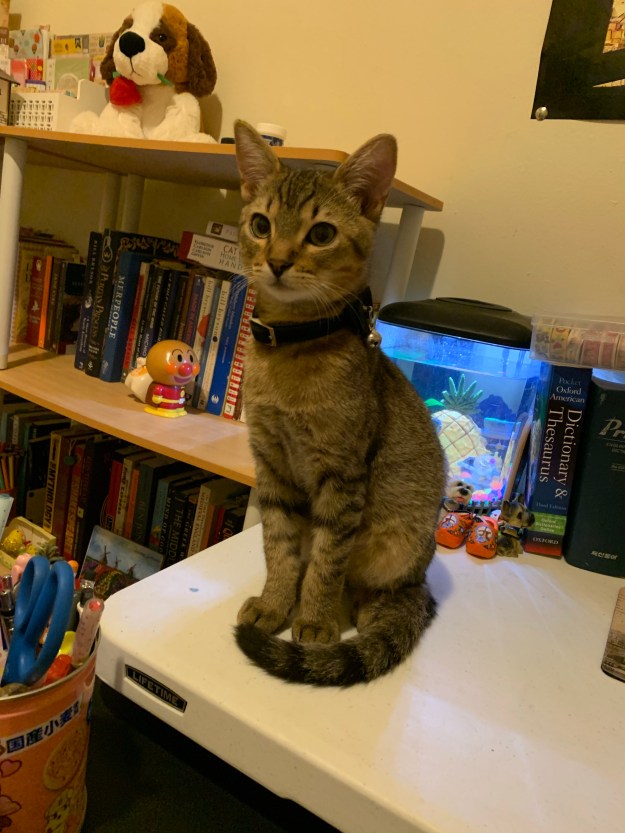

There’s once a cat name Romp Pomp Bunter, aka the Curious Cat,
who liked to romp with pomp and bunt his head against
his guardian, the woman with the beautiful but lonely heart.
She named him in rapt contemplation of the thought, of the thought
of his name; his ineffable, effable name, debonair and extraordinary.
The Romp Pomp Bunter has a secret that no one knows it:
The Romp Pomp Bunter once saw a grand statue of Bastet
In a book on the history of cats originating in ancient Egypt
And was so impressed with the splendid grace of the goddess
That he wanted to emulate the mysteriously beguiling poise
Even if he was a Californian moggie tomcat of Los Angeles.
But the Romp Pomp Bunter, ever the Curious and Adventurous,
An orphan kitten whose parents nobody knew or cared even,
Felt that he was originally from the Ancient World with a reason
That he looked nothing like the ordinary domestic short-haired,
The insignificant, the common, the trite, the obsequiously tamed
Breed of Cats that contrasted the Egyptian Mau, the First of Firsts
Endeared to Pharaohs, Queens, Priests, Soldiers, Farmers, and Artists.
So, the Romp Pomp Bunter believed that he was the Royal Descendant,
The indolently elegant, adoringly capricious, the inscrutably alluring
Egyptian Mau, the paragon of the goddess Bastet, divinely beguiling.
You see, that is why his name is the Romp Pomp Bunter, the Curious Cat.

Dear Readers,
Howdy to all. Thanks for visiting my hermit blog either by happenstance or curiosity. Writing has always been my favorite activity by which I feel meaningful and truthful. It has been a magic marble, an alchemical mode of transforming myself into all that I want to become or capable of becoming via the magical process of words. As Francis Bacon corroborates, reading makes a full person, writing makes a whole person by expressing the self to the extent possible. I am not a great writer, but my passionate volition to express my inmost thoughts and feelings that strive for artistic manifestation exceeds such fear of public derision. This yearning for manifested creativity chimes the bell of Kurt Vonnegut’s benevolent adage: “To practice any art, no matter how well or badly, is a way to make your soul grow. So do it.”
Hence I published my first-time official short fiction on Amazon Kindle that is available now for free. It’s a whimsical story without a complex plot about a young girl unsure of herself experiences a kind of Midsummer Night’s Dream or Rip Van Winkle’s fairy tale. This may sound audacious hyperbole, vis-a-vis the works of the geniuses in Literature, but the semblance of thematic and the author’s affinity for the brilliance of the great literature allow her to make a literary parallel thereto, so to speak.
As some of you may know, English is not my mother tongue but a beloved adoptive linguistic child of mine that I love to nourish and nurture. That said, my first e-book is my attempt at producing a child of labor. This doesn’t surpass the degree of affection for this blog of mine, which is also a labor of love, but writing a book is certainly on a different spectrum of mental efforts.
Solicitation of readership may come across as an aggressive way of forcing people to read what she writes because it may not satisfy the level of expectations that a reader has set as an intellectual or entertaining touchstone, which is why I find it hard to self-promote my e-book. And yet, despite my shyness fused with hesitation, I would like to request that you try my e-book and leave your feedback on Amazon after reading because that’s the way I can grow into and blossom into a beautiful literary rose in the future. Won’t you as a kindred writing pard throw me a rope of hope to climb up the Alpine Path? Many thanks in advance! 🙂
Best regards,
Stephanie
My rating: 5 of 5 stars
When I first came across this book while looking for my next read on the train, I was immediately hooked on by the simple no-nonsense title of Plain Girl and incredulously surprised by the famous name of Arthur Miller, a celebrity playwright who had once married Marylin Monroe in his prime. Such an incongruous admixture of the images sprang in my mind like phantasms from a presumed association between the Dolorous and the Gorgeous, the Lonely and the Lovely, the Unlucky and the Lucky, all compactness in this beautifully elliptical and deeply heartfelt story about a plain girl whose jewel of beauty was wrapped in a dull, grey, crude titular epithet.
Janice Sessions, an intelligent young Jewish woman living in New York City, seems to share the sentiments of the introverts whose quiet modes of behaviors and shyness often make them unnoticed, if not obscure, among vociferous, glamorous crowds. Think Maupassant, who at the hour of his death confides in his close friend, “I coveted everything and enjoyed nothing.” And Charlotte Bronte, who always thinks she is deprived of beauty and fortune, which prevents her from a delight of love as a prerogative of beautiful fortunate women. And then the Monster created by Dr. Frankenstein whose deformity puts him in a cruel shackle of absolute loneliness with an outcry of “I see inside but dare not to go inside!” They are the concerted echoes of estrangement – whether voluntarily or involuntarily imagined or devised – from lonely souls roaming around, wandering about in a search of happiness in life that can culminate in the union of loves, both Eros and Psyche, the spiritualization of sensuality in totality. This Janice is in want of, this is the source of her existential distress, noogenic frustration that keeps her away from anything miraculous and wonderful every happening to her.
In fact, I wonder if Miller writes this story of a plain girl on the thematics of existential frustration in which his protagonist is made to believe what she really isn’t, whereas her extraordinariness of resilient spirit against endless disappointment and distress renders her all the more distinguished from her peers whose ordinary femininity looks banal and trifle without stories to tell. Such emotional distress may arise from an existential vacuum caused by a collective value, such as in this story the disillusioned tenets of political and social ideologies ultimately culminating in World War II and the aftermath thereof. And Miller so elegantly and dexterously accounts for a woman’s solitary quest for the meaning of life, a sense of purpose in life as a woman of true value against epochal tides of world crisis. The apex of Miller’s literary finesse manifests in every sentence delicately nuanced sentiment wrapped in his elliptical expressions and laconic use of plain words, defying every streak of intricately baroque literature that does not communicate straightforwardly to the hearts of readers.
This book is not to discuss woman’s liberation or to lecture about the superiority of spiritual beauty over physical beauty that so many of you would quickly respond with stock answers. Janice’s doubt about her value of being loved and her preoccupied consciousness to her appearance makes her all the more palpable and realistic to those of you who find a kindred spirit in her and feel that you are not alone in loneliness and that what you think you are may not be the truth. Janice doesn’t need the glamour spell to transform herself into beauty because Janice is not a plain girl, nor has been, and will never be. The same goes for you.
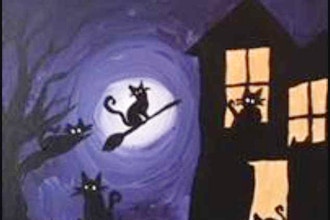
The night was a strange paradox of light and dark. It was too dark to invoke images of the bright beautiful things. It was too light to provoke imaginations of the blissful obliviousness. The night was a white heat of the sleepless senses that kept taking in all seen and heard even after the provocateurs were long gone out of sight. This was maddening and becoming madder and striking the notes of all madness. Iris couldn’t sleep as the night was getting deeper and darker, and it was consuming every part of her in a great white incandescent flame like a funeral pyre that once engulfed Dido’s forsaken body and unfortunate heart. The senses that kept her awake besieged her glass castle without mercy and started to screen the scenes of sadness and more sadness as an apparition of the past narrated the story buried in its tomb without an epitaph. She was wide awake at the bewitching hour, and she was helplessly defenseless against the force of the hour.
Since she was a little girl, Iris has been going through the same nocturnal rituals of waking up at 3:00 AM on time, precisely, continuously, as always. Every single night was every single rite of this uncanny performance of sleeplessness – that is, exactly at 3:00 AM. When she wakes up, the electronic digits always show 3:00 AM with glows that seems to grow lighter the more she looks at it in fearful awe. Fearful because Iris has learned that it is the hour when the gates of the underworld, the netherworld, the world beyond are open, and the regions of faeries and wandering spirits roam the earth as witches fly to the devil’s banquets. Hokum it may be, but the bewitching hour also seems to include Iris as a coterie of the supernatural for what’s worth. This secret is hers and hers only in fear of being branded as a weirdo or a witch’s apprentice even. Yet, because Iris’s soft heart cannot bear a secret too long for its painfully tender fullness of emotions and feelings to keep it to herself, it now agonizes her sense and antagonizes her sensibility. And it was this night that got her to a paroxysm of inquisitiveness, inadmissibility, and ineffableness, enveloped in the mysterious veil of incredibility so enigmatically eerie that it almost felt infatuating with the unknown.
The magical hour was now in possession of the waken Iris with wide eyes, and the effect was smeared into every part of her body without a miss like ink instantly and ferociously diffusing in a glass of clear water. She did not like it, but her opinion was useless under the power of the supernatural hour. Iris wanted to break the spell and doing so would require her of facing another unknown mysterious force. Her Catholicism would defy her magical assumption on the incredible symptom, but Iris knew that her religion itself entailed the magical qualities of belief and that it was only natural for her to connect the dots between the two belief systems as a solution to her ghostly malady. That’s it. She can’t take it anymore, she can’t have it any longer. Forget the religion, and think primal. Iris has made up her mind to start her investigation of the supernatural phenomenon that she has been going through to find whys and wherefores.

If she is pretty, she is never lonely because she is wanted and loved. This much is truth, no? Beauty works a miracle in the eyes of a dull man without imagination and of a cruel man without tears. Oscar Wilde, who always had something to say about beauty, affirmed that it’s better to be beautiful than to be good because beauty captures your attention. So, if you are bereft of beauty, then you must work very hard to get people to know who you are. Beauty is indeed a joy for all seasons, rain or shine, and is also a privilege to be loved first before loving.
Judy always must be in love with someone who didn’t even know of her existence because the feeling of love would transform her from a plain Jane to a sultry Cleopatra as if a pixie had cast a glamour spell on her, pitying her denied sense of pleasure and detachment from a constellation of lovers. Judy, despite some flattering feedback on her appearance from onlookers, was always discontent with what she saw in the mirror that seemed to reflect her what she didn’t want or couldn’t see in her true self. She felt that her features were in want of spectacular beauty that would make herself loved, and her solitary disposition dipped in an exclusive flavor of selectiveness doubled the inaccessibility of the worldly sensuousness that even not so pretty or homely women were allowed as their feminine rights.
Judy was sitting like a pillar of melancholy at the dinner table embarrassed by the ordinariness of her appearance in the presence of handsome Fred who made Judy feel like an awkward wallflower that nobody would pay attention to. You would say she obviously lacked self-confidence, but self-confidence is also built upon the kind of feedback you get from others. Judy was a firm believer of existentialism which says that experience exceeds essence and of Robert Cooley’s sociological theory of “Looking Glassed Self” that you become the way how others treat you. Or you might say what she lacked in appearance could be compensated by her intelligence, wits, or those other “inner” qualities, all of which she did possess. But let’s be honest, my dear readers. Beauty is the power and the wisdom of women regardless of leaps of times, distances of places, and differences of races. Any man- rich or poor, bigoted or liberal, young or old- loves a pretty woman and will act on his best behavior with kindness. Likewise, Judy, who was not drop-dead gorgeous, always kept herself guarded with a stern look at the sight of a man who might be unkind or curt. However, Fred was different. He was being very affable to her with a genuine smile. This time Judy wanted to claim her right of happiness and make her existence visible to her figure of love, so she secretly wished for a glamour spell to change herself from an insignificant wallflower to a beautiful rose that would make Fred crazy about her.


You must be logged in to post a comment.