
The curious cat wonders
On the top of the glass palace
If he can touch the finny faeries
With an eyeful of curiosity
Thinking curiouser, curiouser.
The curious cat wonders
On the top of the glass palace
If he can touch the finny faeries
With an eyeful of curiosity
Thinking curiouser, curiouser.

When my eleven-months old cat Toro started drooling in white foams last Wednesday evening after swallowing a tiny flying insect in my bedroom, I was in a panic. I called nearby emergencies, describing the state Toro was in, but they told me his symptoms were not regarded as critical. Instead, they told me to monitor him, so I did. He stopped drooling the next day and drank a lot of water. Nevertheless, my concern was still growing, doubled with regret that Toro should have met an owner in a vast, spacious home with that which would make him happy. The pang of grief punctuated my already broken heart, and I was distraught.

Luckily, a vet to whom I had previously taken Toro for his difficulty in excreting in Little Tokyo said she could see Toro on Saturday morning. The waiting period until the appointment was an ordeal by the torture of the heart. My spirit was sunk in a sea of sadness, blaming myself for not providing Toro the optimum environment to thrive in his best feline nature. The bedroom is so tiny that it is more of a den, and the living room where my elderly infirm mother spends most of the day intermittently is off-limit to Toro by keeping him alone during the day when I am working. My evening playing with him might probably bore him to death because my lack of creativity fails to invent more stimulating kinds of play that will perk up his energy. I cannot help but think that I am becoming a bane of Toro’s existence, the cause of his unhappiness.
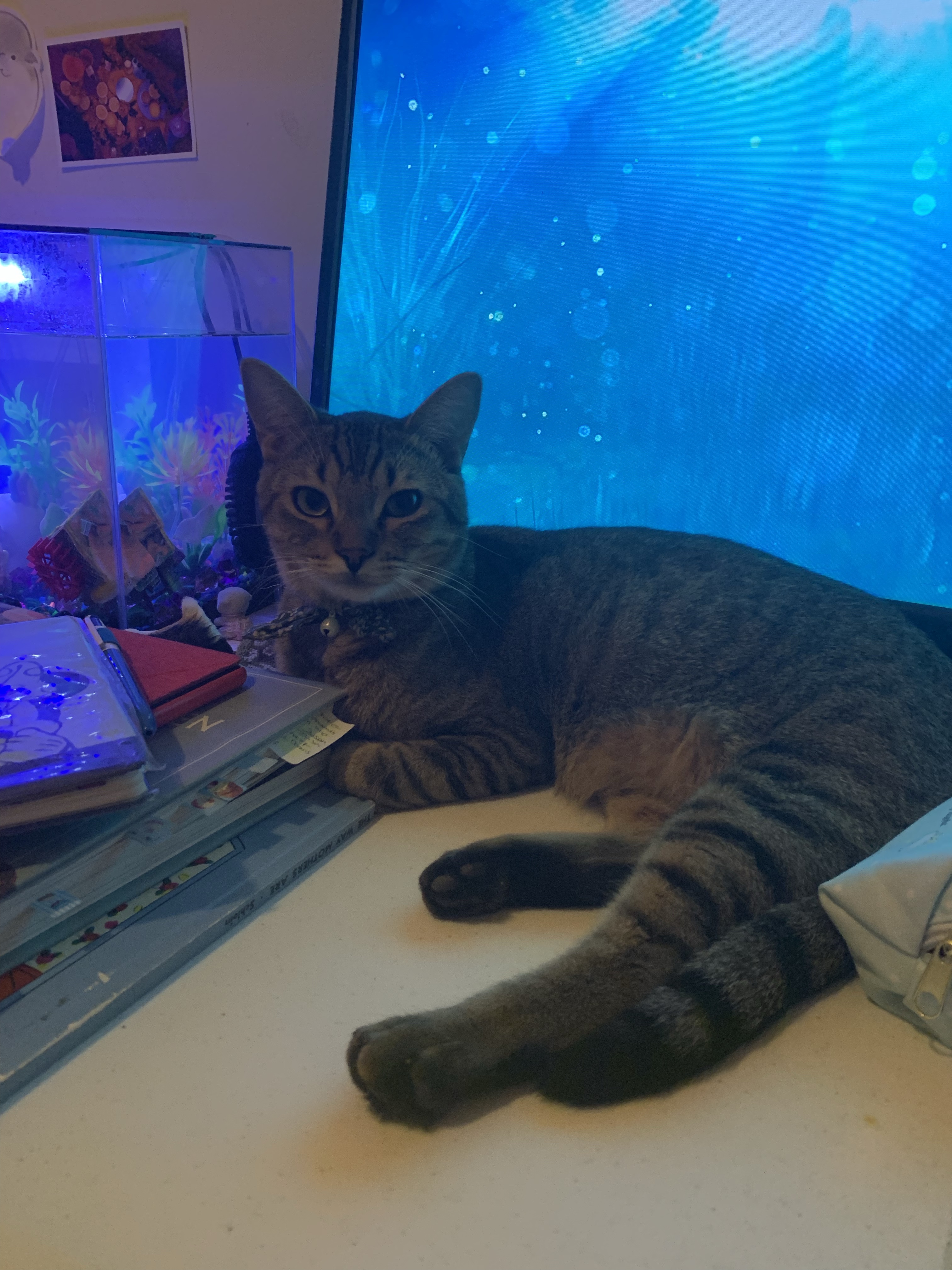
To pour lead on my open wound in the heart, when I finally took Toro to the vet on Saturday, she diagnosed him with idiopathic cystitis. She showed me a scanned copy of Toro’s mildly swollen bladders with information on the illness caused by stress. That’s it. The diagnosis realized my imagination and shattered a slim hope of something other than STRESS. I see all the cares I had given to Toro as best as I could beyond my measure by taking him to vets and telling him how much I loved him as much as I could dissipate into the elusive dreams of my little happiness with Toro. My happy moments with Toro vanished into yesterdays, bidding farewells to tomorrows.

It’s been a week since the diagnosis, and now Toro has changed. Toro now hides under the bed, doesn’t come up to my bed, and avoids me when I am home. Besides, he doesn’t eat as much as he used to, about which the vet told me to be patient because that could be the effect of changing his prescriptive diet from gastrointestinal to urinary care. What is strange about his sudden change of behaviors is that he was never like this from his previous visits to vets. Come what may, Toro seems to be unhappy, and I am very downtrodden for his changed behavior. He was the only one who showed me his affection.

I still remember his adorable, curious big eyes peeping out of an opening from a box carrier when I brought him from Ventura Animal Shelter last August at the age of nine weeks. Purring and kneading are long gone. My reason suggests that re-homing Toro is the best I can do for his happiness, yet my heart tells me not to listen to it and look for another place for a better living environment. Nevertheless, I yield to my heart’s voice and want to believe that there is still hope for us to be happy in a better living condition. I hope to see mirth wonton around us and happiness sparkle before our very eyes soon.

Like muffled drums in rains of thunder and lightening, her heart was still beating as the intuitive leap within her was on the verge of falling into the crevice of darkness. She hoped that life would be better or that if life wasn’t unresponsive to her hope, she could seek an elbow room in her writings blog, her glass castle of the soul. In this regard, her purpose of writing and that of George Orwell agreed that it was for sheer egoism of being an individual and recognizing it. For all she had read and seen, her spirit wanted to record it in writing before leaving the world without a trace. How pathetic it would be!
If only. The girl hoped to articulate her thoughts to the unseen public somewhere out there. But above all, the girl used her writing practice as an autodidactic exercise to improve writing skills in the language she fell for. She loved the English language so much that she was ready to forsake the native language if she must choose one. She would have wished to possess the art of English Writing if a benign fairy had asked about what gift she would want. Perhaps she would have made a Mephistolean pact for the craft. Yet her love was alone because she loved the language more than it reciprocated the appreciation to her. How cruel it was!
To pure lead into an open wound, the girl realized her brain was not as alert as it used to be in the locomotive of thinking. As thoughts shape language, she reasoned that a slowly deteriorating neuroplasticity in her brain might have contributed to her difficulty in reading and writing. Something ominous was happening to her, and it was gripping her spirit under its diabolic aegis for the sheer pleasure of tormenting the soul in hopelessness. Words she saw refused to make a coherently complete sentence and enter a faculty of thinking. The circuits to the control center of the brain felt blogged or damaged to the point of making telegraphic phrases swiveling at a vortex of frustration. It had never happened until last year. But why was it happening to her? Alas!
She tried to find reasons for the ghastly maladies and self-diagnosed the following:
She further decided that the existential frustrations were exhausting her will to essay her creative and experiential values in fulfilling her meaning of life to be expressed in writing. All of it was tantamount to the enormous boulder Sisyphus had to roll up on a steep hill in Hades as punishment for his trickery on gods. But the girl was more akin to a Caryatid, a sculptured female figure used as a pillar supporting an entablature of a building on her head.
But what then was her solution to untangle the web of the menacing spider? She had nothing but her will and resilience born of eruditeness and level-headiness. It helped her sail through some of the difficult adventures between the Scylla and Charybdis in her life’s odyssey. Like an earthling who never gives up hope on getting a signal from an extraterrestrial being via radio transmission, every day, she would write even if it would receive no response. Thereby hangs a tale told by a mad girl in hopeless love with words, full of words and madness, but signifying something.

A dreamer’s shadow in search of the star
It had seen falling over the mountain
Met a stranger’s shadow with a star
It held in the hands, brilliant golden
And asked it wherefrom.
“Over the mountain, and nowhere else.”
The head collapsed, the heart shattered,
A dreamer’s shadow at one fell swoop
Flied to a stranger’s shadow in heartbeat,
Grabbed with its hands the star, brilliant golden
and swallowed it in pride of lions anon.
The star entered its heart’s chamber,
And the shadow became a fire demon.
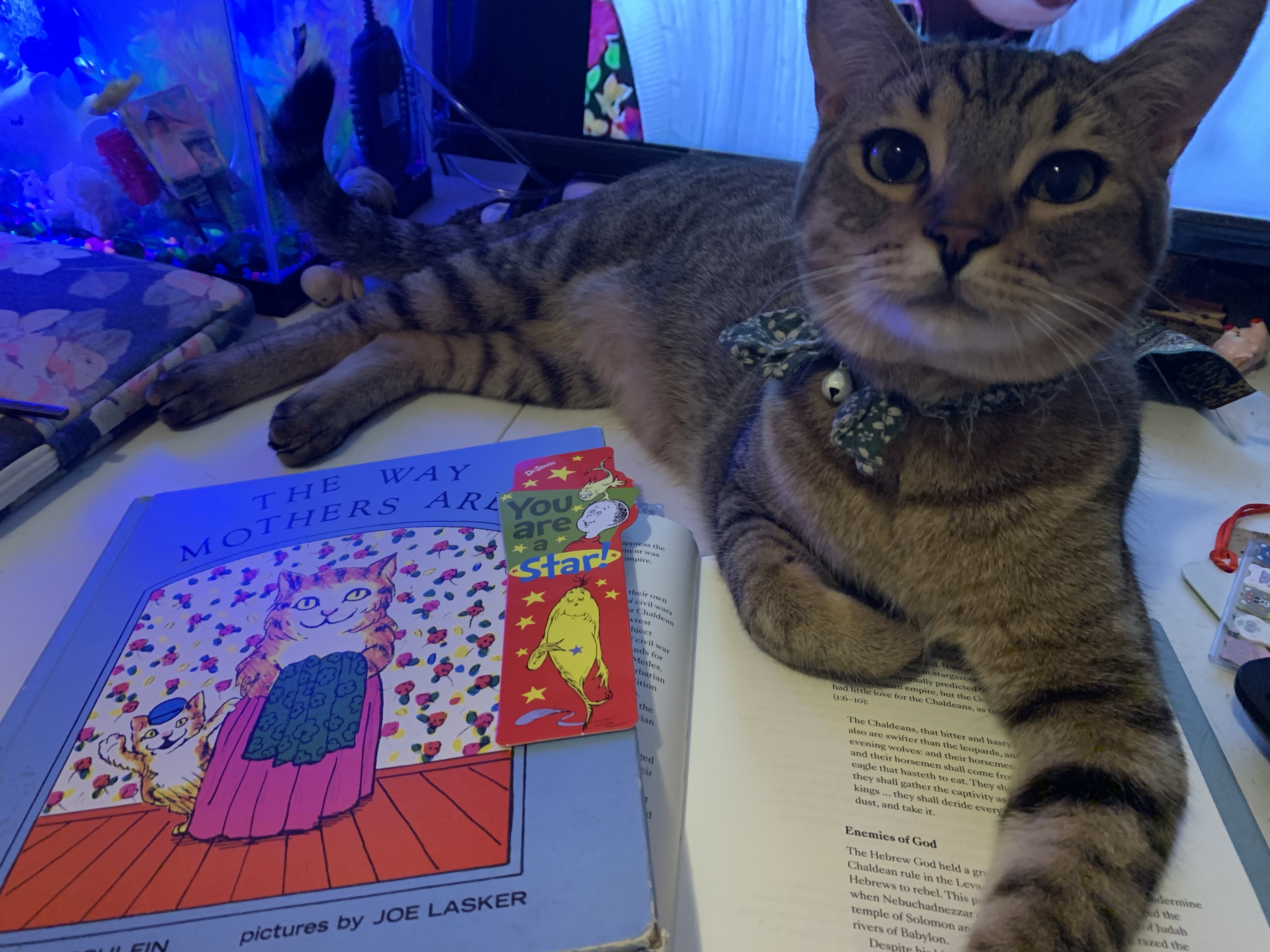
Nietzsche’s theory of Immanence is about intellectual kind of love of God, Agape, through an elevated perspective of God’s existence manifested in things great and small. That said, this vintage book about unconditional motherly love, first published in 1963, is a charming adaptation of immanence translated in simplicity of language in speaking “charity,” which also means love, as it is derived from “Caritas,” meaning “dear” in Latin. It is a kind of love that Mother Teresa expressed to all, discriminating none to prove superior level of love. And it is this love that Mother Cat has for her son.
The story of the Tabby Cat Mother and Son reads like a poem. Also, the book has adoring illustrations delineated with admiring details on the backgrounds: the wallpapers of rooms, the feline version of Mount Rushmore’s Great Faces, and the carved decorations of charming furnishings – all heartwarming elements that are so fitting to this book about love. The son asks why his mother loves him even when he is a little urchin to his younger sister and is naughty all day. The mother tells him full of affection that she loves him because he is her son and cares for him for who he is, not what he does. The son cat tries to reason his mother’s love for more innocent questions rather than nagging but then finds that the reason she loves him even in his least desirable behavior is lovely. The epiphany of true love also reminds me of Marilyn Monroe’s saying that if one cannot love her in her worst self, that person does not deserve her love. It is not a blatant egoism of a Tinseltown celebrity, but the truth about unconditional love, which is not synonymous with Eros on the heat of passion.
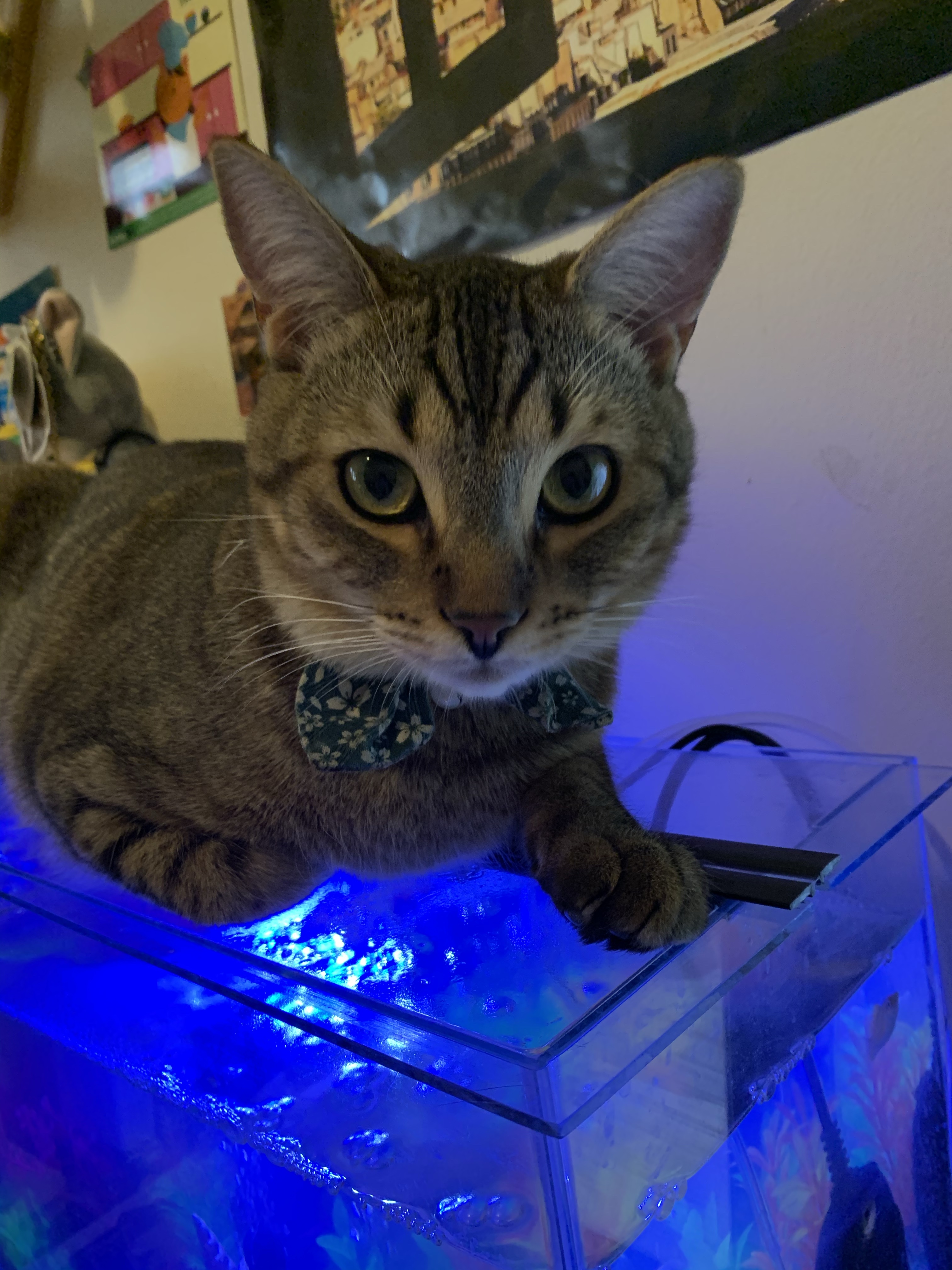
It is a story for all ages whose inner children refuse to grow beyond the evolutionary scale of time. Mark Twain, Lucy Maud Montgomery, and Walt Disney had never outgrown their childhood whose childlikeness became all the more radiant and illustrious with their boundless imaginations conjured in the alchemy of the arts. On a personal note, When I saw a tweet about this book, the forever child in me urged the grown-up me to get it because of the adorable illustrations of the Tabbies reminding me of my tabby cat Toro. I wonder if Toro’s mother might have looked like the Mother Cat because the son cat takes a solid resemblance to Toro. So I read the book to Toro, and he seemed to like it, starting to close his eyes on my desk and then purring softly. And I understand Mother Cat’s love for her son because that is how I feel for my little Toro, whom I adopted when he was nine weeks old. Now he is 11 months old, and although he is a sweetheart, his occasional Zoomies and forceful nibbling surprise me. Still, Toro is my cat. And I say to him every day thus: “I love you, Toro. Never forget that.” I know how the mother cat felt for her dear son.

The Fugitive (1993) is an adventure and a drama cleverly put together by the elements of popular entertainment and thought-provoking thematic subject of human nature in dealing with the malice of fortune. It consists of elegant scripts, solid storyline, and outstanding performance of the already cracking cast with Harrison Ford as the Fugitive and Tommy Lee Jones as Senior Deputy U.S. Marshall. Brilliantly, veteran actors do not vie for the best shot of cameras to claim the title of Hollywood aristocracy. Still, they only do their very best to portray their roles as possessed by their fictional characters.
Ford plays the role of a renowned cardiologist with the brain and the heart to care for patients in need. Then one day, the doctor finds himself on the run for the crime he didn’t commit, and above all, for the love of his wife. He has to find who killed his beloved wife, and the Marshall played by Jones has to catch him alive because, well, it’s his job. So much so that when the doctor confronts the Marshall face to face within an arm’s reach and tells the latter that he didn’t kill his wife, the henchman of law says, “I don’t care!” But the marshal isn’t all grim-faced reaper of death hell-bent on capturing the Fugitive, which makes him hard to dislike. Both the Fugitive and the marshal are alike as the mythological Teumessian Fox that never gets caught and the Laelaps Dog that never fails to catch, whether they like it or not.


Harrison Ford is one of the greatest American actors whom I think belongs to the last 20th century’s Hollywood nobility of actors, including still alive Clint Eastwood. He has the face of a romantic adventurer, an intelligent doctor, an ambitious corporate man, and a no-nonsense prosecutor. From the galaxy far away to the offices in cities, Ford is a protean actor who can pull out the characters as if conjuring them from his grimoire without trying too hard or with overtly effusive sex appeal. The emotions wanting to outburst are nuanced in the power of his voice carried in the elliptical words. He is an action adventurer who seems so natural living in our real-world yet so ideal on-screen, making us wonder whether life imitates art and vice versa.
The Fugitive is worth watching again if you want to watch something smart and thrilling to forget about the momentary existential dilemma or frustrations. The movie is at present for free to view if you are an amazon prime member. It is a one-of-kind American movie that has become a classic of our own time, and I wish there would be more movies such as this.


You must be logged in to post a comment.