“I’ll teach you differences,” said King Lear as his motto of philosophical investigations in Shakespeare’s eponymous play. I imagine the ghost of King Lear would utter it again when he deigned to come to our realities of universities in this time. The importance of responsible education to remove the social ills and carbuncles resulting from dissentious political domination has never been more conspicuously called for in our high learning institutions as a recent consequence of the George Floyd incident, and the following the Black Lives Matter movement. However, this doesn’t mean that universities should be a breeding ground for training gladiators equipped with political syllabuses and dogmatic agendas to fight against the public foes. Instead, education should disabuse the ignorance of the unenlightened for our society’s universal betterment.
Professor Benjamin Y. Fong, in his NY Times article “Teaching Racial Justice isn’t Racial Justice,” addressed the issue of education as the fighting tool. It has become fashionable that most American universities have competingly added courses on social injustice to the Black Lives Matter movement. However, the idea of education is to provide students opportunities to learn and actively engage with conflicting thoughts and various real-life issues in a place enriched with knowledge linked with the fellow members of the human race from antiquity. In this environment, a university is a place for education that can improve social conditions in the fight against social, political carbuncles, not for the battle itself, training students for social gladiators.
Many universities are focused on the quantitative quota of educational syllabuses aimed for the universities’ reputations as the most liberal and forward-thinking higher-learning institutions for the socially recognized prestige, not the qualitative aspect of the education of the minds. It is not the textual syllabuses filled with political ideologies and social campaigns. Still, the practical teaching of various conservative and progressive considerations enables students to incorporate the learning to their perspectives. Education serves to articulate ideas based on the standard of reason and taste universal in all human creatures regarding the principles of judgment and sentiment common to all humankind.
Suppose we want our higher learning institutions to remedy the existing ills of our social and political realities by implementing more social justice courses. In that case, we must first understand the fact that education itself is not the fight itself. Neither Plato’s academy nor Aristotle’s lyceum was a place for the battle against the absurdities of Man. Or even the beloved, peripatetic Socrates did not use his open universities in Athens as a place for campaigning against the government hostile to his philosophy. Remember that there is no new thing under the sun as long as we as the collective enterprise called Humanity continue to voyage in the Universe.

Tag: society
-
Let Children out of Politics.
There has been a vortex of fiery opinions on the controversial Netflix film “Cuties,” directed by French Senegalese Maimouna Maimouna Doucoure as her debut feature. I first heard of the movie while checking on Twitter feed filled with vehement subjective narratives divided -yet again-by the in-vogue trend of racially charged political views, which seems to blur the ambit of art for art’s sake appealing to the universal audience. But the unified viewpoint on the provocative representation of sexualized pre-adolescent girls weighs against the film’s thematic slogan of liberation from oppression, come what may.
The movie has gained a cult status among self-professed progressive keyboard warriors, defenders of social inequality, when in fact, they are seldom in contact with the people they speak for or even get together in their daily lives. That said, the movie has become something of a visual manifesto of social activism, rather than a joy of cinematic experience that bestows a sensory pleasure and mental piquancy on viewers. No pornification and the misguided display of sexual oppression in children’s figures can be sublimated into art. Children are not a medium of political efficacy or a vehicle of personal ambition. The sexualization of children imitating adult acts is counter-productive in translating onto screen per se the socially disfranchised class consciousness in a highly secular society where the income level defines individuals’ worth. Little girls in skimpy attires, gyrating and eyeing in a way that makes them the cult of Ishtar at a Babylonian temple where girls offer their bodies to strange men for holy prostitution. Or shall I say it is a revisionist adaption of “Pretty Baby” or “Lolita” directed by a black woman whose directorial debut is undoubtedly impressive and provocative in the BLM wake?
It amazes me to see people think themselves rational and reasonable when they are just self-professed egoists illustrated with their ostentatiously abstract view of social reality that seems to be out of touch with their own class. They regard “Cuties” as telltale cinematic radical feminism and socialism with a view to liberation by the parody of the reality. However, these intellectuals oversee or willfully ignore the truth about human nature: physical, rather than metaphysical; it is tactile rather than theoretical. Our faculty of mind is affected by the works of the senses and of the imaginations. To this effect, ‘Cuties” will adversely affect people’s judgment when their eyes direct toward the visual feast of perverted pleasure because the impulse, when arisen by stimuli, defeats Ego, voids the Superego, and commandeers false promise of liberation with rapacious sensuality.
-
vertigo – chapter eleven

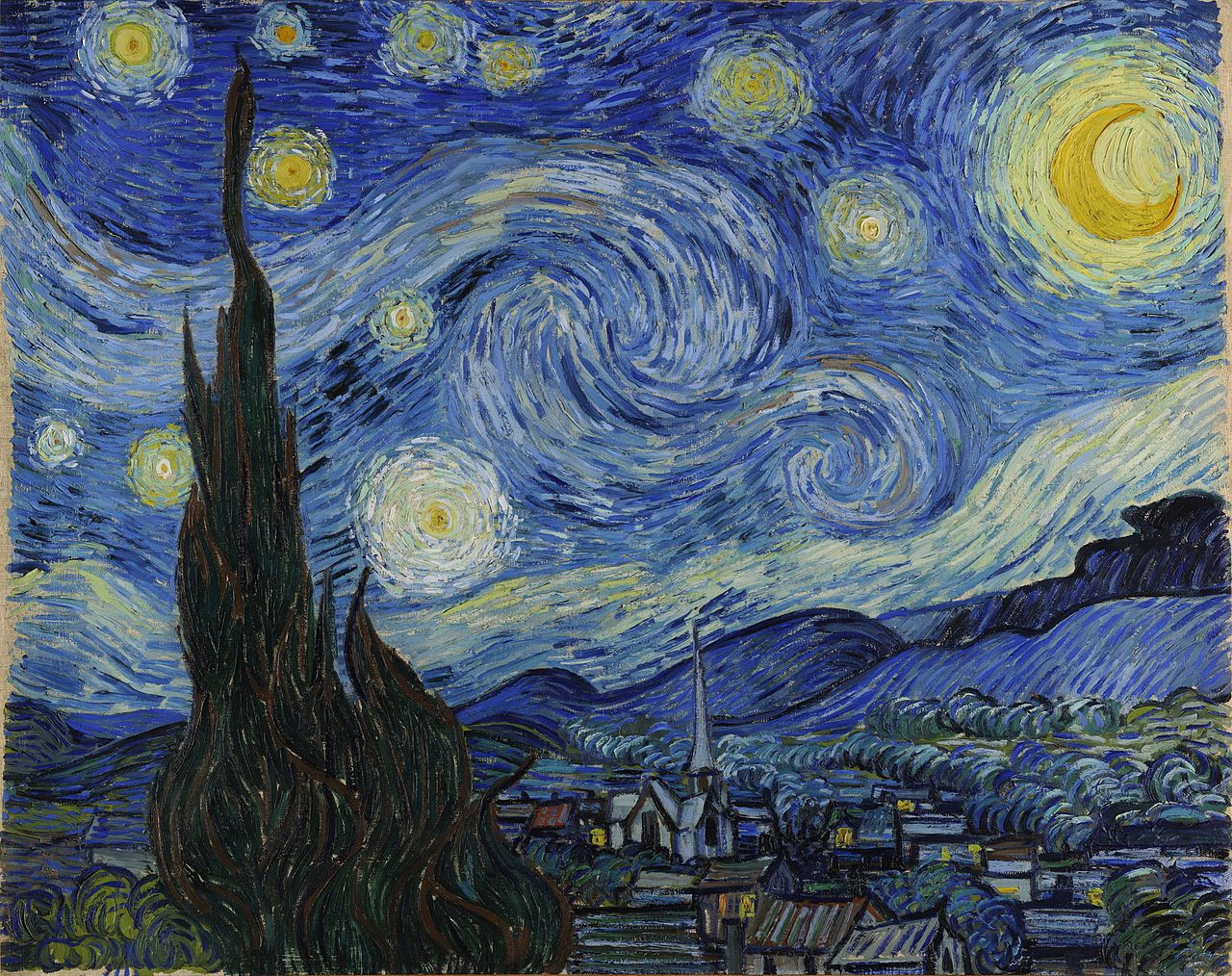
“Starry Night” by Vincent Van Gogh It is the star above her that governs her conditions. Iris knows that the fault is not entirely in herself but mostly in the lucky star that does not seem to know where to find its beneficiary. The star was born when Libra and Capricorn were met in the house of Aquarius on the nineteenth hour of a blustery snowy wintry night. The star hangs on the vault of nightly celestial ballroom among the other stars twinkling merrily and boldly but alone in a corner of the limitless dome, twinkling ruefully and dutifully as if it were trying to signify its insignificant presence on the nocturnal cosmic stage. For this lone star has not found its beneficiary, the ascribed terrestrial hair of its power, and without it, the star cannot become a lucky star. Which is a tragedy for both Iris and her star.
In fact, Iris’s existential frustration or noogenic neurosis agrees to what Shakespeare was suspected of harboring in all his life. Surely, the Bard was a very successful playwright and poet who marched in a parade of famed hits in his time, but he was wrestling with a doubt whether it was Fate or Freedom of Will that governed human lives as conveyed in his works, such as “Julius Caesar”, “Othello”, and “Hamlet”. The characters of these plays fight for their causes as masters of their fates, but the consequences are not entirely fortuitous in bliss. That’s why the Greek soldier and historian Thucydides regarded vain hope imbued with a paroxysm of flattering confidence and blind devotion to the law of attraction as a dangerous hubris to one’s philosophy of life.
Hope plays its role as a morale booster when one sees it as a card of chance in awareness of odds in one’s favor. In this manner, one does not have to think about it but can fight with every hope of winning. This also relates to a principle of Logotheraphy: the less one cares, the more one can without stress for success. But alas, my dear reader, to pour lead into the wound, all the aforesaid needs luck as the Bard chips in thus: “There is a tide in the affairs of men, which taken at the flood, leads on to fortune.” A tide of the deep wide ocean of Life that arises from the heart of the ocean to surge in bounty of fortune to a weary wayfarer on the land is what Iris has been waiting for till now.
All this thought, all this doubt about her so-called life – the existential frustration- are vexing her mind and crippling her faculties of the mind like vermin, so much that she feels utterly disoriented and deserted in the crossroads of life. The faith she has begun to lose with reasons justifiable only to herself, meaning of life she still hasn’t found, Iris finds herself lost in the Labyrinth where the Minotaur is roaming around to find his prey. And she does not have the hero Theseus nor Ariadne for help. Iris must find the way out anyhow for her dear life. But one thing is certain my dear reader; that although fortune’s malice or absence might conspire to overthrow her state, her feisty and recalcitrant mind will eventually exceed the compass of her will of fortune with a triumphant laugh.
-
‘In Pursuit of Civility: Manners and Civilization in Early Modern England’ by Keith Thomas – review
In Pursuit of Civility: Manners and Civilization in Early Modern England by Keith ThomasMy rating: 5 of 5 stars
We live in an age of casual manners that would alarm the folks who still remember when letters and rotary telephones were the prime means of communication, not to speak of those in days of yore. But the leniency of manners is not a thing of our age, but it has been constant of every age as a note faintly scribbled on a tablet discovered in an ancient Roman archaeological site reveals, “Today’s kids are rude imps.” Which also brings us to the ensuing questions of what defines civility. Does civility equate submissiveness with anachronistic fogyism and therefore must be overruled with unrelenting individualism? Keith Thomas’s In pursuit of civility delves into the history of civility in England in an attempt to reach the subjectivity of civility as a universal social cohesion to live harmoniously as citizens of the world.Civility is a tacitly agreed social duty, a state of refinement equivalent to one’s moral character that subsumes civilization in its widest sense, opposite barbarism, a primordial state of beastliness dispossessed of all things antonymous with humanity. Originally derived from the Greek word, “barbarous,” meaning a person whose speech was incomprehensible, a dichotomy between the civilized and the barbarian has retained its rhetorical utility throughout the centuries: Civility is of good manner and good citizenship, whereas barbarianism denotes vulgarity, ignorance, and violence. Thomas discourses that civility as the crucial index of a country’s social harmony and political stability has set a template for a leviathan module of defining civilization, the end product of cultural, moral, and material condition of the civilizing process. That is, where civility reigns, there is civilization and therefore humanity. For civility sprang from a necessity of communal life rather than from an abstract ideology to subjugate the unseemly at the low rungs of the social ladder. Surely, the aristocrats refined a distinctive code of manners as the merit of the elites to distinguish themselves from the melee, but in a wider picture of a society, civility was a must to make all lives easier to live as they, especially the middle class and the working class, strove to progress by being interdependent of each other for economic gains. Thomas points out that intensive labor raised people above rude and sordid barbarism and begets arts by which human life is civilized because productive, labor-driven industry is the bedrock of civility from which economic, artistic, and intellectual benefits ensue.
Thomas unpicks that nowadays politeness is synonymous with effeminacy, acquiescence, servility, foppishness, kowtowing, even, as opposed to the fierce slogan of “equality to all.” Politeness is politically and socially and liberally misconstrued as a weakness of character or diffidence of self-esteem or an exotic cultural custom. People misidentify politeness, a set of good behaviors as servility because they are foolishly led to a belief that politeness is an anachronistically incoherent legacy of the racist conservative history of the past that they must thwart with full force and effect. However, Thomas benevolently keeps us in a positive light in this vacuum of civility by saying that what we have these days is “a new and more equal form of civility,” which indicates that we as a collective human enterprise is not retrogressing but progressing toward the better future if we understand that civility is as important in an egalitarian society as in a hierarchical one by learning to disagree without being disagreeable. All in all, this is a highly informative read accessible to the general reader who regards politeness as sweetness of the mind and who extends it to all humankind as a citizen of the world.


You must be logged in to post a comment.