Tag: thoughts

  • still now and then

    There is an excellent article in the newest issue of BBC History Revealed about how the Industrial Revolution has upended the fundamental social and cultural structures of the world as the French Revolution has changed political and economic systems of the world as we take for granted nowadays. Epochal changes are a juggernaut of our human civilizations as a process akin to a caterpillar turning mulberry leaves into fine silk despite seismic transitions ensuing from such transformation. A terse army motto of “No pain, no gain” rings true as a universal objective reality, whether or not you embrace it with open arms.

    Yet, amid the mountainous waves of indomitable revolutions and a Levitan that dictates new norms and conventions in every aspect of life from clothing to parlance, one thing never changes, and that is a life of a worker, spending most of the day outside the home with strangers for livelihood. For instance, a person whose labor is paid is not entirely free from the whims and caprice of the employer for fear of losing jobs. There are still employers whose common sense is inconsistent with the progressive minds that today’s employees are not modern-day indentured servants or maids, if not those ancient slaves under Roman mastership. It would be anachronistic and unfair to compare the slaves with free citizens working for money, but a provision of service for subsistence puts the progeny on the same continuum.

    Come to think of it, now I know why neurologist/psychiatrist/linguist Steven Pinker, aka the Rational Thinker, disagrees with Descartes’ dualism that the body and the mind are separable and Rousseau’s theory of the Blank State of the mind. We can’t be all workaholics without being personal, like cyborgs at work. Maybe that’s why nowadays, many self-checkouts have proliferated in retail and manufacturing sectors. Mind you, that the Luddites were not brute, ignorant anti-machinists destroying the factory machinery in 19th century England. They were somewhat naive angry workers who repelled against the sordid working conditions they were placed like human-like automation. The class distinctions demarcated by the types of work have become new social hierarchy even after the revolutions as aforesaid.
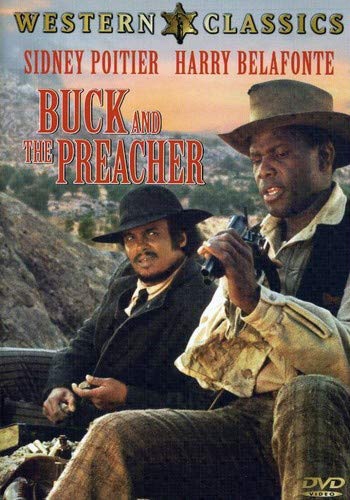

  • ‘Buck and the Preacher’ (1971)

    Rousseau’s dictum of “Men are born free and are chains everywhere.” fittingly describes the condition of what it means to be free from slavery after the Civil War. Even so, freedom was recalcitrant to belong to them, and the hardships that came with the price of liberty from the carnage of the war still beset the newly freed along the trail of exodus to the new promised land in the west as articulated in Sidney Poitier’s classic western film “Buck and the Preacher” (1971).

    Buck (played by Sidney Poitier), a former Union sergeant turned scout, leads a wagon of freed blacks from Louisiana to the west, where they hope to start their new lives without a shadow of slavery. But alas, the shadow of slavery still haunts them. It is up for grabs in the form of renegade ex-soldiers, probably both of the Union and the Confederates, hired by the former enslavers to bring the migrants back to the chains of slavery. They attack the wagon, rape women, and kill the old and the young, constantly intimidating them to return to where they belong. But the pain of loss and death is even less painful than the thought of returning to the past, and the journey marches on. Buck protects the journey, and the self-proclaimed preacher conman artist (played by Harry Belafonte) a former slave, chimed in, despite his original ulterior motive of money-gaining. This unlikely dup proves to be something of Moses and Aaron, so to speak, in a way that they guide and protect the persecuted people from the sordid bondage to a new promised land even if it takes a nearly decimal lot.

    Then there are Indians across the wilderness as gatekeepers to the land of freedom. They are no outsiders to the persecution with their land taken away and their very beings threatened to decimate. The Indians live by the toll fees migrants have to pay when crossing their territories, not the least due to the paucity of livelihood resulting from the government’s confiscation of the land. When Buck implores the tribal chief to help them against the white attackers because they are all brothers, the chief retorts him by saying, “But black people also fought against us with the whites.” The mistrust is natural, as is the confrontation of the two peoples whose rights are put to contests orchestrated by the forfeiter of the rights. The class consciousness between the Indians and the blacks needs a manifestation of shared injustice and empathy, which both of them attest to an objective reality where they prove to be on the same side.

    This film is one of the great Sidney Poitier’s and finest as I have been watching as remembering this brilliant actor who has recently died. Always poised with a commending presence filled with natural confidence and will without being febrile and vociferous, Poitier exudes his irresistibly graceful charisma on screen in this memorable Western about blacks and Indians, who are often seen in the peripheral characters contributing to highlighting main white characters. But this is not a revisionist Western at all to polarize the thematic elements of the genre. Hardly so. Instead, “Buck and the Preacher” is an eye-opening Western film about the peoples who are likely to be cast as outsiders even if they also rightfully belong to, to quote Lincoln, “the family of freedom with a jewel of liberty” called Americans.

  • Birthday

    Today, whatever the Fates weave
    Shall still be worn with beauty by me;
    Today then don’t let you be told,
    How many chapters of life are turned;
    That you are old, and so I am indeed;
    Nor think dreams have waned with tears,
    And talk of the youth wasted with sighs.
    Tomorrow will always be tomorrow
    And nothing will change, even sorrow.
    But a thought from reason brings the truth
    An everlasting and brilliant truth,
    Which can, in spite of all smirks,
    Open your eyes and my ears
    To the evening star twinkling bright
    With sweet soft winds fluting in the twilight,
    Made of fire, spirit, and dew.

  • Wanderlust

    For one hundred and twenty years
    Trapped in the maze of this mirage,
    Where I began, I can go back never;
    Here I stand and face the bare fate
    Or is it nothing but the illusion ever?

    As Aurora releases the first dewdrop,
    I go high over, down under
    From one end of the horizon to the other
    Across the five continents and six oceans
    Above the heavens, below the abyss
    Far into the milky ways and back to earth
    with the jewel of hope in beatitude.

  • ‘Enlightenment Now: The Case for Reason, Science, Humanism, and Progress’ by Steven Pinker

    My rating: 5 of 5 stars

    Gods may be crazy, as the tribal men thought when they picked up a bottle of coke dropped from an airplane. But the world is not crazy and will not be crazier unless you wish it. So you’d better lose faith in the doomsday industry that prompts you to think so because our faculty is intuitive rather than reasoning, rather physical than metaphysical. Steven Pinker points out in this book that we need rationality or a habit of rational thinking to aspire to objective understanding lest we should fall back on the doomsday scenario of a dystopian world.

    To begin with, the enlighten movement is not a product of the west but rooted in human nature as the universal feature. The spirit of the enlightenment movement is “Dare to Understand,” which means applying knowledge to understanding our world to enhance our human welfare to the full effect and force. Enlightenment is comprised of Reason, progress, science, and humanism. However, the currents of modernity flow into global populist tractions that champion totalitarian relativism from individual modes of thinking to social and political policy-making in the name of progressive liberalism or conservatism, when it is not with the absence of Reason and humanism. The proponents of the ideologies described above take precedence of faith over Reason, nation, or culture over individualism and metaphysical over real because they couldn’t care less about it.

    The most impressive finding that I have described from this book is Pinker’s perceptive analysis of the counter-enlightenment movements run by both conservatives and liberals, especially in the States. As many people might conjecture, Pinker is not an ultra-right-wing intellectual because his view on former President Trump and his cult is logically solid and intellectually revoking. He explains that the philosophical roots of Trumpism are a synthesis of a militant derivative of Nietzchean school of philosophy and anti-enlightenment humanism. It’s not conservatism but racism lite, shading into authoritarian populism and romantic nationalism, harping on the good ole days, which weren’t good in respects of the quality of living conditions and level of human rights.

    Amid the bipartisan world of ideologies, the heightened pessimistic opinions of our planet from the environment to social services, Pinker’s education on what Enlightenment means on human progress shines like a beacon of light on Slough Despond. This book gives the world a sense of self-confidence in our cultural progress this far as a collective human enterprise. The history of the world is not cyclical or linear, but progressive and in progress as long as humanity continues. It is this humanity that Pinker emphasizes in the truest sense of Enlightenment that the thinkers such as Voltaire and Kant also professed to be an inseparable element of human progress. Progress without humanism is not progress. Humanism is not a sign of shallow intellectual culture akin to pastoral romanticism or unproductive ideals. Humanism represents the sense, as science reason, which are universal human traits common to all. That is what this book wants to teach us.

    View all my reviews

  • New Odyssey

    Sail away to a new beginning
    sail away from an old harbor;
    Sail, Ship of Destiny, ongoing
    Across life’s wide oceans
    Thru the tides of fortune;
    The year has swiftly gone
    let her go, and look at the star;
    Sail away to the bright anon
    Sail away from the dark afar.