Tag: verse

  • Reading Book II of the Aeneid by Virgil

    Thursday, September 10, 2026

    I often wonder why God allows the ills of society to persist and their victims to suffer violence for no reason. What are the sins of children who suffer such violence? Why can’t he care more about changing the fates of these children? The same question arises through Aeneas in Book II when he sees his beloved Troy burning and, with a yearning heart, seems to demand an answer. If fate requires suffering, what is fate? Is God truly omnipotent and omniscient?

    Book II is Aeneas’s ballad of burning Troy—the story of his fate, which does not allow him to enjoy the ordinary life of a married man. His life doesn’t seem to be protected by the gods, even by his divine mother, who appears to her son as Venus, not as a mother. They force him to fulfill sacred pietas by carrying Troy’s future to foreign soil, where his descendants will build Rome. He tries to resist their gambit on the chessboard, where he is their number-one knight, moved around at their pleasure. Even his mother Venus is part of the divine ilk and hurries him out of Troy like a mom sending her son to school before it’s too late. In Aeneas’s mortal eyes, the idea of becoming the forefather of Rome appeals to him less than being a husband, a father, and a son at home. Can even his divine mother protect him from this fate?

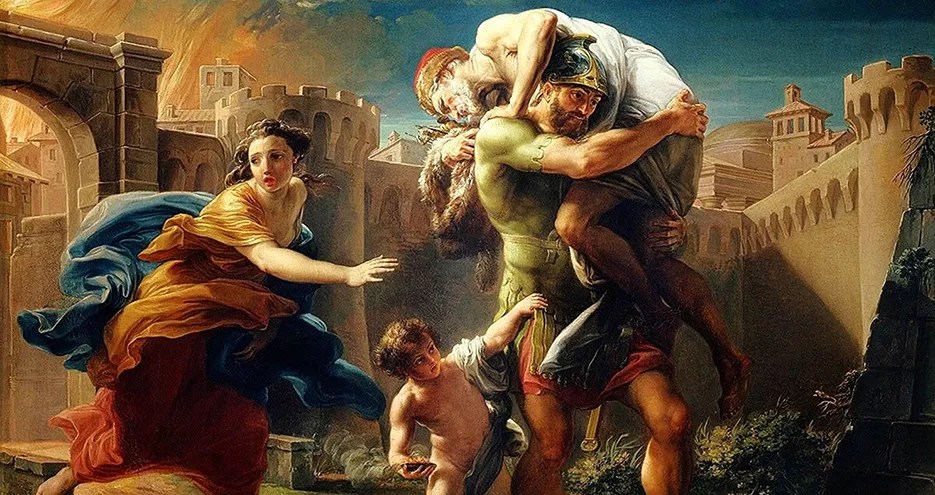
    Gods are cruel just as God is cruel. They make his life easy only when he acts according to their will. Without the gods’ command, Aeneas would not have thought of fleeing the burning city with his elderly father Anchises on his back, his little son Ascanius at his right hand, and his wife Creusa following behind. But then Creusa must stay away from her husband, who has a duty far greater than his personal life. Her ghost appears and tells Aeneas that he must leave; as she vanishes into the folds of mist, all his chances of escaping his fate and its burdens vanish with her. He has no reason to stay but must move forward against his will.

    The Trojan Horse, Laocoön and his two sons engulfed by the sea serpents, and the cries of Priam and his wife Hecuba all signify the great labor of birth in the process of dying, all within the fate of a man who must act out his assigned role in the divine chess game.

  • About Writing

    I can’t think of myself just simply vanishing into the passage of time, becoming a tribe of the forgotten. I don’t want to leave this world without a trace of my existence. That is one of the reasons why I have been submitting my work to journals and my first poetry chapbook since last May. Before, writing was my soliloquy in which I wallowed myself away from the cruel reality where God was unkind, let alone people. However, things have shifted for me. Now, it’s different. This is a time of striking hard when the iron is hot. And boy, is my iron so hot that I can’t hold it any longer.

    My first chapbook, “The Glass and the Flame,” consisting of 40 poems, was submitted to a couple of presses last week and this week. One of them required $15.00 for submission, which was quite costly considering that even if my chapbook were not selected, I would still have to pay the sum, just so the editors would read. Still, I decided it was worth it because I wanted to be famous. I want to mark my name in the aisles of bookstores from LA to Rome, to Paris, and wherever literate people live. Not vanity. Justice. My voice deserves to be heard. I write ache, loneliness, sorrow, and desire — with no shame. For whom should I feel shameful about expressing a free spirit in the language of beauty and truth? After all, even scholars have sex. No, my writing is not of Anaïs Nin. Instead, my writing follows the tradition of Anne Ernaux, Duras, and Sappho with the mind of Szymborska. Furthermore, elsewhere across the fields of desire, Plath calls for intelligent lust, which comes in the form of Eros in a purple cloak. And of course, Psyche comes in together. In the secret garden of language.

    I have received rejections from journals that tout themselves as publishers of so-called “intellectual,” “confessional,” “existential,” or “societal” poems that demand social activism. Writers are routinely defined by their social, racial, and cultural backgrounds, as if these alone drive their voices. For example, if you are a Korean-American woman from an immigrant family, you are expected to address prejudice and alienation, tinged with jingoism. The prevailing belief is that my race and gender are the only traits editors value — as if being an “exotic” woman seeking an audience is enough. God, when will they realize that, beyond differences, we share more in common?

    Maybe this is just a writer’s rant. If so, so be it. Nevertheless, I write the most universal human feelings about love and desire, about solitude and sorrow that any woman across all cultures, ages, and classes can understand. Forget the MFA writers. After all, writers do not need master’s degrees to be considered intellectuals whose work takes precedence over writers who have lived rather than studied.

    If this essay moved you, you can support my writing at Ko-fi: https://ko-fi.com/steph79650

  • The Poignant Loss: A Reflection on Absence

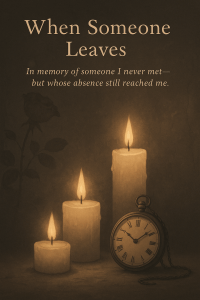
    I never stood beside him.

    Nor did my eyes ever meet his.

    But when I heard he was gone—

    forever, yesterday—

    a strange sadness fell upon me,

    like dusk after the sun has set.

    One soul less in the world,

    and silence filled the void.

    We will never see him again.

    His voice and face are lost to us,

    like an old photograph of the beloved

    set quietly aflame.

  • Living with a Ghost: Lessons from Loneliness

    I’ve been living with a ghost since I was a child. She doesn’t speak, but sometimes I hear her in the rain tapping on the windows or in the whisper of leaves rustling in the wind. When I gaze at the stars at night, she leans in and murmurs, You are alone. You are meant to be alone.

    Loneliness — that is her name. And she is the only one who has stayed with me all this time. I suspect she doesn’t like it when I make friends or feel happy. That’s when I stop listening to her and try to cast her out, like an evil spirit haunting me. But she seems to like my cats, Toro and Camille. Perhaps it’s because cats, too, are solitary and spiritual creatures.

    Come to think of it, some people don’t like cats — as if there’s virtue in disliking them. But many writers have lived with feline companions. Edgar Allan Poe once said his cat, Catterina, was his muse. Lucy Maud Montgomery was also a devoted cat lover.

    Loneliness doesn’t have to be your enemy. If you get to know her, she can help you notice the quiet details of life that others overlook or take for granted. In those everyday little things, you may find beauty — and a quiet joy in simply being alive to witness them.

    Ready to say hello to loneliness?

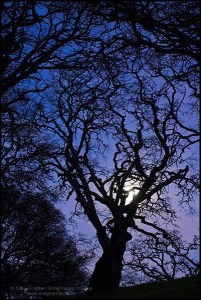
  • Oak

    Eeny, meany, miny, moe
    Who’ll spend the night
    Under the old oak tree
    To meet and greet the spirit
    From the world in-between
    And chase it all night long
    While heard but unseen
    Laughing then howling
    Till the first ray of the dawn
    Basks it in light and let it go.