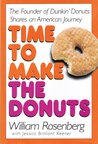
 Time to Make the Donuts by William Rosenberg
My rating: 4 of 5 stars
Before Starbucks claimed a monopoly on franchised coffee-houses around the world, Dunkin Donuts had been arguably one of the most popular American food service franchises in the States as well as other countries. With its signatory Munchkins and famous slogan of “American runs on Dunkin” presented by Super Mario-look alike Fred the Baker (although he retired from the public in the late 90s), the famous coffeehouse brand has made its mark on the American urban culture thanks to its straight-talking, no-nonsense founder William Rosenberg who drew up his case history of being a successful entrepreneur against personal all odds in this simple but admirable memoir written during his last days of life while succumbed to a cancer.
Rosenberg’s business philosophy of what works and what does not in business to share with the public forms the basis of this book whose inception was first conceived by encouragement of Mario Puzo, the author of The Godfather in the 60s. Straightforward and enterprising he was, Rosenberg’s sharing of his own experiences with the reader for altruistic motive without a sense of entrepreneurial machismo is traceable in every chapter. What he lacked in formal educational background because he had dropped out of school at age fourteen in the height of the Great Depression in 1930, was compensated by the simple but timeless tenets of achievements: diligence, persistence, determination, risk-taking, diligence, innovation, vision, and passion. Surely, all of the aforesaid seems bromidic, but oftentimes, it is these simple elements of life that we oversee as trifle and insignificant without pondering over Leonardo Da Vinci’s truthful adage: “Simplicity is the ultimate sophistication”
In fact, there are parallels that the reader can make between Rosenberg’s elements of success and the three values for meaningful life in Logotherapy, the third Viennese school of psychotherapy established by the great Viktor E. Frankl whose experience in Auschwitz was a testament to its veracity and validity of Logotherapy, which is to help us find a meaning of life by freedom of will and will to meaning. Throughout the book, Rosenberg emphasizes that it is what we do with the challenges that determine our failure of success because learning from errors is the sine qua non of success. Whatever the circumstances may be, a person can find a way to succeed, and it is attitude that makes it possible. Having a good-hearted but violent-tempered father did not stop him from going out of his way and establishing world famous Dunkin Donuts. This forthright attitude links to attitudinal value of Logotherapy signifying our triumph over biological, social, and cultural inhibitions during difficult times with a discovery of meaning of suffering by the way in which we respond to. That is, how we respond to challenges will make a heaven out of hell, a hell out of heaven.
Also, a sense of humor is a must-have for taking us a long way to succeed in life. “Work hard, play hard,” was Rosenberg’s mantra. Yet to put it lightly is to miss the gist of the meaning; humor is a prerogative of human that can help us take on a different view of life in a light-hearted way, so that we can be soundly assured that unpleasant things we may be going through are not everlasting and that they are occurring because there is a meaning to them. This, in fact, also relates to humor as a vehicle to turn our backs against emotional distress in life that may hamper our continuation of searching for a meaning of life. Whether or not Rosenberg might have been aware of Logotherapy in his lifetime, the reader will find at every turn analogy between Rosenberg’s business philosophy and Dr. Frankl’s Logotherapy.
Philosophy aside, there is plenty of interesting information on how the brand name came up with, the origin of Munchkins, and revolutionary way of operating the stores . To illustrate, the catchy name of “Dunkin’ Donuts” came from “You dunk a donut,” Munchkins, previously called Dunkin Donuts Donut Holes sold for 19 cents per set, got the name of a character from “The Wizard of Oz” with the right to utilize the name exclusively in the food service business. After all, the famous Munchkins have become a household name throughout the States and achieved a unique status in the food firmament.
This is an interesting read that the reader will find both practically helpful in applying Rosenberg’s elements of success to his own set of principles for betterment in life and entertaining to discover the history of the franchise in pastime. The reader will also find that the narrative will reflect the author’s artlessness, cleverness, and forwardness in this engaging book that matches its topic worth the writing.
 Amalfi Coast photo book, Italy (60 photos) : Europe series 4 by Akira Okubo
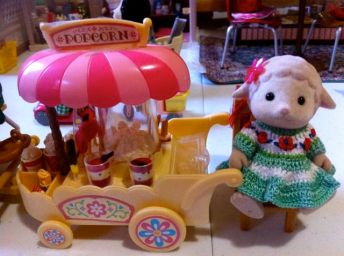
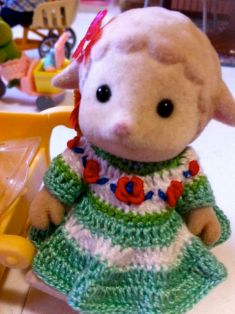 The proximate cause of the vagary of her state of mind is her inability to go to see the outdoor music concert held in Elusian Park today at 12:00 PM. It’s a classical music event in which her favorite Regal Philharmonic Orchestra will play scores of music from the Baroque to Romantic periods. According to a program Sally has read from the Calico Times, the orchestra will play her beloved “Brandenburg Concerto No. 3 in G Major” By Bach, “Fledermaus Waltz” by Strauss II, “Trumpet Voluntary” by Hendel, “Radetzky March” by Strauss I, and so forth. Sally’s soul leapt up with effervescent joy and her spirit sprang from the dormant mode of cultural activity upon reading it and wanted to attend the concert in a heartbeat. So she checked the onlie ticket booth to get a ticket, which was sold at $3.00 each yesterday. But alas, all were sold out as there were many more likely-minded spirits wanting to enjoy the festivity of music – the festivity of art in the same place at the same time. A phantasm of a basking herself in the gorgeous feast of elegant music is vanquished.
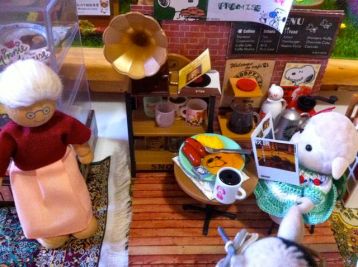 Nevertheless, Sally is not sulky or soaked in a miserable feeling of being left out of a cultured crowd. It’s just one of those moments when you feel like doing things that you feel most comfortable and familiar with differently just for one day. Being a responsible and sensible being she is, Sally tries to take the image of the musical concert in her mind’s eye and the music that plays in her ears off her mind by gently forcing herself to turn to a different subject. “I should have nice brunch with a cup of fresh Americano coffee at Snoopy’s now. It will make me awake again!” So she goes to the cafe that is just around the corner of the street with her cart being attended by her fellow street vendor Randy, the fruit guy. “Randy, thanks much for your help as always. I will come back in an hour with a nice take-out set from the cafe.” And when she goes into the cafe, to her pleasant surprise, Bach’s “Bourandebourgh Concerto No. 3 in G Major” welcomes her lovely entrance. This is sufficient for Sally to make amends for her failed hope of going to the concert today, and what with a cup of warm Americano coffee accompanied by her beloved brunch meal set and what with the customary cozy ambience of the cafe, Sally desires nothing more and becomes content with such simple joy of the moment she’s in.


You must be logged in to post a comment.