Tag: Writing

  • Two Fellows – Part I

    two

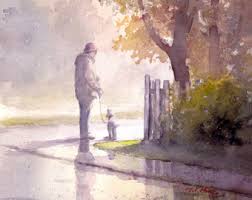
    So there he was. You could always find him there at the same time, at the same place regardless of a change of four seasons, like it was his duty to do. Looking over the fence smartly seated on a rock on one balmy afternoon, Toto was calm and steady. His big brown eyes full of yearnings and visions glanced at the dancing leaves on the quince tree outside the fence where there were only a few fruits left because Grandma, being of generous and affable nature, had given the well ripe ones to the neighbors. However, such intermittently displayed quinces surrounded by the abundant leaves appealed to Toto’s inquisitive eyes: the way the leaves swayed to the tune of the breeze was a part of the nature’s orchestra that stimulated all of his senses, which ultimately led him to the outburst of his exhilaration in long howling like a wolf pup in the wild.

    Toto was a Jindo mix, aged 9 weeks or so. Toto came to Joe’s home on a cold winter afternoon a year ago with Pa who brought him in his jacket. He was a white puppy looking healthy but a bit apprehensive about the new surrounding. But mind you that there was no sign of fear in his eyes but intelligence. Joe named him Toto after a legendary dog in Korea who returned to his owner, an old woman who had given the dog to her nephew in a city miles away from her home in Jindo. So he wanted to have a dog whose faithfulness and loyalty would be equivalent of those of the legendary namesake. Joe wanted to keep his new puppy till the end of the world because he had lost Lana, a Samoyed mix puppy of 9 weeks old, to distemper 2 years ago. This time, Joe thought, would be the last time to let such thing happen to him and the dog. It was his new bound duty, a duty that suddenly appeared sacred and fateful to his destiny. Boy as he was, Joe was resolute in his new pledge to the life and protection of Toto as his guardian. Looking at Toto who was napping beside him on the rock by the quince tree, Joe could hear the whisper of the breeze that blessed his guardianship and fellowship of the human and the canine. What a nice afternoon it was to both the boy and the dog.

    “Joe, can you come here quickly?” It was Joe’s sister Judy. She was 16 years old, 2 years senior to him. Judy also loved Toto and dogs, although her favorite breeds were Labs, Border Collies, Shiba Inus, and Bichon Frises. She had been secretly entertained having a Bichon Frise until Pa brought Toto home. She had a soft spot for this particular breed since she had read about a homeless elderly man who sailed through the tribulations with his Bichon Frise dog named Willow; the image of the small, curly haired dog with large soulful eyes in the arms of the man still lingered in her mind. But it’s not that she did not lie their Toto. Toto was their another sibling, the youngest brother whom Ma had lost by miscarriage 6 years ago. Judy’s love of Toto was not to be confused with anthropomorphism because she loved Toto the way he was, the way Toto was the closest natural wonder. He was Judy and Joe’s guide to the natural world like Virgil to Dante in his journey to Hell, Purgatory, and Paradise. Through Toto, Judy and Joe could see the wonder of Nature in which all creatures existed and made the human existence all the more conspicuous by appreciating the pristine beauty which was to be beheld in the eyes of the innocent.


  • Through a Dog’s Eyes by Jennifer Arnold

    Through a Dog's EyesThrough a Dog’s Eyes by Jennifer Arnold

    My rating: 5 of 5 stars

    If you are a dog person, reading this book will make you become better understanding of your dog or just any dog in sight – in his perspective. This book is written with knowledge and heart by Jennifer Arnold, the Executive Director of Canine Assistants, a school for educating dogs to help people with disabilities, including epilepsy, paralysis of broken spinal cords, and others that prevent them from functioning their ordinary tasks of daily lives . The author specifically emphasizes on the word “education” of her dogs, not “training” because the student dogs are taught to respond to foreseeable/unforeseeable situations that require their immediate problem-solving skills for the safety of their human partners based upon the author’s belief on ethology, the scientific and objective study of animal behavior, by incorporating Operant Conditioning method to modify a behavior by reinforcement and
    punishment.

    What Ms. Arnold avers in the book actually corroborates what I have always believed to be true: (1) that dogs do have feelings without filtering them through the intellect, which can be found in the cerebral cortex of human. But because of this absence, dogs are artless in expressing their emotions toward us; (2) that dogs’ characteristics of being loyal and empathetic indicates that consciousness, the state of being awake and aware, enables them to do what’s in the best interest of others; (3) that in no way, is a concept of “alpha dog” in a human-canine relationship useful or even sensical; and; (4) that operant conditioning with positive reinforcement (rewarding with a treat)  and negative punishment (not giving it) works the best to reinforce intended behaviors.

    You will find a kindred spirit in this book filled with laughters by the wonder dogs at the Canine Assistants, tears by the pains of those who were and are in need of their canine assistants, heartaches by those fallen dogs because of misunderstanding on our human parts, but most of all, joy by understanding our fido friends in their own paws.

  • My Life in Dog Years by Gary Paulsen

    My Life in Dog YearsMy Life in Dog Years by Gary Paulsen

    My rating: 5 of 5 stars

    Reading this book is like listening to Mr. Paulsen’s tale of wondrous dogs he has encountered in his life: His colloquial English writing style is all the more realistic and straightforwardly addressed to readers’ hearts, leaving strong imprints in their minds without elaborate metaphor. Mr. Paulsen introduces his readers to the dogs that have provided his life with compassion, loyalty, faithfulness, and joy, the virtues which only humans are thought to be endowed with. Take Ike, the black Lab who appeared out of the blue to console the author’s lonely heart and become a good friend; and Josh, an incredibly smart and remarkably faithful Border Collie, who was not only a good herding dog but also a loyal friend. I would dare say that these wonder dogs were his saving grace that helped him to find his calling as a fine American writer.

  • Mind-block

    ies

    Can’t write any good any longer, any more,
    after all these years of ignorance of the words,
    intended for freedom from the old self with the rugged mask.

    But today she calls to reclaim her will to acquire the power of the words
    once more, if possible, to unchain her arrested mind of

    Cognition, Imagination, Passion,
    long forgotten by the delusion of her reflection in the mirror.

    So she shall do. It’s now, and it will be now, here, with her, by her.
    For it is hers, and shall be hers forever.

  • About Me: Why I Blog.

    ex

    Dear Readers,

    Hi there. Thank you for stopping by my blog. It’s always pleasure communicating with people through writing, which I believe is the most authentic vehicle of expression of a self. Not that did I major in English at Rutgers University (a Scarlet Knight) with a sense of duty to exercise the field of study but that I like reading and writing prompted me to publish my thinkings in this blog. So Welcome All with my Whole Heart.

    My name is Stephanie, living in a suburban New Jersey town in the vicinity of the New York City. I work in the City for livelihood and write at home (or sometimes on the Second Floor in a Dunkin’ Donuts’ shop nearby my workplace) for selfhood. The great psychologist and thinker Viktor E. Frankl, who is also the founder of Logotheraphy has urged us that we humans must strive for realizing our values that are: Creative Value, Experiential Value, and Attitudinal Value in order to arrive at meanings of our lives. How true the maxim it is! I believe those who write are united spiritually in fulfilling such noble deeds. We are kindred spirits.

    I may not write perfect English prose due to English being my Second – surrogate, that is – language. I may not sound ordinary in the sense that my writing speaks with certain streaks of foreignness. Nevertheless, it is my quest for actualizing what I possess inside, Something that is yearned for its being unearthed by means of literary expression. And I have to purge it out, unravel the mystery in me that is dying for the discovery of the truth in me.

    Hence this little blog has come into being; it is the birth of my brain child, or rather the manifested ego qua meaningfulness as in terms of Logotheraphy. So many thanks again for your readership, which is also meaningful to me.

    Merry Christmas and God Bless Your Hearts.

    All the Best,

    Stephanie S.


  • To tame a Spirit of Writing: How to start, describe, and end your writing of any kind.

    writing1When do you have a writer’s block in writing an essay, email, a letter, or just about anything? Introduction? Body? or Conclusion? My writer’s block begins to form in writing an introduction. How to begin requires clarity, creativity, and cleverness of me in terms of presenting a subject matter of writing lucid and interesting. Everyone has of course different points when it comes to encountering his/her writer’s block. But most of the time, such difficulty results from a lack of organization of an idea, a thought sprung from the mind that needs to be disciplined. Thus, I have briefly summarized the following methods of taming your free spirit of writing:

    Slide4

    A. Writing as a four-step process:

    1. You think of things you want to say-as many as possible as quickly as possible.
    2. You figure out a sensible order for those thoughts; that is, your outline.
    3. With the outline as your guide, you write out a draft.
    4. After setting the draft aside for a matter of minutes or days, you come back and edit it.

    As developed by Dr. Betty Sue Flowers, a University of Texas English professor, each of the above-referenced steps are also called by the following names according to the corresponding intellectual functions:

    (1)  Mad man, the creative spirit who generates ideas (Brainstorming);

    • Your essential Imagination, however sloppy and raw it may be
    • In this stage, you are going for copious thoughts as many as possible
    • Jotting down ideas in the absence of sentences and paragraphs
    • Fast and furious outpourings of thoughts, ideas.
    • Need to protect against the Judge disapproving the sloppiness.
    • Save the Judge for later stage in the writing; otherwise, the Madman could be at considerable risk, causing ‘writer’s block”.
    • Writers commonly have little battles in their heads if the hypercritical Judge is allowed to start “censoring” ideas even as the Madman is trying to develop them.
    • “Keep the Judge out of the realm of the Madman!”
    • The Non-linear outlined ideas in resemblance of the Madman frame of mind.

    (2)  Architect, the planner who ensures that the structure is sound and appealing (Syntax builder to make a sensible, effective sentence structure;

    • He must arrange the ideas with sensible sentence structures with the right words.
    • An architectural design/outline with specifications is to be made for the next step.
    • However, for the Architect to do his job well, the Madman should be given a complete free rein to exercise his right of free thoughts without linguistic boundaries.

    (3)   Carpenter, the builder who makes the corners square and the counters level (Crafting of words for the effect of articulation); and

    • He is the “leader”, who will lead the writing to an effective force of communicability.
    • According to the Architect’s design with specifications, the Carpenter builds the draft.
    • Ideally, the Carpenter writes quickly, treating the outline as a series of gaps that need filling in.
    • In fact, although this stage is where writing begins in earnest, the carpentry is the hardest part of writing in terms of producing a draft.
    • The reason for this difficulty results from the absence of the Madman (Thinking of Ideas) and Architect (Sequencing the Ideas) stage to singlehandedly use the Carpenter (Verbalizing the Ideas).
    • Such disregard for these Two Men stages is out of the context; the Carpenter’s job would be relatively easy with the proper jobs by these two men.
    • Keep the autocratic Judge out of sight at this stage; otherwise, you will slow down yourself. The Carpenter is a Writer, not an Editor.
    • Still, though, the Carpenter must exercise considerable discretion in following the Architect’s plans by making architectural refinements here and there when producing paragraphs and sections.

    (4) Judge, who checks to see whether anything has gone wrong (Editing of the product to ensure communicability thereof).

    • The Judge finally takes over when you have a raw draft.
    • You can now fix the ragged edges.
    • The Judge does everything from smoothing over rough transitions to correcting grammar, spelling, and typos. (The Smooth Syntax Operator)
    • Or the alternative name is “Janitor” who tidies up little messes.

    writer

    B. Visualization of the works (as in a legal case)

    1. The nonlinear Whirlybird by the Mad Man
    1. The Design Plan by the Architect

    1)   Main issue: The cause of action and the question thereon. e.g., “Upon being reprimanded, Penfold threatened his supervisor by saying, “I am gonna get you for this!” The supervisor immediately fired him. Was the termination justified?

    2)  Detailed factual statement

    3)  General principles re the cause of action. That is, the evidence on each element of his cause of action, causation, and damages.e.g., re: threatened violence at work

    • Corporate policy statement
    • Type of threat involved
    • General/specific
    • Violent/nonviolent
    • Effect on others
    • Coworkers
    • Target
    • Examples relating to safety in modern workplace

    4)  Caselaw on similar threats

    5)  Decision in this case: the facts suggest that threat was real. Internal appellate-review board agreed.

    6)  Conclusion

    img-thing