The labyrinth I’m in The paths after paths Cycle in epicycle repeats Without Ariadne’s thread In the endless pursuit Of the uncertain exit That the maze hides By stalking me with it From day one, flat out Till I reckon it’s my plight My creation, mine only
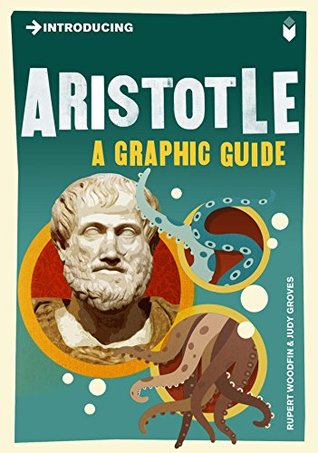
Socrate was a liberal, Plato was a conservative, and Aristotle? Well, he was an educator, an academic, an intellectual with perks and passions who was never dull. His school of thought dominated western Europe during the Middle Ages. It became a foundation of Christian theology because of the conciliation of humanities with science, especially biology, to approach the hows in the quest of whys and whats.
But don’t be intimidated by the dauntingly impressive resume of the philosopher. You don’t have to strain yourself with a burden to know the wondrous truth of our human life and the universe beyond. Woodfin’s illustrated guide to Aristotle will become your scholarly and witty Virgil to his circles of knowledge as seen in his mind’s casements. Through them, you are welcome to appreciate the panorama of Teleology, Thinness, the Four Causes, Beauty, Ethics, and the Cosmos like you never realized in plain language.
Suppose you want to know more about the man who taught Alexander the Great and Thomas Aquinas, the top Doctor of the Church, and assured the distraught that excellence comes from habit. In that case, this book deserves your attention – with delightful Eureka!
Still yearning Still learning The eager heart Even for the fate Riddled with Tangled plagues Keeps the eyes At the stars above And soars, falls Falls and soars With neverending Aspiration to fly Across the sky Even on one Winged foot.

A fire ablaze Saving grace Of humanity Guard it always With all might! Or you’ll let loose Of the other horse On your chariot Wild and furious Without the force Of the wise horse And return once To the island anon Of the lord of the flies
We know our brain is our body’s and mind’s control room, but how much do we know about the superlative organ and the supernatural power? So relax. Have no fear because Amaze Yourself: Take a Quantum Leap by Dr. Jill Ammon-Wexler will be your Cumin Sibyl to the mysterious world of the brain where the secret of the universe is locked in and waiting for you to unlock it if you believe in it.
Dr. Jill is a doctor of psychology and a 47-year pioneer brain/mind researcher who has devoted herself to enlightening the public about the psychosomatic effects of the brain that are so wondrous and magical that they give the brain the status of a supernatural being. For example, stress isn’t just an easy, convenient excuse for our burned-out selves; it is, in effect, the evil of psychological and physiological ailments. Also, negative thoughts are not a metaphysical concept without a scientific foundation but are like a cancerous cyst that impedes the production of glucose (the brain food), which hampers a faculty of thoughts and a sense of imagination. The wonder doesn’t stop here. There is a third eye called the pineal gland in the brain that responds to altered mental states. So we all have some degree of ability to foresee the future, but that’s only if we consciously endeavor to access the subconscious mind. No wonder some of us can see and hear ghosts, and that’s true to the end of reckoning by way of a quantum leap from one sphere to another without effort.
Suppose I am being captious by playing the role of Devil’s Advocate in the review of this admirably elegant and inspirational book. In that case, it is this: like any renowned figure of academic researchers, Dr. Jill’s successful experiments on positive thoughts confine to a pool of comparatively well-off human subjects with statuses. Of course, it’s unfair to cavil at her intention to find the truth, as her contemporary peers do the same. But I hope that someone like Dr. Jill, who writes with general readers in mind with her wealth of knowledge, includes a broad spectrum of classes in her study so that none of her readers will feel left out of the selected few. Nevertheless, Dr. Jill is a pioneer in her field, translating the mystery of brain power into our everyday language to make us realize that we are indeed starstuff harvesting sunlight only if we believe in ourselves. Therefore, this book is an excellent primer for the beautiful world of neuroscience, met with the supernatural power of the brain within us.
Since I don’t like the word “pet,” I won’t say it when I refer to my two-year-old tabby, tom Toro, a family member. Toro pays a portion of his rental fee and is a controller of rodents in our dilapidated humble apartment we long to escape. But that’s another story, and this story I am going to unravel is for Toro.
Toro before entering the clinic
It was that time again to get Toro’s annual physical exam, also required for his Hills prescription Urinary care food. So we took a trip to the vet at Little Tokyo, and all’s well that ended well. His weight was steady at 11 pounds, the same as the last year (what an excellent dieter he is!). He got his FVRCP, FelV, and nails done and was proven generally healthy. What a relief because I had been concerned about his taking more naps than usual and tired expressions with half-cast eyes. The doctor told me that it was customary for cats to show such symptoms as they grew bigger. So albeit my mom thinks that I am overly concerned about Toro’s otherwise fine status quo, aren’t we all concerned about the general well-being of our flurry fur babies?
Samuel Johnson and Hodge
It all makes me think of the story of Samuel Johnson and his cat Hodge. Samuel Johnson, one of the greatest men of letters from 18th century England and the author of A Dictionary of the English Language, had his beloved sale-furred cat Hodge, who was immortalized in literary works and as a bronze statue outside his guardian’s once resident abode. We first come to know of Johnson’s cat Hodge thanks to his lawyer friend and biographer James Boswell’s Life of Johnson. Johnson used to go out to buy Hodge’s favorite food, oysters. He refused to let his loyal and faithful Jamaican-born master-servant Francis Barber because he felt that it would be degrading to Francis to do such errands for him. But I like to think that it was more affection toward Hodge, whom he called thus: “He is a very fine cat, very fine indeed.” When Hodge was nearing to cross the rainbow bridges due to his old age, Johnson would get valerian, an herbal painkiller extracted from the flower to lessen his fur baby’s pain. But the end of Hodge wasn’t lost in the inner circle of the ether, for his life was memorialized in ‘An Energy on the Death of Dr. Johnson’s Favorite Cat’ by Percival Stockdale, published in 1778:
The general conduct if we trace Of our articulating race, Hodge’s, example we shall find A keen reproof of human kind.
Samuel Johnson is one of my most admirable literary persons because of his humanist rules of thought articulated in his mastership of the English language. Hence it gives me a feeling of kinship with his love of Hodge. His affection for Hodge felt genuinely caring and familial, which was never mawkish or superficial. So, likewise, my cat Toro is a muse of my writings: whimsical, independent, intelligent, and affectionate. Sometimes, I wonder if Toro is really a little boy bespelled a tom. Well, what more can I say? Toro is a very fine cat, very fine indeed.
Hodge’s bronze statue was inaugurated in 1997 by Sir Roger Cook, the then-Lord Mayer of London. Note the oyster at his paw as his eternal token of Johnson’s affection.
You must be logged in to post a comment.