Tag: Writing

  • Untitled

    Is anyone out there? Although I feel like a lonely gauche scientist who incessantly sends a life signal to an extraterrestrial being across the galaxies, I am again sending another life signal in writing to express that I am still alive. So, if any accidental reader stumbles on this blog, welcome.

    I once read that magic is the power of manipulating nature without knowing the source of the force. If so, then the magic I once possessed is lost, making me good for nothing. But, as observed by Francis Bacon, I am talking about the faculty of cognition that affects linguistic abilities for speech that makes a ready person, reading a full person, and writing an exact person. The satisfaction of reason, the power of expression aspiring to development of the spirit, which gave me a content elbow room, vanished into the curtains of the past, leaving me to fend for provisional existence of survival in the most primitive way. It reminds me of Viktor E. Frankl’s memories in concentration camps, where many of the inmates dissipated into the hopelessness of abandoning themselves in the stupendousness of tragedies.

    I always think of my life as an inspiration fit for a documentary film about a working-class immigrant single woman who painstakingly tries to preserve a sense of purpose in life with a grasp on intellectual aspiration. Doing so makes her compare to the burgeoning careers of her peers, who seem to be of a higher station in life than she. I am not trying to play a typecast role of proverbial fatalist or unreconstructed defeatist caviling at the happiness of others as a result of their hard work and abilities to do wonders. That would be a callous and sordid a priori judgment for her unfortunately cursed life. Didn’t Shakespeare also say that our lives are governed by our stars? Didn’t Cicero believe that our lives can be read by avian augury? Come to think of it, Francis Bacon and Isaac Newton also believed in and engaged in alchemy craft. The commonality of the examples described above illustrates that there are more things in heaven and earth than are dreamt in your philosophy about the world, whatever it may be.

  • exiled

    I never told my wishes
    But let my concealment,
    like a furnace of fury,
    feed on my eyes riveted
    by ire and impudence;
    I eternally pined in thought,
    And with a blue and gray melancholy
    I sat like Longing on a pew,
    smiling at Grief and teardrops
    welled in the windows of my soul.
    No other Gods listened to my pleas;
    No other Sun lit up my heaven,
    No other star ever shone for me.
    And even yet, I dared not let
    my useless passion and vain hope
    languish in rapturous, radiant pain;
    Drinking deep of that profound anguish,
    How could I find my place again?

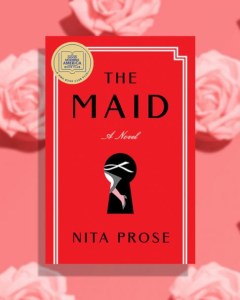
  • ‘The Maid’ by Nita Prose

    The Maid by Nita Prose is a one-of-kind, touchy-feely novel without collapsed grand narratives and vehement subjective rhetorics about existential vertigoes in life that burdens the reader with a duty to interpret the philosophical, the intellectual meaning of a story, all fragmented and adrift. Instead, the story uses the real to perfect the ideal delightfully blended with a taste of Murder She Wrote with relatively ordinary characters doing the most extraordinary things like you never know.

    The Maid is one lonely young Molly Gray. She is a Maid of Maids, taking her job religiously in a hotel that does not quite reciprocate her dedicated service but sees her as a quiet oddball because of her reclusive comportment. But Molly is a swan in a lake of ducklings and geese, a harpist among percussionists, whose feet constantly move beneath reality’s surface. Molly is anachronistically muliebral and incongruously proper. She belongs to a preceding era of decency, saying early Edwardian London as a chambermaid, a coveted position for working-class women. To judge Molly as a misfit is downright callous and heartless because she inwardly craves recognition from those she thinks of as sympathetic souls who use her as a pawn in their game of passion and avarice. The more we learn about Molly as the narrative deepens, the better we know of her as if we were contracted severe strains of Stockholm Syndrome. Hence, our better angels persuade us to forgive and forget the stupendousness of truth that Molly confides to us at the end of the story’s labyrinth.

    This fictional Maid by Nita Prose and that real-life Maid by Stephanie Land are stories about working-class women struggling with the realities of life by themselves. The only difference is that the former has a blessing of luck in the form of sympathetic and resourceful supporters who rescue her from a dungeon of hopelessness. It is understanding because, as Charlotte Brontë expressed, one of the reasons she wrote was to be a kind creator for her stories’ heroines otherwise to whom no sweet soft touch of warmth and love would caress their weeping heads. However, Molly, the Maid is not all melancholic, a damsel in distress, a clueless loner succumbing to a subtle form of gaslighting because she is the one who laughs the last laugh with intelligence wrapped in a maid’s hide. Molly Gray the Maid may have a woman’s body but has the king’s stomach and heart in the most magnanimous way. Therefore, don’t mess with Molly – and the likes.

  • Dying today

    For all this time beneath this visiting moon,
    Where treasure is, my heart has not been at it
    with the lights of the lamp glowing in the gloom.
    But now I see the voracious time
    devour the kingdom of the shore,
    And the solid earth rule over the liquid main,
    Increasing store with loss and loss with store;
    When I see such vicissitudes of state,
    Or fate itself repeated over and over;
    Splashes of battle have taught me to ruminate
    That nothing stays the same to remain forever
    And I can’t depend on anything that changes.
    This thought is a truth that hope chooses
    And in the dying moments of today, fears I lose.

  • ‘American Made: What happens to people when work disappears’ by Farah Stockman

    Howard Stern might not be everyone’s friend, but he’s got the point when he articulated in his radio show a decade ago that what was eating out this great nation was not racism but classicism. The recent unionization movements among service industry workers, such as Amazon and Starbucks, indicate that the demand for the dignity of workers supersedes ideological politics that discourage the growth of American esprit de corps. American Made is a story about this American class consciousness that will put together disintegrated tesserae of the collective national mosaic made by the people and events.

    The author follows the three principal workers of the now-defunct Rexnord Factory in Indiana: Wally, a black man whose diligence and amiability promoted him to a coveted position in the factory; Shannon, a single white woman with an abusive partner taking pride herself in being a wielder, a male-dominated position, and John whose fortitude and conscience never left him during his long, turbulent unemployment days. Sex and race don’t matter when it comes to losing their jobs, let alone loving them because the importance of what they do for a living and the need for their livelihood are their commonalities that build a sense of camaraderie. In fact, class solidarity can never be achieved if class consciousness is transcendent of racial prejudice to be achieved first. Unfortunately, the antebellum wealthy southern plantation owners systematically destroyed the poor white laborers’ wage systems by replacing their workforce with the free labor of African slaves, thus planting the seeds of racial hatred in the hearts of the poor whites. The vicious cycle of devious racialized economic caste system has since firmly constituted the American economic system ethos under “Separated but Equal.” The author sees the absurdities of American society as a result of the disintegrated labor movements primarily due to racial prejudices, which is why worker’s solidarity is a way forward to achieve national unity.

    Wally, Shannon, and John are not just working-class Americans. The author emphasizes differentiating her elite station characterized by expensive private higher education and intellectual “profession” from those with hardened coarse hands of workers in the factory. They are ordinary people, a majority of Americans making up this country, ubiquitous in the landscape of our daily life. They are expendable at the whims and caprice of profit-driven employers who see their employees as no more than living at-will automates. That is what happened to the Rexnord Factory, where workers’ lives were no less than collateral damage for a successful operational mission of the company.

    At times, the author positions herself as a conscientious liberal intellectual, paralleling her fortunate environment with her unfortunate subjects. Perhaps it’s an occupational hazard for being an NYT journalist. Nevertheless, the book succeeds in pointing out a lack of national cohesion resulting from the politicization of racial rhetorics into bipartisan ideology, which falls by the wayside of solidarity of labor movement overcoming institutionalized racial prejudices. Recently, I have read that the workers of Starbucks and Amazon in New York have voted to unionize. American Made is a story about them and us too because the dignity of work makes us who we are.

  • Wonderful Adventures of Mary Seacole in Many Lands – book review

    What we know as history takes a winning and popular side reflecting mass psychology because a winner writes it, and it is our human nature to win. Perhaps that is why the glare of Florence Nightingale eclipses the brilliance of Mary Seacole. Written in 1857, Wonderful Adventures of Mary Seacole in Many Lands is a vivid autobiographical touchy-feely account of one remarkable Mary Seacole who resisted herself being invisible and manifested her existence with a story to tell.

    Seacole was a healer and entrepreneur born of a Scottish father and a Jamaican mother. Her medicinal knowledge and business acumen distinguished her from her contemporary peers. They often showed discrediting and unappreciative regard to such achievements and her person, not least because of their bias. Seacole identified herself as a British with pride and patriotism, especially when confronting Americans whom she observed to be egregiously racists with unruly behaviors. She took pride in feminine propriety and cultural sophistication, which made her look audaciously flamboyant to those who determined to ignore her virtue, one of whom was Florence Nightingale.

    In the wake of the Crimean War, Seacole was imbued with the flames of patriotism and humanity to volunteer for Nightingale’s nurse corps. However, Nightingale and her nurses kept refusing her aspiration, calling her intention dubious because they suspected her setting up the famous Seacole’s Hotel at the battlefield by providing sensual comfort to soldiers with her women employees. Her noble courage and abundant charity were unreciprocated in non-institutionalized racist 19th-century zeitgeist that paved the way to systematic 20th-century scientific racism. It perceived non-white women as no more than sexual subjects of imprudence and passion. Being dark, Seacole was not seen for the flame of Nightingale’s candles.

    Had it not been for Nightingale, would Seacole have been regarded as the angel of the Crimean War? Or was it because of Nightingale that Seacole became known? I think that would be harsh undue judgment for both great women. It would be a typical social dynamic of praising one to the detriment of the other. Yet, I believe Seacole deserves recognition for what she did and who she was worth noting. To me, Seacole embodies Queen Elizabeth I’s Tilbury Address that though she might have a woman’s body, she had a king’s stomach and heart. That says it.