John Dee: The Life and Legacy of the English Occultist, Alchemist, and Philosopher Who Became Queen Elizabeth I’s Spiritual Advisor by Charles River Editors
My rating: 5 of 5 stars
Ben Jonson’s alchemist Subtle in his famous Elizabethan play ‘The Alchemist’ is a knave quack intent upon doing a lucrative occult business by luring the gullible, rich or poor, learned or general. But John Dee, Queen Elizabeth I’s English-Welsh astrologer, was anything but. He was a highly educated man graduating from Cambridge University with a penchant for esoteric knowledge beyond the realm of the physical world, and brilliant engineering feat contributed to his epithet as the queen’s occultist to the eyes of those who regarded him as something of Rasputin in the queen’s retinue. To me, Dee was a curious figure of science and magic, fact and mystery dissolving into one another.
From the cradle to the grave, John Dee’s life appears to be starlit with mystical numbers and stars that govern his destiny to pursue the knowledge of the beyond. Born in the household of a well-to-do textile merchant on July 13th, 1527, Dee’s fate was already revealed in the combination of the lucky number 7 and the ominous 13. He was endowed with intellect and heart, which is not typical for an astute scholar with a high education degree. Also, an ingenious engineer in stage productions of plays, Dee created the modern-day equivalent of special effects employing a man-powered crane and other apparatuses used as a counterweight fly system. He was fascinated with the science behind mathematics and used it to know astrology and celestial navigation in understanding human lives. He chose the coronation date for Elizabeth when Jupiter juxtaposed alone with Venus, opposing Saturn, and conjecturing Mars. The astrological interpretation betrays the virgin queen’s reign with the beauty of the goddesses and the power of the god of gods. Methinks, Dee’s interpretation must have attributed to the queen’s famous Tilbury Address in which she described herself as possessing “the body of a weak, feeble woman but the heart and stomach of a king.” Furthermore, the famous secret code of “007” was an invention of Dee used between Dee and the queen meaning “For your eyes only” as in “00” as a symbol of eyes and “7” Dee’s favorite lucky number.
Dee had a bona fide intention to use his knowledge to benefit people of all classes. During his post as royal astrologer under Queen Mary’s reign, Dee proposed to the queen that she establish a national library accessible to all for the universal education of the minds. This revolutionary idea was unprecedented and rejected. Dee was a man of books and used his learning from reading for the welfare of England. He propelled England into the Age of Exploration. He legitimized the British expansion of territories, including America, to which, according to Dee’s certification, a Welsh prince sailed in 1170, which was three centuries before Columbus’ voyage. Patriotic stargazer elucidated further that it was Grate Britain’s destiny to gain all of the territories supposedly appropriated by King Arthur by coining the term “The British Empire.”
After the death of his beloved Queen Elizabeth, Dee dwindled in his career and fell into obscurity, not least because he lost favor with the successor King James I, the scourge of god against witchcraft and magic as deviltry. We don’t know whether he was secretly in league with the devil in his once magnificent personal library. The opinions on John Dee are still debatable, if not controversial. Some might say he was a would-be Merlin or Gandalf. Some might call him a Rasputin who tricked the virgin queen into believing superstitions with his mephistophelean pact for the souls to populate the circles of hell. I want to say Dee was akin to Atlas, one of the Titans who was also fascinated with astrology and astronomy and generous with munificent generosity in the form of divine fire to mortals, for which he was condemned to bear the weight of the celestial globe.
View all my reviews
Tag: Writing
-
John Dee, Queen Elizabeth’s Gandalf who designed 007 – book review
-
the golden apples
Maidens of the Evening Star, Daughters of Atlas
Goddesses of the Evening, Children of Nyx
Live far away from here beyond glorious oceans
On the boundary of the Night encircled by stars
with pales hues of sunshine in the land of the Hesperides;
Mirth and music spring from the land of the Hesperides
Where they tend a garden of divine golden apples
Guarded by the faithful dragon Ladon with mighty wings
Swooping four winds, bellowing a crescendo of flames
That envelope the circle of divine parameter against the mortals
Till the impetuous half-man, half-god Hercules darts an arrow
Dipped in the blood of Hydra piercing the heart that dies in sorrow
shedding the tears for love for his goddesses, the Hesperides;
They mourn for the death of their beloved Ladon, whose blood flows
From the still warm heart and meets with tears from the diamond eyes;
And the gods of Olympus bring the slain dragon among the stars
And give him a house of his own named Draco where he can watch always
Over the garden of golden apples in his beloved land of the Hesperides. -
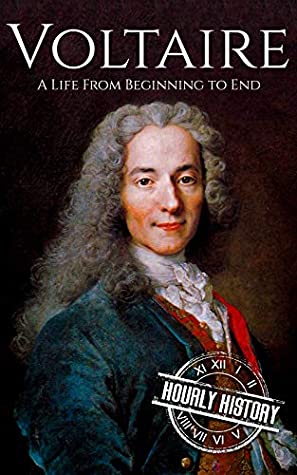
Voltaire, the moral rebel – book review
Voltaire: A Life from Beginning to End by Hourly History
My rating: 5 of 5 stars
The role of intellectuals is to see the corrupt at the heart of society and stand furious with the mass and constantly monitor the conditions of ill-effects and actively work on the improvement of living conditions. For books can never teach the use of books. Otherwise, they are no more than armchair academics complacent with their impressive scholastic achievements and high social esteem as elites of society, proudly distanced themselves from the general. But Voltaire wasn’t, nor was he a demagogic writer grandstanding with the ire of the have-nots.
Born as Francois-Marie Arouet on November 21, 1694, when the discovery of the New World and religious turmoil swept Europe, Voltaire was destined to become a cavalier of new thoughts, the Enlightenment of Thoughts, which the Catholic Church regarded as a dangerous school of ideas to the mass. Yet, Voltaire wasn’t hell-bent on destroying the Catholic Church as a freemason but pilloried the corruption of the ecclesiastical members and the duplicities of their teachings and acts in practice. Religion is also a social institution made and governed by people and therefore subject to corruption and dysfunction. Before the French Revolution, the Catholic Church controlled people’s ways of thinking and exerted its authority over political and cultural spheres. That was why Voltaire’s lifelong resistance against the Catholic Church arose, not from blindly malicious intention to sabotage belief of the religion.
Voltaire was very human with his volatile temper but also with passionate munificence. He was fluent in English and his years of stay in England, the country he regarded as a model country of liberty of thoughts and religions. During his visit, he met John Locke, Jonathan Swift, and Alexander Pope, to whom Voltaire was said to be very rude for reasons clandestine. Methinks that for a person as at once passionate and sensitive as Voltaire, the anecdotal vignette sounds true, but who can blame him for his temper and let it eclipse his wholesale brilliance as an unbridled thinker and writer unafraid of speaking against the social injustice against the unprivileged? Rousseau, a fellow freethinker, abandoned his child at an orphanage and berated the illiterate. Isaac Newton, whom Voltaire respected for his scientific findings and logical mind, mistreated his servants with whacks and beatings. But, on the contrary, Voltaire paid off all the tax debts of his tenants on his properties. Also, he published ‘Candide,’ which is an allegorical book about the absurdities of the teachings of the Church and a man’s search for a God in this world, in 1759 at a meager price accessible to poor readers yearning for a taste of Enlightenment.
The absence of God’s presence in the deeds of the clergy and religious people and the presence of injustice in the name of elusive God were the questions Voltaire had in mind, and yet he wasn’t blasphemous about the God they believed. On the contrary, Voltaire’s belief was ecumenical in the principle of syncretism founded on a universal belief system according to Natural Law, a conscience. He was liberal in ideas but responsible in acts by accommodating his knowledge to practice for ordinary life. Samuel Johnson’s definition of an imperiously sullen scholar who loses his days in unsocial silence and lives in the crowd of life without a companion was the opposite of Voltaire. Indeed, Voltaire had no morals, yet he was a very moral person for sure.
View all my reviews -
republic of heaven
Come with a cheer or come with a call,
Come with a dream or not at all;
Up the rainbows and down the valleys
Good will prevails, hope sparkles;
Humor is a jolly good friend as always,
The joy of the world your spirit finds;
Your smile shines through the gray sky,
The soul flits on the avenues of ecstasy.
Republic of heaven is here, come what may.
-
The young heart at flame
Who would have thought of it? The evening was alight with pillars of fire, and Washington was burning. The heart of the young republic streets was filled with a cacophony of screams, footsteps, and hollers as the king’s soldiers from the old country unfurled the British flag over the capital city. It was August 24th, 1814, thirty-eight years after the U.S. become a sovereign independent country from Great Britain.
The British invasion of Washington resulted from a combination of a longing to bring back its former colony and vengeance upon the former colony’s brazen-faced act of independence. The U.S. invaded the British territory of Canada in 1812, attacking the city of York, modern-day Toronto as well as Port Dover, which saw American troops destroy a large number of food supplies. However, thanks to the Canadian militia and the Native American forces, the U.S. attempt to take over British-ruled Canada flopped and only fueled the British fury for the imperious behaviors of the young country. To destabilize American power from within, the British supported the Native Americans, who continued to resist the U.S.’s westward expansion and impressed American merchant seamen to become crew on British ships, alluring them with better pay and higher career prospects. Moreover, the British could devote their time to the American affair when the war against France ended triumphantly, exiling the French leader Napoleon to St. Alba in 1814. So, it was ripe time for the British to march into the streets of the American capital city during the presidency of James Madison.
However, the British army was not altogether barbaric in ransacking civilian houses and burning historical and cultural artifacts like the Taliban. For example, the Taliban destroyed the ancient Buddhas of Bamiyan in Afghanistan in 2001 that were incredible historical artifacts showing a spectacular combination of Indus and Hellenistic civilizations. The British didn’t harm the U.S. Patent Office, whose then-superintendent Dr. William Ornton’s plea for preserving the artifacts of humanity chimed the bell of the universal mind. They also didn’t set ablaze on civilian houses or buildings, except for the Capitol Building and the U.S. Treasury building. However, they did capture many of the valuable pictures and works of art, including the paintings of George III and Queen Charlotte from the President’s House (modern-day White House), later transported to Bermuda. How duplicitous it was to find the portraitures of the royalty from which Americans bled to gain independence owned by the American President’s House!
That might have become a great war between the two countries ended in the British retreat, thanks to the American blessing of untamed natural climate. An unexpected tornado pushed the British back to their ships and carried them back to their motherland, the Queen’s land. Come to think of it, America has been blessed with luck and timing, not to mention everlasting youth. Yet, this relatively unknown part of American history I have recently learned from a history magazine confirms that history is a series of vengeance on generations upon generations, as Herodotus observed. In that regard, the British burning of Washington reminds me of Julius Caesar’s burning of the library of Alexandria, the Greeks’ burning of Troy, and Nazi Germany’s burning of Paris. American is certainly no exception to the natural cycle of human history, invading and invaded, continuous in cycle and epicycle.


You must be logged in to post a comment.