Author: Stephanie Suh

  • Moonstruck

    50A0D646-5D03-461B-847D-1C7F89A49D77

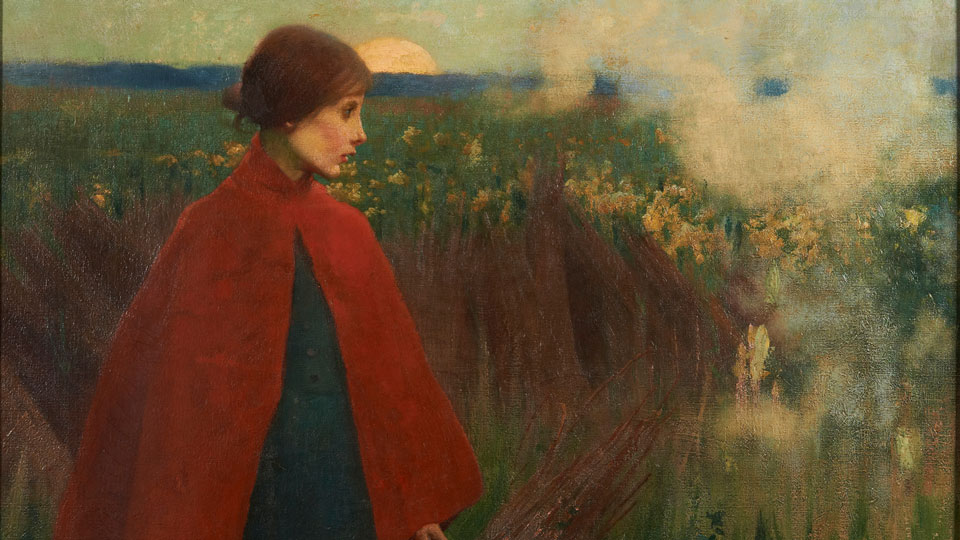
    Up in the misty airy mountain yonder

    Where trees and flowers never wither

    The lunar beauty comes upon her

    and covers her with a veil of silver

    with a wreath of stars on her hair

    In the luster of amaranthine glamor;


    Then her eyes gather light and fire

    Burning with felicity, rapture, or desire

    Like a condensed colossal meteor

    Wrapped in mystic eternal camphor

    in serene brilliance of Moon’s Sphere

    growing bright and glowing brighter;


    Nymphs and fairies weave into the ether

    The melodies of Aeolian harps sweeter

    Softer than the milky way’s gossamer

    Allaying the wild untamed waves of dander –

    Her heart entranced with elevated Passion

    Forgetting the nobility of exalted Reason.


    P.S.: Fairie-tale is a fantastic means of translating an Author’s inmost feelings, deep-set emotions, and solipsistic philosophy smothered under the necessity of fulfilling demands placed upon daily tasks in existential life in the safest and, therefore, the most eloquent fashion the Author can rely on. As Edmund Spencer, William Shakespeare, William Wordsworth, and John Keats all used faeries as their faithful and wonderful subjects of their imaginative kingdoms, so do I take the liberty of doing the same as a way of escapism to the Otherworld where I can become all I want to morph into and enjoy what I covet without a moral qualm in the reign of religiosity. Here the subject of the poem is a maiden desiring of beauty which she believes to have been forfeited or deprived of by the callously whimsical play with her fate by the supernatural powers-that-be on a lark. 
  • alchemist and four fairies

    all

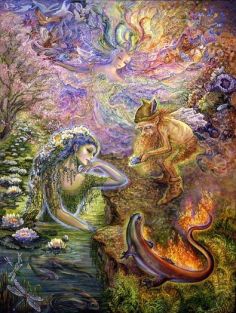
    An old alchemist had assistants

    Of Craft from Titania’s Kingdom

    And they worked for him at nights

    in return for fairy food abloom.


    Salamander belched out a fire

    Under the tripod holding a beaker

    In shrill forever fiery yellow ire

    that grew hotter and madder;


    Until Undine’s Purified Water

    From the well of Fairy Realm

    Boiled and bubbled in the beaker

    She watched with pensive calm;


    As Gnome put a sorcerer’s stone

    As black as the Stygian River

    From the bottom of Earth alone

    Into the Water like a wise thinker;


    While Sylph was breathing Air

    Into the Earth joined with the Water

    And the Fire in the Craft of Wonder

    Creating Gold and Elixir in Splendor.


    P.S.: The fundamental personality types are sanguine – red (hopeful), choleric-yellow (ireful), melancholic -black (shy), and phlegmatic -blue (calm). In fairy-tale theory, the following fairies represent the four elements: Sylphs – air (red), Salamanders – fire (yellow), Gnomes -earth (black), and Undines – water (blue) . Hence this poem is an amalgam of the aforesaid theories conjured up in my mind’s eye.

  • Fairy-Tale Tuesday: Queen Titania and her Courtesans

    P.S: It’s Fairy-tale Tuesday on Twitter, and this is my poesy contribution to the weekly fairy twitter feast for those of you who take a fancy to fanciful elements and dwell in the beauty of the mysterious nature.

  • the secret of the sea

    Scylla-and-Charybdis

    In the wilderness of the great ocean

    Lies a secret script of the Fate of Man

    Sealed in the silence of tidal motion

    In dissimulation of the opprobrious plan

    Harboring the secrecy of the Age of Man

    That gods so have kept to themselves alone.


    The Ages of Man, the Plays of Man

    On the Stages of Acts in Humanity –

    Those gods wrote and watched for fun

    In the theater of Comedy and Tragedy

    As the Wheel of Fortune decided what

    Would be played the next, and whatnot.


    The heart of the ocean sends a pulse thru me

    Of the secret hidden in the watery main

    With the sunny breeze that pushed Odyssey

    To sail forth against the forces of the divine

    To find and write a new Age of Man to witness

    The victory between the Scylla and Charybdis.


    P.S.: This is a poem written out of my existential crisis in the reflection of Herodutus’s theory of the Age of Man. I am not a fatalist but a believer of luck as Shakespeare was. I believe that time and chance are what ascribe to the fulfillment of your ends in life or for the nonce. Didn’t Thomas Alba Edison also corroborate that a genius is made of 1 percent of ingenuity and 99 percent of efforts? I want to embark on an Odyssey to claim my own destiny.

  • The Heroic Age Revisited: ‘The Tale of Troy’, by Roger Lancelyn Green – review

    The Tale of TroyThe Tale of Troy by Roger Lancelyn Green

    My rating: 5 of 5 stars

    History is a branch of literature woven by artists and artificers with stories full of events, places, and people embroidered on the latticework of time, which mirrors the invariable pith of humanity to posterity. In truth, history is a literary creation of reality in the habiliment of artistic imagination, which we call mythology. In this regard, The Tale of Troy by Roger Lancelyn Green is a refreshingly cracking retelling of historical Trojan War knitted together with mythological strands as though to be seen from a magical casement to the misty antiquity, which Herodotus defines as the Heroic Age of the Five Ages of Man (which, by the way, Ovid interestingly omitted in his Roman version of the Ages of Men) when divine immortals responded to your pleas directly and promptly and freely made love with their beautiful mortal subjects with unquelled divine lust.

    Drawn on a compendium of classical narratives of ancient writers, principally Homer’s Iliad, Green retells the beginning and end of Trojan War, reprises the scenes of the heroic characters and capricious Immortals, and remasters the thematic theater of dramas collapsing a great divide of time and space with his genius story-telling skills as an erudite but affable raconteur. Green takes you to the wedding banquet of Menelaus and Helen in Sparta where the goddess of discord Eris first presented an apple of discord, to Paris of Troy happily living with Oenone, a mountain nymph, on Mount Ida, to the Greek Camp outside the Wall of Troy where Agamemnon and Achilles were having a row over their beautiful Trojan female captives, and to Odysseus’s 10-year journey back home in Ithaca. The tale of Troy regenerates more stories about the fates of the characters following the end of the epic war, which leads to the dawn of the Iron Age, the Age of Man, in which we live. The Tale of Troy is a literary equivalent of Matryoshka, a frame story that presents manifold stories that delight you with pleasant surprises.

    The great Roman poet Horace once said it’s harder to treat a story in your own way. In fact, to retell a story is harder than to create one from void because it requires a special ability with the aid of natural wit to make the original source texts adapt to the contemporary readership of the time the author belongs to. To that effect, this book is a magical casement of the misty past told by a Homeric storyteller of our modern time who will take you to where the ancient ocean sends forth the breeze of the shrill Aegean Sea to let you sail an imaginary voyage with the Greek Kings and the Trojan refugees, while the Olympian gods are watching you from Mount Olympus.

    View all my reviews

  • vertigo of words

    Stokes_The-Passing-Train_WEB_cover

    Words inviting, the eyes accepted

    the spirit willing, the heart exalted

    the mind laboring, the brain revolted

    against the lust of learning to be learned;

    Woe was to her as her will yet essayed

    Amid the vertigo of cogitation whirled

    Like a never-ending merry-go-around

    Swiveling her head in pandemonium.